Autor Cointelegraph By Brian Quarmby

Axie Infinity looking to 'double-down' on Korean market: KBW

Sky Mavis, the firm behind Play-to-Earn (P2E) heavyweight Axie Infinity is looking to “double down” in South Korea and ramp up adoption despite the regulatory hurdles. Speaking with Cointelegraph at the Korea Blockchain Week on Aug. 9 (local time), Sky Mavis co-founder and growth lead Jeffrey Zirlin stated that despite the domestic ban on P2E games still being in place, the “Korean market is one of the most important gaming markets in the world, and we have tons of players in South Korea.”Zirlin added that the company is currently looking at ways to tailor the Axie Infinity game to its cohort of Korean gamers: “I think you know, we want to double down. We want to localize for example, Koreans don’t speak much English, right? So there are actually a lot of barriers to actually getting the game into the hands of Korean players.” “But a lot of our top players on the leaderboard are Korean […] Koreans are some of the best gamers in the world,” he added. South Korea Game Rating and Administration Committee prohibits the release of domestic blockchain P2E games as a result of strict anti-gambling policies. In December, the government also moved to prohibit Google Play and the Apple Store from listing such games in Korea. “In terms of the regulation, it’s still quite early. It’s similar to the app stores where you know, it’s gonna be a process of negotiation and education,” Zirlin noted, adding that he hopes P2E adoption is enough to sway the government to walk back its hawkish regulation in the future: “It’s really Uber as an approach right? They just launched, they got it into the hands of as many people as possible and once they had a critical mass the regulators had to go with it.”Related: Vitalik Buterin proposes stealth addresses for anonymous NFT ownershipThe Axie Infinity project is still in its early access stage and is yet to roll out an app via Google Play or the Apple Store. According to Active Player, the game had roughly 766,000 people that logged in to play the game last month, a far cry from the heights of 2.7 million recorded in January this year. As it stands, Axie Infinity is looking to ramp up adoption — in Korea and globally — by improving the gaming experience and expanding out its ecosystem via new battle modes such as Origin, which topped more than 600,000 sign ups as of mid-June. “Origin is our main focus right now. So building that out and making it more immersive, adding in vertical progression, like runes and charms and body part upgrades to act as sustainable sinks [burning mechanisms] for tokens and making it more fun.”“Origin crucially comes with three free starter Axies (NFT characters) so that people can fall in love with the game [without having] to make any economic or financial decisions,” he added.

Čítaj viac
20 million JavaScript devs can now build applications on NEAR: KBW 2022

20 million JavaScript developers will now have the ability to write blockchain smart contracts and build applications on the NEAR Protocol, after rolling out JavaScript Software Development Kits (JS SDKs) on Monday. Speaking with Cointelegraph at the Korea Blockchain Week (KBW) on Aug. 9 (local time), NEAR founder Illia Polosukhin emphasized that the move will open up the niche field of blockchain development to a substantially broader audience: “There’s about 20 million JavaScript developers in the world. Probably like every developer one way or another wrote JavaScript in their life. And what we allow you to do is to write smart contracts in JavaScript.”“Before we had Solidity so for Ethereum and other Layer 2s, we had Rust, which is what Solana and Near are mainly. And so Solidity has probably 100,000 developers who are familiar with it, and those who are active is even less. There is even less probably in Rust,” he added.In an Aug. 8 announcement shared with Cointelegraph, NEAR outlined that the JS SDK includes the “contract framework itself, JavaScript and TypeScript contract examples and tests.” Polosukhin went on to note that the JS SDKs could be utilized by anyone from students looking to dip their toes into the blockchain, to people in the commercial sector looking to accelerate their projects. “A student can build an app without needing to learn new languages without needing to learn new skills. It will also be easier for entrepreneurs to hire [devs], so they can actually build teams stronger, faster, and deliver products faster,” he said, adding that: “So kind of the idea from Near is to build a very extensible and powerful system that allows developers to build really anything from simple apps to very complex apps.”Questioned on whether the JS SDKs will be Ethereum Virtual Machine Compatible given that NEAR is an Ethereum competitor, Polosukhin stated that the offering will run specifically on Near, but that it is possible to create EVM compatible smart contracts from the SDK, much like how EVM compatible scaling Aurora was created on NEAR. Related: Korea Blockchain Week, Aug. 8: First-day takeaways from the Cointelegraph teamNEAR is a decentralized application (dApp) platform launched in April 2020 that is designed to be developer and user-friendly. Its native token NEAR is currently the twenty-fourth largest crypto asset in terms of market cap at $4.1 billion. The asset is priced at $5.44 at the time of writing and is up a notably 42.8% over the past 30 days according to CoinGecko.

Čítaj viac

Korea Blockchain Week, Aug. 8: First-day takeaways from the Cointelegraph team

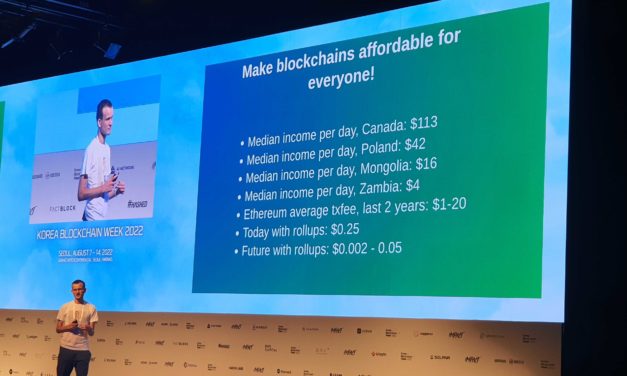
The fifth annual Korea Blockchain Week kicked off on Sunday, with more than 7,000 people attending Asia’s largest blockchain event of 2022. The Seoul-based event is set to run its main-stage sessions on Aug. 8 and 9, while side events such as music festivals and nonfungible token (NFT) art galleries will go through until Aug. 12. This year Korea Blockchain Week features presentations from more than 120 figures in the blockchain space, including prominent names such as Ethereum co-founder Vitalik Buterin, Binance CEO Changpeng Zhao, Animoca Brands chair Yat Siu and Polygon co-founder Sandeep Nailwal. The event is hosted by FactBlock and Hashed (co-host) and is sponsored by Solana, Klaytn and Wemade. Key focus topics will include decentralized finance, NFTs, gaming, the Metaverse, Web3 technology and crypto.If you missed the action, here’s a literary highlight reel of all the most important moments from the first day of the event, brought to you by the Cointelegraph team currently on the ground in Seoul.Vitalik: Layer-2 scaling will make crypto payments ‘make sense’ againEthereum co-founder Vitalik Buterin has argued that crypto payments will once again “make sense” as transaction costs will soon fall to fractions of a cent due to layer-2 rollups.He pointed to “solid work happening” with rollups at the moment, such as Optimism’s layer-2 scaling solution for Ethereum, which has worked to get the size and cost of data in blockchain transactions down by introducing zero byte compression:“So today with roll-ups, transaction fees are generally somewhere between $0.25, sometimes $0.10, and in the future with roll-ups with all of the improvements to efficiency that I talked about. The transaction costs could go down to $0.05, or even maybe as low as $0.02. So much cheaper, much more affordable, and a complete game changer.”Related: 60 million NFTs could be minted in a single transaction: StarkWare founderWeb2 adoption key to Metaverse success, says Klaytn Foundation directSam Seo, the director of the metaverse and blockchain ecosystem Klaytn Foundation, thinks that the widespread adoption of the Metaverse will be “easier” if Web2 companies integrate the tech with their products and services. Related: Major crypto exchange announces its arrival in the metaverseSpeaking with Cointelegraph during the Korea Blockchain Week (KBW), Seo suggested that Web3 Mmetaverse projects generally have issues attracting a mainstream audience, as people often have a hesitancy to use new technology from companies that they have never heard of:“If new ideas are combined with Web2 platforms like [local social media app] Kakao, especially in South Korea, I mean, there’s accessibility to these new ideas for new services that couldn’t be easier than just starting from scratch.”Pictured: Klaytn Foundation director Sam Seo at Korea Blockchain Week 2022DeFi market has room for growth in Korea: 1inch co-founderDecentralized finance (DeFi) aggregator 1inch Network has revealed plans to expand within the Asian market, according to its co-founder Sergej Kunz.Speaking to Cointelegraph, Kunz said that despite the DeFi market being relatively small in Korea and Asia, there are a number of Asia-based Web3 companies that 1inch is looking to partner with.Related: Wirex partners with 1inch to enable wallet-based token swapsHowever, Kunz also added that the biggest barrier to entry appears to be a lack of understanding about DeFi and how to use crypto wallets:“As soon as people understand that they can [yield] farm, they can swap, they can exchange and get easy access to cryptocurrencies on Ethereum with a few simple EVM-compatible networks, the market will grow a lot.”Crypto.com hits key regulatory milestone in South KoreaCrypto exchange Crypto.com has announced a key regulatory milestone in South Korea after acquiring two local companies, giving it access to crypto and payments registration in the country.The announcement came during Korea Blockchain Week 2022 after the company acquired payment service provider PnLink Co. Ltd. and virtual asset service provider OK-BIT Co. Ltd.Related: Crypto.com scores regulatory approval from Cyprus SECThe move means they have now secured the electronic financial transaction act and virtual asset service provider registration in South Korea. However, the company did not disclose whether this means it can offer its full-suite of crypto trading services in the country.

Čítaj viac

Web2 adoption key to Metaverse success, Klaytn Foundation founder — KBW 2022

Sam Seo, the director of metaverse-focused blockchain Klaytn Foundation believes widespread adoption of the Metaverse will be “easier” if Web2 companies integrate the tech with their products and services. Speaking to Cointelegraph during the Korea Blockchain Week (KBW) on Aug. 8, Seo suggested that Web3 Metaverse projects generally have issues attracting a mainstream audience, as normal people often have a hesitancy to use new technology from companies that they have never heard of. “If new ideas are combined with Web2 platforms like [social media app] Kakao, especially in South Korea, there’s accessibility to these new ideas for new services that could be easier than just starting from scratch.”“Even though it’s hard, adapting Web3 technologies to Web2 platforms could be a way to bring mass adoption,” he explained. Klaytn’s blockchain is primarily geared towards hosting Metaverse, GameFi, and creator economy applications, and is one of the biggest projects of its type in South Korea.During a presentation at KBW, Seo said the team is hoping to scale up its transaction throughput and while also bringing the cost of transaction fees down. “We’re smart enough to know that people are still hesitating about using this platform because anyway, they have to pay something right. So we believe that gas fees should be as low as possible. So they can have the people enter this area. That’s our thought. And that’s why we are trying to reduce the gas prices,” he said. Related: Major crypto exchange announces its arrival in the metaverseSeo also revealed that Klaytn will roll out an open-source Metaverse package with tools for builders to foster development on the blockchain later this year. [Klaytn at #KBW2022]We hope you enjoyed Sam Seo’s Keynote speech, here’s a short recap of what he shared:Why choose #Klaytn Open Source package for the #MetaverseUpcoming events #KlayDevDay #Klaymakers22Klaytn’s 2022 Roadmap pic.twitter.com/jukNUne0Mr— Klaytn (@klaytn_official) August 8, 2022

Čítaj viac

Vitalik: Crypto payments will 'make sense' as tx costs fall to mere cents — KBW 2022

Ethereum co-founder Vitalik Buterin has argued that crypto payments will once again “make sense” as transaction costs will soon fall to fractions of a cent due to layer-2 rollups.The Cointelegraph team currently on the ground at Korea Blockchain Week (KBW) quoted Buterin as stating that the final hurdle to getting transactions down to fractions of a cent at scale is blockchain data compression. He pointed to “solid work happening” with roll-ups at the moment such as Optimism’s layer-2 scaling solution for Ethereum, which has worked to get the size and cost of data in blockchain transactions down by introducing zero byte compression. “So today with roll ups, transaction fees are generally somewhere between $0.25, sometimes $0.10, and in the future with roll ups with all of the improvements to efficiency that I talked about. The transaction costs could go down to $0.05, or even maybe as low as $0.02. So much cheaper, much more affordable, and a complete game changer.”Despite primarily functioning as a speculative store of value, Buterin emphasized the key use case of Bitcoin (BTC) presented in its white paper from 2008 was to provide a “peer-to-peer electronic cash system” that was cheaper than traditional payment methods. However, while that was true up until 2013 according to Buterin, this became no longer the case in 2018 when adoption increased and blockchain transactions became too expensive. “It’s a vision that has been, I think, forgotten a little bit and I think one of the reasons why it has been forgotten is basically because it got priced out of the market,” he said. In the Ethereum co-founder’s view, BTC and other assets will soon be able to provide this use case once again as scaling solutions — such as the lightning network in the case of BTC — gradually bring the costs down to fractions of a cent. Crypto payment use casesButerin outlined a couple of different areas that cheap crypto transaction will be particularly important. Firstly he pointed to “lower income countries or places where the existing financial system is not very effective,” as it will give citizens access to vital payments structure over the internet, something which is already adopted despite the cost for international remittances. Related: 60 million NFTs could be minted in a single transaction: StarkWare founderSecondly, he noted that in the context of Ethereum, cheap crypto transactions will also help ramp up adoption for non-financial applications such as domain name system (DNS) servers, humanity proof of attendance protocols and Web3 account management services. “You need to actually send a transaction to create a DNS name, you need to actually send the transaction to recover your account, you need to actually send a transaction to meet some of these adaptations. If doing each of those operations costs like $11, then people are not going into it.”“Scalability isn’t just like some boring thing where you just need like cost numbers go down scalability, I think actually enables and unlocks entirely new classes of applications,” he added.

Čítaj viac

Získaj BONUS 8 € v Bitcoinoch

nakup bitcoin z karty

Registrácia Binance

Burza Binance

Aktuálne kurzy