Autor Cointelegraph By Brian Quarmby

Inflation-pegged ‘flatcoin’ launches testnet to track the cost of living

Blockchain tech firm Laguna Labs has launched a testnet for its in-development “flatcoin” — a spin-off of stablecoin tokens — pegged to the cost of living rather than a fiat currency or a commodity. In an Oct. 24 announcement, Laguna Labs said that the Nuon flatcoin is unlike tokens tied to fiat currencies, such as the United States dollar, as it is pegged to the cost of living via “daily unbiased, authentic, and on-chain inflation data.”The firm said the idea is inspired by discussions and Twitter threads from big players in the space, such as Coinbase CEO Brian Armstrong, ex-Coinbase CTO Balaji S. Srinivasan and Ethereum co-founder Vitalik Buterin, who all call for alternative ways to peg an asset so that it maintains its purchasing power over time. However, while the concept of an inflation-linked crypto token is not new, it remains relatively untested. In April, Frax Finance launched a consumer price index-tracking (CPI) stablecoin called the Frax Price Index (FPI) that utilizes oracle data from ChainLink. Launching at around $1.02, the price hit an all-time high of $1.18 on July 19 but is down 10.6% since then to $1.05. Given the asset is less than a year old, it is hard to judge its success in beating out inflation rates until more time has passed. The Volt Protocol (VALT) token also follows the CPI-tracking route, but its price history is hard to come by as platforms such as CoinMarketCap and CoinGecko are not actively tracking the asset. It is not listed on any major exchanges like Binance and Coinbase.There is also the aptly named Inflation Hedging Coin (IHC), launched in October 2021, which utilizes a burning mechanism “based on the annual United States inflation data” and monthly CPI rate to determine the asset’s burn rate and, in theory, increase its value over time.However, a person snapping up IHC a year ago will see the value of their holdings fall as much as 96.4% as of today, according to data from CoinGecko, with IHC priced at $0.00009529 at the time of writing. The Nuon white paper states that it utilizes an independent inflation index oracle to calculate the Nuon peg daily and uses “over-collateralization and arbitrage to maintain the peg while offsetting inflation.”It also claims that the asset’s over-collateralization will stop it from falling from its peg. However, it is unclear how well that theory holds up if the value of the collateralized assets were to tank significantly. Details are sparse on the testnet, but the firm states that people can now use the testnet to try out the Nuon flatcoin’s minting mechanism. Related: UK inflation rate hits 10.1%, British Bitcoin community respondsAnnual U.S. Inflation rates have surged dramatically since the beginning of the COVID-19 pandemic, going from 1.4% to around 8.2% in 2022 according to U.S. Inflation Calculator.As such, the purchasing power of the USD has taken a significant hit with the general price of goods and services continuing to increase. Crypto, and particularly stablecoins have also been an important tool for citizens in countries dealing with significant inflation and economic trouble.

Čítaj viac

Ripple's lead engineer to exit after nearly a decade with the firm

Ripple Labs’ director of engineering Nik Bougalis is exiting the firm after nearly 10 years, becoming the latest of crypto’s long-time serving executives to depart from the space. In an Oct. 22 tweet, Bougalis noted that: “my decade-long journey at Ripplehas been a fantastic (if exhausting and all-consuming) one. I got to work on a project that I love, towards a goal I believe in. But that journey will be coming to an end in a few weeks.” “All good things…”My decade-long journey at @Ripple has been a fantastic (if exhausting and all-consuming) one.I got to work on a project that I love, towards a goal I believe in.But that journey will be coming to an end in a few weeks.—     (@nbougalis) October 21, 2022Interestingly, the Ripple developer noted that he will not be joining a blockchain project or company next. “As for what’s next? I’ll talk about it when it’s time, but I am NOT joining another blockchain project/company, nor am I doing NFTs or DeFi,” he said.Bougalis has a lengthy background in software engineering and cryptography, and while at Ripple, he primarily worked on open-source code projects for the payments XRP Ledger, also known as XRPL. One of Ripple’s key recent developments that Bougalis has overseen is the XLS-20 amendment which will see the introduction of nonfungible tokens (NFTs) to XRPL. While there were a few initial bugs that reportedly needed ironing out, the upgrade is reportedly set to go through in early November. The cryptographer went on to state his thoughts that Ripple will do just fine without him. “Its long-term health and success isn’t predicated on any one person. I’m confident that it will be just fine, thanks to talented and passionate individuals who contribute and participate, each in their own way.”Related: Ripple’s $250M fund backs Web3 projects focused on ‘entertainment and media’The blockchain sector has seen a number of top figures step away from their companies this month, such as the chief financial officer of NFT marketplace OpenSea, Brian Roberts who revealed on Oct. 7 that he is exiting the firm.On Oct. 21, Polkadot co-founder Gavin Wood also called an end to his time at blockchain infrastructure company Parity Technologies, stating that it was not a position where he saw himself finding “eternal happiness.” Other high-profile execs that followed the same route over the past few months include FTX US president Brett Harrison, Kraken CEO Jesse Powell, MicroStrategy CEO Michael Saylor and Genesis Trading CEO Michael Moro.On a broader front, Ripple recently scored a notable win in its long-running legal battle with the U.S. Securities and Exchange Commission (SEC) over alleged securities violations with XRP. On Oct. 21, Ripple general counsel Stuart Alderoty revealed on Oct. 21 that the firm finally got their hands on important documents that could significantly strengthen its defence against SEC.The documents in question relate to a 2018 speech by former SEC division director William Hinman relating to the regulatory status of Ether, which the government agency has fought long and hard to keep under wraps during the legal dispute.

Čítaj viac

Mango Market exploiter brags after rug pulling Mango Inu 'shitcoin'

In just over a week after pulling off the $117 million exploit of Mango Markets, Avraham Eisenberg is now boasting about making $100,000 rug-pulling a “shitcoin” called Mango Inu, again claiming he “did nothing wrong.” Eisenberg recently ousted himself as one of the persons behind the recent $117 million exploit of the Solana-based decentralized finance (DeFi) platform Mango Markets, which he has also claimed was “legal.”  In an Oct. 23 post on Twitter, Eisenberg said the scheme involved deploying a “shitcoin” named Mango Inu, which he suggests was aimed at “exploiting bots” that gobble up newly launched tokens. Eisenberg said the strategy involved deploying tokens, adding liquidity, and then “rug” right after the bots buy the token. “Talked to someone who would deploy coins, add liquidity, and rug right after the bots bought, was a good low capacity strat last year when the bots bought anything that moved,” he said.Much like the Mango Markets exploit, when people on Twitter questioned the morality and legality of the whole ordeal, Eisenberg argued that he hadn’t broken any laws as there was no promotion of the token: “What part? Mango Inu is definitely not a security (no marketing, etc), no promises were made, just open market liquidity transactions.”Eisenberg said the token managed to get over $250,000 “invested/gambled” within half an hour with “absolutely no promotion,” and that the fact that it occurred meant that “we’re still so far away from the bottom.” He also explicitly warned not to buy the token, as “if you buy this you will definitely lose all your money.”The other day I deployed a shitcoin called Mango Inu and did absolutely no promotion. It got over 250k invested/gambled in like a half hour. We’re still so far away from the bottom.(to be clear if you buy this you will definitely lose all your money)— Avraham Eisenberg (@avi_eisen) October 23, 2022Pointless tokens continue to ariseThe Mango Inu token is another example of a token that has gained questionable market takeup recently despite not having any utility — a symptom usually associated with bull markets. Earlier this month, a memecoin named “THE” token was created in response to a satirical Oct. 14 Twitter post from Ethereum co-founder Vitalik Buterin calling for the creation of an easily shilible project called “The Protocol.”THE was subsequently launched on Ethereum and the Binance Smart Chain right after Buterin’s tweet, and pumped 77% by Oct. 20, though it has since dropped back down 60% to sit at $0.015 at the time of writing. Related: 3Commas issues security alert as FTX deletes API keys following hackThe token, which was listed on exchanges such as Uniswap (V3), MEXC Global and Bitget, appears to serve no other function than the actualization of a joke made by Vitalik to foster wild speculation. Blockchain cybersecurity firm PeckShield has urged caution with this token. #PeckShieldAlert #THEProtocol PeckShield has detected ~25 $THE are newly created on both Ethereum and BSC6 out of 25 of these $THE appear to be #honeypot 0x0cbA6 distributed 100M $THE to address Vb (Vitalik) 0x716Fb distributed 6.4M $THE to address vitalik.eth Be Cautious! pic.twitter.com/nGNhR8kuj7— PeckShieldAlert (@PeckShieldAlert) October 18, 2022

Čítaj viac

Metaverse trading volume plummeted 80% but hype hasn’t decreased

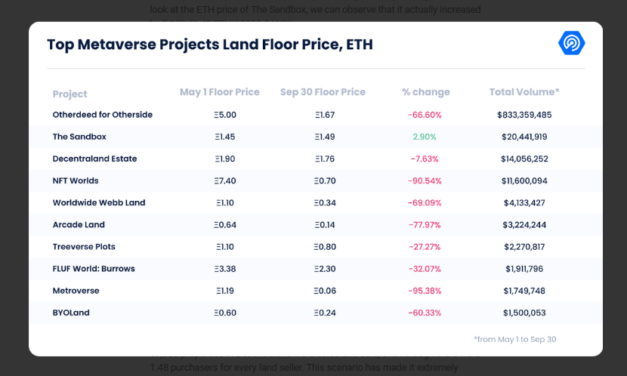
Third-quarter trading volume for the top 10 Metaverse projects may have fallen 80% compared to the second quarter, but analytics firm Dappradar suggests that interest in virtual worlds still remains.The Metaverse sector has been hit with a fair amount of negative press as of late, particularly around suggested low user activity across certain platforms, such as Decentraland and Meta — reports which they have refuted. DappRadar noted in an Oct. 20 report that while trading volumes have taken a sharp hit during Q3, the average number of NFT sales for these 10 projects only decreased by 11.55% compared to Q2. DappRadar explains that lower trading volumes could merely reflect decreasing asset prices and not necessarily lack of interest, noting that: “We consider this a bullish sign because it shows that the hype for these types of projects hasn’t decreased. Instead, the fall of cryptocurrency prices has affected the projects’ overall trading volume instead of a lack of interest.”A caveat to these sentiments however, is that eight of the top 10 Metaverse projects saw significant decreases in their NFT sales counts during Q3, with Yuga Labs’ Otherside seeing a 74% decrease for the quarter. The positive action was primarily driven by The Sandbox and former Minecraft-based platform NFT Worlds V2, which saw NFT sale count increases of 190% and 79% apiece. DappRadar attributed this to the hype surrounding The Sandbox’s Alpha Season 3 which offers a host of new gaming experiences and collectibles. While NFT Worlds V2 being booted off of Minecraft may have been seen as a “buying opportunity” as the value of its NFTs dropped by 90% in Q3. Virtual lands floor prices plummet Meanwhile, DappRadar’s report indicated that the floor prices for NFT land plots had decreased by 75% on average, which may have been one of the reasons why trading volumes had decreased by so much.Tanking floor prices: DappRadarWhile the value of any piece of real estate, virtual or otherwise, is subject to swings, “Metaverse real estate is currently very depreciated,” DappRadar stated, adding that the declining prices are in accordance with the broader bear market of the crypto sector. Related: Q&A: NFTs and metaverses will play a key role in gaming — as long as one key thing happensDappRadar was forced to defend its metaverse data last week, which had been interpreted to mean that platforms such as Decentraland had less than 40 daily active users.The firm alsnoted that its user data tool only tracks users’ interaction with a blockchain, usually in the case of transactions, and did not count “non-blockchain-based activities” such as non-spending users. The Sandbox tweeted on Oct. 10 that it had hit 39,000 daily active users, and 201,000 monthly active users over the previous 30 days. Decentraland also reported having 8,000 daily active users and 56,697 monthly active users as of Oct. 8.

Čítaj viac

Put your hands up! Interpol storms into the Metaverse

The International Criminal Police Organization (Interpol) is putting on its virtual reality headsets as it prepares to crack down on an expanding list of “possible crimes” in the Metaverse. According to an Oct. 20 announcement, Interpol has launched the “first ever Metaverse specifically designed for law enforcement worldwide” — introducing it at the 90th Interpol General Assembly in New Delhi — already fully operational. Metaverse office: InterpolInterpol outlined that a key driver behind its jump into the metaverse is due to bad actors already leveraging the tech to conduct crimes, while public adoption rates are likely to significantly increase over the next few years. “Criminals are already starting to exploit the Metaverse. The World Economic Forum […] has warned that social engineering scams, violent extremism and misinformation could be particular challenges,” the announcement reads, adding that:“As the number of Metaverse users grows and the technology further develops, the list of possible crimes will only expand to potentially include crimes against children, data theft, money laundering, financial fraud, counterfeiting, ransomware, phishing, and sexual assault and harassment.”Notably, people have already been put behind bars for their actions in the Metaverse. Last month, a South Korean man was sentenced to four years in prison for sexually harassing children in the Metaverse, and luring them to send lude photos and videos. At the event in Delhi, Interpol also revealed plans to develop a division dedicated to cracking down on crypto crime. Interpol secretary general Jürgen Stock highlighted the need for the specified unit, as many law enforcement agencies are not currently equipped to deal with the complexities of the sector. The special director of India’s Central Bureau of Investigations, Praveen Sinha also noted that it has become increasingly difficult to monitor cybercrime due to its global nature, and that coordination is a key factor that will make their efforts easier. “The only answer is international cooperation, coordination, trust, and real-time sharing of information,” Sinha said.[embedded content]The new Interpol metaverse will allow registered users to visit the platform and take a tour through a “virtual facsimile of the Interpol General Secretariat headquarters in Lyon, France” and partake in forensic investigation courses, among other things. Related: Terra co-founder Do Kwon says he’s ‘making zero effort to hide’ following Interpol noticeInterpol has outlined that its metaverse will hopefully provide a more streamlined and efficient way for its various outfits across the globe to communicate and work with each other. While education and training for students/new recruits was also highlighted. Earlier this week, the Ajman Police announced it would provide its services to customers through metaverse technology, according to an Oct. 16 tweet from the authority.

Čítaj viac

Získaj BONUS 8 € v Bitcoinoch

nakup bitcoin z karty

Registrácia Binance

Burza Binance

Aktuálne kurzy