
Autor Cointelegraph By Brian Quarmby

Anchorage launches agentic banking as CEO tips ‘trillion-dollar’ opportunity

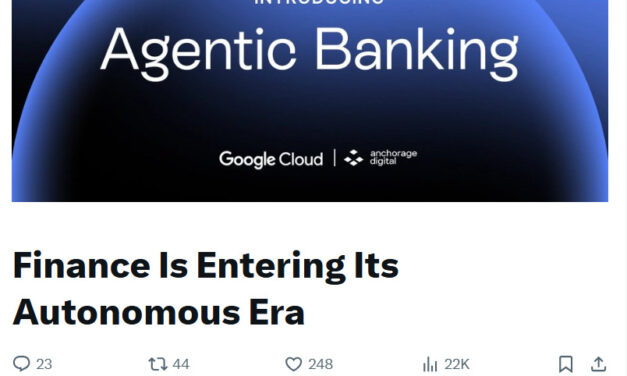
Crypto bank Anchorage is launching a new agentic banking service, seeking to give AI agents the ability to access and move money without human interference — an industry that could be worth a trillion dollars, according to its co-founder. In an X post on Tuesday, Anchorage co-founder and CEO Nathan McCauley said the firm’s new agentic banking infrastructure gives AI agents the ability to access both traditional finance and crypto payment rails.Blockchain and tech companies have been rushing to prepare themselves for the future of agentic commerce. Firms such as Stripe argued in February that blockchains will need to eventually be able to process between 1 million and 1 billion transactions per second to handle the network demand coming from AI agents.”Institutions are experimenting with automation across treasury, payments, and procurement, but they’re doing it on top of systems that were never designed for non-human actors,” said McCauley.The new banking service would give AI agents a verifiable ID to transact with, preset spending limits, permissions and policies, along with auditability features to maintain regulatory compliance.The launch came alongside a partnership with Google Cloud, which will provide the intelligence layer that allows AI agents to “discover, negotiate and coordinate” with each other.Source: Nathan McCauleyRipple Labs researcher and former head of product marketing Oliver Segovia said the deal also reflects a shifting trend in which tech labs and regulated banks are working more closely together. “Hyperscalers typically viewed banks as tier 1 enterprise customers, but moving forward, we’ll start seeing more alliances as labs get deeper into regulated infrastructure and banks build intelligence on top of core systems,” he said in a post on X. Related: Ripple CEO says market structure bill not a ‘done deal,’ despite stablecoin compromiseSpeaking at the Consensus 2026 conference in Miami on Tuesday, McCauley argued that the sector will be one of the most important “trends of the next decade.””This is, in my view, set to be a trillion-dollar industry where we are going to have agents paying each other, agents paying merchants, and agents getting paid,” he said. This isn’t the only agentic finance product rolled out in crypto recently. On Tuesday, the Solana Foundation launched a new gateway service with Google Cloud, allowing AI agents to pay for any APIs using stablecoins on Solana. On April 30, Tether-backed crypto wallet startup Oobit released a Visa-supported virtual card enabling AI agents to make online purchases with USDT for businesses without requiring human interaction.The cards are funded with USDT directly from Tether’s treasury, enabling agents to keep using capital without needing to top up via fiat on-ramps or conversions. Magazine: AI-driven hacks could kill DeFi — unless projects act nowCointelegraph is committed to independent, transparent journalism. This news article is produced in accordance with Cointelegraph’s Editorial Policy and aims to provide accurate and timely information. Readers are encouraged to verify information independently.

Čítaj viac
Polygon rolls out private stablecoin payments targeting institutions

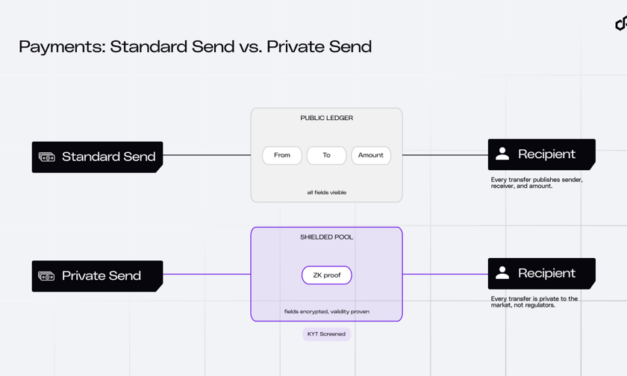
Ethereum scaling solution Polygon has launched private stablecoin payments in an effort to attract more businesses and institutions to the chain. In a statement on Sunday, Polygon introduced its new wallet feature that enables users to privately route transactions through a shielded pool, with verification handled by zero-knowledge proofs. The move is part of an integration with privacy protocol Hinkal.“For onchain payments to go mainstream, businesses need privacy. Not ‘hide from regulators’ privacy. Operational privacy,” noted Polygon community lead Smokey on X. Privacy was one of the biggest crypto themes in 2025, with many crypto assets tied to privacy projects surging last year despite a broader market downturn. Polygon highlighted the importance of privacy, arguing that many institutions are unlikely to move significant volume onchain without it.“Confidentiality has been the single biggest gap between onchain rails and what institutional finance actually needs to move serious stablecoin volume,” Polygon said.“Banks, treasuries and payments teams already live with confidentiality on traditional rails. They won’t move operational flows onto a ledger that broadcasts every counterparty and every amount to every observer on the network.” Payment process for private transactions vs normal transactions. Source: PolygonPolygon’s new feature is that it enables users to hide transactions from the public while maintaining compliance and auditability. Polygon said that “privacy means opacity to the market, not opacity to regulators.”This happens in two key ways. First, every private transaction on Polygon “passes through KYT (Know Your Transaction) screening before execution.” Meanwhile, Hinkal’s documentation indicates that users can generate audit files to hand over to tax officials or regulators.The move from Polygon comes just weeks after layer-1 blockchain Aptos made its own privacy play by launching the Confidential APT coin on April 24.The coin is pegged to the value of the Aptos (APT) token and uses zero-knowledge proofs to conceal and verify transfer information.Related: DeFi can freeze stolen funds, but not everyone agrees it shouldThe total market capitalization of stablecoins on Polygon hit an all-time high of $3.6 billion on April 10, according to data from DefiLlama, making it the eighth-largest stablecoin chain.US passage of the stablecoin-friendly GENIUS Act in July last year sparked an uptick in interest and trading volume for the asset class. On Sunday, Western Union became the latest traditional finance firm to launch a stablecoin through its USD-pegged USDPT on Solana.Magazine: AI-driven hacks could kill DeFi — unless projects act nowCointelegraph is committed to independent, transparent journalism. This news article is produced in accordance with Cointelegraph’s Editorial Policy and aims to provide accurate and timely information. Readers are encouraged to verify information independently.

Čítaj viac

DeFi protocol Carrot becomes first casualty of $285M Drift exploit

Solana-based decentralized finance yield protocol Carrot said Thursday that it is shutting down permanently, becoming one of the first DeFi protocols to fall due to contagion from the Drift Protocol exploit in early April. In an X post on Thursday, Carrot said the Drift exploit was “catastrophic” for the protocol and had left it financially unable to continue operating. The platform set a May 14 deadline for users to withdraw remaining funds. It said it will continue to help recovery efforts related to Drift and distribute assets once they become available.“We are setting May 14th as the deadline to withdraw any remaining funds from Boost, Turbo, and CRT before we will then begin to deleverage the system. Your deposited funds are still yours, but all leverage will be reduced to zero, freeing up all liquidity for CRT redemption,” the protocol’s team said.The Drift protocol exploit on April 1 was the second-largest in 2026. It was a highly coordinated attack that involved months of social engineering by a group of hackers who gained admin control and drained more than half the protocol’s total value locked. The contagion spread to several affiliated projects such as the yield protocol Gauntlet, the lending and borrowing platform PrimeFi and the crypto fund Elemental DeFi. Related: Insider trading backlash forces Polymarket to step up surveillanceCarrot was integrated with Drift’s infrastructure and used its pools to generate yield for its users. Its TVL collapsed after the Drift Protocol hack. According to data from DefiLlama, Carrot’s total value locked was around $28 million before the Drift hack, and is currently $1.99 million, marking a decrease of roughly 93%.Carrot’s sharp TVL drop after the Drift hack. Source: DefiLlamaDefiLlama data also shows nearly $630 million worth of digital assets were stolen in April across 25 incidents, making it the month with the largest losses since February 2025, when $1.47 billion was stolen.The $293 million hack on liquid staking protocol Kelp is the largest exploit of 2026 so far. The Drift hack is close behind at $285 million. Together, these two attacks account for more than 90% of all crypto stolen in April.Magazine: AI-driven hacks could kill DeFi — unless projects act nowCointelegraph is committed to independent, transparent journalism. This news article is produced in accordance with Cointelegraph’s Editorial Policy and aims to provide accurate and timely information. Readers are encouraged to verify information independently.

Čítaj viac
WLFI drops 14% as controversial token unlock goes to vote

The native token of Trump-family-linked World Liberty Financial dropped nearly 14% on Wednesday as a controversial governance proposal that would place over 62 billion WLFI tokens under new multiyear vesting schedules went to a community vote. The proposal was first submitted to the World Liberty governance community on April 15 and officially went live for voting on Wednesday. It proposes locking more than 62 billion WLFI tokens held by early investors and insiders for two years before gradually being released over a span of two to three years. Voting runs until May 7. At the time of writing, 99.95% of votes are in favor of the proposal, and the quorum requirement of 1 billion WLFI tokens has already been met, with 6 billion tokens in favor and 3.2 million against.“This is one of the most significant governance proposals in WLFI history,” World Liberty Financial said in an X post on Wednesday, adding: “62,282,252,205 locked WLFI tokens [are] subject to this proposal. None of it touches the market for a minimum of 2 years if passed.”Despite nearly 100% of voting power being allocated to the “yes” vote, the proposal has been met with strong criticism from some members of the community.Cointelegraph previously reported that figures such as Moonrock Capital founder Simon Dedic likened the proposal to a rug pull and questioned the two-year unlocks coinciding with the remainder of Donald Trump’s term as US president. Tron founder Justin Sun, who holds a significant amount of WLFI, also labeled the proposal one of the “most absurd” he’s ever seen.In the replies to World Liberty’s latest X post announcing that the vote had gone live, the majority of comments were critical of the proposal.Source: World Liberty Financial The unlocking schedule for early investors involves a two-year cliff followed by a two-year linear vest, while insiders such as founders, team members and advisers have a two-year cliff and three-year linear vest.The proposed schedule has faced backlash for its length, while the voting process has also been criticized because those who don’t vote will have their tokens locked up indefinitely.Related: Visa adds Polygon, Base support as stablecoin settlement run rate hits $7BThe World Liberty Financial team said this structure was designed to give a “more clear, bounded picture of governance preferences” and to keep tokens in the hands of those who are “genuinely committed” to the future of the project.According to data from CoinGecko, WLFI was priced at $0.06367 at the time of writing, down 13.6% over the past 24 hours. Overall, it is down 72.8% since hitting the open market. Cointelegraph has reached out to World Liberty Financial for comment.Magazine: Will the CLARITY Act be good — or bad — for DeFi?Cointelegraph is committed to independent, transparent journalism. This news article is produced in accordance with Cointelegraph’s Editorial Policy and aims to provide accurate and timely information. Readers are encouraged to verify information independently.

Čítaj viac

Acting AG Todd Blanche confirms ‘code is not a crime’ in DOJ pivot

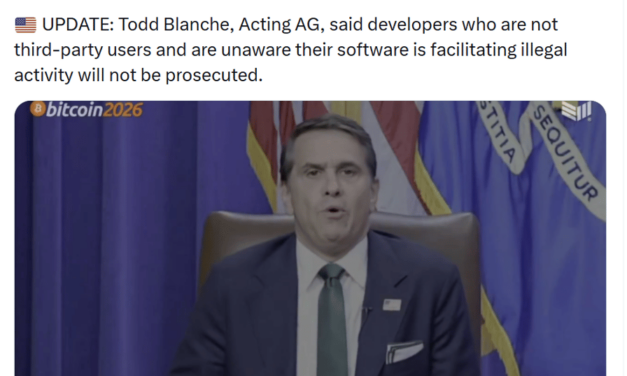
Acting US Attorney General Todd Blanche said the US Department of Justice and FBI are no longer targeting blockchain developers over platforms used for illegal activity, instead shifting focus to the users engaged in financial crime.Speaking at a Bitcoin conference in Las Vegas alongside FBI Director Kash Patel and Coinbase chief legal officer Paul Grewal on Monday, Blanche said that the approach to enforcement has significantly changed under the Trump administration.The acting attorney general explained that as long as developers have nothing to do with illicit activity, the DOJ and FBI have no reason to go after them, noting that “we have fundamentally changed the game when it comes to our investigations.”“The basic principle is that if you are developing software, if you are a coder, if you are part of that process and you are not the third-party user, and you are not helping and knowing the third party is using what you developed to commit crimes, you are not going to be investigated and not going to be charged,” he said.The comments mark a shift in tone from the US government, which had taken strong action against the developers of platforms like Tornado Cash. The crypto mixer and privacy protocol faced significant enforcement action over illicit activity facilitated on the platform, such as money laundering and sanctions evasion.Tornado Cash was sanctioned by the Office of Foreign Assets Control in August 2022 before the sanctions were lifted in November 2024. Developers Roman Storm and Roman Semenov were indicted in August 2023; Storm was convicted in August 2025, while Semenov remains at large. Storm has denied any wrongdoing.Source: CointelegraphDoubts remain over DOJ’s approachBlanche’s comments were seen as positive within the crypto community, but some argued that more work needs to be done to provide developers with clarity. Responding to Blanche on X, Coin Center executive director Peter Van Valkenburgh said it was a “better message than developers have heard from DOJ in recent years,” but the message still leaves room for doubt. “But the real question is where [the] DOJ draws the line between publishing noncustodial software and ‘helping’ or ‘knowing’ about a bad user,” he said. Van Valkenburgh pointed to a court case in which developer Michael Lewellen sued the DOJ for pre-enforcement clarity on whether publishing his Ethereum-based crowdfunding tool constituted money transmission.  Related: Tennessee crypto kiosk ban set to go into effect July 1The case was dismissed in late March, with a Texas court finding that Lewellen had failed to demonstrate that there was a credible threat of enforcement from the DOJ. “DOJ is publicly acknowledging that developers are still sleeping with one eye open. At the same time, DOJ is telling the courts that Lewellen should not be allowed to ask for legal clarity because there is no credible threat,” he said, adding:  “If the law is so clear why are devs sleeping with one eye open? If the law is so clear why fight to have the case dismissed?”The DOJ’s change in approach has been taking shape for more than a year. In April 2025, Blanche released a memo explaining how the DOJ would handle enforcement differently going forward.The memo outlines a commitment to “ending regulation by prosecution,” under which developers will not be targeted for the actions of users of their platforms or for unwitting regulatory violations.“I do not want any platform to look at the Department of Justice or the FBI as somebody who’s going to just cause them a lot of problems,” Blanche said at the Las Vegas conference. Magazine: AI-driven hacks could kill DeFi — unless projects act nowCointelegraph is committed to independent, transparent journalism. This news article is produced in accordance with Cointelegraph’s Editorial Policy and aims to provide accurate and timely information. Readers are encouraged to verify information independently.

Čítaj viac

Získaj BONUS 8 € v Bitcoinoch

nakup bitcoin z karty

Registrácia Binance

Burza Binance

Aktuálne kurzy