Autor Cointelegraph By Brian Quarmby

Signal hints it could leave Canada over lawful access bill

Privacy messaging app Signal has said it may exit Canada if forced to comply with the country’s proposed lawful access bill, which would require companies to build technical surveillance capabilities that some argue could threaten end-to-end encryption.In an interview with Canadian news outlet The Globe and Mail on Thursday, Signal’s vice president of strategy and global affairs, Udbhav Tiwari, argued that the bill could threaten encryption and leave private messaging services vulnerable to potential cyberattacks. Bill C-22 is part of a regulatory package introduced in March. It would require electronic service providers to build surveillance capabilities and retain certain user metadata for up to a year as part of a broader push to help law enforcement investigate crimes such as terrorism and child exploitation.Some have criticized the bill because of its implications for user privacy, echoing concerns of the EU’s controversial chat control proposal, which posed threats to encryption by pushing for client-side scanning of private messages. In an X post on Thursday, Canadian Conservative Party Member of Parliament Jacob Mantle claimed that “every member of Parliament in the country” uses Signal primarily for its safety and privacy features, arguing that the bill would contradict that and allow the government to read everyone’s messages.Tiwari said the firm “would rather pull out of the country” than comply with the law and compromise on the “privacy promises” it has made to users.“Bill C-22 could potentially allow hackers to exploit these very vulnerabilities engineered into electronic systems, with private messaging services serving as an ideal target for foreign adversaries,” he added.The bill is not yet law, as it still has to pass through parliamentary review and receive royal assent before taking effect. Committee hearings began on May 7 and are ongoing.Tech giants such as Meta have welcomed certain aspects of the bill, noting that it would “provide law enforcement with an effective legal framework to obtain critical evidence and protect public safety,” while also raising concerns that certain parts negatively affect “Canadians’ privacy and cybersecurity.”Related: US Senate Banking Committee votes to advance CLARITY ActSignal isn’t the only company feeling pressure from the proposed regulation. In an X post on Thursday responding to The Globe and Mail article, VPN service provider Windscribe said it would follow Signal out of Canada, arguing that the law poses a threat to user privacy.“We won’t be far behind if C-22 passes. In its current state, VPNs would almost certainly require us to log identifying user data,” Windscribe said.“Signal isn’t headquartered in Canada so they can just shut off Canadian servers, but our HQ is. We pay an ungodly amount of taxes to this corrupt government, and in return they want to destroy the entire essence of our service to basically spy on its own citizens,” Windscribe added.Cointelegraph reached out to Signal for comment and will update the article if the company responds.Magazine: eToro founder timed Bitcoin top perfectly due to belief in 4 year cycles

Čítaj viac

NY judge pushes back hearing for Aave’s bid to unfreeze $71M in ETH

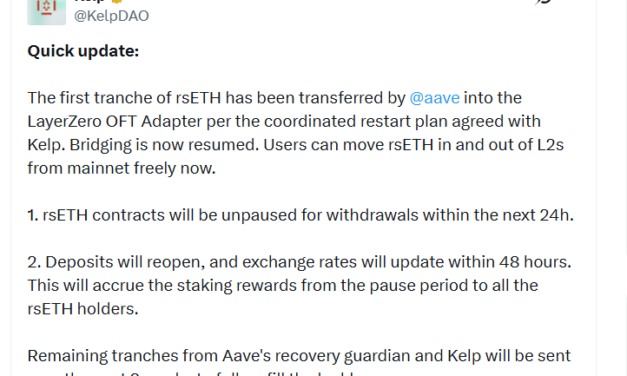
A New York judge has delayed a decision on Aave’s emergency bid to unfreeze $71 million worth of crypto tied to victims of the $293 million Kelp DAO hack, asking for additional information ahead of a new hearing in June. Aave has sought to use $71 million in ETH that Arbitrum froze to assist with recovery efforts following the Kelp DAO hack, one of the worst DeFi hacks this year.However, US law firm Gerstein Harrow LLP filed a restraining notice at the start of May, arguing its clients have a claim to the funds. Aave then filed an emergency motion to get the funds unlocked, arguing that user liquidations and potential DeFi market destabilization could occur if the funds are not unlocked soon.   According to documents filed Wednesday in the Southern District of New York, Judge Margaret M. Garnett said Aave had not adequately outlined how “compounding losses” on user funds could “occur if the restraining notice remains in place” in its filing earlier this month. Judge requests more information from both sides Judge Garnett acknowledged that the case is complex and that there are risks for the victims, and called for additional briefings from both sides to further outline their cases.  “The court recognizes the risk of potential near-term harm to Aave LLC and Aave Protocol users. Due to the complexity of the issues raised in the parties’ motions and at oral argument on May 6, 2026, and the extremely abbreviated timeline on which they were briefed, the Court orders the parties to submit supplemental briefing,” Judge Garnett said.  The judge outlined six key points on which the court wants more information, including whether the hacking transactions are governed by New York’s shelter principle; the legal distinction between fraud and theft and what interest hackers have in stolen assets; which law controls creditor priority over the frozen assets; whether a constructive trust would be an appropriate remedy and whether Aave or Arbitrum can identify individual victims to return the assets on a pro rata basis.Aave and Gerstein Harrow will now have until May 22 to submit their briefs, with the hearing scheduled for June 5.Related: DeFi can freeze stolen funds, but not everyone agrees it shouldThe case comes amid broader Kelp DAO recovery efforts. Kelp and Aave announced Tuesday that they had taken important steps to restore the backing of rsETH. The hacker’s rsETH have been burned on Arbitrum, while the lost tokens, worth about $278 million, will be restored over the next two weeks via funds from the Aave Recovery Guardian multisignature wallet.  Once the associated smart contracts are reactivated, all rsETH uses will return to normal. Source: Kelp DAOMagazine: AI-driven hacks could kill DeFi — unless projects act now

Čítaj viac

Binance says AI-powered security thwarted $10B in fraud since 2025

Crypto exchange Binance says its artificial intelligence-based security tools helped prevent the loss of more than $10 billion worth of user funds from scams and fraud between 2025 to March 2026.Binance said in a blog post on Monday that it had protected more than 5.4 million users from fraud between the first quarter of 2025 and the first quarter of 2026 after rolling out over 24 AI-driven initiatives and more than 100 models.“AI-powered scams and exploits are accelerating,” Binance said. “The barrier to entry for scam perpetrators is falling fast, with AI accelerating the drop. What once required technical expertise can now be executed for next to nothing and at scale.”Scams and exploits have plagued crypto as highly organized threat actors have adopted AI to create more sophisticated attacks. The FBI reported in April that US citizens lost $11 billion worth of crypto to scams, with the impersonation of government officials or crypto companies being a key avenue used to dupe victims.“AI is amplifying social engineering at an unprecedented level, powering deepfakes, phishing bots, fake platforms, voice cloning and impersonation across chat applications, exploiting trust and urgency,” Binance said.Binance said that over the 15 months to March, it prevented $10.53 billion worth of user funds and blacklisted 36,000 malicious addresses via the integration of AI with its security protocols.Related: DeFi can freeze stolen funds, but not everyone agrees it shouldIn the first quarter of 2026 alone, the exchange said it “intercepted 22.9 million scam and phishing attempts,” saving $1.98 billion worth of user funds. Binance’s efforts to stop AI scams. Source: BinanceBinance said it has implemented computer vision to detect fake payment proofs and real-time language analysis to detect scam patterns, while also integrating the technology on the identity verification side to counter “increasingly sophisticated deepfakes and synthetic identities.””AI-driven decisioning now powers 57% of fraud controls, contributing to a 60-70% reduction in card fraud rates compared to industry benchmarks,” Binance said.Magazine: AI-driven hacks could kill DeFi — unless projects act nowCointelegraph is committed to independent, transparent journalism. This news article is produced in accordance with Cointelegraph’s Editorial Policy and aims to provide accurate and timely information. Readers are encouraged to verify information independently.

Čítaj viac

Australia plans capital gains tax changes affecting crypto investors: Report

The Australian government is reportedly seeking to replace capital gains tax discounts on crypto and other assets with an inflation indexation tax, which could increase the taxes on long-term crypto gains.The Albanese government’s fiscal year 2027 budget, set to be released on Tuesday, would cut the current 50% capital gains tax discount alongside changes to housing investment taxes, the Australian Financial Review reported on Sunday, citing people familiar with the budget.Australian investors can currently claim a 50% capital gains tax discount on assets held for more than 12 months. The proposed indexation model would instead tax full real gains, adjusted for inflation, over the time the asset is held.The move is likely to impact long-term investors and could potentially see a significant increase in tax obligations for high-income earners on assets with low inflation-adjusted returns.Chris Joye, a portfolio manager at Coolabah Capital Investments and an AFR columnist, criticized the change, arguing in an X post that it would drive Australians out of most forms of investment and into assets with tax incentives, such as housing.”After the budget doubles the capital gains tax on productive businesses and assets from about 23.5% to 46-47%, investors will understandably pull money from businesses, shares, commercial property and rental housing and plough it into their tax-free owner-occupied home,” he said.”The single biggest winner from the budget: the tax-free owner-occupied home, which is where people will put their money,” Joye added.Changes in the federal budget will take effect at the end of the fiscal year in July 2027, with a one-year grace period for assets acquired after May 10. During the transition to a new system, the existing 50% discount will still apply.Related: Coinbase launches crypto service for Australian retirement fundsThe AFR report also notes that assets purchased before May 10 will be partially exempt, with the final capital gains tax discount calculated proportionally based on how long the asset was held under each tax regime.Source: Chris Joye Scott Phillips, chief investment officer at investment advice firm The Motley Fool, argued that while investors will likely pay more tax under the changes, they will still make considerable returns and be incentivized for further investments.”Not for nothing, but when people say a CGT change would hit founders and growth investors, they’re not wrong. But implicit in that argument is that those groups will be making a motza in the first place. That’s all the incentive they will need,” he said.Magazine: XRP ‘probably going to $12,’ Bitcoin ETFs add $1B: Market Moves

Čítaj viac

CLARITY Act support carries electoral boost, HarrisX poll finds

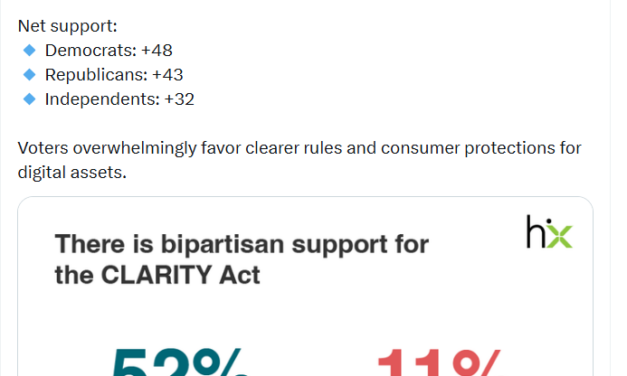
Nearly half of US voters are willing to cross party lines to get clear crypto regulation off the ground, while public support for the CLARITY Act could bring an electoral benefit for politicians, according to a new survey from HarrisX.The poll included responses from 2,008 registered voters from May 1-4. It found that 52% of respondents support the CLARITY Act, with just 11% opposed. About half, or 47%, said they would consider voting for a candidate outside their preferred party if that candidate backed the bill and their own party did not. Among crypto users, that number jumped to 72%.”Passing the CLARITY Act is a bipartisan, winning issue,” Coinbase CEO Brian Armstrong said on X on Thursday. Robinhood CEO Vlad Tenev added: “There’s real momentum now to finally get CLARITY across the finish line. One more small push and we establish the legislative foundation to ensure American dominance in digital finance.”Source: HarrisXThe crypto industry has been waiting for the CLARITY Act to move through the US legislative process. It is expected to provide long-awaited regulatory clarity for crypto and could help the country become a major hub for crypto and digital finance.The HarrisX poll also highlighted strong bipartisan support for the bill, with 55% of Democrats, 58% of Republicans and 42% of independents supporting it. Public support for the bill could also give senators a 20-point electoral advantage, it saidRelated: Bitmine’s Tom Lee says ‘crypto spring’ has already begunSome predict the CLARITY Act will receive additional markups as soon as next week.Speaking at the Consensus 2026 crypto industry conference in Miami on Wednesday, Coinbase’s vice president of US policy, Kara Calvert, said her “prediction is that we have a markup next week” from the Senate Banking Committee.Calvert stressed that bipartisan support will get the bill across the line, saying it needs at least 60 votes to pass the Senate, but she is unsure how things will unfold in the coming days.”That means you need Democrats. You need a bipartisan bill, and we have all been working really hard to make sure that bipartisanship holds. I think the big question is, how do these votes shape up over the next few days?”The timeline for a vote may still be months away, however. US Sen. Kirsten Gillibrand recently suggested additional markups are required before the bill can progress, predicting a Senate vote in August.Magazine: Guide to the top and emerging global crypto hubs — Mid-2026 Cointelegraph is committed to independent, transparent journalism. This news article is produced in accordance with Cointelegraph’s Editorial Policy and aims to provide accurate and timely information. Readers are encouraged to verify information independently.

Čítaj viac

Získaj BONUS 8 € v Bitcoinoch

nakup bitcoin z karty

Registrácia Binance

Burza Binance

Aktuálne kurzy