Autor Cointelegraph By Brian Newar

Australian central bank governor favors private sector crypto technology

Australian central bank Governor Phillip Lowe said that a private solution “is going to be better” for cryptocurrency as long as risks are mitigated through regulation.Lowe commented at a recent G20 finance meeting in Indonesia. Reuters reported on July 17 that officials from other countries discussed the impact of stablecoins and decentralized finance (DeFi) on global financial systems.Recent risks associated with stablecoins can largely be chalked up to depegging events. In May, the Terra USD stablecoin UST, which has since changed to Terra Classic USD (USTC), lost its peg and drove down the value of the entire Terra Classic ecosystem. It caused a multi-billion dollar cascade effect leading to Tether (USDT) and the DEI stablecoin briefly depegging.Lowe suggested that strong regulations or even state backing could help mitigate the risks to the public.”If these tokens are going to be used widely by the community, they are going to need to be backed by the state or regulated just as we regulate bank deposits.”While the regulations would come from the government side, Lowe noted that the technology would be best if it were developed by the private sector. In his view, private companies are “better than the central bank at innovating” the best features for cryptocurrency. He added, “there are also likely to be very significant costs for the central bank setting up a digital token system.” The National Association of Federally-Insured Credit Unions shared Lowe’s skepticism about implementing a digital token at central banks due to high costs in a letter to the U.S. Commerce Department, according to Cointelegraph on July 8.However, his view on the costs of digital token systems at central banks is not echoed by the countries currently developing or experimenting with central bank digital currencies (CBDC), such as China, the European Union, and the Bahamas.In the same G20 meeting, Hong Kong Monetary Authority CEO Eddie Yue backed Lowe’s opinion that stablecoins should be scrutinized more closely. He said that reliable stablecoins would, in turn, reduce risks in DeFi, where stablecoins act as the main transactional currency.Related: Aussie FPA supports ‘crypto rule book’ and regulation of exchangesReferring to DeFi and stablecoins, Yue said, “the technology and the business innovation behind these developments are likely to be important for our future financial system.”

Čítaj viac


Paraguay’s crypto framework one step away from becoming law

The Paraguayan Senate passed a bill on July 14 establishing a tax and regulatory framework for businesses operating in the cryptocurrency and the crypto mining sectors.The bill, introduced last July by Senator Fernando Silva Facetti and passed in Congress in May before reaching the Senate, calls for the formation of the Ministry of Industry and Commerce (MIC) to oversee crypto industry service providers. The bill is now one step away from being ratified as law by President Mario Abdo Benítez.A notice from Congress in May stated that the bill pertains specifically to crypto mining, commercialization, intermediation, exchange, transfer, custody, and/or administration of crypto assets or instruments that allow control over crypto assets.Local news outlet ABC reported on July 14 that companies that operate in the crypto industry would be treated the same as those dealing with securities for tax purposes. As a result, they will be exempted by the Undersecretary of State for Taxation from paying a Value Added Tax (VAT) but will be included in the income tax regime.PARAGUAY: #Bitcoin and crypto companies exempt from paying VAT in newly approved bill.— Bitcoin Archive (@BTC_Archive) July 16, 2022The bill reportedly considers how crypto miners should interact with local power suppliers. Prospective mining operations will be required to report their energy consumption schedule to the National Electricity Administration (ANDE), Paraguay’s national electricity regime. If miners are found to be consuming more electricity than planned, ANDE may cut off their electricity supply.While the bill stipulates that energy costs for miners will be subsidized, they will pay a rate 15% higher than other industries. According to reports, Senator Facetti said that modifications made to the bill over the last year “improved the original project.” Detractors to the bill, such as Senator Enrique Bacchetta, reportedly stated that while regulating the crypto industry would lead to greater profits, he questioned whether it would actually create jobs for his fellow citizens. Senator Esperanza Martinez seconded Senator Baccetta’s concerns, claiming that the energy consumption rate from miners far outpaces the number of jobs they would create.Related: USD stablecoin premiums surge in Argentina following economy minister’s resignationThis makes Paraguay the latest LATAM nation to take a leap forward in crypto adoption and regulation. El Salvador adopted Bitcoin (BTC) as legal currency in 2021, and the governments of Brazil, Argentina, and Panama are all working on their own crypto legislation.

Čítaj viac

Nifty News: Old Navy's BAYC shirts, expensive whisky NFTs, Sandbox publishing

A bottle of 52-year-old whisky made at Japan’s famous defunct Karuizawa distillery is being auctioned off as an NFT.The starting price for the nonfungible token (NFT) and bottle of whisky is a dizzying $75,000, or about 62 Ether (ETH). Direct-to-Customer NFT wine and spirits marketplace BlockBar is handling the auction.To whisky collectors, the ultra-rare bottle of whisky from “The Last Masterpiece” cask made in 1970 is attractive as there are now only 211 bottles of it left, according to a July 12 report by Finbold. Now an NFT collector can bolster their collection with a token that verifies authentic ownership of a bottle.NFT authenticating a bottle of “The Last Masterpiece” from Kurizawa.The auction began on July 12 and will continue until July 18. The artwork for the NFT and the bottle was made especially for the BlackBar auction by calligrapher Sounn Takeda. There has been one bid made on the item so far. Old Navy gets boredAmerican clothing brand Old Navy has issued a new $19.95 T-shirt depicting Bored Ape Yacht Club (BAYC) #7285. Is this a good thing for BAYC?Some have questioned the association, while others are delighted to see their favorite NFT collection gain widespread recognition in mainstream culture. BAYC owner JBond said in a July 15 tweet that in general, it helps Bored Apes.I saw arguments on whether a $19.99 @OldNavy shirt with an ape on it hurts or helps bored apesThoughts:1) It helps – a licensing example between a major clothing brand & bored ape2) It helps drive awareness too3) It doesn’t necessarily hurt official BAYC shirt value. Why?⬇️— JBond (@jbondwagon) July 15, 2022According to BAYC creator Yuga Labs’ terms of service, owners have the right to use the image of their BAYC as they please under most circumstances. Some of the NFT community claimed it was an unauthorized use of the image, however Old Navy’s product site indicates that the image on the shirt has been licensed, The owner of this BAYC is clearly an enthusiast, as they own six other BAYCs, 11 Mutant Apes, 20 Otherdeeds, along with two Bored Ape Kennel Club NFTs. Creating more in The SandboxYou can now publish game assets that you have created in the Metaverse and NFT gaming platform The Sandbox (SAND).A July 13 announcement from the project outlines how voxel creators can now publish their artwork and use it on their plots of metaverse LAND.The process for publishing appears fairly straightforward as a creator merely needs an account on the platform, to create an asset using VoxEdit, and then export it to The Sandbox’s marketplace for publishing.The catch is that creations will not be publishable or mintable as NFTs initially, however minting and selling will be enabled soon.Syscoin blockchain gets a new NFT marketplaceThe Syscoin Layer-1 blockchain has completed integrating the Luxy NFT marketplace. This is the first official NFT marketplace available on Syscoin, according to a July 13 announcement. Luxy features include a marketplace to buy and sell NFTs, a collection launchpad, support for audio and video tokens and discounts for LUXY token holders.Other Nifty NewsRoughly one-third of gamers would be open to using crypto in the Metaverse according to a new survey published by software developer Globant. The survey was conducted by YouGov with 1,000 respondents, 34% of whom indicated that they had some interest in making crypto transactions in a play-to-earn (P2E) setting.The world’s largest NFT marketplace OpenSea has laid off 20% of its staff because of financial complications caused by “crypto winter,” as it stated in a July 14 announcement. The company believes that the layoffs will help it weather the market downturn.

Čítaj viac

Celsius bankruptcy filings show a company in deep trouble

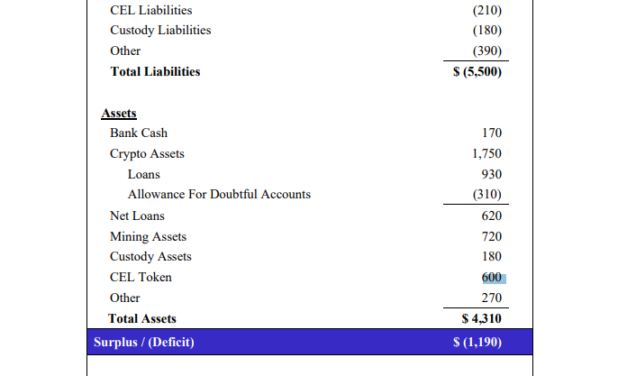
Celsius’ bankruptcy filing has revealed some unpleasant surprises about the state of the crypto lending platform, including a $1.2 billion deficit formed largely as a result of user deposits. A chapter 11 bankruptcy document signed off by Celsius CEO Alex Mashinsky on July 14 has revealed that the company holds around $4.3 billion in assets against $5.5 billion in liabilities, representing a $1.2 billion deficit.User deposits made up the majority of liabilities at $4.72 billion, while Celsius’ assets include CEL tokens as assets valued at $600 million, mining assets worth $720 million, and $1.75 billion in crypto assets.  The value of the CEL tokens has drawn suspicion from some in the crypto community however, as the entire market cap for CEL tokes is only $321 million, according to CoinGecko data.The financial roundup for Celsius reveals a $1.2 billion deficit.Among the crypto assets are 410,421 Lido Staked ETH (stETH) tokens worth about $479 million which are generating 5% APY, though the tokens themselves cannot be redeemed for Ether (ETH) until the Ethereum network transitions into Proof-of-Stake consensus in the Merge.Celsius CEO Alex Mashinsky signed a document stating that the company could also sell Bitcoin (BTC) mined by its Celsius Mining Bitcoin mining operation to “generate sufficient assets” to repay at least one of its loans and provide revenue for the company in the future. The company projects that it could generate about 15,000 BTC through 2023.Swan Bitcoin founder Cory Klippstein has deplored both Celsius and Voyager’s recent decision to file for Chapter 11 protection rather than the Securities Investor Protection Act (SIPA). In a July 14 tweet, Klippstein said filing under SIPA would have shifted ownership of the firm’s assets over to customers, which would have at least given them a portion of their deposits back. Under Chapter 11 bankruptcy proceedings, the company filing for protection claims ownership of all assets. Under SIPA, a failed firm must either transfer its accounts to another firm or be liquidated and send funds to investors.If @celsiusnetwork and @investvoyager cared about their users they’d file for SIPA bankruptcy as brokers (which they always claimed to be), where ALL proceeds go to customers first.Filing for Chapter 11 is them saying EXPLICITLY that THE COMPANY OWNS ALL USER ASSETS. pic.twitter.com/FMDzmjRBZO— Cory Klippsten (@coryklippsten) July 14, 2022Crypto skeptic economist and blogger Frances Coppola shared more potential bad news in a July 14 blog post by explaining why she believes Celsius depositors “won’t get their money back.” She argues that Celsius is running what she calls a “shadow bank,” which is defined by Investopedia as a non-bank “unregulated financial intermediary.” “Deposits in banks aren’t even ‘customer assets,’ let alone ‘assets under management.’ They are unsecured loans to the bank. They are thus liabilities of the bank and fully at risk in bankruptcy.”“Depositors in a bank do not have any legal right to return of their funds. Even if the terms of the account say funds can be withdrawn whenever the customer chooses, the bank can refuse to allow customers to withdraw their funds if it doesn’t have the cash to pay them,” she explained. Despite assertions in its terms of use that it is not a bank, Celsius’s business model is that of an unlicensed, unregulated bank with no deposit insurance – a “shadow bank”.— Frances Schadenfreude Cassandra (@Frances_Coppola) July 14, 2022

Related: Voyager token skyrockets as VGX pump scheme toutedCoppola also added that Celsius’s terms of use make it clear that Celsius are allowed “to do with as it pleases” with funds deposited by customers.“And it specifically says that in the event of bankruptcy, customers might not get all — or indeed any — of their money back.”CEL has been falling since January, dropping 84% from $4.38 to $0.73, with a spike in June coinciding with a short squeeze attempt by the community.

Čítaj viac

Ankr Network’s 2.0 upgrade aims to improve Web3 decentralization

Decentralized Web3 infrastructure provider Ankr Network (ANKR) has introduced its Ankr Network 2.0 upgrade aimed at transitioning blockchains into more resilient node networks.The upgrade is detailed in the Ankr 2.0 Whitepaper which was obtained by Cointelegraph ahead of its release later today.The upgrade centers around making Web3 more decentralized through several new features, such as an option to run an independent node, the ability to stake ANKR tokens on a full node, and the Ankr DAO. A spokesperson explained to Cointelegraph:“The upgrade is aimed at transitioning more blockchains, and the DApps built on them, to more distributed and resilient node networks supported by independent node providers.”Ankr is one of the largest remote procedure call (RPC) endpoint providers in the crypto space. RPCs are essential tools blockchain developers use to build decentralized apps and projects. Every time Ankr handles an RPC request, a node is required to fulfill it. By expanding access to independent node providers, Ankr 2.0 aims to increase the number of nodes and the degree of decentralization on the network to eliminate a single point of failure in the node infrastructure. This also means that Ankr competitors may be able to join the protocol to provide nodes.The more nodes running on the network, the greater ability to handle higher RPC request volumes and prevent failed requests. Independent node operators will also begin earning ANKR rewards for the work they do in securing the network.The upgrade will also allow users to, for the first time, stake their ANKR on full nodes to secure the network and earn income. Stakers will also be entitled to a 49% share of the user fees spent on Ankr Network for their contribution.ANKR stakers will also have voting power in the new Ankr DAO governance tool which will be used to make decisions on allocations of treasury funds, determining pricing and revenues for nodes, and choosing which blockchains to onboard.Related: Brazil beams Bitcoin from space: A case for BTC satellite nodesFor developers, Ankr 2.0 provides three new API services designed to “simplify querying blockchain data of all types,” according to the whitepaper.These include APIs which reduce time spent searching blocks for addresses and events, allow searches across any EVM-compatible blockchain supported by Ankr, and allow searches for ownership history and metadata of nonfungible tokens (NFT) across six different blockchains.Ethereum Virtual Machine (EVM) chains mimic the development environment of the Ethereum network. They support smart contracts and decentralized apps (Dapps).The price of the native ANKR token, which is used to pay for services on the platform, is up 1.8% over the past 24 hours trading at $0.0267 according to CoinGecko.

Čítaj viac

Získaj BONUS 8 € v Bitcoinoch

nakup bitcoin z karty

Registrácia Binance

Burza Binance

Aktuálne kurzy