Autor Cointelegraph By Brian Newar

7 NFL players that chose crypto over cash salaries

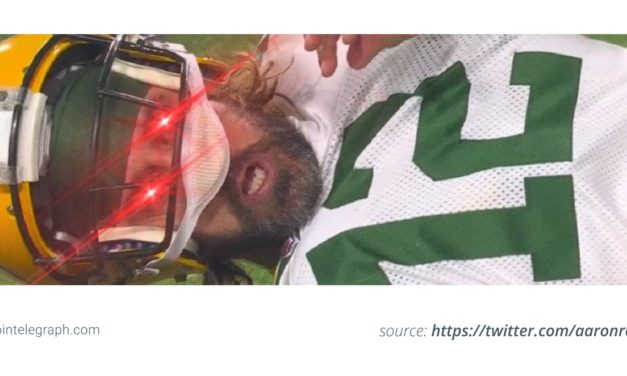
For NFL fans, 2021 was a great year. Stadiums returned to capacity crowds after the 2020 season was shortened with limited attendance. Stadium parking lots were again filled with the enthusiastic anticipation of tailgaters and their barbequed camaraderie. It was also a great year for Bitcoin (BTC) investors as the largest cryptocurrency by market capitalization reached all-time high prices multiple times throughout 2021, eventually topping out at $69,000 in early November. This led to a dramatic increase in media coverage of Bitcoin.Seven NFL players in 2021 decided to call the audible and begin either being paid in crypto or having their cash salary partially converted to crypto. These players have capitalized on the return of the regular season and the increased profitability of Bitcoin.Aaron RodgersThe reigning 2020 NFL MVP announced via a Nov. 1 video post on Twitter that he was partnering with Cash App payment service to accept a portion of his salary in Bitcoin. Rodgers will earn roughly $22.3 million this year.The video depicted Rodgers dressed as John Wick for a Halloween party. If that wasn’t strange enough, likely by design, Rodgers also told viewers that he would donate $1 million in BTC.In Rodgers’ case, he will have a portion of his salary sent to his Cash App account, which he will then use to buy BTC. The Twitter profile for the star quarterback for the Green Bay Packers features a picture of himself on the field during a game with the iconic laser eyes, further signaling his support for BTC.Tom BradyTom Brady is another very high-profile NFL star quarterback who dabbled heavily in cryptocurrency in 2021. Brady has not yet said that he is being paid in BTC by the NFL, but he will be paid in crypto by FTX exchange after he took an equity stake in Sam Bankman-Fried’s exchange, and will serve as a brand ambassador.Brady has not reserved himself to crypto assets alone, however. The iconic football star launched his own NFT platform, called Autograph, in April to attract the top talent in sports, entertainment, fashion and pop culture. Tom Brady getting into Crypto was a top signal pic.twitter.com/hc6qxQou9o— Tom Brady (@TomBrady) October 20, 2021It doesn’t end there for Brady and crypto, though. Late in October, Brady threw the 600th passing touchdown of his career, marking an all-time high for the NFL, and helping to secure Brady’s position as the all-time leading touchdown passer in the league’s history. Brady paid 1 BTC to the fan who was initially given the ball by the receiver who completed the touchdown.That BTC was worth about $62,000 at the time of the game, but the ball itself may be worth over $500,000 according to Goldin Auctions sports memorabilia auction company. Odell Beckham Jr.Odell Beckham Jr. (OBJ) followed in Aaron Rodgers’ footsteps by announcing late in November that he had partnered with Cash App to receive his salary from the NFL in BTC. His contract stipulates that he should receive about $4.25 million from the NFL this season.The Los Angeles Rams’ wide receiver told fans that he would give back $1 million in BTC as part of his new partnership with Cash App. Beckham appears to be no stranger to the crypto and NFT scene as his Twitter profile dons a Crypto Punk NFT.In case you haven’t noticed, Jack Dorsey’s Cash App is involved with both OBJ’s and Aaron Rodgers’ BTC salary deal. The payment service app has had a great 2021 through the first three quarters of the year by raking in nearly $10 billion in revenue from 36 million active users and 100 million downloads.Trevor LawrenceThe Carolina Panthers’ new star quarterback joined the ranks of NFL superstars who are publicly accepting crypto payments. Lawrence’s deal, however, is not with the NFL directly. The 2021 NFL top draft pick’s crypto salary comes from an endorsement deal with the crypto portfolio app FTX (formerly Blockfolio). Congrats on being the #1 pick @Trevorlawrencee!We’ve got a surprise for you — check your @blockfolio account for $25k of SOL.Tonight is on crypto, thanks to you! pic.twitter.com/ci8yHp3e8W— SBF (@SBF_FTX) April 30, 2021

The value of his deal has not been made public, but if Lawrence has been hodling his crypto earnings, there is a good chance he has enjoyed an appreciation in value, especially from the Solana (SOL) coins. The total crypto market cap has increased by about $500 billion since late April when the deal was announced.Saquon BarkleySaquon Barkley, the superstar running back from the New York Giants, revealed in July that he was converting all of his endorsement pay into BTC. As with most others on this list, Barkley is not being paid directly with crypto. Instead, he is swapping some of his cash earnings for crypto.Barkley is using the Strike payment app to acquire his BTC. He is not the first NFL player to use Strike to buy BTC with his salary, however. Last year, former NFL offensive lineman Russel Okung became the first player to publicly share that he was using Strike to convert his NFL salary to BTC. Barkley’s reasoning for trying to amass wealth with BTC revolved around the lack of longevity among NFL athletes. He told The Best Business Show host Anthony Pompliano on July 15:”When you see the KD’s, the Lebrons and Bradys of the world and you want to create generational wealth, you can’t do that with the sport that I play and the position that I play and coming off of injuries. When you sit out of football for a whole year, you realize that this game could be taken away from you.”Sean CulkinKansas City Chiefs’ tight end Sean Culkin went public with his plans to convert his entire salary from the NFL into BTC. While others on this list committed to converting only a portion of their salary into Bitcoin or being paid for endorsements with cryptos, Culkin is swapping 100% of his salary.I fully believe Bitcoin is the future of finance and I wanted to prove that I have real skin in the game — not just trying to make a quick buck. I will be converting my entire 2021 NFL salary to #Bitcoin.— Sean Culkin (@culkin22) April 26, 2021

Like with Saquon Barkley, Culkin’s reasoning for turning to crypto has to do with the short half-life common among players in the league. The average time most athletes spend in the NFL is 3.3 years, according to Statista. Culkin said in a statement:“Considering my career—particularly its physical demands, and brevity–it makes the most sense to be paid in sound money that I believe protects its purchasing power over time.”Aaron JonesLast but certainly not least on the list of NFL stars earning crypto is the Green Bay Packers’ Aaron Jones. The running back signed a deal with FTX to become an ambassador for the exchange in September. Like with Tom Brady’s deal, Jones purchased an equity stake in the exchange.Jones will also integrate the FTX Pay platform into his own charity’s website to enable it to accept crypto donations. Got my first NFT Shout out to @MaisonDeGOAT thank you for welcoming me to the herd #GOATz Excited to be apart of the community !!! pic.twitter.com/oLRquKjGRE— Aaron Jones 3️⃣3️⃣ (@Showtyme_33) December 9, 2021

Čítaj viac
Make a wish: New Year's resolutions from crypto industry insiders

As the new year rapidly approaches, people are thinking about what they can do to make 2022 even better than 2021. With so much anticipation for cryptocurrency in the coming year from government policymakers and market action, it’s no wonder that some in the crypto industry have ambitious resolutions for the new year with how they will help to shape the industry for the better.National governments have taken steps to increase the global adoption of blockchain technology right up to the end of 2021. Late in the year, governments from Australia, Kazakhstan, Brazil and the Eastern Caribbean launched, or made public, their plans regarding central bank digital currencies (CBDCs). The United States Senate heard testimonies from crypto company executives in December, and Thailand’s government vowed to issue a regulatory framework for crypto by 2022.As for the bull market, nobody truly knows what will happen. Some analysts believe that the four-year market cycle has been broken, indicating that the bull run will continue well into 2022. However, bearish signals persist despite the strength of Ether (ETH) and altcoins, making a stronger case for the argument that this time around, things are different.Several industry participants shared their thoughts with Cointelegraph regarding their New Year’s resolutions. They range from education and inspiration to healthcare concerns. They even floated ideas of a global metaverse GDP.Bobby Ong, CoinGeckoBobby Ong, co-founder of CoinGecko, also shared his resolutions for the new year. As with others in the industry, Ong feels that education is one of the keys to crypto adoption. He told Cointelegraph that his greatest ambition is to see the industry use education to help users keep their digital assets safe.His concerns regarding user security have genuine merit considering that so far in December 2021, there have been over $149 million in losses due to security breaches at Grim Finance, Badger DAO, MonoX, Visor Finance and AscendEX. At the time of publishing, there is still about a week left in the month for other breaches to be revealed. Ong said:“I hope to see more people educating themselves on crypto security in 2022. Too many new users have lost cryptocurrencies and NFTs due to bad security practices and I hope more projects and companies will educate their users on best practices.”He went on about how he believes that crypto users — both new and experienced — need access to as much information and education as they can get: “Our motivation in doing this is to help users make sense of the crypto world and we hold the view that anything that can be tokenized will be tokenized.”Yat Siu, Animoca BrandsAnimoca co-founder and chairman Yat Siu voiced his aim to see the metaverse niche mature in 2022. His lofty goals for the new year include bringing metaverses onto a global scale of recognition which could have evolutionary implications for the nonfungible token, or NFT, market as well.It may be safe to say that the Metaverse have come closer to mainstream adoption than they ever had before thanks, in no small part, to Mark Zuckerberg and Meta. Siu and Animoca, one of the biggest investment firms in the NFT and metaverse space, are counting on the continued expansion of those markets.Animoca had a fantastic 2021, especially in the last few months of the year when the firm increased its treasury value five-fold from $2.9 billion in September to $15.9 billion by the end of November. As the latest winner of Deloitte Hong Kong’s Fast Technology award, Animoca may have the momentum needed to continue its success in 2022. Siu said his New Year’s resolution was:“To help in constructing an open metaverse with such a significant GDP that closed metaverses are forced open in much the same way that free trade opened up the global economy. Where we are no longer digitally defined as ‘users’ but as metaverse citizens with true digital ownership.”Pradeep Goel, Solve.CareNext, Solve.Care blockchain-based healthcare platform CEO Pradeep Goel shared his thoughts on what can be done to improve the crypto space in 2022. The telehealth field, which Solve.Care has one foot in, saw a 63-fold increase in utilization through 2021, according to the United States Department of Health and Human Services.Especially for geriatric patients and those with low mobility who cannot easily make regular doctor visits, the utility of telehealth services was fleshed out over the past 20 months through the COVID-19 pandemic. Solve’s position as a crypto-telehealth leader aided in the launch of its Global Telehealth Exchange and various other services, which Goel hopes will help users obtain the health services they need. Goel told Cointelegraph:“It is my wish that in 2022, we will see greater utility and adoption of cryptocurrencies, especially for the healthcare sector. Not only can they be used as a payment currency, but they can be programmed to streamline and facilitate seamless interactions between stakeholders like patients, healthcare providers, government agencies and insurance companies.”Jen Buakew, To The Moon LabJen Buakaew, founder of growth accelerator To the Moon Lab, hopes that 2022 will make the crypto space more accessible for laypeople who want to explore its possibilities. In her experience at crypto conferences, many people become befuddled by the NFTs that sell for millions of dollars and the technical jargon tossed around by industry experts. She said, “These things usually mean nothing to people besides making them feel that crypto success is unattainable.”In her view, people interested in joining the industry as traders, entrepreneurs, or professionals don’t have an adequate support system in place to help them reach their goals should they choose to join the industry. That lack of support is what she thinks keeps some individuals from contributing their valuable input in the first place. Buakaew said:“My New Year’s resolution is to inspire as many people as I can to get themselves into crypto by showing them the simplest ways where they can benefit from being part of the decentralized economy. I would like to change this narrative or the mindsets of the ordinary people, especially those in the less fortunate demographics to ‘if Jen can do it, well then so can we.’”

Čítaj viac

'Mecca of mining': Brazil considers zero tax on green bitcoin mining

A new proposal in the Brazilian Congress calls for a tax exemption on both the importation of crypto mining rigs and on any mining conducted using renewable energy sources.A Dec. 4 report from Brazilian media outlet Seudinheiro explains that a series of new proposals from Brazilian lawmakers could reduce the criticism crypto gets in South America’s largest country. Congress also heard a proposal to have cryptocurrency be regarded as a currency as opposed to a commodity. If this proposal passes, crypto exchanges will be able to provide financial services and issue loans to Brazilian residents. Senator Irajá Silvestre Filho made all three proposals to congress. It is presently unclear how much support the proposals have in the legislature, but there is plenty of support from the Brazilian crypto community.Ray Nasser, CEO of Arthur Mining, said that if Brazil passes the tax exemption on crypto miners, it could become a global “Mecca of mining”. Under the condition that cryptocurrency becomes a legal currency, the Central Bank of Brazil would be allowed to issue a digital real central bank digital currency (CBDC). This would put Brazil among nine other countries or jurisdictions that currently issue CBDC to its residents.Brazil currently produces just under half of its electricity from renewable sources, according to the International Trade Administration. The cost per kilowatt hour is about $0.12, putting it roughly in the middle of the global pack in that regard.Taynaah Reis, CEO of Moeda, a Brazil-based blockchain finance company, told Cointelegraph: “Crypto is rising rapidly in Brazil and the regulatory bodies have been very proactive and protective on incentivising mining and drafting policies on best practices as major businesses announced their plans on including crypto.”Reis also said that miners would have to register their equipment with the Brazilian government as a means of monitoring the ecosystem. There are existing power supply concerns in Brazil, where power rationing is becoming a reality. Power rationing is where small portions of a country are provided with smaller amounts of power so as to protect the overall power grid.Related: Kazakhstan to decide whether to launch CBDC by late 2022Rudá Pellini, president of Arthur Mining, said that while Brazil deals with power rationing, he does not see the new addition of Bitcoin miners as a threat to the power supply:“One of the main problems in the energy issue in Brazil is transmission. We have a large energy generation surplus in the country, and it is possible to promote greater investments in clean energy generation.”Electricity supply has been an ongoing issue in Kazakhstan, which has become the world’s second-biggest Bitcoin mining nation.

Čítaj viac

SPLC report examines use of Bitcoin and Monero by right wing extremists

The Southern Poverty Law Center (SPLC) has released a report examining the extensive ties between the far right and Bitcoin, many of whom built fortunes in the cryptocurrency.In a Dec. 9 Hatewatch report, the SPLC shared its findings on how right wing extremists and white supremacists, discuss and use cryptocurrencies claiming that many have amassed “tens of millions of dollars” from crypto donations. The report How Cryptocurrency Revolutionized the White Supremacist Movement  identified and compiled over 600 cryptocurrency addresses associated with white supremacists and other prominent far-right extremists” to reach its conclusions. One of the main claims it makes is that although less than one quarter of Americans own cryptocurrency:”Hatewatch struggled to find any prominent player in the global far right who hasn’t yet embraced cryptocurrency to at least some degree.”The most common reasons these individuals used cryptocurrency was because they were debanked or because they want to hide the their transactions.Stefan Molyneaux, who is described by Wikipedia as a far-right white nationalist and white supremacist  has been accepting donations in Bitcoin for eight years. The SPLC noted that the first Bitcoin wallet that has been linked to Molyneaux dates back to Jan. 25, 2013 and that his followers have donated a total of 1250 Bitcoin since 2013.Molyneaux has realized an estimated $3.28 million from $1.28 million in crypto donations. This is more than any other extremist studied for the SPLC report.Greg Johnson, who goes by the pseudonym Karl Thorburn, has gained over $800,000 from crypto. Johnson is the founder of the controversial website CounterCurrents.The site requests donations from his followers to be paid in 12 different cryptocurrencies and is currently trying to raise $200,000 goal to further its political ambitions.Crypto critic and author David Gerard told the SPLC in an email that although at first glance the amount of money these extremists are making from crypto is alarming, it is not a reason to associate all cryptocurrency with their actions. He claimed: “Bitcoin started in right-wing libertarianism… This is not at all the same as being a neo-Nazi subculture. That said, there’s a greater proportion of Nazis there than you’d expect just by chance, and the Bitcoin subculture really doesn’t bother kicking its Nazis out.”While extensive, the SPLC report relies heavily on historical events and incidents that have been reported previously, such as extremist publication Daily Stormer citing in 2017 a Bitcoiner TV host’s views on the use of the cryptocurrency as a way to liberate its readers from what it sees as Jewish control of centralized banks.Related: Ross Ulbricht’s debut NFT sold for $6.2M at auctionIt tied extremist Andrew “Weev” Auernheimer to the privacy coin Monero, which facilitates private, untraceable transactions better than Bitcoin, with a 2017 podcast when he said: “I hold a lot of Monero though. That’s my big thing now. I’m way into Monero. I hold a significant amount.”

Čítaj viac

AWS outage hits dYdX raising concerns over decentralization

An Amazon Web Service (AWS) outage on Dec. 7 forced the decentralized exchange dYdX to halt operations, raising questions over the reliance on centralized services by DeFi protocols. AWS is one of the most widely used cloud services in the world and a considerable amount of decentralized infrastructure uses it. AWS offers servers, storage, networking, remote computing, email, mobile development, and security for websites. dYdX issued an update via Twitter on Dec. 8 acknowledging that its reliance on a centralized web service like AWS is problematic. It pledged to improve the true decentralization of its operations, but did not state how.“Unfortunately, there are still some parts of the exchange that rely on centralized services (AWS in this case). We are deeply committed to fully decentralizing and this remains one of our top priorities as we continue to iterate on the protocol.”Centralized exchanges (CEX) Binance.US and Coinbase also saw service outages due to the AWS issue.dYdX is the 11th biggest DeFi app on the Ethereum Network according to Dappradar. It does about $1.5 billion in daily trading volume. As a decentralized exchange (DEX) it requires no know-your-customer (KYC) protocol and settles all transactions via smart contracts. Updates on the dydx status portal showed that while trying to remedy the problem, the team was unable to access key elements of its back end due to the outage. The status from 9:20pm UTC read:“We are looking into whether we can just have all of those orders cancel, however the AWS outage is preventing us from currently being sure if that’s possible.”Related: DeFi TVL hits new highs while Metaverse tokens show signs of exhaustiondYdX token is down about 10% over the past 24 hours, trading at $8.63 according to Coingecko.

Čítaj viac

Získaj BONUS 8 € v Bitcoinoch

nakup bitcoin z karty

Registrácia Binance

Burza Binance

Aktuálne kurzy