Autor Cointelegraph By Brian Newar

Malaysia’s Central Bank actively assessing CBDC options

Malaysia has joined the growing cadre of nations that are exploring the value of researching and developing a central bank digital currency (CBDC).Malaysia’s central bank, Bank Negara Malaysia, stated to Bloomberg on Jan. 17 that while a decision about exactly how to move forward with a CBDC has not yet been determined, it has focused research on a CBDC “via proof-of-concept and experimentation to enhance our technical and policy capabilities.”It also stated that the ostensible reason for the current research effort was to ensure it is prepared to launch a CBDC program “should the need to issue CBDC arise in the future.” In 2021, Malaysia collaborated with South Africa, Australia, and Southeast Asian neighbor Singapore to develop a proof-of-concept CBDC pilot called Project Dunbar, according to a joint announcement. Project Dunbar utilized the Corda and Quorum blockchain platforms from r3 and ConsenSys respectively to demonstrate various capabilities of blockchain-based cross-border remittances. Most notably, it aimed to demonstrate how blockchain technology could “eliminate the need for intermediaries and cut the time and cost of transactions.”An increasing number of nations are researching how a CBDC program would operate in their jurisdiction. China is by far the largest nation currently executing a CBDC pilot program, dubbed the Digital Yuan, and the mobile app already has over 20 million downloads since Jan. 4. China plans to launch the program and allow international visitors to access Digital Yuan with their passports during the upcoming Winter Olympics in Beijing next month.Related: CBDCs and stablecoins: EY advises banks to ‘prepare for what’s coming’The Eastern Caribbean Central Bank (ECCB) rolled out its finalized CBDC called the “EC dollar” in Mar. 2021. As of Dec. 2021, Antigua was the last of eight jurisdictions in the ECCB to not have adopted the EC dollar. Nearby Jamaica also plans on launching a finalized CBDC by Q1 2022 following the successful pilot program which concluded two weeks ago.

Čítaj viac

Tether freezes $150 million in USDT

Tether has added three more Ethereum addresses, holding more $150 million worth of the USDT stablecoin between them, to its blacklist.As a centralized company, Tether is able to blacklist addresses it believes are involved in crime, money laundering — or for any other reason it chooses.This is the first time Tether has blacklisted an address in 2022 but it added 312 addresses to the blacklist last year and has added 563 all up since it first did so on Nov. 28, 2017.Tether has not revealed why the three new addresses were blacklisted, however it has used its power to blacklist addresses involved in cyber attacks and law enforcement investigations. Following the Kucoin hack in Sep. 2020, Tether froze about $35 million USDT to prevent hackers from capitalizing on their theft. There may also be “precautionary reasons” for the blacklisting, such as being associated with scams, which Arcane Asset’s CIO Eric Wall noted as a reason for a separate Tether freeze in 2020.Concerns over a lack of decentralization may be a factor driving up adoption of the TerraUSD (UST) stablecoin from algo stablecoin blockchain Terra. It is currently the fourth largest stablecoin with a market cap of $10.6 billion. The marketcap of the decentralized challenger still pales in comparison to USDT however, which is the fourth largest crypto overall with a market cap of $78.5 billion.Related: Crypto regulation concerns make decentralized stablecoins attractive to DeFi investorsDo Kwon, founder of Terra, tweeted in response to the news of Tether’s actions that there was no way to blacklist UST addresses.

Čítaj viac

North Korean hackers stole $400M in 2021, mostly ETH: Chainalysis

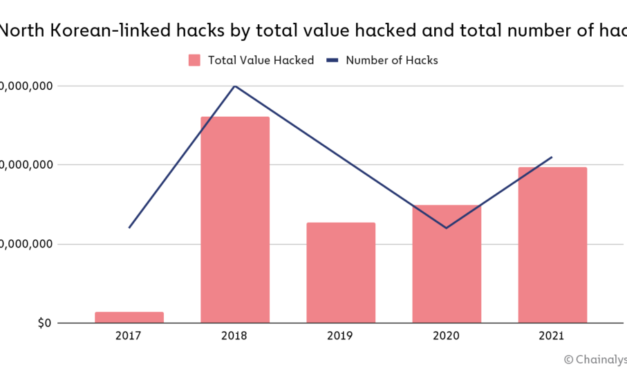
North Korean crypto hackers siphoned off nearly $400 million in crypto through cyber attacks in 2021 according to new data from Chainalysis.The type of crypto stolen has also seen a sea change according to the Jan. 13 report from the blockchain analytics firm. In 2017, BTC accounted for nearly all the crypto stolen by the DPRK, but it now accounts for just one fifth:“In 2021, only 20% of the stolen funds were Bitcoin, whereas 22% were either ERC-20 tokens or altcoins. And for the first time ever, Ether accounted for a majority of the funds stolen at 58%.”The report stated that attacks in 2021 from North Korea (DPRK) primarily targeted “investment firms and centralized exchanges, and made use of phishing lures, code exploits, malware, and advanced social engineering” to maliciously acquire the funds. Stolen cryptocurrency is believed to be used by the DPRK to evade economic sanctions and to help fund nuclear weapons and ballistic missile programs, according to a UN Security Council report.The threat that the DPRK presents to global crypto platforms has become ever-present. Chainalysis now refers to hackers from the Hermit Kingdom, such as Lazarus Group, as advanced persistent threats (APT). These threats have been on the increase over the past three years, following the all-time high of over $500 million in crypto stolen in 2018.Chainalysis reported that the funds were meticulously laundered. Methods range from chain hopping, the ‘Peel Chain’ method, and more recently the hackers have employed a complicated system of coin swaps and mixing.Related: LCX loses $6.8M in a hot wallet compromise over Ethereum blockchainMixers were used on over 65% of the funds stolen in 2021, which is a 3-fold increase since 2019. A mixer is a software-based privacy system that allows users to hide the source and destination of the coins they send. Decentralized exchanges (DEX) are increasingly preferred by hackers since they are permissionless and have ample liquidity for coins to be swapped at the user’s will.Chainalysis used the Aug. 19, 2021 hack at Liquid.com in which $91 million in crypto was stolen as an example of the typical way in which DPRK hackers launder funds. They first swapped ERC-20 coins for Ether (ETH) at decentralized exchanges. Then the ETH was sent to a mixer and swapped for Bitcoin (BTC), which was also mixed. Finally, BTC was sent from the mixer to centralized Asian exchanges as a likely fiat off-ramp.

Čítaj viac

Vitalik deluged after asking for the 'most unhinged' criticisms about him

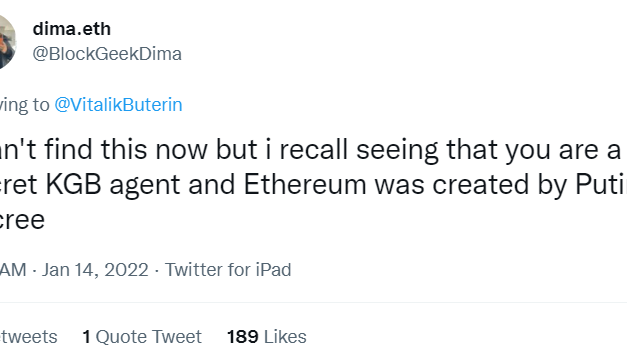
Ethereum co-founder Vitalik Buterin asked for, and received in spades, examples of “the craziest and most unhinged criticisms” of him on Twitter and elsewhere.Buterin’s lighthearted request came in a Jan. 14 tweet in which he shared some of his own favorite criticisms and revealed the Ethereum (ETH) creator’s lighter side. More than 500 people responded in the first fifteen minutes, although most were in support of Buterin. At the time of writing his tweet had over 1,200 comments.Among the four criticisms Buterin posted was one from a user that said he “Looks like an alien crackhead.”What are the craziest and most unhinged criticisms of me you’ve seen on twitter or elsewhere? Here are a few good ones, I wonder what else people have seen that I haven’t! pic.twitter.com/2qvwgNkHyM— vitalik.eth (@VitalikButerin) January 13, 2022Vitalik’s father Dmitry recalled a fairly unhinged conspiracy theory that he was actually a Russian secret agent and that Russian President Vladimir Putin was behind the creation of Ethereum. Vitalik himself brought up how “2 different Reddit trolls!” had compared him to Hitler back in 2017 and shared a screenshot of the comparison in a tweet. Ethereum was an early example of an initial coin offerings (ICO) in the crypto space and has been one of the most successful with over 778,000% in gains since 2015. But to this day it is criticized for being a “centralized premine.” One user cited an unhinged take frequently seen during the 2017 ICO craze shows the “spider Vitalik ponzi”  and depicts Vitalik as the spider in charge of the Ethereum ponzi web.Not everything was a criticism, some users took the opportunity to share their favorite memes, including this joke that leans heavily on a pun. Other users dusted off the classics, including this meme shared in a comment displaying an aged Buterin with a headline from a hypothetical news show reading “Breaking News: Ethereum 2.0 finally ships.” Given how old the meme is, it’s hard to say there isn’t some truth to criticism over the length of time Eth2 is taking to ship. Related: Industry players respond to Vitalik Buterin’s thoughts on cross-chain ecosystemsWhile the Twitter thread was about all the crazy criticisms Buterin has received over the years, most users who responded did so in jest. And ConsenSys alumnus John Lilic pointed out that despite all the criticism of Buterin, both real and comedic, he has ”been working to make the space better since almost day zero.”

Čítaj viac

Interest wanes in Bitcoin futures ETF’s as contracts fall below 5K

After a stellar launch, interest has waned in the ProShares Bitcoin Strategy Exchange Traded Fund (BITO) which now has the lowest amount of CME contracts since Nov. 2021.The Bitcoin futures exchange traded fund (ETF) holds a total of 4,904 Chicago Mercantile Exchange (CME) futures contracts, according to the fund’s latest update from Jan. 11. A Bitcoin futures ETF allows investors to speculate on the future price of Bitcoin (BTC) without having to hold the asset themselves.BITO’s assets under management (AUM) figure has retraced to $1.16 billion from a high of $1.4 billion last Nov. This is about the same amount it held two days after its Oct. 18 launch when it became the fastest fund to reach $1 billion in AUM ever.Arcane Research discussed possible reasons for the BITO retrace in its latest Weekly Update. As you might expect, the poor price performance of BTC over the past two months is the chief explanation, as Bitcoins drifts ever further from the $69,000 it reached on Nov. 10 down to its current price around $43,700. Arcane suggests another explanation for the declining interest in BITO is the high cost that comes with operating a futures-based ETF, with the rolling costs required each month to stay ahead of the current BTC price driving up costs:“BITO sells its front-month exposure to buy the next-month contract each time the contract approaches expiry.”Arcane believes that a spot-based BTC ETF would not be subject to the same high fees that grow over time. The SEC has not yet approved any such ETFs, but a ruling on the filing by Fidelity Investments is scheduled to be made by Jan. 20.Other BTC futures ETFs have also failed to significantly increase their AUMs, which are a fraction of the assets of BITO. Valkyrie’s Bitcoin futures ETF (BTFD), which launched just days after BITO, currently holds $71.9 million. Related: Bitcoin holdings of public companies surged in 2021Although the VanEck Bitcoin Strategy ETF (XBTF) has increased its AUM by $6 million since its Nov. 16 launch, it currently holds just $15.8 million according to Dividend.com.

Čítaj viac

Získaj BONUS 8 € v Bitcoinoch

nakup bitcoin z karty

Registrácia Binance

Burza Binance

Aktuálne kurzy