
Autor Cointelegraph By Brian Newar

Individual ETH miner hits jackpot with $540K block reward

An individual Ether (ETH) miner struck it big by mining a block on their own and receiving a reward valued at about $540,000. The miner was operating through the 2miners Ethereum SOLO pool on Jan. 17 when they mined an entire block and received 168 ETH. That reward vastly outstrips the per-block average reward of about 4 ETH according to BitInfoCharts.Adding to the remarkable nature of the reward is the size and hash power of the SOLO pool. It is relatively small with 854 miners online and 1.5 Tera hashes per second at time of writing, meaning that the average miner contributes 1.85 Giga hashes per second. The lucky miner currently contributes 2.25 Giga hashes per second which could be generated between 1 to 20 of the latest GPU devices.Hash power is the amount of computer processing power a device contributes to a Proof-of-Work blockchain like Ethereum and Bitcoin. More hashpower helps secure the network by processing transactions and mining blocks.The lucky jackpot on the Ethereum network marks the third time in two weeks that an individual crypto miner has hit the big time. A Bitcoin (BTC) miner from the Solo CK anonymous solo mining operation raked in 6.25 BTC for mining an entire block on their own on Jan. 11. Two days later, another solo miner using Solo CK again mined a new block on Bitcoin with only one to three rigs. Each miner had a 1 in 1,400,000 chance of mining an entire block, and the chances of two tiny miners managing the same feat in the same week have been estimated at 1 in a billion.Average daily Ethereum mining profitability has been on a decline since it spiked to an all time high of $0.282 on May 12, 2021. Average profitability is now about $0.0474 according to BitInfoCharts. This is partly due to EIP-1559 which burns fees rather than distributing them to miners.Related: Ethereum’s EIP-1559 upgrade launches on Polygon to burn MATICA jackpot reward like the one earlier this week may be consigned to the past when the Ethereum network completes “the Merge,” referring to its move to a Proof-of-Stake (POS) consensus algorithm. With POS, network stability is maintained by staking tokens. This will reduce the electrical resource requirements of the network.

Čítaj viac

USDC flips Tether on the Ethereum network

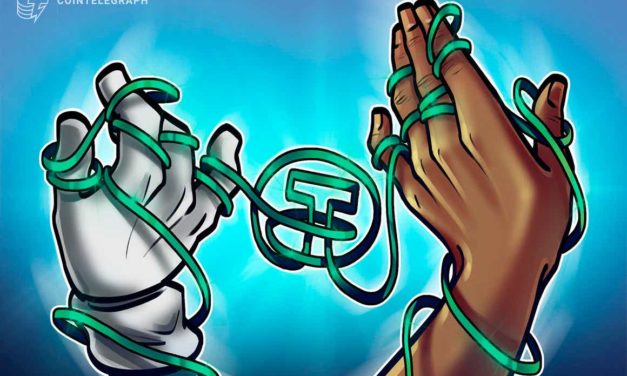
Circle’s USD Coin (USDC) has reached a major milestone by surpassing Tether (USDT) in total supply on the Ethereum network.USDC’s current supply on Ethereum as of writing is 40.06 billion tokens, just ahead of USDT’s supply of 39.82 billion. Tether has been the most popular stablecoin since at least 2016, after originally sharing the market with BitUSD and NuBits (USNBT) stablecoins when it launched in late 2014. At that time, USDT ran on Omni. As the latter two fell into obscurity due to losing their dollar peg and shedding users, USDC emerged in 2018 as a more transparent and more regulated competitor to Tether, which has been under a cloud for years due to doubts over its backing. Although USDT is still the most popular stablecoin with a total supply of 78.5 billion, nearly 50% of the supply or 38.7 billion tokens, is on the Tron network. USDT can also be found on BSC, Solana, Huobi ECO Chain, Avalanche, Polygon, and 13 other chains or layer 2 solutions. The current total supply for USDC is 45.7 tokens across 21 chains or layer-two solutions.Doubts over Tether’s backing has caused its public image to decline over the years. Controversy has plagued the company over how the stablecoin is collateralized and how its reserve funds are managed. The issuance of two Consolidated Reserves Reports about Tether’s financial reserves from accounting firm Moore Cayman in 2021 did little to quell the doubters. In its latest financial report, Tether revealed that it holds $30.8 billion in unspecific commercial paper in addition to other assets backing USDT. Circle has been more transparent about its reserves, though not to the extent some critics demand. In Aug. 2021, Coinbase President Emilie Choi said that the USDC reserves backing the second largest stablecoin in the market would shift entirely to cash and US Treasury bonds. This did indeed happen by Oct. 27 2021 according to an Independent Accountant’s Report done by Grant Thornton.Coinbase is a close partner with Circle, a digital payments service, which helped launch USDC in Oct. 2018. Circle is backed by Bitmain, China Everbright Bank, and eight others.It has been supportive of efforts to solidify a regulatory framework for all stablecoins. Circle CEO Jeremy Allaire supported a Nov. 2021 Biden Administration proposal to treat stablecoin issuers similarly to banks. Allaire also attended a Congressional hearing with several top crypto industry leaders in Dec. 2021 to discuss policy direction with the Financial Services Committee.Centralized stablecoins USDT, USDC, and BUSD are currently the top three in their category, however decentralized stablecoin options have begun to proliferate. Related: Hong Kong Monetary Authority aims to oversee stablecoin reservesTerraUSD (UST) is the fourth largest stablecoin, but is the fastest growing since Nov. 2021. Since then, it has surpassed Magic Internet Money (MIM) and DAI (DAI), and achieved a $10.7 billion market cap.

Čítaj viac

Georgian citizens made to swear an oath to stop mining crypto

Residents of Svaneti, Georgia, have reportedly been made to pledge a holy oath they will not mine cryptocurrency in order to deal with energy shortages blamed on Bitcoin mining.The economy of the northwest Svaneti region of Georgia depends on tourism spending, which rose every year from 2000 to 2019 according to Macrotrends. As a result of the Covid-19 pandemic, however, tourism plummeted in 2020 and has only recently begun to return to pre-Covid levels of growth. To make do, hundreds of residents turned to mining crypto which has been blamed for severely disrupting the electrical supply. A video cited by local media outlet Sputnik Georgia show miners crowding a church on Dec. 30 2021 to pledge a holy oath to St. George that they would not mine cryptocurrency. Such pledges are traditionally seen as unbreakable bonds.Crypto mining has become a controversial topic, with residents staging protests in the Svaneti town of Mestia and the electric company that provides them with power, Energo Pro, threatening to increase electricity tariffs.Svaneti is a mountainous region of Georgia which currently enjoys free electricity in some parts, which makes mining more attractive.This situation is becoming increasingly common around the world. Bitcoin miners have flocked to countries with cheap energy to the chagrin of local residents. In the cases of Kosovo and Kazakhstan, governments have banned crypto mining in order to preserve the gr.The municipality of Mestia issued a statement at the end of 2021 explaining the extent to which crypto mining has disrupted the local energy supply. It said, “In comparison with earlier years, consumption has grown by 237% this year.”Energy company Energo Pro called the vast increase in consumption “unsustainable.” On Jan. 5, the company stated to local media that the region was consuming 27 megawatts, nearly four times the amount of power the infrastructure was designed to handle. Related: Bitcoin miners’ resilience to geopolitics — A healthy sign for the networkKosovo in southern Europe recently banned crypto mining due to a dangerous winter supply drain. The Kosovar government seized 300 mining rigs on Jan. 10, forcing mining operations to sell their rigs or move to nearby countries.Kazakhstan was the second most active country for Bitcoin mining but effectively pulled the plug on miners amid political protests in the first week of this year. An internet blackout in the central Asian country led to a 13.4% decrease in hash power across the Bitcoin network.

Čítaj viac

Korean Bithumb exchange to launch NFT marketplace

South Korean crypto exchange Bithumb is developing an NFT marketplace with “a large company” thought to be LG CNS, a subsidiary of LG Corporation. Bithumb CEO Heo Baek-young confirmed in a Jan. 13 interview that the exchange was currently developing a nonfungible token (NFT) exchange which would help it stay competitive with Korbit and Upbit, two other domestic Korean exchanges. Heo said:“An NFT marketplace will be important in promoting blockchain-based content, which will become a driving force in the future.”There is no confirmation yet on the identity of the content creators or artists that have agreed to issue work in NFT form for Bithumb.Several media outlets in South Korea have reported that the NFT marketplace is being developed in collaboration with tech giant LG CNS, but an official from Bithumb said on Jan. 17 that “it is impossible to confirm whether it is LG CNS and whether it is just them or a group of companies.”Launching an NFT marketplace would help Bithumb remain competitive. Bithumb currently sits comfortably in second place among Korean exchanges ranked by trading volume. However, it is a distant second behind Upbit which boasts $1.7 billion in 24 hour trading volume compared to Bithumb’s $730 million. Upbit launched its own NFT marketplace in Nov. 2021 with some fanfare as it was able to secure several K-pop groups including BTS to agree to commit exclusive NFT content. The Korbit crypto exchange, which is owned by gaming giant Nexon, was South Korea’s first exchange to launch a NFT marketplace in June 2021. Korbit is Korea’s fourth-largest crypto exchange with about $7 million in 24-hour trading volume.Related: An Indonesian 22-year-old makes $1M by selling NFT selfies on OpenSeaWhile global NFT traders tend to mint and trade on-chain on OpenSea, Korean traders tend to remain on centralized platforms. Despite the Klaytn blockchain being developed in South Korea and being just one of three platforms with native support on OpenSea, trading volume there has lagged behind Polygon and Ethereum-based marketplaces.

Čítaj viac

Binance eyes Thailand for latest crypto exchange expansion

Binance is looking to re-establish crypto exchange services and possibly open a new branch in Thailand after signing an agreement with Gulf Energy Development PCL.Gulf Energy Development PCL is a Thai holding company run by billionaire Sarath Ratanavadi that focuses on the energy sector.Gulf Energy reportedly made the agreement with the world’s largest crypto exchange based on the strong assumption that Thailand’s digital economy infrastructure will see “rapid growth” in the next few years. The cooperative efforts between Gulf Energy, Binance, and the Thai government will be focused on exploring Binance’s options in the Thai market, which may include opening an exchange and related businesses in the Kingdom. A spokesperson for Binance told Reuters on Jan. 17, “Our goal is to work with government, regulators and innovative companies to develop the crypto and blockchain ecosystem in Thailand.”The Thai digital economy is poised to see greater regulatory clarity for digital asset traders. The director-general for the Thai government’s Revenue Department made regulatory transparency a top priority this month after announcing a planned 15% capital gains tax on crypto trades on Jan. 6.On Jan. 9, the Thai Digital Asset Association requested clarification on the specifics of the tax based on concerns from domestic traders that they may unintentionally violate the tax code.Despite the positive developments, Thailand’s central bank has repeatedly issued warnings to commercial banks and local businesses over accepting cryptocurrencies as payments.Related: Former Thai SEC chief lays out three critical issues with crypto taxationsBinance was on the receiving end of a criminal complaint from the Thai Securities and Exchange Commission (SEC) in July 2021. The complaint accused Binance of operating a digital asset business without a license and opened an investigation against the exchange. The SEC stated that Binance ignored warnings from as far back as April 2021, and had wrongfully granted Thai citizens access to crypto trading on its website by “matching orders or arranging for the counterparties or providing the system or facilitating entry into an agreement.”

Čítaj viac

Získaj BONUS 8 € v Bitcoinoch

nakup bitcoin z karty

Registrácia Binance

Burza Binance

Aktuálne kurzy