Autor Cointelegraph By Brian Newar

Zuckerberg unfazed about $2.8B metaverse division loss in Q2

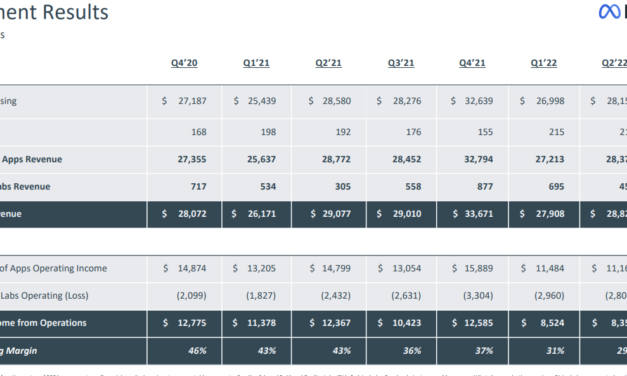
Meta’s virtual reality (VR) and metaverse division Reality Labs has posted its seventh straight quarter of losses, but CEO Mark Zuckerberg remains steadfast in investing in the technology, which he calls a “massive opportunity.During Meta’s Q2 earnings call on July 27, Zuckerberg acknowledged that such losses could continue for several more years until VR applications and its Metaverse platform are mature enough to tap into the “massive opportunity” worth “hundreds of billions of dollars” “The Metaverse is a massive opportunity for a number of reasons. I feel even more strongly now that developing these platforms will unlock hundreds of billions of dollars, if not, trillions over time.”“This is obviously a very expensive undertaking over the next several years,” Zuckerberg added, “I’m confident that we’re going to be glad that we played an important role in building this.”The extended stretch of operating losses for Reality Labs was revealed in Meta’s Q2 earnings report earlier in the day. Such losses are not unusual for divisions in a research and development phase.Reality Labs builds VR and augmented reality (AR) applications to help Meta users connect over its various social platforms, including the Metaverse, with the Oculus line of VR headsets.In addition to the losses, Reality Lab’s revenue has been trending down since 2021 and its operating margin has been trending down since 2020. The $11.1 billion in revenue and 29% margin posted in Q2 2022 are the lowest over the past seven quarters. Reality Labs posted $2.9 billion in losses for Q1.Zuckerberg also noted that a “challenging macro environment” could be exacerbating the losses. He said that the economic situation now is worse than it was a quarter ago, and his opinion is corroborated by the fact that the Federal Reserve raised interest rates by 0.75 percentage points for the second time in a row on July 27 before the Meta earnings call took place, adding: “We seem to have entered an economic downturn that will have a broad impact on the digital advertising business. In this environment, we’re focused on making a long term investment that will position us to come out stronger.”Despite the economic troubles, Zuckerberg is confident that his company and its subsidiaries will come out of the current economic downturn as “a stronger and more disciplined organization.” He attributed this confidence to the investments his company is making now to ensure it is able to remain a leader in an industry that may be undergoing a shift to accommodate more Metaverse platforms.Related: Experts clash on where virtual reality sits in the MetaverseMeanwhile, the Federal Trade Commission (FTC) has filed a lawsuit against Meta alleging that the firm is aiming to monopolize the entire Metaverse market. The complaint states that Meta’s moves within the space hinder innovation and “competitive rivalry” among US-based companies looking to build Metaverse platforms and applications.

Čítaj viac

KuCoin CEO Johnny Lyu launches 'Anti-FUD Fund'

The CEO of crypto exchange KuCoin says it is launching an “Anti-FUD Fund” to track down and potentially take legal action against “FUDers” and educate crypto users on identifying misinformation.Johnny Lyu, CEO of the exchange announced the fund in a July 26 Twitter thread and comes only days after publishing a blog post criticizing Twitter user “Otteroooo” for spreading misinformation about his firm. (1/5) FUD benefits no one except the FUDers. It misleads investors and harms the industry’s image and market confidence.To build a crypto space with less FUD, #KuCoin is going to launch an Anti-FUD Fund.Currently, the fund will mainly focus on…thread pic.twitter.com/dWA93nEmHz— Johnny_KuCoin (@lyu_johnny) July 26, 2022Lyu said the Anti-FUD fund will cover three elements, the first being education, which will “deliver knowledge, including what is FUD and how to distinguish it” through online and offline means.The fund will also motivate and spread acclaim for industry leaders and influencers who are responsible and help followers or product users avoid FUD. Finally, the fund will seek to weed out and take legal action against individuals who “intentionally spread FUD.” Speaking to Indian Express earlier this week, Lyu addressed the topic of market FUD saying that people who spread rumors should be held accountable for their words as they can affect the market and that Web 3.0 technology can help increase tracking technology.“The accountability mechanism in the Web 2.0 era is not mature enough and the cost of spreading rumors is very low.” He made the comments with the outlet at the same time as noting the firm is making efforts to expand its services into India.The Fund’s launch comes a short time since Lyu had a heated exchange with crypto industry whistleblower Otteroooo on July 2. Otteroooo accused KuCoin of having exposure to the former Wrapped LUNA (wLUNA) token which crashed in dramatic fashion in May, leaving the exchange insolvent. Lyu denied that the exchange had internal exposure to LUNA and is not insolvent. Otteroooo’s account has since been removed from Twitter.Related: GameStop ‘Falling Man’ NFT saga shows people’s power at its finestLyu’s new crusade against FUD and the individuals who spread it may be welcome news to many in the crypto industry, but it may come with a caveat. Whereas some defenders of crypto projects attempt to fight back against false claims designed to denigrate a project, others believe that any negative press is FUD regardless of its veracity.An example of the latter comes from the founder of online investment platform BanktoTheFuture Simon Dixon. He pointed out on July 26 that his qualms about beleaguered crypto lender Celsius’s balance sheet were met with criticisms that he was merely spreading FUD. However, Dixon, who has supported several efforts to rescue Celsius from its troubles, claimed that his concerns were legitimate and data-based.

Čítaj viac

IMF global outlook suggests dark clouds ahead for crypto

Investors are warning of further volatility in the digital asset markets as the International Monetary Fund (IMF) forecasts a slowdown in global economic growth.The IMF’s July update on the World Economic Outlook titled “Gloomy and More Uncertain” points to “higher-than-expected inflation,” and a contraction of global output as indicators of incoming poor economic growth. The report states in succinct terms that there are likely economic slowdowns ahead.“The risks to the outlook are overwhelmingly tilted to the downside.”Macro factors have been linked to the crypto bear market, prompting crypto analyst Miles Deutscher to warn his 154,000 Twitter followers to expect volatility in the markets. He noted the incoming earnings reports from Microsoft, Google, Apple, and Meta along with the gross domestic product (GDP) numbers from the U.S. could create further turbulence.It’s going to be a massive week for the markets. July 26: FOMC Meeting, Microsoft & Google EarningsJuly 27: Meta EarningsJuly 28: US Q2 GDP Release, Apple EarningsVolatility incoming. — Miles Deutscher (@milesdeutscher) July 25, 2022Crypto investors are also bracing for a rise in interest rates in the United States this week.  Bloomberg reported on July 26 that the Fed is expected to raise rates by as much as 75 basis points, or 0.75%, up to 2.25% in an attempt to tighten its monetary policy and stump inflation.There are also industry observers who expect the U.S. to be officially in recession when the Q2 GDP figures for the country are published on July 28. Investopedia defines a recession as two consecutive quarters of negative GDP growth.Major market moving events this week for #bitcoin, #crypto, and #stocks. – Corporate earnings reports starting- FED Meeting (27th)- US GDP Q2 data release (28th)White House already getting in front of what must be bad data saying it is time to change the definition! LOL!— Lark Davis (@TheCryptoLark) July 26, 2022

Crypto market YouTuber DustyBC tweeted on July 26 that the global slowdown coupled with potentially reduced U.S. GDP numbers could explain why Bitcoin (BTC) price dipped below $21,000. International Monetary Fund (IMF) released its July 2022 World Economic Outlook, forecasting significant slowdown in global growth which should average 3.2% this year and 2.9% in 2023.This + tomorrow’s FOMC meeting could explain why #BTC dipped below $21,000— DustyBC Crypto (@TheDustyBC) July 26, 2022

Meanwhile, founder of Cosmos-based cross-chain decentralized finance (DeFi) hub Umee Brent Xu asked on July 25 in a tweet “Does a macro recession = a crypto recession?”Cointelegraph quoted the Material Indicators Twitter account on July 25 in reporting that there is “no guarantee that any support holds” after the GDP and interest rate numbers are announced. It added that there may be several days of volatility, echoing Deutscher’s observations.Elizabeth Gail wrote in Cointelegraph on July 26 that Bitcoin markets were likely to recover when the uncertainty about the current state of the economy and geopolitical tensions are resolved. However, there is no telling how long that will take.While the economic outlook looks gloomy, the IMF pointed out that the sell-offs in crypto since May due to liquidations, bankruptcies, and losses at major firms like Celsius, Three Arrows Capital, and Voyager Digital Holdings have had little impact on other financial systems. Related: Bitcoin price struggles to defend $21K as Coinbase faces new SEC wrathThis suggests that as the broader financial systems can have a massive effect on crypto, the same cannot be said the other way around.“Crypto assets have experienced a dramatic sell-off that has led to large losses in crypto investment vehicles and caused the failure of algorithmic stablecoins and crypto hedge funds, but spillovers to the broader financial system have been limited so far.”As of the time of writing, the total crypto market cap is sitting just barely over $1 trillion according to the TCAP Index. Disappointing earnings reports and GDP numbers this week could spoil these levels as Cointelegraph reported on July 25 that investors are already starting to seek shelter in fiat in preparation for the worst.

Čítaj viac

‘Extreme demand’ for BTC at $20K creating new support levels: Glassnode

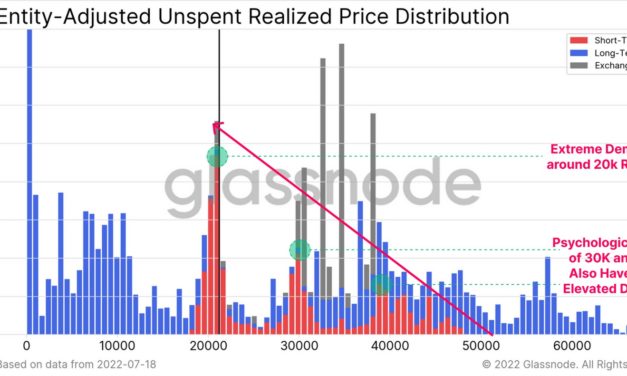
“Extreme” demand at the $20,000 price point for Bitcoin (BTC) appears to have forced the coins back into the hands of investors who care less about price while creating a new realized price level.In the latest The Week OnChain Newsletter published on July 25, Glassnode’s UkuriaOC pointed to “extreme demand” around the $20,000 region, noting that at each psychological price level from $40,000 to $30,000 to $20,000 creates a new group of short-term holders (STHs).The Glassode analyst noted that much of the supply that new STHs bought during that drawdown has not been sold even though prices are significantly down. This may be due to less price sensitive buyers, or those who care more about Bitcoin fundamentals than investment gains, driving demand.Between late April through June, BTC price has fallen 55% from $40,000 to a low of about $18,100 according to CoinGecko. Glassnode wrote that this suggests the newly-minted STHs are price insensitive buyers with more confidence in Bitcoin, adding that their conversion from a STH to a long-term holder (LTH) who does not sell for at least 155 days would help confirm this.“It would be constructive to see these STH held coins at the $40k-$50K level start to mature to LTH status over coming weeks, helping to bolster this argument.”In this current bear market, confirmed LTHs have locked in nearly 400 days straight of yearly profitability performing better than 30-day profitability. This is nearly the same duration that LTHs experienced during the 2018 bear market. Glassnode wrote that this suggests losses are being locked in by LTHs which, if the previous argument holds, means the new buyers have less price sensitivity than the cohort who sold, meaning they could become the newest group of LTHs.Another point of note in the report is that “unprecedented forced selling” from crypto companies amid mass liquidations and bankruptcies created conditions ripe for a relief pump. Related: The battle between crypto bulls and bears shows hope for the futureThe report concludes by stating that while the “worst of the capitulation may be over,” BTC could remain in this low range for some time as the cost basis for new coin buyers has diverged below the realized price for only about 17 days straight. Previous bear cycles have endured low divergences between 248 and 575 days.BTC has retreated 3.1% over the past 24 hours to trade at $21,146 at the time of writing.

Čítaj viac

LidoDAO rejects sale of 10M LDO tokens to Dragonfly Capital

LidoDAO, the governance body that controls Lido Finance, has voted to reject a proposal that would have sent 1% of the LDO token supply to Dragonfly Capital in exchange for about $14.5 million in DAI.LDO is the native token on the Lido Finance protocol, which issues the Lido Staked Ether (stETH) token. DAI is the dollar-pegged stablecoin issued by the Maker Protocol. If it had passed, crypto VC Dragonfly Capital would have received 10 million LDO tokens at $1.45 each. A total of 609 votes were cast across three options, but the proposal was ultimately rejected with 43 million total tokens in favor of rejection. Nine whales whose collective 40.3 million tokens comprised the vast majority of the weight of the votes. The other two options were each in favor of the proposal either with a one-year lockup on the LDO tokens or with no lockup. This vote was for the first half of the total 20 million LDO token allocation stipulated in the proposal. The second portion of 10 million LDO tokens could be sold to LidoDAO’s treasury, but it is unclear whether that vote will take place following this first rejection. Lido’s treasury is currently valued at about $228 million as of the time of writing.The July 18 proposal issued by DAO member Jacob Blish aimed to secure a two-year runway for LidoDAO to carry out its functions in the Lido Finance protocol without worrying about further fundraising. Blish stated: “This will ensure Lido and its core contributors are able to continue the important work needed for the protocol in the long term and to flourish as an autonomous, self-governing collective.”Blish added that the proposal specifies accumulation of stablecoins to ensure that Lido can remain in a  “steady state to ensure survivability and security for Lido independent of further market actions.”Lido community members appear nonchalant about the outcome of the vote as the project’s Discord and Twitter accounts have been silent since the results came in. With the rejection, the proposal will go back to the drawing board and possibly be voted on again.Dragonfly Capital, led by Haseeb Qureshi and Bo Feng, has at least 57 companies in its crypto and Web3 investment portfolio. The firm closed a $650 million funding round in April.Lido allows ETH investors to stake their coins in preparation for the Ethereum network’s transition to Proof-of-Stake (PoS) consensus expected by September. Related: Lido co-founder discusses the future of Ethereum at EthCCThe LDO whale who swung their considerable weight of 17 million tokens to reject the proposal has voted in favor of another ongoing vote at LidoDAO that will add a developer to one of the project’s multi-sig wallets if passed. This proposal is designed to increase the security of the protocol’s funds.

Čítaj viac

Získaj BONUS 8 € v Bitcoinoch

nakup bitcoin z karty

Registrácia Binance

Burza Binance

Aktuálne kurzy