Autor Cointelegraph By Brian Newar

Wormhole token bridge loses $321M in largest hack so far in 2022

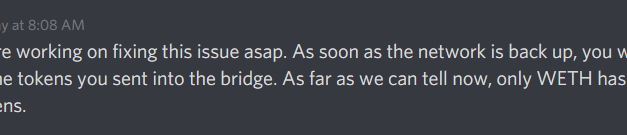
The Wormhole token bridge experienced a security exploit today, resulting in the loss of 120,000 wETH tokens ($321 million) from the platform.Wormhole is a token bridge that allows users to send and receive crypto between Ethereum, Solana, BSC, Polygon, Avalanche, Oasis, and Terra without the use of a centralized exchange (CEX). This is the largest crypto hack of 2022 so far and the second largest DeFi hack to date. The Wormhole team has offered a $10M bug bounty for the return of the funds. The hack took place on the Solana side of the bridge and there are fears Wormhole’s bridge to Terra could be similarly vulnerable.The Wormhole team has assured the community that its ETH supply would be replenished to “ensure wETH is backed 1:1,” but there is no word yet on where those funds will come from or when.The wormhole network was exploited for 120k wETH. ETH will be added over the next hours to ensure wETH is backed 1:1. More details to come shortly.We are working to get the network back up quickly. Thanks for your patience.— Wormhole (@wormholecrypto) February 2, 2022The hack took place at 6:24pm UTC on Feb. 2. The attacker minted 120,000 wETH (WETH) on Solana, then redeemed 93,750 WETH for ETH worth $254 million onto the Ethereum network at 6:28pm UTC. The hacker has since used some funds to buy SportX (SX), Meta Capital (MCAP), Finally Usable Crypto Karma (FUCK), and Bored Ape Yacht Club Token (APE).The remaining WETH was swapped for SOL and USDC on Solana. The hacker’s Solana wallet currently holds 432,662 SOL ($44 million). No other assets or chains served by Wormhole have been reported affected, but smart contract auditing firm Certik said in a report today that “It is possible that Wormhole’s bridge to the Terra blockchain shares the same vulnerability as their Solana bridge.”The Wormhole team contacted the hacker through their Ethereum address to offered to let the hacker keep $10 million worth of funds stolen if the remaining funds are returned.“This is the Wormhole Deployer: We noticed you were able to exploit the Solana VAA verification and mint tokens. We’d like to offer you a whitehat agreement, and present you a bug bounty of $10 million for exploit details, and returning the wETH you’ve minted. You can reach out to us at contact@certus.one”As of the time of writing, wETH tokens sent across the bridge are not yet redeemable while the Wormhole team attempts to fix the exploit.This is the second smart contract exploit on a token bridge in a week. On Jan. 28, Qubit Finance’s QBridge was exploited for $80 million on BSC. It is also reminiscent of the Poly Network hack last August wherein $610 million in crypto was stolen off the platform. In that case, nearly all of the funds were returned by the whitehat hacker.Related: $2.5B in stolen BTC from Bitfinex hack awakensThe frequency of smart contract hacks on token bridges serves to validate Vitalik Buterin’s Jan. 7 warning that there are “fundamental security limits of bridges.” The Ethereum co-founder’s admonition was within the context of a 51% attack on Ethereum, but his advice was well-timed as he pointed out the general vulnerability apparent on bridges that send tokens across layer-1 blockchains.

Čítaj viac


Apple stock jumps after CEO reveals it's investing in the Metaverse

Apple’s stock price jumped in after hours trading after CEO Tim Cook said during the company’s Q1 2022 earnings call that he sees considerable potential in the Metaverse space.When asked on Jan. 27 during the call about Apple’s opportunities within the Metaverse, Cook responded “we see a lot of potential in this space and are investing accordingly.” “We’re always exploring new and emerging technologies and I’ve spoken at length about how it’s very interesting to us right now.”The Metaverse is an interoperable virtual universe created in part by users, offering socialization, gaming and even live concerts. Although it can be accessed with a browser, the experience is better with virtual reality (VR) or augmented reality (AR).APPL had dropped about 3% to $159.22 during regular trading hours, but has since jumped up 8% to $167.23 in after hours trading. The Metaverse was just one of the topics discussed on the call.Appleinsider reported that in the Jan. 27 call, Cook pointed out that Apple (APPL) already has a bevy of 14,000 apps on its App Store that have been designed using the AR developer platform ARKit. Apps designed using ARKit could help users gain access to the Metaverse.Whereas Meta has leaned toward using the Oculus headset to immerse users into the Metaverse, Apple is placing its bets so far on AR technology. An Apple headset was scheduled for release in 2022, but Bloomberg reported on Jan. 14 that it may be delayed due to hardware and software challenges.Despite Cook’s embrace of the Metaverse, the headset in development is believed to be focused on gaming, communication, and content consumption. So far, the largest company in the world by market cap is lagging behind other tech leaders like Meta and Microsoft, both of which are moving forward with public plans to develop in the Metaverse. Related: Meta poaches staff from Microsoft and Apple for metaverse plansMicrosoft recently purchased Activision Blizzard for $69B with the intention of expanding Metaverse gaming.

Čítaj viac

White House reportedly preparing executive order on crypto

Joe Biden’s White House is expected to issue an executive order in the coming weeks about actions the U.S. government will take regarding digital assets.A source “familiar with the White House’s plan” told Barron’s that the executive order would be issued in a national security memorandum. Biden’s memorandum would assign some government entities to study crypto, stablecoins, and nonfungible tokens (NFT) with the goal of developing a workable regulatory framework.The source was quoted as saying: “This is designed to look holistically at digital assets and develop a set of policies that give coherency to what the government is trying to do in this space.”Rumors of a potential executive order on crypto have been swirling in recent days. Earlier this week Forbes reported those government entities would likely issue reports on their findings by mid-2022  looking at “the systemic risks of cryptocurrencies and their illicit uses.”The rationale for the executive order falling under national security is that crypto is a cross border tool for shifting money. The ability of decentralized blockchain technology to circumvent geo-specific surveillance or rules means the administration may push for synchronized international regulations with other countries.Senior ETF analyst at Bloomberg Eric Balchunas noted earlier today that the Biden Administration viewing crypto as a national security threat may also be behind the constant rejections of Bitcoin (BTC) spot ETFs. He also referred to the new developments as a “broader crypto crackdown” in a Jan. 28 tweet.Broader crackdownAnother piece of legislation worrying the crypto industry was proposed by House Democrats on Jan. 25, the America COMPETES Act. Jerry Brito, the Executive Director for Washington D.C.-based think tank Coin Center, noted that one provision in the proposed bill would allow the Treasury Secretary to ban crypto exchanges from operating without any prior notice. 2/ The so-called “special measures” provision (proposed by @jahimes) would essentially give the Treasury Secretary unchecked and unilateral power to ban exchanges and other financial institutions from engaging in cryptocurrency transactions. How would it do this? pic.twitter.com/f3tVow9nxA— Jerry Brito (@jerrybrito) January 26, 2022Brito said that he believes the bill is likely to pass “in some form.”Related: President Biden taps economists for Fed governors’ seats, Sarah Bloom Raskin as vice chair for supervisionMeanwhile supporters among lawmakers are trying to smooth off the rougher edges of already passed legislation. Echoing pleas from crypto industry experts, a bipartisan group of House Representatives has asked Biden-nominated Treasury Secretary Janet Yellen to clarify aspects of the Infrastructure Bill that pertain to digital assets. The Infrastructure Bill was signed into law last November amid some controversy as its definition of a ‘broker’ is arguably too broad by including miners, software developers, transaction validators and node operators.The group of bipartisan lawmakers proposed on Jan. 26 to narrow the scope of what information a broker can obtain to prevent creating an “un-level playing field for transactions in digital assets and those required to provide them.” Some brokers, as they are currently defined in the bill, do not have the ability to verify information about senders and receivers of crypto as required by law. Yellen has yet to respond to this request.

Čítaj viac

ETH to hit $20 trillion market cap by 2030: Ark Invest

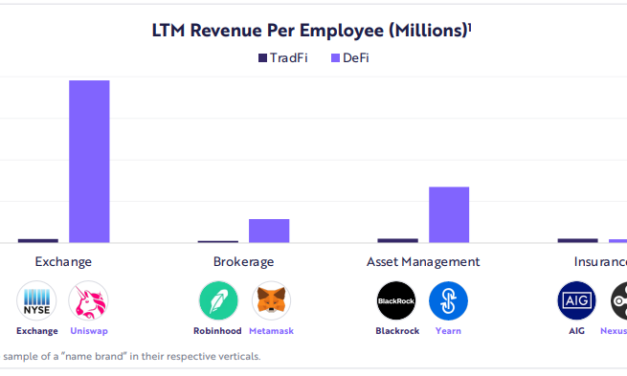
A new report from Cathy Woods’ ARK Invest forecasts Ethereum (ETH) will meet or even exceed a $20 trillion market cap within the next 10 years, which would equate to a price around $170,000 to $180,000 per ETH.The report also predicted big things for Bitcoin (BTC), saying it is “likely to scale as nation-states adopt (it) as legal tender… the price of one bitcoin could exceed $1 million by 2030.”ARK Invest is a tech focused American asset management firm based in the United States with $12.43 billion AUM.#BigIdeas2022 Report is here! To enlighten investors on the impact of breakthrough technologies we began publishing Big Ideas in 2017. This annual research report seeks to highlight our most provocative research conclusions for the year. Download! https://t.co/QvUbuqVpIL— ARK Invest (@ARKInvest) January 26, 2022The prediction in ARK Invest’s report Big Ideas 2022 is predicated on how quickly the Ethereum network has grown in utility and efficiency. Much of the growth over the past two years has come from decentralized finance (DeFi). ARK described the appeal of DeFi, stating:“Decentralized Finance promises more interoperability, transparency, and financial services while minimizing intermediary fees and counterparty risk.”According to ARK, smart contracts and decentralized apps (DApps) on Ethereum is “usurping traditional financial functions at the margin.” The report highlighted that banking and lending, exchanges, brokerages, asset management, insurance, and derivatives can all be found on Ethereum-based smart contracts.What’s more, DeFi is a lot more efficient too. ARK estimated that DeFi outperformed traditional finance over the last twelve months in terms of revenue per employee $88 million to $8 million.In terms of Bitcoin, the report forecasts $1.36 million per BTC with a market cap of $28.5 trillion by 2030. ARK researchers assigned an estimated future value to eight of Bitcoin’s use cases, and used the sum of all of them to reach their conclusion about BTC price. By 2030, the firm expects Bitcoin to account for 50% of global remittances at 1.5x velocity, 10% of emerging markets’ currency, 25% of US bank settlement volumes, 1% of nation-state treasuries worldwide, 5% of global high net worth individual (HNWI) wealth, 2.55% of institutional asset base, 5% of the cash from S&P 500 companies, and 50% of gold’s total market cap.ARK also argued that Bitcoin mining “could revolutionize energy production.” While global concerns have been raised about the tremendous amount of energy that Bitcoin mining requires, the researchers believe that “Bitcoin mining will encourage and generate more electricity from renewable carbon-free sources.”“The addition of Bitcoin mining into power developers’ toolboxes should increase the overall addressable market for renewable and intermittent power sources.”Related: Ban less likely? Putin says crypto mining has advantages in RussiaBoth ETH and BTC have had a rough past seven days by falling 22.2% and 13% respectively according to CoinGecko.

Čítaj viac

Crypto money laundering up by one third in 2021 but still below record

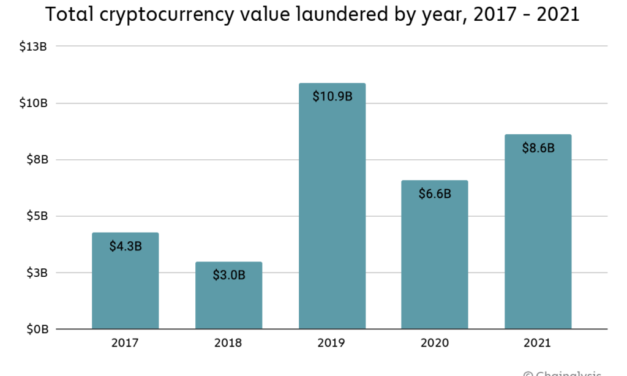
A new Chainalysis report has revealed that $8.6 billion in value was laundered through cryptocurrency in 2021. It marks a 25% increase from 2020, but still remains well below the high watermark hit in 2019. That year $10.9 billion in value was laundered via cryptocurrency. Since 2017, Chainalysis estimates that a total of $33.4 billion in crypto has been laundered.Chainalysis points out the $33.4 billion in crypto laundered since 2017 pales in comparison to the estimated $2 trillion in fiat is laundered yearly from offline crimes such as drug trafficking. However, a reliable assessment of the amount of fiat laundered is more difficult to determine than crypto due to the use of untraceable cash in offline crimes. The report states:“The biggest difference between fiat and cryptocurrency-based money laundering is that, due to the inherent transparency of blockchains, we can more easily trace how criminals move cryptocurrency between wallets and services in their efforts to convert their funds into cash.”According to the cybersecurity analytics provider the value of the laundered crypto was derived from “crypto-native crimes” in which “profits are virtually always derived in cryptocurrency rather than fiat currency.”For the first time since 2018, centralized exchanges (CEX) accounted for less than half (47%) of the value laundered, signalling a potential change in cyber criminals’ behavior. DeFi protocols saw their utility for illicit addresses increase nearly 2,000% from a 2% share in 2020 to 17% in 2021.Hackers, such as the infamous North Koreans who stole about $400 million, strongly preferred DeFi while scammers tended to prefer CEX, which Chainalysis attributes to a “relative lack of sophistication.”Chainalysis said, “Mining pools, high-risk exchanges, and mixers also saw substantial increases in value received from illicit addresses as well.”Of the funds laundered in 2021, a greater proportion arrived at the top-five laundering services in 2021 (58%) than in 2020 (54%). The overall concentration of money laundering, however, decreased in 2021 as 583 addresses received deposits of at least $1 million in value while in 2020, 270 such addresses were used.Related: Crypto crime’s overall impact set to fall even further in 2022: ChainalysisBy asset, altcoins saw the largest amount of concentration as 68% of those laundered went to the 20 largest deposit addresses used for illicit activity. Ethereum (ETH) was next with 63%, stablecoins at 57%, and Bitcoin (BTC) was by far the least concentrated with only 19% going to the top addresses.

Čítaj viac

Získaj BONUS 8 € v Bitcoinoch

nakup bitcoin z karty

Registrácia Binance

Burza Binance

Aktuálne kurzy