
Autor Cointelegraph By Brian Newar

Allbridge to become the first token bridge for the Stacks token

Multi-chain token bridge Allbridge will become the first to offer Stacks (STX) transfers as part of a partnership with Bitcoin software developer Daemon Technologies.STX is the native token for the Stacks Layer-1 blockchain which settles transactions on the Bitcoin (BTC) network. It currently has a market cap of $1.7 billion. Allbridge currently serves 12 blockchains including Ethereum, various Ethereum-compatible sidechains, Solana, Terra, and others.A token bridge allows crypto from one blockchain to be transferred to another one. The new bridge will allow transfers between Stacks and all chains served by Allbridge.The Stacks Bridge will go live in Q2 2022. It will initially only support transfers of STX, but is planned to support transfers of other Stacks protocol SIP010 tokens such as ALEX and the USDA stablecoin. There are also plans to enable NFT transfers between chains. In a Feb. 10 announcement, Allbridge co-founder Andriy Velykyv expressed how the partnership will help serve the crypto community’s need for access to the Bitcoin ecosystem. “Creating a bridge that allows for people to interact with Bitcoin-powered applications will help streamline processes that were previously only limited to a single chain and ecosystem.”Daemon Technologies is providing a $140,000 grant to Allbridge to help facilitate growth of the bridge. Daemon Technologies founder Xan Ditkoff told Cointelegraph that partnering with Allbridge to create the Stacks Bridge will “allow users to come and use the assets within the network for whatever the use case is.”Ditkoff illustrated what he sees as the beneficial interplay between Stacks’ utilization of the Bitcoin network’s security for transaction settlement and separate blockchains for higher throughput. He said: “It’s good for people who want to transact on faster networks, then bring their assets onto Bitcoin for security.”The security of token bridges has been in the spotlight this month. In the past 2 weeks, there have been three hacks of token bridge smart contracts. On Feb. 3, $321 million in wETH was minted through the exploit of a bug on Wormhole’s smart contracts on Solana, which created an inorganic surplus of tokens on the blockchain. Related: Major crypto firms and groups form coalition aimed at promoting ‘market integrity’Ditkoff brushed off security concerns related to the Allbridge token bridge. He said, “We have a lot of confidence in the Allbridge team.” “It’s easy for people to forget that these bridges are so new. How long have people been coding with Solana’s VM? Everything is still at the bleeding edge.”Ethereum creator Vitalik Buterin made an eerily well-timed warning to the crypto community by writing in an early January Reddit post that there are “fundamental security limits of bridges.”Ditkoff refuted Vitalik’s statement in saying, “I have a hard time seeing a future when bridges are not a huge part of the ecosystem,” and continued:“The logic behind Vitalik’s words would be that everything settles on one chain that is optimized for the one thing that (Proof-of-Work) is made for: byzantine fault tolerance. Bitcoin doing that better than anything in human history will have an impact on whether one chain eventually dominates.”

Čítaj viac

'Powder keg’: FSInsight report says a single spark could see BTC 5X

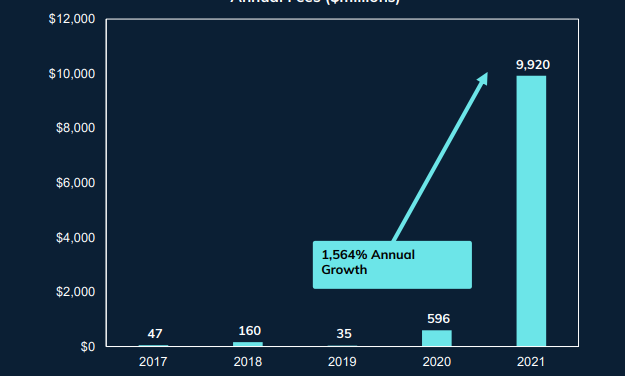
Financial research firm FSInsight predicts in a new report that Bitcoin could reach $222,000, and Ether could reach $12,000, by the end of 2022.At current prices of BTC ($43,350) and ETH ($3,080), that would mean a nearly five-time and four-time increase in price for each coin respectively.The Digital Assets In A Post-Cycle World report explained several factors that are likely to combine to drive prices to those heights by the end of the year. Compared to other cycles, it would appear that BTC has not achieved what the report calls “overly frothy valuations.” This could be attributed to better efficiency in the market, or a transition from a payment solution to a store-of-value.The lack of bubble-like prices is shown by the fact that since the May 2020 Bitcoin halving, BTC market cap peaked at an increase of just 3.7x. This is the lowest increase since the 2016 halving, when the market cap peaked at an increase of 4.2x. The halving is when the mining reward issued per block is reduced by half, reducing the new supply coming onto the market. The 2020 halving saw block rewards go down to 6.25 BTC per block.Supply-side dynamics are also seen as a bullish signal by FSInsight. Illiquid supply of BTC — Bitcoin which has found a long term home in storage — comprises about 75% of the circulating supply. The report states:“The current supply dynamics can best be described as a powder keg. The question remains who lights the match.”This observation tallies neatly with the Feb 7 video from the InvestAnswers Youtube channel. Host James Mullarney said that due to the current lack of sellers, a “buy between 100,000 and 200,000 Bitcoin within the space of one or two weeks” could send the price up 3X.The FSInsight report also noted that market value to realized value (MVRV) of BTC is at the lowest level since April 2020, when price was still below $10,000. From that point, BTC price climbed steadily up over the next year to a high of about $57,000 in May 2021.Ultimately, the report forecasts BTC price to reach a range of $138,000 to $222,000 by the end of 2022.The case for ETHThe bullish forecast for ETH began by showing how Ethereum generated nearly $10 billion in fees in 2021. According to the report, that is a 1,564% annual growth rate from 2020.ETH saw a 1,564% annual growth rate in 2021 from 2020, according to FSInsight.The ETH supply-side dynamics also spell bullish signals for the analysts, which noted that the burn mechanism from th implementation of EIP 1559 creates “disinflationary pressure,” but added:“While we do not necessarily believe this to make ETH ‘sound’ money, it is certainly beneficial for price.”Related: Ethereum price holds above $3K but network data suggests bulls may get trappedFSInsight analysts conclude that ETH is “remarkably undervalued.” Analysts factored in The Merge, when Ethereum is scheduled to transition to Proof-of-Stake consensus, Layer 2 platform development, and the potential launch of Exchange Traded Funds (ETFs), to forecast a price of $12,000 by the end of 2022.

Čítaj viac

Softbank backed startup to offer retail crypto trading

Stock brokerage firm DriveWealth has entered the cryptocurrency industry by launching two subsidiaries designed to allow its partners to offer crypto trading to retail investors. DriveWealth is a New Jersey-based company backed by Japanese tech giant Softbank and is valued at $2.85 billion. The push into the crypto space was motivated by traders who are forced to trade across what DriveWealth CEO Bob Cortright told CNBC is an “unsustainable” transaction spread on Coinbase. He continued:“As regulatory environments tighten around crypto and customers get more focused on spreads and efficiency, we can’t continue in a world where you can charge 200 basis points on a transaction.”Coinbase is the largest US-based crypto exchange and charges fees as high as 4.5% of the transaction value plus a spread fee on its platform. The exchange earned 88% of its $1.2 billion in total revenue from those transaction fees in Q3, according to its financial report at the time.The new crypto offerings are made possible by DriveWealth’s recent acquisition of Crypto-Systems, a separate crypto startup. Through that acquisition, DriveWealth launched its DriveLiquidity subsidiary which will provide liquidity for partners wishing to invest in and trade crypto assets. DriveWealth has also launched DriveDigital as a subsidiary crypto exchange. It plans on providing API (application programming interface) access to its partners to allow retail investors to make trades on Bitcoin (BTC) and Ethereum (ETH).Related: Major crypto firms and groups form coalition aimed at promoting ‘market integrity’Cortright said that an increasing number of companies across various fields are requesting access to crypto liquidity to let their users trade or earn crypto rewards. He continued:“Even the established, large e-commerce players are finding that, when surveying their clients, a huge percentage want to own some crypto.”If it intends on competing with Coinbase, DriveWealth has a veritable uphill battle to climb. The exchange had over 68 million users as of Q3 2021. Coinbase (COIN) also touts a $39 billion market cap with an enterprise valuation of about $36.5 billion. 

Čítaj viac

Kazakhstan proposes power price hikes and taxes targeting crypto miners

The Kazakh government is considering a three-pronged proposal designed to make crypto miners pay much more for operating in the country, which could make Kazakhstan less attractive to the industry.On Feb. 4, Kazakhstan’s First Vice Minister of Finance, Marat Sultangaziyev, proposed a price increase from $0.0023 per Kwh to $0.01 (around a 335% increase) specifically for crypto miners. He also proposed a tax on each individual graphics card (GPU) and each piece of equipment needed for crypto mining. He likened the tax-per-video card to the way casinos are taxed for each table they run, whether or not the table is active.The third part of his proposal was to remove mining hardware from an exemption on value-added tax (VAT).Mining Bitcoin requires the use of specific hardware to complete the mathematical calculations needed to create new blocks on the blockchain. Larger mining operations house upwards of 10,000 mining rigs including ASICs (application-specific integrated circuits), GPUs, racks, cooling units, and associated facilities. Up until political unrest caused the government to restrict internet access last month, Kazakhstan has become one of the most popular destinations for crypto miners following the China ban on mining last summer. Around Jan. 5, the Bitcoin network’s hash rate plummeted by 13.4% in a day from about 205 exahashes per second (EH/s) to 177 EH/s due to the brief shut down in Kazakhstan.BIT Mining, a large Bitcoin mining operation that moved from China to Kazakhstan last July, stated in January that the political unrest would not force it to move its operations elsewhere. However, that was before the power and tax increases were proposed. Cheap electricity costs and proximity to China have attracted miners fleeing from Chinese authorities amid crackdowns in the country. This led Kazakhstan to become the second-largest producer of hash power for Bitcoin behind the United States, producing about 18% of the network’s hashrate as of August 2021 according to Cambridge University. It may become less desirable for new and existing miners to call it their base of operations if the crippling taxation proposals come into force. It should also be noted that Kazakhstan has struggled with power supply issues since late last year, around the same time when crypto miners rushed in from China. The country saw an 8% increase in domestic electricity consumption through 2021, leading the government to consider building a nuclear power plant to ease the stress on the power grid and keep energy costs low.Related: All eyes on Asia: Crypto’s new chapter post-ChinaInexpensive electricity seems to be the single most important factor attracting miners. Cointelegraph reported on Jan. 27 that the U.S. cannot provide the cheapest electricity and therefore “cannot hold on to the mining champion title for long.” Removing that advantage from miners in Kazakhstan could spell doom for the country’s ambitions to extract $1.5 billion from miners within the next 5 years.

Čítaj viac

Latest DeFi bridge exploit results in $4.4M losses for Meter

The Meter Passport token bridge platform has incurred $4.4 million in losses due to a smart contract hack which also caused Hundred Finance to lose $3.3 million through under-collateralized loans.Meter.io’s Meter Passport (MTRG) is a token bridge that is compatible with Ethereum and its sidechains. This attack affected the Moonriver side of the bridge.Moonriver is a smart contract platform based on Polkadot’s Kusama network. Hundred Finance is a crypto lending platform based on the code for Compound Finance.Starting at 2pm UTC on Feb. 5 and over the course of several transactions, about $4.4 million in Binance Coin (BNB) and wETH were minted through a “wrong trust assumption” in the code, according to a Feb. 6 statement from the Meter team. In this case, an arbitrary amount of ETH was deposited to Meter which the hacker used to mint tokens using the vulnerability.1. Around 6am Pacific time we identified someone was able to leverage a vulnerability of the bridge to mint a large amount of BNB and WETH tokens and depleted the bridge reserve for BNB on WETH.— ⚡️Meter.io⚡️ (@Meter_IO) February 5, 2022The attack caused a cascade effect across the Kusama-based Moonriver ecosystem. After draining Meter of its BNB and wETH reserves, the attacker sold the BNB on SushiSwap, a popular decentralized exchange. This led to a 77% crash in the price of BNB on Moonriver at the time.A number of opportunists then took advantage of the price dip by buying cheap BNB. They used the tokens as collateral on Hundred Finance in order to take out FRAX and MIM stablecoin loans. Due to the discrepancy in BNB price, however, their loans were worth more than the collateral they had provided, causing a supply crisis.2/4. Accounts were able to purchase BNB.bsc at a reduced price and use these tokens as collateral at the global Chainlink price to borrow uncompromised assets on our platform. Of these, MIM and FRAX are currently impacted.— Hundred Finance (@HundredFinance) February 6, 2022

Amazingly, two of the loans were repaid, leaving an outstanding $3.3 million in losses to the Hundred protocol. The Hundred team has attempted to reach out to the parties involved to ask that they return the BNB tokens used as collateral to Meter.The Meter team has committed to reimbursing its community and Hundred Finance for losses incurred due to the hack. The team stated on Feb. 6 that it had set aside $4.4 million in MTRG tokens to cover initial losses. “Vfat”, the pseudonymous founder of Hundred Finance, said in a statement to Rekt News on Feb. 6 that:“Meter have of course accepted responsibility for this hack and are intending to use their native token for reimbursement to the extent that they can, currently we are in the gathering addresses and amounts stage.”Related: Qubit Finance suffers $80 million loss following hackThe blockchain security firm PeckShield estimated that in total, 1,391 ETH and 2.74 wBTC were taken by the attacker and have since been sent to Ethereum where the tokens have gone through Tornado Cash, an ETH transactions privacy tool.The Hundred Finance team has not yet responded to a request for comment.The initial details of the exploit of Meter’s code resemble the Wormhole hack on Feb. 3 in which 120,000 wETH ($321 million) were maliciously minted and extracted from Wormhole’s platform. In that incident, the hacker exploited a smart contract bug to mint wETH at will and sent the tokens to Ethereum, where they were washed via Tornado Cash.

Čítaj viac

Získaj BONUS 8 € v Bitcoinoch

nakup bitcoin z karty

Registrácia Binance

Burza Binance

Aktuálne kurzy