Autor Cointelegraph By Brian Newar

Low Millennial financial well-being drives crypto adoption: report

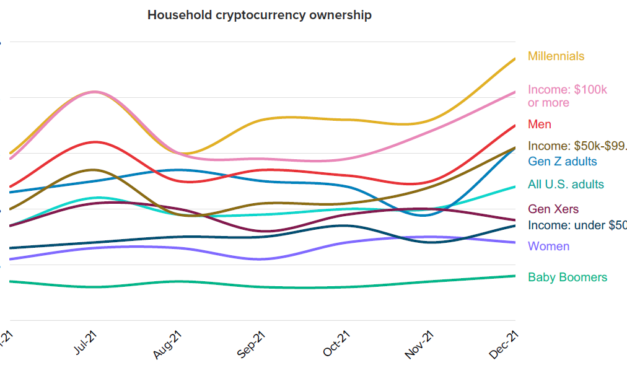
Data shows that Millennials in the United States are flocking to alternative financing methods such as crypto assets to boost their financial well-being.A report titled The State of Consumer Banking & Payments by Morning Consult in January found that Millennials are adopting new technologies to help them make financial decisions at a higher rate than any other generation. The author of the report, financial services analyst Charlotte Principato, combined data from 50,000 different respondents to monthly surveys conducted in the U.S. and internationally from July to December 2021.Principato stated in email comments to Cointelegraph today that the increase in the use of cryptocurrency in 2021 was an outlier among the statistics that jumped out to her while putting together the report. She said, “Although a volatile asset, cryptocurrency has successfully held the interest of consumers around the world and continued to grow.”By last December, about 48% of Millennial households owned cryptocurrency, up from only about 30% in June. During the same time period, 20% of all U.S. adults reported owning cryptocurrency. Source: Morning ConsultMillennials’ use of alternative financial services such as cryptocurrencies may be due to the fact that they suffered from financial well-being scores which remained “persistently lower than the national average” since June 2021, according to the report. The global average by last December was 50.98, but the Millennial group lingered at 49.54. Principato told Cointelegraph that reduced financial well-being was a trend she noticed over the last seven months. She attributes the decline to “the Delta and Omicron variants, and rising inflation in the U.S., which has not fully recovered.”Morning Consult’s website states that The financial well-being score is determined by a scale that “includes 10 questions for gauging present and future security and freedom of choice, touching on consumers’ control over their finances, their capacity to absorb financial shocks and their trajectory to meet their financial goals.”Source: Morning ConsultWhile Millennials in general are the leaders, crypto owners are “disproportionately high-earning Millennial men.” 70% of Millennial men use crypto, 25% of them earning over $100,000 annually. Interestingly, Hispanic people have a higher rate of crypto use than their representation in the general adult population. About 16% of all U.S. adults are Hispanic, but they account for 24% of all crypto owners.Source: Morning ConsultAs cryptocurrency became more mainstream throughout 2021, respondents from every generation polled from Baby Boomers, Gen Xers, Millennials, and Gen Z adults were increasingly likely to consider making purchases from U.S. exchange Coinbase. Related: 70% of US crypto holders started investing in 2021: ReportThe results from the report led Principato to conclude that “Cryptocurrency will boom in 2022.” The report stated that the adoption of crypto and onboarding younger generations will be two main factors leading to the boom.

Čítaj viac
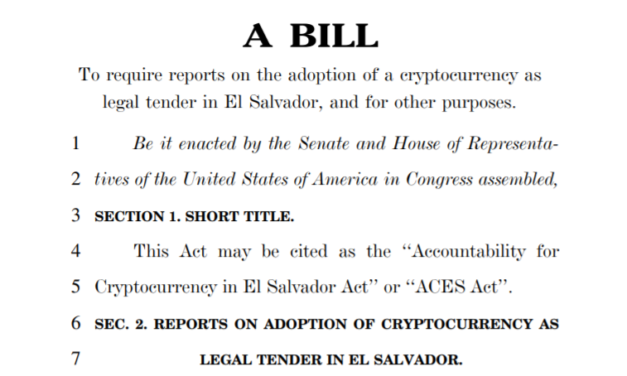

New bill aims to 'mitigate risks' to US from El Salvador's Bitcoin Law

A bipartisan group of senators introduced legislation in the U.S. Senate which seeks to mitigate perceived risks posed by El Salvador’s adoption of Bitcoin as a legal currency.The proposed Accountability for Cryptocurrency in El Salvador Act (ACES) aims to “mitigate potential risks to the U.S. financial system” such as money laundering and terrorism funding.The bill was introduced by Republican Senators Jim Risch and Bill Cassidy with Democratic Senator Bob Menendez signing on. Senator Risch wrote in the Feb. 16 announcement that:“El Salvador’s adoption of Bitcoin as legal tender raises significant concerns about the economic stability and financial integrity of a vulnerable U.S. trading partner in Central America.”Senator Cassidy wrote that “recognizing Bitcoin as official currency opens the door for money laundering cartels and undermines U.S. interests.”If the bill passes, it would give Federal agencies 60 days to submit a report that assesses several aspects of the Central American nation’s abilities regarding cybersecurity and financial stability.The first part of the report would assess how El Salvador developed and enacted the Bitcoin Law, how El Salvador will “mitigate the financial integrity and cyber security risks” from virtual assets, whether it meets Financial Action Task Force (FATF) requirements, the impact on individuals and businesses, and the effect crypto will have on its economy.The next part of the report would describe El Salvador’s internet infrastructure and assess “the degree to which cryptocurrency is used” there, custody of funds and the potential for hacks, and the rate of financial access underprivileged or unbanked El Salvadorans enjoy.Following the issuance of these reports, the bill would stipulate action plans from various agencies based on the findings.El Salvador’s President Nayib Bukele reacted against the perceived interference in his country, tweeting “You have 0 jurisdiction on a sovereign and independent nation. We are not your colony, your back yard, or your front yard.”OK boomers…You have 0 jurisdiction on a sovereign and independent nation.We are not your colony, your back yard or your front yard.Stay out of our internal affairs.Don’t try to control something you can’t control https://t.co/pkejw6dtYn— Nayib Bukele (@nayibbukele) February 16, 2022El Salvador’s government passed the Bitcoin Law in June 2021. This made Bitcoin (BTC) a legal currency in the country, forcing businesses to accept it as a means of payment. Related: What’s shaping the future of the institutional crypto market?The law has seen some opposition from domestic lawmakers and the IMF, which urged President Bukele to repeal the Bitcoin Law numerous times, most recently on Jan. 25. It has, of course, been praised by proponents of the world’s largest crypto by market cap.

Čítaj viac

Syndicate protocol helps create 450 new DAOs in just three weeks

Blockchain-based investing protocol Syndicate claims that 10% of all decentralized autonomous organizations (DAO) in existence have been created on its platform in less than three weeks of operation.Syndicate is a DAO creation platform that has landed investments from A13Z and Coinbase Ventures, among others. The team revealed the development in a Feb. 15 tweet.As of this morning, 10% of *all* DAOs have now been created on @SyndicateDAO.In less than 3 weeks And this is just the beginning.— Syndicate ✺ (@SyndicateDAO) February 14, 2022Will Papper, co-founder of Syndicate explained to Cointelegraph today that the project had created 450 investment clubs as DAOs, which is just a little bit over 10% of the “best estimates” of 4227 DAOs in existence, based on DeepDAO’s metrics and figures reported in Forbes. DeepDAO is an analysis tool that tracks decentralized organizations. The rapid influx of new organizations at Syndicate indicates that the DAO governance structure has gained popularity since their broad introduction to the crypto mainstream just a couple of years ago. Currently, the two top DAOs are BitDAO (BIT) and Uniswap (UNI). Uniswap DAO was formed in 2020 and BitDAO in 2021. They now command a collective $4.4 billion in treasury funds.The Republic of the Marshall Islands this week became the first sovereign nation to officially recognize DAOs as legal entities.Syndicate’s stated goal is to democratize investing by allowing groups to establish decentralized investment structures. It automates the process on-chain, allowing anyone to set up an investing DAO in under a minute for just the cost of gas. DAOs can also plug in compliance tooling, to help keep everything in accordance with regulations. Papper said that the team believes DAOs are “one of the most powerful structures for coordination that we’ve seen,” and that their utilization in governing businesses and clubs will become more common over time. However, Papper said that there are trade-offs when an organization decides to utilize a decentralized method of coordinating efforts. “Anyone who runs a DAO knows that they are much less efficient than traditional companies or other organizations. This trade-off in efficiency is worth it, however, for the increase in resiliency.”Although there are inherent benefits to coordinating under a DAO, Papper added there are still kinks to be worked out in their mechanics:“For DAOs to emerge in other areas, they’ll need to become more efficient at day-to-day decision making. There are compelling innovations in governance around subDAO and council models, but they’ll still need more time to fully emerge.”Related: MakerDAO launches biggest ever bug bounty with $10M rewardThe Syndicate team did not provide a list of the organizations that had been created through the platform, stating, “We don’t maintain information about our users as everything runs on decentralized smart contracts and to protect their privacy.” However Papper said the information could be verified on-chain.

Čítaj viac

Bitcoin miners selling stock and BTC as returns halve since November

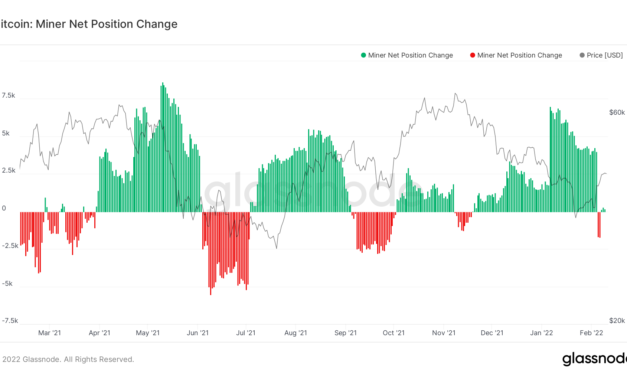
Bitcoin miners are selling off coins from their stockpiles and shares in their companies after the profitability of mining took a dive since November.With Bitcoin (BTC) currently holding around $43,500, about 33% below the all-time high (ATH) of about $69,000 reached that month, miners are selling at a less-than-opportune time. However, electricity and equipment bills must be paid.Data from on-chain analytics firm Glassnode showing that Bitcoin miners have become net sellers, after being net hodlers for months.Since Nov. 9, the return from mining one BTC has decreased by an average of 50.5% for the two most popular mining devices, the S9 and the S19, according to data by blockchain research firm Arcane Research. This means the return on investment has decreased at a greater rate than the price of BTC.A big increase in hashrate has contributed to the lower profitability of mining. Competition among miners increases proportionally with hashrate because it means more devices have been turned on to compete to find the next block.Cointelegraph reported on Feb. 13 that Bitcoin had reached a new ATH in hashrate. That milestone was achieved by jumping from 188.4 exahashes per second (EH/s) to 284.11 EH/s in a single day. The hashrate is currently at about 232.19 EH/s as of the time of writing according to Ycharts.Some large mining operations have opted to increase their cash piles or pay their bills by selling stocks rather than crypto. On Feb. 11, a spokesperson for the Marathon Digital Holdings Inc. (MARA) mining operation told Bloomberg, “We started hodling in October 2020, and since then, we have not sold a single satoshi.”Instead, Marathon filed with the Securities and Exchange Commission (SEC) to sell $750 million in stocks and securities. Seeking Alpha reports that Marathon intends on using a “substantial portion” to purchase hardware and general purposes.MARA is currently down 0.56% and priced at $28.24 in after hours trading.Related: Russian ministry wants to legalize Bitcoin mining in specific areasAn analyst for wealth management firm D.A. Davidson told Bloomberg on Feb. 14 that miners have ideological and business reasons for being reluctant to sell Bitcoin:“Big miners would rather sell equity, because their shareholders want them to hold their Bitcoin and not even think about selling it.”

Čítaj viac

18.36M Ethereum addresses joined the network in 2021

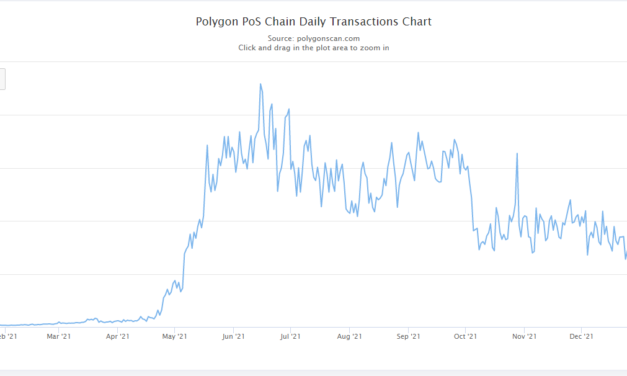
New data reveals that the Ethereum network gained 18.36 million addresses with a balance greater than zero in 2021. That works out to an astonishing growth rate of 1.53 million new addresses per month, but competition is becoming increasingly fierce for market share.Blockchain intelligence firm IntoTheBlock shared its findings about Ethereum in a Feb. 15 tweet.#Ethereum users growth in a nutshellA good way to track the adoption is by following the number of addresses with a balance- There are 70.4m addresses holding $ETH- Just in 2021, it increased 18.36m. That means the network was growing at a pace of 1.53m addresses per month pic.twitter.com/xnhDw3wHVm— IntoTheBlock (@intotheblock) February 15, 2022Despite Ether (ETH) reaching two new all-time highs in price in 2021, the growth rate of new addresses was not particularly correlated with price spikes. The network has gained about 10 million addresses since October.While overall numbers are up, there, there has been a decrease in the proportion of active addresses on the network. Overall, active addresses were 1.05% of all addresses on Jan. 1 2021, peaked at 1.66% on April 25 but havesince fallen to 0.86% as of Feb. 15. The number of whales holding more than 1,000 ETH has also been declining since the start of 2021. On-chain analytics firm Glassnode reported on Feb. 13 that whale wallets had reached a 4-year low of 6,226. The average daily amount of transactions has stagnated around 1.2 million since the middle of  December, according to Ethereum statistics aggregator Ycharts. High gas fees and alternatives in the form of cheaper and often faster sidechains and Layer-2 solutions on Ethereum may be factors. This was noted as a reason in Cointelegraph Magazine with Sameep Singhania for why he chose to build Quickswap on Polygon.Following the tremendous spike in usage last May, the Polygon (MATIC) sidechain has averaged more than double the daily transaction volume of Ethereum. Polygon currently enjoys about 3 million transactions per day.Related: Polygon and Cere network to launch Web3 media platform, DaVinciEthereum is still the leading smart contract platform by total value locked (TVL) in the ecosystem. On-chain statistics platform Defi Llama indicates that Ethereum currently has $124.24 billion in TVL, which vastly outstrips runner up Terra (LUNA) with $15.04 billion.

Čítaj viac

Získaj BONUS 8 € v Bitcoinoch

nakup bitcoin z karty

Registrácia Binance

Burza Binance

Aktuálne kurzy