Autor Cointelegraph By Brian Newar

Appellate court decision allows Bitconnect class action to proceed

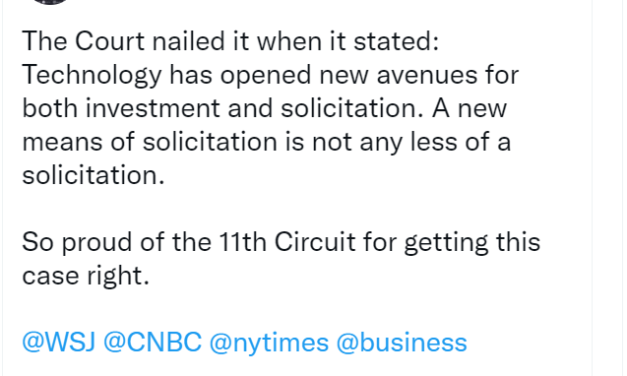
The 11th Circuit Court of Appeals has ruled that victims of the Bitconnect Ponzi scheme can proceed with a class action suit by reversing a previous ruling that prohibited such a case.Bitconnect is the endlessly memed ICO from 2017 that collapsed in January, 2018. Appellate courts are superior courts that are used to review previously tried cases so the ruling may be reversed or confirmed.The alleged victims may now move forward with a class action case against BitConnect (BCC) and its promoters Glenn Arcaro, Ryan Maasen, Trevon James, Ryan HiIdreth, and Craig Grant. There is no word yet on whether the complainants will proceed with the case.The original complainants filed suit in order to be compensated for damages from being defrauded by BitConnect and its promoters. The complaint says promoters “made a mockery of state and federal securities laws.”Law360 wrote on Feb. 22 that the defendants claimed in the Southern District of Florida that since marketing for the project was done using online mass communications platforms, they could not be held liable for securities fraud. The defendants successfully argued that there could “only be liability when a seller directs solicitations to particular prospective buyers.” By using online social media platforms, the promoters argued that they had not directly solicited the cryptocurrency to buyers. Without that direct solicitation, they argued there was no securities fraud.However, the Circuit Court decided to reverse the lower court’s decision to accept that argument since there is no precedent of the Securities Act of 1933 preventing online videos from being used in fraud charges.Judge Britt C. Grant wrote for the court’s panel on Feb. 18:”Because the Securities Act provides no free pass for online solicitations, we reverse the district court’s dismissal of the section 12 claim.”The Circuit Court’s panel called the lower court’s reading of the Securities Act “cramped” and said that it “makes little sense” as it would have held a person liable for soliciting a security in a personal letter, but not an internet video.David Silver, an attorney in the original case against BitConnect and its promoters tweeted on Feb. 19 “This is an incredibly important decision that will reverberate for years to come.” This new precedent adds greater legal risks and responsibilities for crypto promoters who use YouTube, Twitter, and other online communications platforms to shill crypto. Judge Grant wrote, “A new means of solicitation is not any less of a solicitation.” In recent years, YouTube has removed videos and shut down channels related to cryptocurrency it deems “harmful and dangerous.” 11th Circuit Court of Appeals reverses trial court decision in Bitconnect case and holds that peddling shitcoins in a non-targeted way on the interwebs (YouTube, Twitter etc) exposes promoters to liability from purchasers of unregistered securities. pic.twitter.com/Oh7BA4GGo2— Palley (@stephendpalley) February 18, 2022Related: SEC v. Ripple: Here’s how two 2012 memos can turn the tide in the milestone crypto caseThe Securities and Exchange Commission (SEC) filed suit against the founders and promoters last May, and received $12.6 million in cash and BTC through a settlement deal in August. Last November, the Department of Justice (DOJ) said it planned to sell crypto it had seized from BitConnect valued at $56 million as potential compensatory payment for victims in future cases.

Čítaj viac

Bill to regulate crypto in Brazil for first time heads to Senate vote

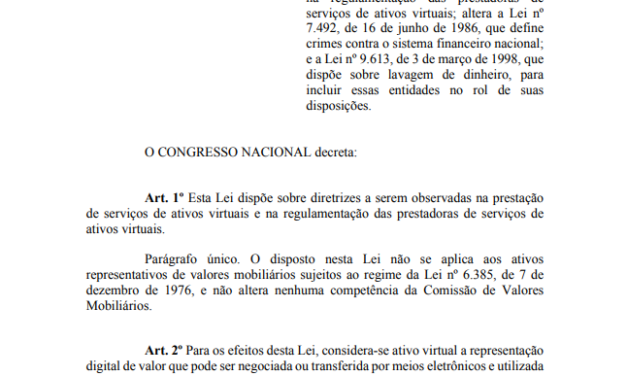
The Brazilian Senate is set to vote on a bill which would make the country the biggest in Latin America to regulate cryptocurrency. The crypto bill was unanimously approved by the Senate’s Economic Affairs Committee on Feb. 22, potentially increasing the chances that it will pass a vote on the Senate floor. Once passed by both the Senate and the lower house, it will be sent to President Jair Bolsonaro to be signed into law.The legislation states that it provides “guidelines for the provision of virtual asset services.” Brazilian Senator Irajá Abreu said on Feb. 22 that he hopes the bill will curb various financial crimes that have been committed with crypto.“The intention of the project is to curb or restrict illegal practices, such as money laundering, tax evasion and many other crimes. There is a market that is licit, legal, which is the vast majority of this market, but there are exceptions.”Senator Abreu, who originally proposed the bill in 2019, also told Bloomberg on Feb. 22 that “Once this regulation is approved, the trend is that (crypto) will be increasingly adopted in the supermarket, in commerce, in a car dealership.”In the works for almost three years now, the bill defines various aspects of what constitutes a virtual asset (VA), a broker or exchange, and which arms of the Federal government would have jurisdiction over the matter.The Brazilian crypto bill is set to be voted on by the Senate.The bill defines a virtual asset as a “digital representation of value that can be traded or transferred by electronic means and used to make payments or for investment purposes.”According to the bill, a crypto broker or exchange is a legal entity that allows “participation in financial services and provisions,” and performs exchanges between VA and fiat currency, VA and other VA, transfer of VA, and custody of VA.If the bill passes, it will make Brazil the largest country in Latin America to regulate cryptocurrency. Probably the most well-known LATAM nation to have such regulations is El Salvador, whose President Nayib Bukele has been vocal about his ambitions to make the country independent of U.S. dollar reliance through the use of Bitcoin (BTC).Related: Top Latin American exchange Bitso officially expands to ColombiaThere can be unexpected benefits from embracing crypto. In El Salvador, the tourism industry has seen a 30% increase since last September, when BTC was made legal tender.

Čítaj viac

Crypto trading firm Amber valued at $3B after big Singaporean investment

Crypto finance service provider Amber has landed a valuation of $3 billion following a funding round led by Singaporean state-owned investment firm Temasek Holdings. Amber Group was able to raise $200 million in its Series B+ funding round as revealed in a Feb. 21 announcement. Other participants included Sequoia China, Pantera Capital, Tiger Global Management, Tru Arrow Partners, and Coinbase Ventures.We are excited to announce our Series B+, which comes at a time of rapidly increasing crypto adoption globally. The investment reinforces Amber Group’s strategic alignment with its investors, as well as a shared vision of digital assets’ future in a new, digital economy. #wagmi pic.twitter.com/6EOHd1H8Gx— Amber Group (@ambergroup_io) February 22, 2022Amber has now increased its valuation by three times since last June when its Series B round of funding saw it valued at $1 billion. The company, which was founded in Hong Kong by former Morgan Stanley traders, currently has $5 billion in assets under management.The company stated that it plans on using the new investment to make “key hires to support our institutional business in Europe and the Americas,” and expand the global reach of its consumer-side WhaleFin mobile-based crypto investing platform. In the same announcement, Steven Ji, Partner at Sequoia China said,”Digital assets are becoming an increasingly important category to watch, especially for institutional investors.”Amber Group helps institutional and commercial investors invest in cryptocurrency. To date, it has over $1 trillion in cumulative trading volume.Amber Group’s growth is evidenced both by the increasing amount of funding it has received and the total number of its holdings. On Feb. 1, Japan-based crypto trading platform DeCurret sold its crypto operations to Amber Group after signaling plans to do so on Jan. 12.Singapore has been one of the friendliest markets to crypto investors in the region. According to a recent KPMG report, the city-state saw $1.48 billion in crypto-related investments in 2021. That is up 10 times from 2020. However, of the 180 companies that have applied for permits to operate a crypto business there, only five have been approved since January, according to Bloomberg.Related: Why Singapore is one of the most crypto-friendly countriesPerhaps in some small part due to the heightened crypto investing activity, regulators have begun cracking down on the marketing tactics some crypto companies employ. New guidelines to advertisers issued on Jan. 17 prohibit ads from being placed in public areas such as public transportation, websites, and print media.

Čítaj viac

Cardano daily transaction volume surges but ADA prices slump

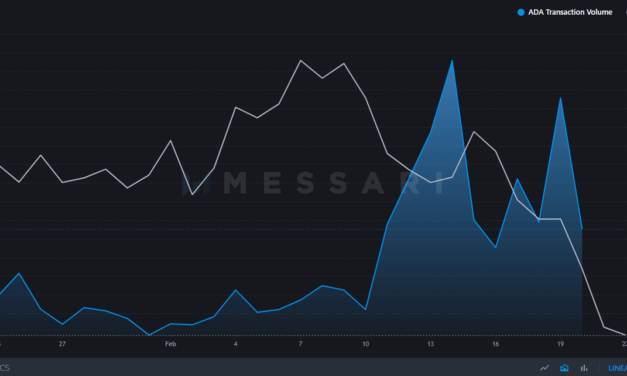
The Cardano blockchain has experienced an explosion in on-chain activity and now trails only Bitcoin in current 24-hour transaction volume, surpassing Ethereum in the process according to Messari.Cardano (ADA) currently has $17.04 billion in 24-hour transaction volume, according to data from on-chain analytics firm Messari. With Bitcoin (BTC) at $18.85 billion and Ethereum (ETH) at $5.25 billion according to Messari, Cardano is in second place in that category and is closing in on the top position for this metric.#Cardano just surpassed $LTC and $ETH in transaction volume.Are you bullish on $ADA?— The Moon (@TheMoonCarl) February 21, 2022Overall, this month has seen tremendous activity on Cardano. On Feb. 14, 24-hour transaction volume topped $35 billion and on Feb. 19 it reached $31 billion. However, it is still far from the $138 billion all-time high in the volume set on Sept. 3 last year.ADA daily tx volume from Jan. 24 to Feb. 22 – Messari.Transaction volume on Cardano has spiked in recent weeks in large part due to the launch of the SundaeSwap decentralized exchange (DEX). The hype around this launch caused days of congestion on the blockchain from the huge influx of transactions. Regardless of the SundaeSwap effect on the network, the total number of transactions on Cardano has increased 480% from 5.5 million on March 30 last year to nearly 32 million on February 20, according to Google’s Cardano Blockchain Insights.Conditions were ripe for Cardano’s move up the ranks as both Bitcoin and Ethereum have seen declining network activity lately. Bitcoin 24-hour volume is down 84% from the 3-month peak of $116 billion on November 25. Ethereum volume has been declining since December 4 when volume reached a 3-month peak of $21.29 billion. It was down 82% to a 3-month low of $3.99 billion on Feb. 19.ETH daily tx volume from Nov. 25 to Feb. 22 – MessariDespite trailing in transaction volumes, Messari shows Ethereum still dominates Cardano in several other key network usage metrics. Ethereum boasts 76 million addresses to Cardano’s 3.4 million addresses for example.Related: Blockchain-based internet company 3air abandons Cardano for SKALE networkCardano was listed by Morgan Stanley’s wealth management global investment office as one of the four ‘Ethereum killer’ blockchains that could usurp smart contract superiority from Ethereum due to their lower costs and faster speeds. The others in the report included Solana, Polkadot, and Tezos.The positive on-chain metrics have not helped ADA prices which have slumped 13% over the past 24 hours according to CoinGecko. ADA is currently trading at $0.833, down 73% from its $3.09 all-time high on Sep. 2, 2021.

Čítaj viac

Manchester City to build Etihad Stadium in the Metaverse

Premier League champions Manchester City and their new partner Sony have begun building a virtual replica of the Etihad Stadium which will be the team’s central hub in the Metaverse.Etihad Stadium is the home of Manchester City, England’s top soccer team at the moment. The team announced on Feb. 18 that it had signed a three-year agreement with Sony, which will provide virtual reality experts to use image analysis and skeletal-tracking technology from subsidiary Hawk-Eye.Manchester City is developing the metaverse’s first football stadium#Crypto #Metaverse #Blockchain #Football #ManchesterCity #CryptoNews #CloutNews https://t.co/nhpUmYixkO— Clout News (@CloutNewsMedia) February 21, 2022Manchester City hopes fans will enjoy all the benefits of having a virtual stadium. Although Covid restrictions are still hampering travel options for some, the ability to watch games in an immersive Metaverse setting could be a relief to fans itching to get a taste of a game setting again. The team is tearing down geographic barriers for fans who want to be part of a live or recorded match by beginning construction of the virtual Etihad Stadium. City Football Group’s chief marketing officer Nuria Tarre told Inews on Feb. 18 that:“The whole point we could imagine of having a Metaverse is you can recreate a game, you could watch the game live, you’re part of the action in a different way through different angles and you can fill the stadium as much as you want because it’s unlimited, it’s completely virtual.”Sony’s Hawk-Eye subsidiary has long been dedicated to enhancing sports for viewers and officials. It helps officials make in-game judgments in real-time with specialized replay technology. Its visualization applications will be used to recreate the dimensions of Etihad Stadium in the Metaverse.Related: Former Manchester United players to launch soccer-centric DAOCointelegraph wrote on Jan. 23 that “increased interactivity and ownership of virtual items” were particular assets to having a base in the Metaverse. Man City may be jumping on both of those opportunities to give fans around the world more accessibility to the team and stadium.Man City’s foray into Web3 and the Metaverse could be of interest to Liverpool FC. The Reds may follow suit in order to boost revenue, according to ECHO, a Liverpool news outlet.Rivals Manchester United have also pushed into the Web3 ecosystem with a new partnership with Tezos (XTZ), announced on Feb. 10. Tezos will be the team’s official crypto and training kit partner, and may also help develop digital merchandise.

Čítaj viac

Získaj BONUS 8 € v Bitcoinoch

nakup bitcoin z karty

Registrácia Binance

Burza Binance

Aktuálne kurzy