Autor Cointelegraph By Brian Newar

Austin mayor embraces Web3 tech and crypto payments

Mayor Steve Adler of Austin, Texas, has fully embraced the discovery of what blockchain technology and crypto payments can bring to his city by proposing two new initiatives.The first initiative aims to ensure that Texas’s fourth-largest city promotes the benefits of blockchain technologies and “promotes equity, diversity, accessibility, and inclusion” in the technological ecosystem. To that end, May Adler directed the City Manager to explore how the city can utilize Web3 and blockchain in 20 fields from smart contracts, supply chain management, and insurance to arts, media, fundraising, and identity verification.“The City Manager is directed to ensure the City is helping to create an environment within city government and in the community generally that supports the creation and development of new technologies, including without limitation blockchain and other Web3 related technologies, protocols, and applications.”Mayor Adler’s second initiative orders the City Manager to conduct a “fact-finding study” on how the city could adopt Bitcoin (BTC) and cryptocurrency-related policies. Through these efforts, Mayor Adler appears to want to find ways for Austin residents to legally pay their bills with crypto. Austin is excited to support the businesses and innovations that will turn the promises of Web3, cryptocurrency, and blockchain technology into reality. Thanks to @MK6ATX for her resolution and @RaffiSapire, @consensus2022, @JoshuaBaer, and @PrestonLJ2 for their leadership! #SXSW pic.twitter.com/HdmuGA0l2Y— Mayor Adler | Get vaccinated! (@MayorAdler) March 11, 2022Under this initiative, the City Manager should find ways to allow “the acceptance of Bitcoin or other cryptocurrencies as payment for municipal taxes, fees, and penalties” as the first set of policies to look into.The success of the two initiatives will be based on the level of effect new applications have on the everyday lives of Austin residents. The proposals will be voted on by the city’s council on March 24.Austin’s City Council has been considering blockchain technological integrations since at least 2020 when a proposal was made to use smart contracts for the MyPass identity verification protocol.Austin is in league with Miami, New York City, and the state of Colorado in rapidly expanding exploration efforts and proposed implementation of policies related to cryptocurrency. Miami and New York have already launched their own city-wide coin projects through City Coin on the Stacks layer-1 blockchain, while Austin’s own program is still in development. Related: The city of Lugano will accept Bitcoin, Tether and LVGA tokens as ‘de facto’ legal tenderPhiladelphia has expressed interest in joining the City Coins program, while Colorado’s Governor Jared Polis said in a Feb. 15 interview that the state will accept crypto for “state tax-related purposes.” He later expects to accept crypto for a wider array of state government services.

Čítaj viac

Polygon network suffers from extended service outage after upgrade

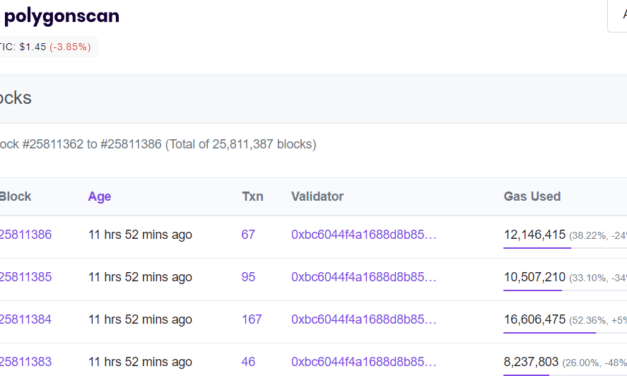
Layer-2 Ethereum scaling solution Polygon has not produced a new block for over 11 hours, with developers attributing the issue to a technical upgrade on the network.On March 10 at 4:20 pm UTC, Polygon (MATIC) network developers notified users on the project’s forum that there would likely be downtime starting at about 5:50 pm UTC due to maintenance required on one of the network’s three layers. A recent upgrade is thought to have caused an error in the network’s ability to achieve consensus.“We suspect there may have been a bug in the upgrade which affected consensus and caused different Heimdall validators to be on different versions of the chain, thereby not reaching 2/3 consensus.”As expected, the outage began at about 5:54 pm UTC. The Polygon team issued an update at about 1:30 am UTC explaining that it was still working to fix the error and that a hotfix was deployed to help continue making blocks. That hotfix does not appear to have taken effect as of the time of writing.The team also assured users that all funds and data on-chain are safe.A network outage on Polygon has lasted for 11 hours.Polygon users apparently understood the outage was expected, but by the sixth hour, rumblings began to appear among the community. Most users have pointed out concerns at the extended amount of time for the outage. So uhhhhh…..Polygons been down for 6 hours and counting….— King (@0xgodking) March 11, 2022Others have noted that their profession or crypto business has been negatively affected by the outage. Twitter user @Miklos211 said:“I’m literally unable to work thanks to that, could you please send us a time where we can expect the network to be back on?”The Polygon network consists of three layers that each serves a unique role. Smart contracts run on the Ethereum (ETH) layer and the Bor layer helps produce blocks. The third Heimdall layer is where the problem lies. Heimdall is a set of proof-of-stake (PoS) nodes that help the network reach consensus. With the Heimdall issue, Polygon cannot reach network consensus.The last major bug that Polygon fixed put $24 billion worth of funds at risk, but was patched up without issue at the end of 2021.Related: Polygon’s focus on building L2 infrastructure outweighs MATIC’s 50% drop from ATHIn related news, Polygon recently partnered with the multichain music nonfungible tokens (NFT) marketplace TokenTraxx to support the marketplace in the Polygon ecosystem. TokenTraxx will allow musicians to tokenize their work and sell it as NFTs.

Čítaj viac

LA Token launches LACHAIN to bridge Ethereum-based networks

Crypto platform LA Token has become the latest exchange to launch its own blockchain with the LACHAIN network which it hopes will give its users access to decentralized finance (DeFi) products and a bridge between other networks.The layer-1 Ethereum Virtual Machine (EVM)-compatible and WebAssembly (WASM)-compatible LACHAIN went live on Mar. 10 to help LA Token capitalize on expected future growth in demand for token bridges between networks. LA Token was launched in 2017 in the Cayman Islands. It has had $281.6 million in trading volume over the last 24 hours according to CoinGecko.EVM compatibility allows tokens on the proof-of-stake LACHAIN to transfer seamlessly between other Ethereum-based networks such as Polygon (MATIC) and others including BNB Chain (formerly Binance Smart Chain). WASM is a competitor to EVM for smart contract platforms.The new network’s main workload is expected to be in handling DeFi services as it is touted as “The DeFi Hub” on its website. As of now, the only dApp that appears to be on the network is LA Token’s own LADEX decentralized exchange.LACHAIN has about $23 million in total value locked (TVL) as of the time of writing from 6 tokens including LA and wrapped versions of LA, Tether (USDT), MATIC, BNB, and Ether (ETH). There are currently jus678 total wallet addresses and four validators on the network. Each validator appears to be LA Token’s own wallets, however, this could not be confirmed as the exchange has not responded to a request for comment. As of the time of writing, there have been 194,615 transactions performed on-chain.Related: Ethereum’s TVL dominance drops to 55% as Bloomberg analyst paints $1.7K bearish targetLACHAIN is entering a highly competitive ecosystem of similar networks. Other centralized exchanges with their own blockchain networks include Crypto.com’s Cronos, and KuCoin with KCC. Currently, BNB Chain (formerly BSC) is the largest centralized exchange blockchain with a market cap of $8.3 billion in BNB tokens. Like with those exchanges, LA Token’s exchange token LA will be used to pay fees and gas on LACHAIN.LA is down 1.4% over the last 24 hours and is trading at about $0.10 according to CoinGecko. It has fallen 94.2% from its $1.82 all-time high set in January 2018.

Čítaj viac

Princeton launches blockchain research initiative with $20M from crypto-alumni

Prestigious Princeton University has launched an initiative to study the “decentralization of societal power” through blockchain technology in an effort to explore the vast depths of it’s social capabilities.For the launch, Bloomberg reported that Princeton’s Venture Forward campaign received $20 million in donations from high-profile alumni Peter Bridger from Fortress Investment, Ethereum co-founder Joseph Lubin, Pantera Capital CEO Daniel Morehead, and Galaxy Digital’s Mike Novogratz.The initiative is designed to study the ways in which modern technology, especially blockchain, can interfere with and change social norms, just as other technologies such as the printing press and the internet have in the past. A March 11 video from the university states that “we are at a very early stage in understanding the opportunities and challenges” associated with cryptocurrency and blockchain.“The initiative will convene scholars across disciplines to understand the potential benefits and pitfalls of blockchain and other technologies, and their potential to disrupt centers of societal power.”Princeton’s Venture Forward campaign is an engagement and fundraising campaign to build community and alumni engagement, seek critical philanthropic support for the University, and share Princeton’s defining principles and their impact on the world.The university believes that focusing on decentralization will promote growth in three areas of study. An official post from the university states that it will help it understand “the underlying engineering behind blockchain and related technologies,” discover new uses for blockchain in finance, voting, news, and elsewhere, and determine “the implications that such technologies could have for society.”#PrincetonU is launching an initiative on blockchain and its potential to disrupt and redistribute power in society, supported by Peter Briger, Jr. ’86, @ethereumJoseph ’87, @dan_pantera ’87 and @novogratz ’87 in a combined major gift to #VentureForward: https://t.co/MZyEfSApL2 pic.twitter.com/w85CHzMPh4— Princeton University (@Princeton) March 10, 2022Princeton’s School of Engineering and Applied Science will take on the work of the new initiative led by Professor Jaswinder Pal Singh, who has sat on the Blockstack PBC Board of Directors since 2019. Singh has embraced a “highly collaborative research” approach to determine how blockchain can “result in the most benefit and the least harm,” according to a statement from the university. Singh commented that computer scientists have faced a long uphill battle in figuring out how to achieve consensus “among a distributed set of entities who don’t trust one another.” He added that while Bitcoin (BTC) has largely solved that problem, decentralization may well be a new turning point for society.“The decentralization of trust may be just as powerful and transformative as the worldwide web. It may transform existing systems and lead to new applications that we cannot even imagine today.”Related: Cambridge University launches crypto research project with IMF and BISThis is the second time in as many weeks Princeton has revealed its ongoing involvement in the blockchain industry. On March 2, a partnership with Metaverse and NFT project Radio Caca (RACA) and Princeton’s Blockchain Society was reported by Cointelegraph.

Čítaj viac

Goldman Sachs is hooking up clients with Galaxy Digital’s ETH fund

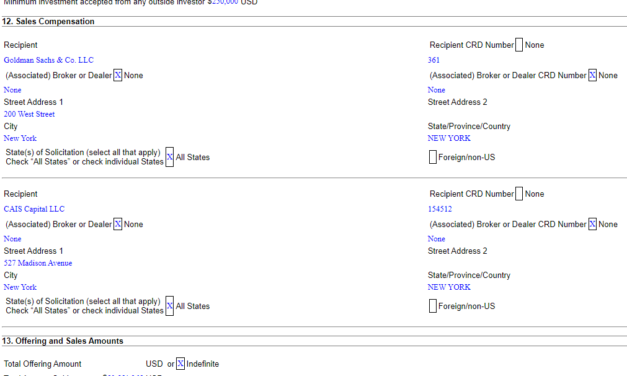
Financial services giant Goldman Sachs has been offering clients exposure to ETH through Galaxy Digital’s Ethereum Fund according to a new Securities and Exchange Commission filing.Goldman Sachs clients keen on spot exposure to Ethereum (ETH) have been offered space in Galaxy’s ETH Fund. This strategy became apparent in a Mar. 8 filing from Galaxy which listed Goldman as a recipient of introduction fees for referring clients to the fund.Galaxy Digital is billionaire Mike Novogratz’s crypto-focused financial service provider. It controlled $2.8 billion assets under management (AUM) as of the end of Q4 2021.It is unclear exactly how much Goldman clients have bought, but the minimum investment per investor is $250,000. The filing also states that Galaxy’s ETH Fund has had sales of just over $50.5 million since inception.Goldman Sachs has begun referring clients to Galaxy Digital’s ETH Fund.Independent wealth management firm CAIS Capital was also listed on the filing as a recipient of placement fees for referring its clients to Galaxy’s ETH Fund. The amount of Goldman’s introduction fee and CAIS’s placement fee has not been disclosed.This is not the first time Goldman has partnered with Galaxy Digital. Last June, Goldman began offering Bitcoin (BTC) futures trading via CME Group Bitcoin futures with Galaxy Digital providing liquidity. Goldman’s employees are also increasingly keen on the crypto space. On Feb. 25 Goldman executive Roger Bartlett announced that he was leaving the traditional financial firm to settle at Coinbase crypto exchange. He will lead global financial operations to, as he said in a LinkedIn post, “embrace opportunities offered by digital assets and its ecosystem.”Senior Chairman at Goldman Sachs Lloyd Blankfein also shares a curiosity about the crypto space. He tweeted on Mar. 7 his wonder at how cryptocurrency was not “having a moment” now in light of extremely high inflation rates and individual bank accounts being frozen around the world.Keeping an open mind about crypto, but given the inflating US dollar and the stark reminder that governments can and will under certain circumstances freeze accounts and block payments, wouldn’t you think crypto would be having a moment now? Not seeing it in the price, so far….— Lloyd Blankfein (@lloydblankfein) March 7, 2022

Čítaj viac

Získaj BONUS 8 € v Bitcoinoch

nakup bitcoin z karty

Registrácia Binance

Burza Binance

Aktuálne kurzy