
Autor Cointelegraph By Brian Newar

Coinbase Cloud launches Avalanche developer tools suite

Web3 developer hub Coinbase Cloud has added a suite of tools to support development on the Avalanche blockchain and smart contract platform.As part of the new support features, Coinbase Cloud is running an Avalanche (AVAX) public validator node. This allows Avalanche network participants to stake their AVAX tokens with Coinbase Cloud and delegate power for validating transactions on the blockchain. .@coinbasecloud is committed to supporting our #AVAX builders and participants. #Avalanche #AvalancheRushFind out more https://t.co/bthhKDrxDz pic.twitter.com/vggilAhFQk— Coinbase Cloud (@CoinbaseCloud) March 22, 2022Ethereum Virtual Machine (EVM) compatibility enables a network to benefit from the security of the Ethereum (ETH) network. Tokens on EVM compatible chains can also be bridged seamlessly between each other.There is also an AVAX integration with Coinbase Wallet, the crypto exchange’s proprietary Web3-enabled digital asset wallet. It will also provide developers with the documentation needed to deploy applications on the Avalanche network. Coinbase Wallet added support for Solana (SOL) last week.Coinbase Cloud will improve the Query and Transact feature for its users. This feature allows developers to more easily find, interact with, and study portions of the code that make up the Avalanche network. Coinbase Cloud believes that by providing such access, developers can “configure who can access the node infrastructure, and distribute their nodes across four geographic regions and two cloud providers” with limited downtime.Coinbase Cloud is a Web3 developer support platform from the Coinbase crypto exchange that launched last October. In addition to Coinbase Cloud’s latest contributions to the AVAX ecosystem, Avalanche has also begun rolling out its support for the Bitcoin (BTC) network through the Avalanche Bridge. Full support is expected to be completed in Q2 of this year. DeFi on Avalanche is about to get a whole lot more orange. pic.twitter.com/9KwTwmkySD— ./kevinsekniqi good vibes only (@kevinsekniqi) March 22, 2022

This will enable BTC holders to transfer their coins onto the Avalanche network and participate in decentralized finance (DeFi) activities there. Co-founder and COO of Avalanche Kevin Sekniqi summed up the BTC integration with Avalanche in a March 23 tweet stating “DeFi on Avalanche is about to get a whole lot more orange.”Related: Avalanche aims to accelerate subnet adoption with multiverse incentive programThis new integration comes as the Avalanche Summit is taking place in Barcelona, Spain where, in addition to the Coinbase Wallet and Bitcoin integrations, the Terra (LUNA) team also announced that its UST stablecoin is now tradable on Avalanche. All three developments this week stand to provide more value to the Avalanche ecosystem over time through investments and new applications.AVAX has dropped 3% over the past 24 hours and is currently down 42.3% from its Nov. 21, 2021, all-time high of $145 according to CoinGecko.

Čítaj viac
DeFiance Capital founder loses $1.6M in hot wallet hack

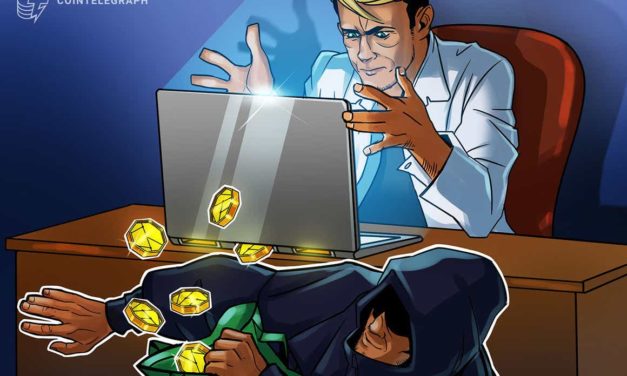
Founder of major crypto investment firm DeFiance Capital, “Arthur_0x”, has suffered a hack on one of his hot wallets resulting in the loss of more than $1.6 million in nonfungible tokens (NFTs) and crypto.In a tremendous show of support, the crypto community has come to his aid to help retrieve the stolen items as he asked people to blacklist the hacker’s wallet. Several individuals on Twitter have attempted to determine exactly how the hack occurred and where the hacker gained access to his wallets.NFT community member “Cirrus” went as far as buying two of the stolen Azuki NFTs and deciding to return them to Arthur at cost. Cirrus told Cointelegraph today that he:“found out they were hacked, and instead of selling them for profit like the other folks who got some of his, decided I’d sell them back to him at cost to help him out.”Cirrus added that this “isn’t the first time” this has happened to him. He said, “I could easily go sell them for 6-8 ETH profit, but it just isn’t right.” His profile states that he has been a victim of rug pulls three times before, which likely guided his sympathies for his fellow victim.Yo @Arthur_0x two of my bids got accepted on your hacked Azukis. Willing to get them back to you at cost. DM me pic.twitter.com/cBIX9QNLNu— Cirrus (@CirrusNFT) March 22, 2022A rug pull is when a crypto or NFT project suddenly closes down and the value of their token or NFT plummets without prior warning. In most cases, rug pulls are confirmations of a scam.In total, Arthur appears to have lost 78 different NFTs from five collections, mostly Azukis. He also lost 68 Wrapped Ether (WETH), 4,349 Staked DYDX (stkDYDX), and 1,578 LooksRare (LOOKS) tokens. The hacker began moving assets at about 12:30 am UTC, then promptly put all the NFTs up for bid on the OpenSea NFT marketplace. As of the time of writing, the hacker’s wallet held 545 ETH worth about $1.6 million. This hack highlights the importance of operational security when dealing with the self-custody of crypto assets because even people in the highest echelons of the industry can be attacked. In Arthur’s case, he is baffled by how this happened to him as he wrote in a tweet “Hot wallet on mobile phone is indeed not safe enough.”Was pretty careful and stuck with only using hardware wallet on PC until I start trading NFT more regularly. Hot wallet on mobile phone is indeed not safe enough— Arthur ⛩️ (@Arthur_0x) March 22, 2022

Had Arthur used a hardware wallet, otherwise known as a cold wallet, he may not have been protected from this attack. Unlike a hot wallet, a hardware wallet is not always connected to the network. It also keeps one’s private key and seed phrase safe from intrusion. However, Arthur believes the security breach happened due to a transaction he made on-chain which would also have compromised a hardware wallet.Related: NeoNexus founder pulls the plug on popular Metaverse NFT projectNFT and crypto scams are always a danger, so investors should take the highest security precautions with their assets. There are even serial scammers who design projects to take advantage of the NFT community and pull the rug then move on to the next scam. As Cirrus pointed out:“This is a gold rush for hackers and they’re doing everything they can to come up with new ways to take advantage.”In light of the frustration and irritation at the hack, Arthur had stern words for the party who stole his assets, stating in a tweet, “The only thing I can say to the hacker is: you mess with the wrong person.”

Čítaj viac

Crypto market selling pressure remains Asia dominated: Glassnode

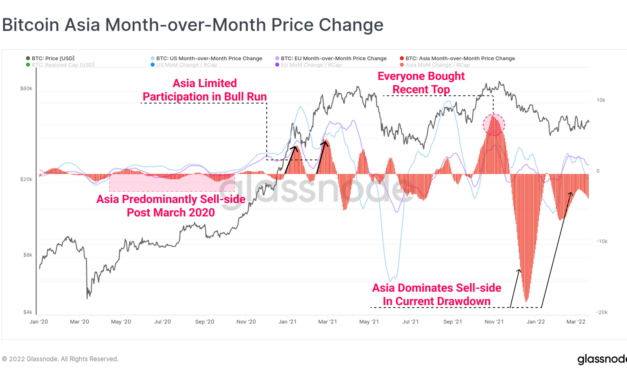
The Bitcoin network’s on-chain activity still appears to be in a bear market as U.S. and E.U. buyers are struggling to stay ahead of sellers based in Asia.Blockchain analytics firm Glassnode’s latest report on the weekly activity of the Bitcoin (BTC) network shows that the price of the largest crypto by market cap has stayed firmly within the same tight $5,000 range from $37,680 to $42,312. However, on March 22 the asset saw a sudden spike in price which elevated prices to a two-week high.Overall, the network is in a demonstrable lull according to Glassnode’s weekly review:“Bitcoin network utilization and on-chain activity remains firmly within bear market territory, albeit is recovering.”The research concluded that there is a distinct difference in the behavior of the average BTC investor based on their geography. Notably, U.S. and E.U.-based investors have tended to be buyers, whereas Asian investors have tended to be sellers. This tendency has remained consistent since March 2020 with the exception of last November when both sides were buying heavily.Specifically, Glassnode researcher and report writer “Checkmate” pointed out that U.S. and E.U. investors have offered general bid support for the past two years with heavy buying between late 2020 and early 2021, while “both regions capitulated throughout May-July.” E.U. buyers are currently providing the largest amount of support.Over the course of this #Bitcoin drawdown, buying pressure has been mainly during US and EU trading hours.Meanwhile, the majority of sell-side pressure has occurred during Asian market hours, suggesting a divergence in regional strategy.Read morehttps://t.co/cyTLZGHR1u pic.twitter.com/mJGGloo1t4— glassnode (@glassnode) March 21, 2022Conversely, Glassnode reported that Asian markets have generally offered lower buying support through Q1-Q3 of 2021 and currently produce heavy selling pressure. However on March 22, co-founder of crypto investment firm Three Arrows Capital Su Zhu tweeted “Asia unironically max bidding BTC,” suggesting that the day’s short-term upswing in price was led by Asia-based traders.Several on-chain metrics suggest that a bear market is well underway. The number of new entities — or new wallets that are not associated with existing wallets — has been in a gradual upswing since mid-2021. This is a bear market pattern that played out similarly from January 2018 through the first half of 2020. There are currently about 110,000 new entities created on the Bitcoin network per day.In a bear market, new entity growth increases in a slow and steady way. In bullish periods, new entity growth experiences large spikes like in January 2018 and January 2021.Transaction volumes of transfers valued at more than $1 million have continued to follow the steep downward trend since the peak last November. Glassnode cautioned that “a severe decline may signal a reduction in network utilization,” further indicating that we have entered a bear market.Related: Bitcoin ‘could easily see $30K’ with stocks due to 30% drawdown in 2022 — AnalystAs reported last week, long-term holders (LTH) have increased selling pressure, but the overall LTH supply has remained stagnant because an equal proportion of short-term holder (STH) supply has converted, and that trend remains in effect. The LTH supply consists of coins that have not moved for at least 155 days.

Čítaj viac

Bitcoin mining could be good for US energy independence: Research

Republican Congressman Pete Sessions from Texas has come out with a bold statement about the impact Bitcoin mining will have not just on his state but on the United States as a whole.The Texan representative, a proponent of Bitcoin (BTC) mining, tweeted on March 22 that “Bitcoin Mining will play a critical role in rebuilding energy independence in the USA.” His statement drew a mixed bag of reactions from both supporters and critics. Wyoming’s Republican Senator Cynthia Lummis was among the supporters who responded to his tweet with a succinct “Indeed.”#Bitcoin Mining will play a critical role in rebuilding energy independence in the USA— Pete Sessions (@PeteSessions) March 21, 2022Both lawmakers have been vocal advocates for policies that support innovation in the crypto industry, not just for miners. As U.S. consumers suffer from a spike in gas prices due to global tensions, the debate has ramped up about how the country can reduce its dependence on external energy sources.Sessions’ view highlights a growing compilation of research that suggests the innovations from the BTC mining industry could have global applications in industrial energy consumption and production. As Texas has come to contribute over 14% of the country’s total Bitcoin hash rate, the stability of the state’s electrical grid and the environmental impact of miners have come to the forefront of growing criticism, as it has in other mining hubs around the world.Despite those concerns, various researchers have suggested that the growing mining market in Texas could reduce its net environmental impact and energy demands on the public energy grid.A March 2021 research paper detailed how flexible data centers could promote renewable energy resources. A flexible data center generates its own energy either from a small dedicated renewable power plant or draws power from the grid depending on the grid’s current state. According to the U.S. Energy Information Administration (EIA), Texas is already the country’s leading wind power generator. Therefore, miners may already have access to renewable energy when needed. Promoting miners to utilize a flexible data center model could stimulate greater growth in renewable energy accessibility and reliability. The paper stated:“Hence, the (integrated energy system) may contribute to grid stability by locally using generated electricity instead of feeding it into the grid.”Software solutions firm Lancium published similar research last October. It concluded that as the mining industry grows and more operations implement a flexible data center model, it will likely prevent energy grid shortages while promoting the growth of renewable energy resources. Researcher Joshua D. Rhodes, Ph.D. said in the paper.“As grids move towards incorporating higher levels of intermittent resources, such as wind and solar, flexible demand will play an ever more important role in keeping the electrical grid system stable.”Related: New York Bitcoin mining moratorium bill garners more supportTexas is a significant hub of Bitcoin mining in the United States as Hive Blockchain, Riot Blockchain, Argo Blockchain, and others have operations in the Lone Star State.

Čítaj viac

Li Finance protocol loses $600,000 in latest DeFi exploit

The Li Finance swap aggregator has experienced a smart contract exploit leading to the loss of around $600,000 from 29 users’ wallets.The exploit took place at 2:51 am UTC on March 20. The attacker was able to extract varying amounts of 10 different tokens from wallets that had given “infinite approval” to the Li Finance protocol. Among the stolen tokens were USD Coin (USDC), Polygon (MATIC), Rocket Pool (RPL), Gnosis (GNO), Tether (USDT), Metaverse Index (MVI), Audius (AUDIO), AAVE (AAVE), Jarvis Reward Token (JRT), and DAI (DAI).TLDR:• ~$600K have been stolen from 29 wallets• User don’t have to do anything• Bug has been fixed and is already deployedhttps://t.co/fqOxJxDrZs— LI.FI – Any-2-Any Swaps (,) (@lifiprotocol) March 21, 2022When the team learned about the exploit 12 hours later at 2:15 pm UTC, it shut down all swapping functions on the platform in order to prevent any further losses. By 2:50 am UTC on March 21, the team had issued a post mortem detailing the events of the exploit. The team said that the attacker swapped the stolen tokens for a total of about 205 Ether (ETH) valued at roughly $600,000. At the time of writing, the stolen ETH had yet to be moved from the attacker’s wallet. LiFi also assured users that the bug has been identified and patched.Today’s LiFi hack happed because its internal swap() function would call out to any address using whatever message the attacker passed in. This allowed the attacker to have the contract transferFrom() out the funds from anyone who had approved the contract. pic.twitter.com/NA3xW7ReUd— Daniel Von Fange (@danielvf) March 20, 2022

Of the 29 wallets that were hit in this attack, 25 have been reimbursed from treasury funds for their losses. Those 25 wallets only accounted for $80,000, or 13% of the total value lost. The owners of the remaining four wallets that lost a combined $517,000 have been contacted and offered a deal to compensate them by honoring their losses as angel investors in the protocol. They would receive LiFi tokens under the same terms as other angel investors in an amount equal to their losses from each wallet. This would also help to mitigate the damage to the platform’s treasury. The hacker was also contacted and offered a bug bounty to return the funds.The Li Finance team reached out to offer a bug bounty to a hacker.The attack appears to have come at an unfortunate time. Li Finance CEO Philipp Zentner told Cointelegraph on March 21 that “We’re literally a week away from our audit,” adding that “we have multiple companies auditing us.”However, even a thorough audit of the code may not have picked up this particular bug, according to a researcher “Transmissions11” at crypto investment firm Paradigm. He explained in a March 21 tweet that the error in Li Finance’s code is easy to miss and “subtle if you’re not in the right mindset.”Related: ‘Unlucky:’ Agave and Hundred Finance DeFi protocols exploited for $11MThis latest hack in the decentralized finance (DeFi) sector demonstrates how giving infinite approvals to smart contracts opens a user’s funds to a greater amount of risk. Infinite approvals allow users to swap coins at a decentralized exchange (DEX) an unlimited amount of times without needing to approve any more transactions.

Čítaj viac

Získaj BONUS 8 € v Bitcoinoch

nakup bitcoin z karty

Registrácia Binance

Burza Binance

Aktuálne kurzy