
Autor Cointelegraph By Brian Newar

'Institutional demand': Large transactions on Cardano up 50X in 2022

Crypto intelligence firm IntoTheBlock reports that the number of large transactions on the Cardano blockchain has increased by more than 50X this year. Large Transaction Volume (LTV) refers to aggregated volume from transactions denominated in Cardano’s native ADA token valued at more than $100,000. Since Jan. 1, LTV has increased from 1.35 billion ADA per day to 69 billion ADA (worth $81.4 billion) changing hands on Cardano on Mar. 28.That’s a 51-fold increase in about three months and marks one of the highest volume levels since mid-2018, according to IntoTheBlock. In a Mar. 29 tweet, the firm said that such high volume indicates “increasing institutional demand.”@Cardano is experiencing increasing institutional demandThe volume of on-chain transactions >$100k has increased by 50x just in 2022Yesterday, a total of 69.09b $ADA were moved in these large transactions, representing 99% of the total on-chain volumehttps://t.co/8ME8STvRSF pic.twitter.com/aqH7hYIPiV— IntoTheBlock (@intotheblock) March 29, 2022While other metrics such as average transaction size and volatility remain relatively stagnant according to the data analytics firm, total addresses have been increasing since the start of 2022. The year began with about 3.4 million addresses, which has now grown to 5 million. While only seven DApps appear on DeFi Llama currently, co-founder Charles Hoskinson said many more are expected following due to a hard fork expected mid year. Total value locked (TVL) is currently at $303 million according to DeFi app tracker DeFiLlama, just shy of the $326 million all-time high set on Mar. 24.Hoskinson gave a rousing keynote speech at Binance Blockchain Week in Dubai on Monday in which he spoke of the need for decentralization and the difficulties in coordination it entails. He said that “we are entering a new era,” with Web3 but the problem is that “unlike with Web2, there’s no leader” to make decisions for the industry.“If we’re truly decentralized, we have to somehow come together and figure this out. We have to write some sort of constitution for these things; we have to decide ‘What is the Bill of Rights for the use of cryptocurrency and blockchain technology?’”Related: ETF provider WisdomTree launches Solana, Cardano, Polkadot ETPs“There are two paths before us — one, we keep our integrity and we look to decentralization, find these things, understand these things,” he said. “Or, two, we ignore it. In which case we’ll have custodians, we’ll have escort keys, highly centralized, highly optimized consensus algorithms that can be reset at any time. The few will be in control of the many.“This is the decision, and I don’t make that decision — all of you do.”

Čítaj viac

Canadian PM candidate supports freedom to use Bitcoin as money

The Canadian Conservative Party candidate for Prime Minister, Pierre Poilievre, has come out in support of allowing Canadians to use Bitcoin (BTC) as legal money in the country.The YouTube channel BITCOIN posted a video on March 29 of Poilievre saying that the people of Canada need “more financial freedom” before a crowd of about 100 at a local restaurant. He added, “That includes freedom to own and use crypto, tokens, smart contracts, and decentralized finance.” “People should have the freedom to choose other money. If the government is going to abuse our cash, we should have the freedom to use other, higher quality cash.”Earlier this year, the Canadian government led by Liberal Party Prime Minister Justin Trudeau had taken a hard-line approach against crypto in response to the Freedom Convoy protests that took place in Ontario. In January and February, Canadian officials froze bank accounts of protestors and attempted to block all donations to the truckers, including those made in crypto.Conservative leadership candidate @PierrePoilievre buys chicken shawarma from @TheRealTahinis using bitcoin Lightning Network. Transaction cost was one satoshi, which the consumer covers. This was the first bitcoin purchase at Tahini’s. pic.twitter.com/T5hVlY4fy0— Andrew Lawton (@AndrewLawton) March 28, 2022The Executive Director of the Canadian Blockchain Consortium (CBC) Koleya Karringten told Cointelegraph today that right now “it’s a hostile environment from the Liberal government towards crypto,” which is “due to a lack of knowledge, understanding, and regulatory clarity.” “It’s important to have a strong advocacy position to educate the government on blockchain. Once they see the level of tax revenue, they will know this isn’t an industry for criminals, it’s an industry for innovation.”Karringten believes there are now more crypto holders following the complications caused by PM Trudeau invoking the Emergencies Act in February. The non-profit organization Catalyst said on Feb. 23 that those complications may have resembled a bank run.Despite his fervency, Poilievre’s support of cryptocurrency may still only resonate with a small group of Canadians. By last October, research firm Ipsos had determined that only about 14% of Canadian citizens over the age of 18 owned cryptocurrency. However, that number is up from just 3% in 2016, signaling a tremendous growth rate.Related: Coinbase to track off-platform crypto transfers in Canada, Singapore and JapanThe outlook for adoption looks bright, as Ipsos also found that about 25% of Canadian adults are considering buying crypto in the future. This sentiment is consistent with a study reported by Cointelegraph in January which concluded that out of 1,000 Canadian respondents, 62% would be interested in being paid in crypto by 2027.Kerrington shares the optimistic outlook for Canada’s adoption of crypto. She said that there has been a “huge increase” in the amount of interest expressed by residents of provincial Alberta, where the CBC operates. She added:“Banks can’t ignore it anymore. Politicians can’t ignore it anymore. They are all starting to ask ‘How can we adopt it?’”

Čítaj viac

Senate Finance Committee Chair probes “lack of safeguards” in crypto tax incentives

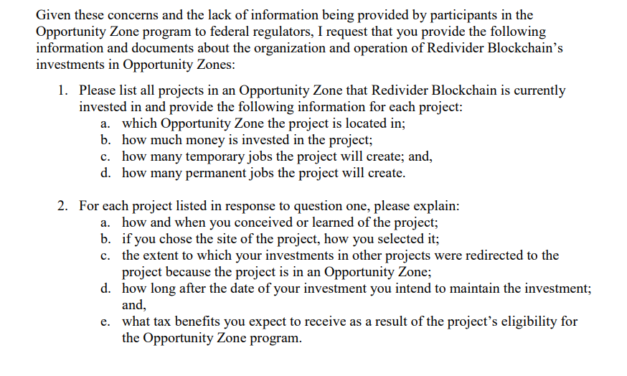
Democratic Senator Ron Wyden is digging into the activities of crypto companies that take advantage of tax breaks provided by the Opportunity Zone program.Senator Wyden’s main concern stems from the perception that some crypto companies may be taking advantage of what he called “a lack of safeguards and transparency measures” in the Opportunity Zone program.The concerns were raised in letters he sent to two companies and one individual. He wants to understand how they are providing the required reciprocal support for low-income communities as stipulated by the rules of the program.The Oregon Senator wrote letters to crypto miners Argo Blockchain and Redivider Blockchain and to Opportunity Zone specialist accountant from accounting firm HCVT Blake Christian. The Opportunity Zone program was implemented in 2017 and designed to offer tax incentives to companies that create jobs and drive private investment into economically distressed communities.In his letters to Argo and Redivider, Wyden requested information about the extent to which each company is engaged in the Opportunity Zone program and when they began their involvement with it. He also asks them to provide information about how many jobs their operations have created, which is one of the core Common Good contributions the program was made for.Democratic Senator Ron Wyden is digging into the activities of crypto companies that take advantage of tax breaks provided by the Opportunity Zone program.Senator Wyden asks Redivider Blockchain about their involvement in the Opportunity Zone program.Last July, Argo Blockchain CEO Peter Wall specifically stated that the location of his company’s Dickens County, Texas, mining facility was chosen specifically because of its inclusion in the Opportunity Zone and abundance of renewable energy. At the time, he told Cointelegraph that he believed the facility could “reinvigorate the community through the creation of jobs,” which is one of the main concerns of Senator Wyden.Wyden pulled into question Redivider’s true reason for operating within the Opportunity Zone based on a February 2022 interview with Huffpost in which CEO Tom Frazier said his company “100%” would have opened a mining facility with or without the tax break. Currently, only accredited investors can invest in Redivider’s $250 million Opportunity Zone fund.To Christian, Senator Wyden requested information about what crypto mining projects in the Opportunity Zone his clients are currently invested in and how many jobs those companies are creating. In this letter, Wyden brought up the same Huffpost interview in which Christian said that his client investors were just “looking for a way to save some money because they’re about to get drilled on short term capital gains taxes.” This insinuates that his clients may simply be looking for a way to offset short-term capital gains taxes by investing in mining operations that receive a tax break.There has not yet been a response from Argo, Redivider, or Blake Christian.Related: Crypto tax rules will reduce US budget deficit by $11B over ten years — White HouseWyden’s new push for clarity in the crypto industry could be signs of what Blockchain Association Executive Director Kristen Smith called a “bipartisan vibe shift on crypto” in the Senate in a March 26 tweet. Based on her analysis, there is now “progressive, libertarian, moderate, conservative, and liberal” support in both houses to take crypto seriously.1/ If you’ve been paying attention the past few weeks, there’s a lot of evidence of a bipartisan vibe shift on crypto. Contrary to the media narrative that pushes a polarized split on the issues, here’s what I’ve seen…— Kristin Smith (@KMSmithDC) March 25, 2022

Čítaj viac

Why NFT adoption is so high in South Korea

South Korea’s reputation as a trend-setter and leader in technological research is quickly spilling into the blockchain realm as nonfungible token (NFT) adoption has skyrocketed in the small East Asian country.As of 2020, South Korea has been among the top-10 countries in the world in the Global Innovation Index by the World Intellectual Property Organization. That level of innovation is made apparent to global retail consumers by tech giants such as Samsung and LG and to gamers through game maker Krafton. Those companies, and many like them, are now also delving into the NFT space by dropping new collections to customers and launching divisions of their company dedicated to developing NFTs.There may be several reasons for the eagerness to expose retail consumers and the general public at large to NFTs that goes beyond just being a thank-you prize for a purchase. This is the idea presented by Strategy Lead at the Korea-based KlayChicken NFT project, Alex Lim. He told Cointelegraph today “NFTs are all the rage but a lot of people don’t even know why.””The NFT hype in South Korea stems from a mixture of sentiments… I believe that in the second half of the year, the time will come when the whole South Korean NFT industry takes a quantum leap.”One reason that may contribute to this quantum leap is the lack of a tax on digital assets in South Korea. The crypto tax has been delayed until 2023, but president-elect Yoon Seok-yeol may push to delay that tax for yet another year to 2024. Additionally, NFTs are not regulated as stringently as cryptocurrency is now. Although local financial regulators at the Financial Services Commission (FSC) are working to introduce new NFT rules, none yet exist. This has kept the market open to be filled by a litany of new marketplaces at exchanges such as Upbit and Bithumb and from other corporations such as gaming giant Krafton to profit from NFTs.Co-founder and CEO at Korea-based blockchain ecosystem accelerator DeSpread GM Chung believes practical use-cases for NFTs will become more common in his country. He told Cointelegraph today that “I expect NFTs to expand into a social on-chain profile layer along with transaction history in the future.” “Previously, the phenomenon of purchasing NFTs for community participation was done, but recently, the expansion of NFT utilities is considered to be a major reason (for its rise in utilization).”While campaigning, president-elect Yoon issued an NFT collection which followers could mint in order to feel a sense of belonging to his cause.Yoon Seok-yeol’s NFT collection on the Aergo blockchain. Source: CCCVGoing beyond participation is South Korea’s Hoseo University which issued diplomas in NFT form to its 2,830 graduating students on March 18. Local news outlet Money Today reported in February that the university decided to issue NFTs in order to improve accessibility and convenience for students and to prevent the forgery of diplomas. Chung may even be understating the utility market participants see in NFTs. Last month, the Ministry of ICT, Science and Future Planning pledged to support the growth of a national Metaverse with a $187.7 million dollar grant. Content creators are expected to benefit the most from the new grant.Content creators appear to be reaping the rewards of increased demand for their services in developing NFT designs for a wide array of companies. A simple search for NFT on the leading job search website JobKorea produces 753 unique positions for content creators and business professionals.The digital assets those creators make have most commonly been in the form of in-game items or characters, and emojis for text messaging apps. This familiarity with digital assets is why the co-founder of crypto investment firm Stablenode Doo Wan Nam believes Koreans have adopted NFTs so readily. He told Cointelegraph today that “Koreans are more open and understanding when it comes to NFT which is another form of digital asset.”Lim said content creators and businesses are now including NFTs in their business plans because they now see the “potential and utility” of NFTs. He added that building a supportive community to enhance brand power “has always been the inevitable, yet difficult task for any content creator.””NFTs have opened a new horizon for those who seek to materialize an ideal community where there is commitment, passion, and autonomy.”

Čítaj viac

Korean crypto exchanges are now in compliance with the Travel Rule

South Korean crypto exchanges have reached the government-mandated deadline to come into compliance with the so-called Travel Rule, but not all industry players are pleased with the measure.Starting today, Korean exchanges will flag any crypto transfers worth more than roughly $821. Transfers higher than that value will be restricted to user-verified wallets and a select number of exchanges that have adopted their anti-money laundering system. The Travel Rule is a set of guidelines issued by the international financial watchdog Financial Action Task Force (FATF) designed to help authorities track the movement of virtual assets between virtual asset service providers (VASP) such as crypto exchanges or digital asset issuers.A source from a local centralized exchange today praised the regulatory measure as a step forward for the country’s crypto industry, telling Cointelegraph that: “The industry is now taking a step towards institutional acceptance and will work harder for mass adoption.”There may be a problem for South Korea’s traders, who racked up $45.8 billion in crypto market value in 2021, in figuring out which exchanges they can transfer funds to and from. Among the big four exchanges (Upbit, Bithumb, Coinone, and Korbit), there are two Travel Rule systems. Each system functions slightly differently and requires international exchanges to follow its guidelines. If those guidelines are not followed, transfers will not be allowed.According to the CEO of South Korea-based crypto VC Hashed, Simon Kim, these differences are likely to cause confusion and frustration among domestic traders. He feels that the Korean crypto community sees the mandate as “clearly over-regulation,” as he emphasized to Cointelegraph that: “In a state where the infrastructure was not prepared, a regulatory body with low understanding was forced to push forward. It is expected that revisions will follow to an appropriate level with criticism from the Korean community.”The Hashed crypto and Web3 portfolio includes blockchain ecosystems Klaytn and Ethereum, NFT game Axie Infinity, and decentralized exchange dYdX.Upbit is the largest exchange in the country with over 78.3% of the exchange market share according to local analyst Jun Hyuk Ahn. It has adopted its home-grown Verify VASP program. As of today, Upbit allows transfers to and from its affiliates in Singapore, Indonesia, and Thailand, Bblock, Gopax, Cashierest, Flat Thai Exchange, Aphrobit, Binance, Bybit, Okcoin, Crypto.com, Coinbase, BITFRONT, Bittrex, Bitbank.cc, Gate.io, Kraken, BitMEX, FTX US, and HARU Invest.Meanwhile Bithumb, Korbit, and Coinone all have adopted the CODE system. This allows transfers between Coinbase, Kraken, Coincheck, bitFlyer, Bybit, Gemini, Coinlist Pro, Phemex, Bitbank, Line bitmax, Bitfront, FTX, Binance. Domestic transfers are blocked until April 8.Related: Bank of England and regulators assess crypto regulation in raft of new reportsThe rules may hit decentralized finance (DeFi) traders hardest as they rely on personal wallets to make trades. Among all exchanges, no transfers to or from private wallets will be allowed unless the user verifies the address in-person.

Čítaj viac

Získaj BONUS 8 € v Bitcoinoch

nakup bitcoin z karty

Registrácia Binance

Burza Binance

Aktuálne kurzy