Autor Cointelegraph By Brian Newar

Slope wallets blamed for Solana-based wallet attack

As the dust settles from yesterday’s Solana ecosystem mayhem, data is surfacing that wallet provider Slope is largely responsible for the security exploit that stole crypto from thousands of Solana users.Slope is a Web3 wallet provider for the Solana layer-1 (L1) blockchain. Through the Solana Status Twitter account on Aug. 3, the Solana Foundation pointed the finger at Slope stating that “it appears affected addresses were at one point created, imported, or used in Slope mobile wallet applications.”After an investigation by developers, ecosystem teams, and security auditors, it appears affected addresses were at one point created, imported, or used in Slope mobile wallet applications. 1/2— Solana Status (@SolanaStatus) August 3, 2022Solana co-founder Anatoly Yakovenko also linked Slope wallets to the hack in his own personal Twitter account. He advised users to regenerate a seed phrase from a service other than Slope as soon as they can. He also told an affected user to “Start practicing the cold/hot wallet separation.”Attacker is lazy at driving all the paths. A bunch of phantom users only saw their slope addresses get drained. I would advise anyone that touched slope to regenerate their seed phrase in a different wallet asap.— SMS aey.sol, (@aeyakovenko) August 3, 2022

The Solana-based wallet exploits first surfaced on Aug. 2, after the community began reporting that their crypto wallets were being drained of their Solana (SOL) and other tokens. It is estimated that roughly $8 million in crypto was stolen from nearly 8,000 wallets.Through its investigation, the Solana Foundation determined that the private keys for each of the wallets compromised in the exploit were “inadvertently transmitted to an application monitoring service” such as Slope. It added that there was no evidence to suggest the Solana protocol or its cryptography was at risk from the attack.Some reports abound that Slope may have logged user seed phrases on its centralized servers. The servers could have been compromised and leaked seed phrases, which a hacker could use to execute transactions.Earlier reports of the attack on the day said that users of Slope and Phantom hot wallets were being targeted, leading many to believe there could be a broader issue with the Solana protocol, a however further analysis shared by Solana’s head of communications Austin Fedora found that the problem was isolated to just hot wallets.Fedora said that while 60% of the victims of the attack were Phantom users, those affected did not generate their seed phrase using Phantom.We spun up a Typeform to collect data and the results were clear – of those drained ~60% were Phantom users and 40% Slope users. But after extensive interviews and requests to the community, we couldn’t find a single Phantom-forever user who had their wallet drained— Austin Federa | sms (@Austin_Federa) August 3, 2022

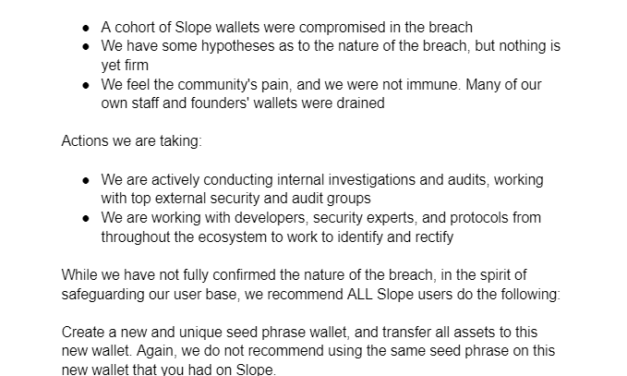
Slope issued a statement addressing the status of its ongoing investigation into the incident on Wednesday confirming that “A cohort of Slope wallets were compromised in the breach,” including some belonging to its own staff.Related: GitHub faces widespread malware attacks affecting projects, including cryptoThe team urged users of Slope wallets to generate a new unique seed phrase and transfer all funds to it rather than keeping any funds on old wallets which could still be exploited later on. The Phantom team stepped up the warning by advising users to move their assets to a new non-Slope wallet.

Čítaj viac

Contributors piling into Bitcoin, Ethereum, and Solana since 2018: Report

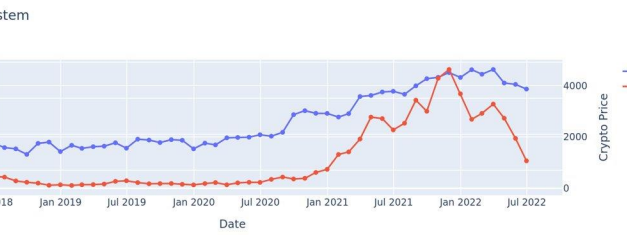
Despite crypto market turbulence, active contributors across Bitcoin, Ethereum, and Solana’s top projects have increased by an average of 71.6% per year since January 2018, according to a new report.The findings come from an August 2 report sent to Cointelegraph by technology investment firm Telstra Ventures, which found that Solana had the most significant annual increase in monthly-active contributors, growing at a compound annual growth rate of 173% since January 1, 2018.Contributors are developers who push updates to code on GitHub, a code repository for computer programs.Ethereum was second with a 24.9% compound annual growth of monthly contributors since 2018 and Bitcoin was third with a “slow and steady” 17.1% yearly increase.Telstra also noted that it found Ethereum to have the “largest and strongest” developer community out of the three blockchains. The network had nearly 2,500 monthly active contributors in April, which fell to over 2,000 contributors in July, coinciding with a fall in the crypto price. The higher number of active contributors could be due to the greater deal of output needed to prepare for the upcoming Merge in which the network transitions into Proof-of-Work consensus. The amount of monthly active contributors on Ethereum in July was more than four times higher than Bitcoin’s 400 contributors and nearly seven times higher than Solana’s 350 contributors. Total contributor count to top Ethereum projects – TelestraThe report however noted that the contributor count fell by 9% since last November, coinciding with a fall in the cryptocurrency’s price since its peak. VC investment opportunitiesThe technology investment firm also found that among the top ten fastest growing projects across Bitcoin, Ethereum and Solana, around 40% of projects have not had any venture capital backing, meaning that investment opportunities remain abundant. Those projects include Ethereum-based investment protocol OlympusDAO, smart contract developer ApeWorx, maximum extracted value (MEV) researcher Flashbots, and Solana-based NFT standard MetaPlex.Related: Investors shifting toward lower-risk crypto yields — Block Earner GMVenture capital funding in crypto throughout 2022 has shifted focus from decentralized finance (DeFi) to Web3 applications, according to research from Cointelegraph in July. Web3 investments accounted for 42% of the $14.67 billion invested in crypto projects in Q2, bringing the first half total to $29.33 billion.Telstra Ventures is a technology-focused venture capital firm with 84 companies in its portfolio of investments and $30 billion in assets under management. It has invested in blockchain companies Blockdaemon and FTX exchange.Data were derived from 1,000 active organizations that contribute more than 30,000 open source projects on Bitcoin, Ethereum, and Solana. Eligible projects for study have at least 100 stars in GitHub repositories and were active between January and April 2022.

Čítaj viac

Textbook publisher wants to use NFTs to skim the used-textbook market

Textbook publisher Pearson has revealed its plans to use non-fungible tokens (NFTs) to keep track of digital textbook sales and effectively “diminish the secondary market” for its digital textbooks. According to a Bloomberg report on August 1, Pearson CEO Andy Bird wants to assign NFTs to its digital textbooks in order to keep better track of sales and capture revenue that was previously lost on the secondhand market.Bird hopes the company can use the technology to earn commission on second-hand sales of its textbooks, which are normally done privately from one student to another. Bird noted:“Technology like blockchain and NFTs allows us to participate in every sale of that particular item as it goes through its life. The possibility to participate in downstream revenues […] I find really interesting.”He noted that a Pearson textbook is typically resold up to seven times over the course of its life. As Pearson explores its options with blockchain technology to scrap further sale revenues, Bird added that his company would be looking into ways his company can take advantage of the Metaverse. “We have a whole team working on the implications of the metaverse and what that could mean for us.”Making a move into the Metaverse could be a lucrative one in the medium term if the market cap of the virtual world is to meet expectations by exceeding $50 billion by 2026. The London-based publisher is part of a growing cohort of academic entities looking into the Metaverse. Last week, the Hong Kong University of Science and Technology (HKUST) launched its first classroom in the Metaverse.The company’s plans to use NFTs have however been met with some criticism from the community.Some academics, such as researcher at Intel Zane Griffin Talley Cooper decried Pearson’s “predatory academic publishing,” though admitted that this is “likely where NFT tech is moving.” In his August 2 tweet, Cooper added “We gotta watch this stuff carefully.”Others say Pearson’s supposed plans for NFTs are not actually using NFT technology at all. Technology analyst Ian Cutress said in an August 2 Tweet that “NFT is just a buzzword here,” and what Pearson is calling an NFT is just a code that second-hand buyers will have to pay a fee for in order to activate their digital books.Is this really NFTs, or is this Pearson just allowing people to bundle a book into a code, sell the code? That’s not an NFT. NFT is just a buzzword here. Note that in order to earn, Pearson charge the person who buys the code a $10 reactivation fee. EA tried something similar. https://t.co/C87uejdXNa— . (@IanCutress) August 2, 2022Related: Gucci becomes first major brand to accept ApeCoin paymentsPearson is already one of the largest publishers in the world with $4.2 billion in revenue in 2021. Their textbooks are used in high schools, colleges, and universities around the world.The company is on pace to beat that mark in 2022 as its first half revenues came in at $2.2 billion, and profits are up 14% to $208.7 million in the same period according to the Telegraph on August 1.

Čítaj viac

Bitcoin network activity decline suggests longer bear market: Glassnode

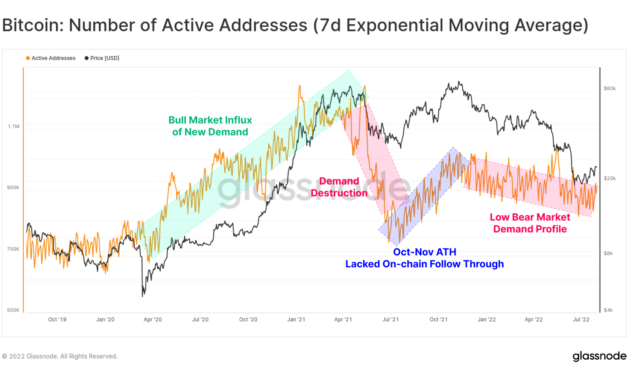
With several on-chain metrics for Bitcoin (BTC) still in a bearish range, a continuation of the recent price recovery will require increased demand and fees spent over the network, says Glassnode. The assessment of mediocre market growth over the past week came from blockchain analysis firm Glassnode in its latest The Week On Chain report on August 1.In it, analysts pointed to sideways growth in transactional demand, active Bitcoin addresses remaining in “a well defined downward channel,” and lower network fees as reasons to temper investors’ excitement about the 15% spike in BTC price over the past week. However, BTC is currently down 2% over the past 24 hours trading below $23,000 to $22,899 according to CoinGecko.#Bitcoin and #Ethereum have rallied strongly off the bottom, reaching above the Realized Price.Attention now turns to whether this is a bear market rally, or whether the fundamentals are following through in support.Read more in The Week On-chain https://t.co/taOkbeVlyv— glassnode (@glassnode) August 1, 2022The report begins by highlighting the characteristics of a bear market which includes a decline in on-chain activity and a rotation from speculative investors to long-term holders. It suggests that the Bitcoin network is still demonstrating each of those traits. Glassnode wrote that a decline in network activity can be interpreted as a lack of new demand for the network from speculative traders over long-term holders (LTHs) and investors who have a high level of conviction in the network’s technology. The report states:“With exception of a few activity spikes higher during major capitulation events, the current network activity suggests that there remains little influx of new demand as yet.”In contrast to last week when a significant level of demand appeared to be established at the $20,000 level for BTC and creating a floor, the additional demand needed to sustain any further price increases is not observable. Glassnode refers to the steady decline in active addresses as a “low bear market demand profile” which has been in effect essentially since last December.The analysis observed similarities between the current network demand pattern and the one established in the 2018-2019 period. Similar to the previous cycle, network demand dried up after the April 2021 all-time high in BTC price. There was a notable recovery in demand leading up to the following November as prices recovered to a new ATH.However, since last November, demand has been on a downward trend, with a major spike down during the mass sell-offs in May. “The Bitcoin network remains HODLer dominated, and as yet, there has not been any noteworthy return of new demand.”Glassnode added that the poor demand from anyone other than dedicated Bitcoin enthusiasts is forcing network fees into “bear market territory.” Over the past week, daily fees amounted to just 13.4 BTC. By contrast, when prices reached ATH last April, daily network fees topped 200 BTC.Related: Bitcoin bulls defend $23K amid warning bear market rally ‘alive and well’Assuming fee rates increase to any noteworthy degree, Glassnode suggests that it could mean demand is on the rise, helping to sustain further “constructive structural shift” in Bitcoin network activity.“Whilst we have not seen a notable uptick in fees yet, keeping an eye on this metric is likely to be a signal of recovery.”

Čítaj viac

Nomad token bridge drained of $190M in funds in security exploit

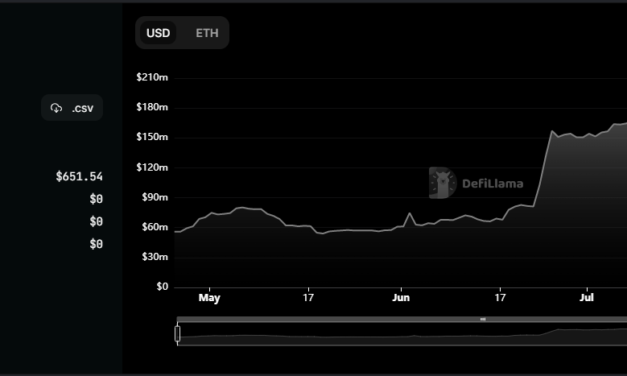
The Nomad token bridge appears to have experienced a security exploit that has allowed hackers to systematically drain the bridge’s funds over a long series of transactions.Nearly the entire $190.7 million in crypto has been removed from the bridge, with only $651.54 left remaining in the wallet, according to decentralized finance (DeFi) tracking platform DeFi Llama.Nomad bridge is getting drained, your funds might be at risk and might be able to still withdraw the remaining funds ⚠️ https://t.co/RgYmjSV9eB— stani.lens (,) (@StaniKulechov) August 1, 2022The first suspicious transaction, which may have been the genesis of the ongoing exploit, came at 9:32pm UTC when someone managed to remove 100 Wrapped Bitcoin (WBTC) worth about $2.3 million tokens from the bridge. Shortly after the community raised alarm bells over the potential exploit, the Nomad team confirmed at 11:35pm UTC that it was aware of the “incident involving the Nomad token bridge” adding it is “currently investigating the incident.” The team did not immediately respond to a request for comment.We are aware of the incident involving the Nomad token bridge. We are currently investigating and will provide updates when we have them.— Nomad (⤭⛓) (@nomadxyz_) August 1, 2022

The incident has seen WBTC, Wrapped Ether (WETH), USD Coin (USDC), Frax (FRAX), Covalent Query Token (CQT), Hummingbird Governance Token (HBOT), IAGON (IAG), Dai (DAI), GeroWallet (GERO), Card Starter (CARDS), Saddle DAO (SDL), and Charli3 (C3) tokens taken from the bridge.Exploiters removed tokens in an unusual fashion as each token was removed in nearly equivalent denominations. For example, transactions with exactly 202,440.725413 USDC were executed over 200 times. Nomad is a token bridge that allows transfers of tokens between Avalanche (AVAX), ethereum (ETH), Evmos (EVMOS), Milkomeda C1, and Moonbeam (GLMR). Unlike other exploits that have become somewhat commonplace in 2022, this event so far has hundreds of addresses receiving tokens directly from the bridge.Meanwhile, the Moonbeam smart contract platform from the Polkadot network, whose native GLMR token was one targeted in the Nomad exploit, went into maintenance mode at 11:18pm UTC “to investigate a security incident.” As a result, Moonbeam’s functionality such as regular user transactions and smart contract interactions will be disabled.1/ Important Notice: The Moonbeam Network has gone into Maintenance Mode in order to investigate a security incident with a smart contract deployed on the network.— Moonbeam Network #HarvestMoonbeam (@MoonbeamNetwork) August 1, 2022

The attack is untimely for the bridge which and its seed round investors from a fundraise in April. On July 29, the project revealed in a tweet that Coinbase Ventures, OpenSea, and five other major companies in the crypto industry participated in an April seed round fundraising which landed Nomad a $225 million valuation.

Čítaj viac

Získaj BONUS 8 € v Bitcoinoch

nakup bitcoin z karty

Registrácia Binance

Burza Binance

Aktuálne kurzy