Autor Cointelegraph By Brian Newar

Inflows to Canadian Bitcoin ETFs hit all-time high: Glassnode

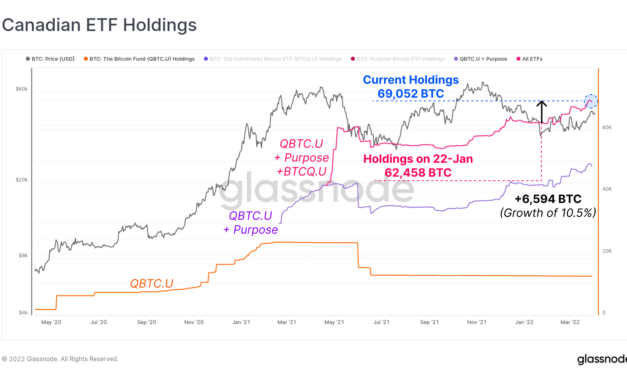
Canadian Bitcoin exchange-traded fund (ETF) holdings have increased to all-time highs according to recent research, and spot-based products are leading the way.Canadian Bitcoin ETFs have increased their holdings by 6,594 Bitcoin (BTC) since January to reach an all-time high of 69,052 total BTC held.The Purpose Bitcoin ETF saw the biggest increase in holdings over that time period with a net growth of 18.7% to 35,000 BTC, according to Glassnode. An ETF is an exchange-traded fund that allows investors to speculate on the price of an asset without having to hold any themselves. The Purpose Bitcoin ETF, a spot Bitcoin ETF, currently has about $1.68 billion in assets under management. No such spot Bitcoin ETF is currently available in the U.S. but the metrics show that investors are hungry for the Canadian product. Blockchain analytics firm Glassnode pointed out in its recent Week OnChain report that the crypto exchange outflow rate reached a 2022 high of 96,200 BTC per month. The analytics provider commented on the juxtaposition of events concerning Bitcoin movements by saying:“It is quite impressive to observe such strong outflows from exchanges (spot holdings), as well as inflows into both ETF products, DeFi applications, and on-chain accumulation wallets, despite the numerous macroeconomic and geopolitical headwinds of recent months.”Bitcoin accumulation has been strong since around mid-March. The biggest accumulators have been so-called shrimps and whales. Shrimps are investors who hold 0 to 100 BTC, while whales are those who hold 1,000 to 10,000 BTC. The #Bitcoin network has mined the 19 millionth $BTC, whilst accumulation by Shrimps alone surpass 1.7x daily issuance.This week also saw an influx of buying from Luna Foundation Guard, inflows into Purpose ETF, and 1k+ $BTC Whales.Read our analysishttps://t.co/o0S5AsYPYO— glassnode (@glassnode) April 4, 2022Among the biggest recent buyers is Terra’s Luna Foundation Guard (LFG) which is on a mission to acquire $3 billion worth of BTC.Related: Terra smash-buys $139M Bitcoin, wallet reaches 31,000 BTCWith just 2 million BTC left to be mined since the 19 millionth coin was mined on April 1, the scarcity of Bitcoin is becoming an issue of note as adoption and investment increase across nations, corporations, and individuals.Glassnode concluded that “the scarcity and pristine nature of Bitcoin as collateral may well be returning to the foreground once again.”

Čítaj viac

Gryphon and Sphere 3D merger scrapped but carbon-neutral mining continues

Despite the canceled merger between Gryphon Digital Mining and Sphere 3D, the two firms still intend on building out carbon-neutral Bitcoin mining operations.An April 4 joint statement from the two crypto mining companies revealed that scrapping the merger was a mutual decision “due to changing market conditions, the passage of time, and the relative financial positions of the companies.” The cancellation will apparently not stop either company from moving forward with plans on building carbon-neutral Bitcoin (BTC) mining facilities. The merger was announced last June and would have seen the two companies become one under the Gryphon name. It also would have made Gryphon a publicly-traded company by virtue of the fact that Canada-based Sphere 3D is already trading under the ANY ticker on NASDAQ.Gryphon claims to be the first carbon-negative miner by acquiring 500,000 carbon offset credits. Neither Sphere 3D nor Gryphon responded to comments on how they achieved net neutrality.The firms already have a close working relationship about which Gryphon CEO Rob Chang said he looks forward to “the mutual success of both companies.” Gryphon manages Sphere’s mining fleet of 1,000 devices and Sphere expects to grow that fleet by 59,000 devices by June of this year. Gryphon controls 7,200 of its own devices which are collocated by blockchain infrastructure provider Core Scientific. Last July, Gryphon purchased 7,200 Antminer mining rigs worth about $48 million which helped boost its hash power by about 720 petahashes per second (PH/s).Related: Core Scientific strikes digital gold: Revenue up 800%, gross profit up 2500%The environmental impact of Bitcoin mining has been the focus of regulators around the world. Operating carbon-neutral facilities could help stave off some of the criticisms caused by Bitcoin mining, such as increased noise pollution and energy grid failures. One of America’s largest hash power contributors, New York state, is considering a moratorium on mining to give its environmental agency time to explore the impact mining has on the environment.

Čítaj viac

Shopify facing another lawsuit from crypto holders over Ledger data breach

Global e-commerce platform Shopify and hardware wallet maker Ledger face a major legal hurdle as a group of Ledger users have filed a class-action lawsuit for its part in failing to prevent a massive data breach in 2020.The suit was filed in the U.S. District Court of Delaware on Apr. 1 and alleges that Shopify “repeatedly and profoundly failed to protect its customers’ identities.”Shopify and its third-party data consultant TaskUs are being held responsible by complainants for leaking personally identifiable information (PII) of Ledger buyers despite marketing promises assuring the full security of the Shopify platform. The plaintiffs claim Shopify and TaskUs were aware of the data breach for over a week before notifying customers. They are asking for the exact type of information leaked to be disclosed by Ledger and Shopify and for a monetary reward that covers actual and punitive damages.A class action suit has been filed against Shopify and Ledger.France-based Ledger is also included as a defendant in the case for its marketing claims promising customer security. The complaint states that Ledger “initially denied that any compromise of PII had occurred,” but later had to backtrack and refer to the leak and to Shopify in an email notification. The complaint stated:”Despite the repeated promises and worldwide advertising campaign touting unmatched security for its customers, Ledger—and its data processing vendors, Shopify and TaskUs—repeatedly and profoundly failed to protect its customers’ identities, causing targeted attacks on thousands of customers’ crypto-assets and causing Class members to receive far less security than they thought they had purchased with their Ledger Wallets.”Hardware wallets, otherwise known as cold wallets, are physical devices that provide crypto users with added security for their private keys and seed phrases. They are marketed to be more secure than hot wallets.As the complaint alleges, Ledger used Shopify to run its website’s online store. As a result of that relationship, Shopify had direct access to the PII of customers on Ledger’s database. Shopify uses TaskUs to provide customer support services, and therefore it also had access to Ledger’s customer data. Hackers made off with personal information from about 272,000 Ledger users and over 1 million email subscribers to Ledger’s newsletter in 2020. A massive phishing and intimidation campaign targeting Ledger owners followed resulting in some victims losing crypto assets.Related: Ledger partners with The Sandbox to promote crypto education in the metaverseThis is not the first class-action suit filed against both Ledger and Shopify regarding the data breach. In April 2021, a different group of complainants filed suit in California. That complaint made allegations similar to the recent Delaware filing that Shopify and Ledger “negligently allowed, recklessly ignored, and then intentionally sought to cover up.”On April 2, hardware wallet maker Trezor was the subject of a phishing attack that targeted its users through the MailChimp marketing service provider. On April 3, Trezor confirmed in a tweet that there had been a data breach. The company warned users that it would stop communicating via the newsletter, and had shut down three of its domains.

Čítaj viac

Is Ethereum really the best blockchain to form a DAO?

The crypto community and industry have chosen Ethereum as the chain of choice for most blockchain-based decentralized applications, but other chains may be better suited to handle the workload for decentralized autonomous organizations (DAOs).Technical advantages and cheaper transactions have yet to become a major pull factor from Ethereum Virtual Machine (EVM) chains. EVM compatibility enables a network to use Ethereum’s security features. Ethereum (ETH) and its compatible chains have a clear advantage in the number of DAOs compared to any other. They house more than 4,200 DAOs and protocols requiring governance participants according to data from blockchain voting platform Snapshot. Comparatively, the Solana (SOL) ecosystem has only 140, Cardano has 10 DAOs according to ecosystem tracker Cardano Cube, and Polkadot (DOT) Substrate says it has just eight. This is not to discount the fact that among the top 10 DAOs by the number of decisions made over the past seven days, DAO tracker DeepDAO shows that three are based on Solana.Ethereum’s leg up over the rest may be due to simple, yet practical reasons, according to DAO tracker DeepDAO CEO Eyal Eithcowich in emailed responses to Cointelegraph. He attributes Ethereum’s dominance to the fact that it is “the chain where the DAO movement started.”“More importantly, (Ethereum’s) the most mature ecosystem in terms of tools for starting and managing all facets of DAOs, mostly financial but not only. This may change as other chains grow in popularity.”On the other hand, he pointed to high gas fees as a shortcoming of Ethereum. He added that Solana allows DAOs to make fast and cheap transactions, “But, again, the supporting features and tools in the ecosystem are less robust.”Additionally, Solana has become vulnerable to infrequent network outages.The co-founder of the nonfungible token (NFT) game on the EOSIO-based WAX network Alien Worlds, Saro McKenna, told Cointelegraph last week that she believes EOSIO (EOS) is better for building DAOs. In her view, Ethereum is too expensive for voting purposes and was designed to be a “general-purpose blockchain” to handle any number of different tasks. This contrasts with EOSIO, which McKenna said “was partly built for the purpose of DAOs.”“The EOSIO codebase is extremely powerful, allowing for layered multisig permissions and dynamic collection election mechanisms that are critical for DAOs to function properly.”Gas fees have long been an issue for Ethereum users, but in March, fees were at their lowest levels since last August.Related: Opera integrates Bitcoin, Solana, Polygon and five other blockchainsHowever, CEO of blockchain consulting firm Koinos, Andrew Levine, had pointed criticisms of EOSIO which could explain why it falls short of Ethereum’s rate of adoption. In February, he wrote that while EOS transactions are virtually fee-less, there is an account creation fee. Furthermore, holding coins on an account is fairly complicated compared to Ethereum:“The EOS database is built on something called “memory-mapped files,” another vestige of the Steem design, an important consequence of which is that it is designed to use the most expensive form of storage possible: random-access memory (RAM).”

Čítaj viac

Aussie crypto 'finfluencers' face tough new legal restrictions

New warnings from the Australian Securities and Investments Commission (ASIC) on appropriate conduct for financial influencers could have a dramatic impact on the local crypto industry.ASIC’s recent Information Sheet outlines the traps influencers and the companies that hire them could fall into while wittingly or unwittingly promoting financial products. The penalties for failing to heed ASIC’s warnings could lead to millions of dollars in fines for corporations and up to five years in prison for individuals.Although it does not specifically mention crypto influencers, the guidelines certainly apply to them as cryptocurrency investing services are seen as financial products. To those financial influencers or ‘finfluencers’ who are not sure whether their brand is in violation of the law, ASIC writes “Think about your content carefully and whether you are providing unlicensed financial services.”One point of confusion in the new rules concerns exactly what constitutes promotion as opposed to innocuous informing of financial products. Financial blogger from Strong Money Dave Gow wrote on March 29 that “Writing almost anything could influence someone to invest or use any financial product.” Gow’s assessment is based on the somewhat nebulous distinction ASIC has made between objective facts about a financial product and the way in which influencers may present them. It states:“If you present factual information in a way that conveys a recommendation that someone should (or should not) invest in that product or class of products, you could breach the law by providing unlicensed financial product advice.”Australian Liberal Senator Andrew Bragg believes there is an incongruence between the new ASIC guidelines and how crypto is regulated in his country. He believes that under current laws, the crypto industry should be exempted from these new restrictions. He told Cointelegraph in an email:“ASIC’s current policy applies the law to crypto to the extent that digital assets fall within the definition of a financial product. Crypto is currently unregulated and not a financial product… I believe we can do more.”Senator Bragg is a proponent of clearer crypto regulations, and recently introduced an ambitious new proposal concerning decentralized autonomous organizations (DAO) at Australia Blockchain Week last month.As someone who may now be considered an unlicensed finfluencer, Gow takes exception to restrictions on what they now may not do, which is make any sort of recommendation. He added that the rule limits influencers to simply “parroting what you can read elsewhere” and harms the investor knowledge base. He stated, “How does that help you wade through the sea of information and nonsense out there?”Modify old content / minimise investing discussion / not mention any financial products, funds etc. Some may choose to close up shop, I know one who is, while others will prob continue for enjoyment in a limited capacity. Sad situation for free speech.— Dave Gow | Strong Money Australia (@strongmoneyaus) April 2, 2022Related: SBF opens Aussie Blockchain Week as gov’t says we’re ‘open for business’As part of Australia’s Corporations Act, individual influencers must beware of how they promote financial products, while corporations must also keep a close watch on their hired influencers to ensure no rules are broken. The commission offers several case studies that provide context that could help identify whether an individual or company is promoting financial services.

Čítaj viac

Získaj BONUS 8 € v Bitcoinoch

nakup bitcoin z karty

Registrácia Binance

Burza Binance

Aktuálne kurzy