Autor Cointelegraph By Brian Newar

Ethereum Foundation treasury expands non-crypto assets to 19%

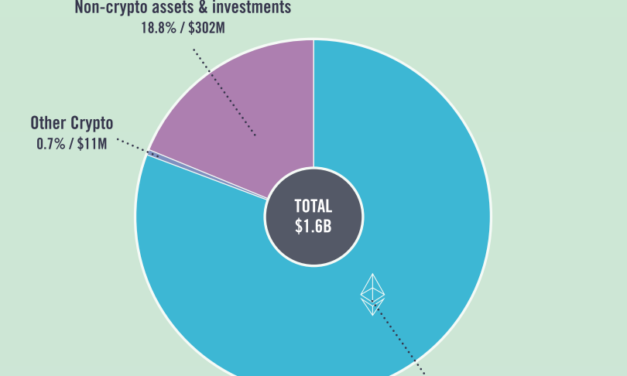
The Ethereum Foundation (EF) has released a report detailing how its $1.6 billion treasury consists mostly of Ether (ETH), but with a surprising 18.8% in non-crypto assets.In total, the EF non-profit organization which manages the funds for Ethereum developments holds about 0.3% of the current total ETH supply, amounting to roughly $1.3 billion which is verifiable on Etherscan. However, its non-crypto holdings account for a sizable $302 million share.The April 2022 report is the first issued by the Foundation to outline what it holds in the treasury and how it is allocating expenditures, including grant funding for various Ethereum-based projects. In all, the EF appears to have a very strong financial footing having spent just $48 million in 2021.The Ethereum Foundation’s treasury as of April 2022.The report stated that it has increased its non-crypto holdings to $302 million from a previously undisclosed amount. That amount is meant to provide “a greater safety margin” in an effort to protect it against a downturn in the crypto market. The Foundation did not immediately respond to a request to disclose the details regarding those non-crypto holdings. However, Ethereum researcher Justin Drake suggested that the non-crypto holdings are just fiat reserves in an April 18 tweet.the EF spent $48M in 2021it has 350K ETH ($1B) and $300M fiathttps://t.co/1AL68I5YgF pic.twitter.com/0yLXNHy3Aj— Justin Ðrake (@drakefjustin) April 18, 2022The Foundation spent $21.8 million on layer-one (L1) research and development, the largest share of its expenditures last year. This total does not include the Client Incentive Program (CIP) which is an ongoing program that rewards nine particular node operators with a share of 39,168 ETH ($132 million) on a fixed schedule.It spent a further $9.7 million on community development, $5.9 million on Ethereum as a developer platform, $5.1 million on international operations, $3.6 million on ZK (zero-knowledge) research and development, and $1.9 million on layer-two (L2) research and development.As far as I know this is the first time the Ethereum Foundation has publicly detailed all of their treasury holdings.Finally pic.twitter.com/AugWk2GF2H— sassal.eth (@sassal0x) April 18, 2022

Related: ETH devs implement first-ever ‘shadow fork’ as PoS testing continuesThe EF’s financial report comes just a few months before The Merge is scheduled to take place where the Ethereum mainnet transitions to a proof-of-stake (PoS) consensus algorithm. Doing this is expected to vastly reduce the network’s energy requirements and carbon footprint.

Čítaj viac

FBI and CSIA issue alert over North Korean cyberattacks on crypto targets

The Cybersecurity and Infrastructure Security Agency (CISA) and FBI have issued an alert on North Korean state-sponsored cyber threats that target blockchain companies in response to the Ronin Bridge hack last month.The alert was issued on April 18 in conjunction with the Federal Bureau of Investigation and the Treasury Department which had warnings and mitigation suggestions for blockchain and crypto firms to ensure their own operations remain safe from hackers.With the @FBI, and @USTreasury, we released a new cybersecurity advisory on North Korean state-sponsored activity targeting blockchain technology and the cryptocurrency industry. Read the technical guidance and mitigation strategies: https://t.co/Oio478Ouv3 pic.twitter.com/VLa3HUrsPY— Cybersecurity and Infrastructure Security Agency (@CISAgov) April 18, 2022Lazarus is not the only hacker group listed by name as an advanced persistent threat (APT). Included among Lazarus are APT38, BlueNoroff, and Stardust Chollima. These groups and others like them have been observed targeting what the bulletin called “a variety of organizations in the blockchain technology and cryptocurrency industry,” such as exchanges, decentralized finance (DeFi) protocols, and play-to-earn games.Their efforts filled their coffers with $400 million in stolen crypto funds in 2021 according to a report from Chainalysis. The regime has already topped that amount this year with the Ronin Bridge hack from which it extracted about $620 million in crypto in late March.The CSIA does not believe the rate of thefts will see a downturn any time soon as it stated that groups are using spearphishing and malware to steal crypto. It added that:“These actors will likely continue exploiting vulnerabilities of cryptocurrency technology firms, gaming companies, and exchanges to generate and launder funds to support the North Korean regime.”Kim Jong Eun’s staunch refusal to dismantle his nuclear weapons program forced the U.S. to levy some of the harshest economic sanctions ever against his country. This has led him to turn to cryptocurrency to fund the nuclear weapons program since his cash flows through traditional means have been almost entirely sealed off. While the alert goes into greater detail about exactly how these groups use malware such as AppleJeus to target blockchain and crypto firms, it also offers suggestions on how users can mitigate the risk to themselves and their users’ funds. Most of the recommendations are common sense security procedures such as using multi-factor authentication on private accounts, educating users on common social engineering threats, blocking newly registered domain emails, and endpoint protection.Related: The aftermath of Axie Infinity’s $650M Ronin Bridge hackThe laundry list of mitigation strategies firms should take to ensure they are secure from harm include all sensible suggestions, however, the CSIA believes that education and awareness of the existent threat is one of the best strategies.“A cybersecurity aware workforce is one of the best defenses against social engineering techniques like phishing,” it concluded.

Čítaj viac

Beanstalk Farms loses $182M in DeFi governance exploit

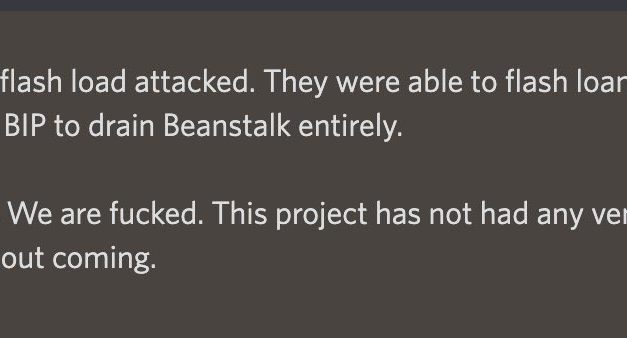
Credit-based stablecoin protocol Beanstalk Farms lost all of its $182 million collateral from a security breach caused by two sinister governance proposals and a flash loan attack.The problem for the protocol was seeded by suspicious governance proposals BIP-18 and BIP-19 issued on April 16 by the exploiter that asked for the protocol to donate funds to Ukraine. However, those proposals had a malicious rider attached to them which ultimately created the sinkhole of funds from the protocol according to smart contract auditor BlockSec.This latest security breach of a decentralized finance (DeFi) protocol took place at 12:24 pm UTC. At that time, the exploiter took out $1 billion in flash loans from the AAVE (AAVE) protocol denominated in DAI (DAI), USD Coin (USDC), and Tether (USDT) stablecoins. They used these funds to accumulate enough assets to take over 67% of the protocol’s governance and approve their own proposals.We’re engaging all efforts to try to move forward. As a decentralized project, we are asking the DeFi community and experts in chain analytics to help us limit the exploiter’s ability to withdraw funds via CEXes. If the exploiter is open to a discussion, we are as well. https://t.co/fwceVz6hbi— Beanstalk Farms (@BeanstalkFarms) April 17, 2022A flash loan must be executed and repaid within a single block and usually calls on several smart contracts at once to complete. Flash loans have been used in the past to perform hacks or security exploits of other protocols. Beanstalk Farms is a decentralized algorithmic stablecoin issuing platform on Ethereum.This case was technically not a hack as the smart contracts and governance procedures functioned as designed. Flaws in their design were exploited, which project spokesperson “Publius” acknowledged in a meeting on April 18th when he said:“It’s unfortunate that the same governance procedure that put beanstalk in a position to succeed was ultimately its undoing.”Blockchain security analysis firm PeckShield notified the Beanstalk team via Twitter at 12:41pm UTC on April 17 that there might be an issue with the ominous statement: “Hi, @beanstalkFarms, you may want to take a look.”Our initial analysis shows the @BeanstalkFarms loss is ~$182m ! Here is the breakdown of stolen assets: 79,238,241 BEAN3CRV-f, 1,637,956 BEANLUSD-f, 36,084,584 BEAN, and 0.54 UNI-V2_WETH_BEAN. https://t.co/8OzPn8F8ot— PeckShield Inc. (@peckshield) April 17, 2022

At that point, it was too late. The exploiter had already made off with roughly $80 million in Ether (ETH) and Beans (BEAN) while the entire protocol lost its $182 million in total value locked (TVL) according to PeckShield. BEAN is currently down about 83% trading at $0.17 according to CoinGecko but troughed at $0.06 when the exploiter dumped their tokens.The exploiter swapped BEAN for ETH and then sent the coins to Tornado Cash to cover their digital tracks. However, they also sent 250,000 USDC to the Ukraine Crypto Donation wallet. At 11:49 pm UTC on April 17, Publius wrote that the project is likely lost since there is no venture capital backing to recoup losses, adding “We are f**ked.”In a team and community meeting on the Beanstalk Discord channel on April 18, Publius doxxed the three individuals who developed the project. They are Benjamin Weintraub, Brendan Sanderson, and Michael Montoya, all of whom attended the University of Chicago together and conceived Beanstalk Farms. Montoya said that the team had reached out to the Federal Bureau of Investigation (FBI) Crime Center and would “fully cooperate with them to track down the perpetrators and recover funds.” The protocol’s smart contracts have been paused and all governance privileges have been revoked by the team.Related: North Korean Lazarus Group allegedly behind Ronin Bridge hackThe team did not respond when Cointelegraph asked if they believe the FBI has any legal recourse to help them, but Publius believes this is definitely a theft that should be investigated.Beanstalk’s community has been mostly supportive of the team in the trying time despite their own tremendous personal losses. However, community member “Astrabean” believes the team should be taking more responsibility for the attack rather than accepting what happened as an honest mistake that the project must move on from. He stated that “I would have wanted you as leaders to take accountability for what happened.”Community member “CharlieP” echoed those concerns about trust in the protocol. He asked the team “Are you saying you have no responsibility for this endeavor? If that’s the case, who are we to trust that this is not going to happen again?”Publius responded that the project is just an open-source code experiment, not a business and that neither he nor the team should be held accountable for what happened. He added,“When you ask us to take responsibility, it’s really inappropriate.”

Čítaj viac

Montenegro makes Vitalik a citizen, part of plans to promote it as a blockchain hub

The Montenegrin government has begun fulfilling its pledge to become a hub for blockchain innovation by reportedly making Ethereum creator Vitalik Buterin its newest citizen.Montenegrin news outlet RTCB reported that Prime Minister Zdravko Krivokapić recommended Buterin receive the privilege to help the southeastern European nation promote its efforts to become a blockchain innovation hub. There does not appear to be an official announcement, however this photo was reportedly shared by the Minister of Finance and Social Welfare Milojko Spajić when Buterin received his passport.Vitalik Buterin receiving citizenship to Montenegro from the Minister of Finance and Social Welfare Milojko Spajić. Source: TwitterMontenegro hosted the Ethereum (ETH) co-founder on April 7 at the Future Now! panel discussion hosted by Minister Spajić. There, panelists Buterin, Ethereum researcher Vlad Zamfir, University of Memphis Professor of law Boris Mamlyk, and Minister Spajić spoke on the legality of blockchain identity, smart contracts in government, and other topics.Budućnost Sad! Kripto zakon, inovacije, zajednicaPrilika za uspostavljanje zdrave, održive, blokčejn industrije u službi naroda.V.Buterin – osnivač ETHV.Zamfir – glavni istraživač ETHB.Mamlyk – internacionalni profesor pravaM.Spajić – moderatorhttps://t.co/PvBNeQi52n pic.twitter.com/X9WCNJz6eZ— Milojko Spajić (@MickeySpajic) April 7, 2022In an April 4 meeting, Prime Minister Krivokapić, Buterin, and several other government officials also discussed Montenegro’s options in terms of the blockchain industry, as reported by local news outlet Mina. One important aspect brought up was how to regulate crypto for his citizens.Minister Spajić stated that he wishes his country to be strict on criminals in the industry, but feels fairness would stimulate growth and “reduce the gray economy in all areas.” He added: “Montenegro strives to become a center of innovation in blockchain technology with an emphasis on all the advantages of a legitimate industry that will bring attractive regulations.”Montenegro’s government is now starting to dig into the complicated regulatory entanglements that come from integrating blockchain technology into its various systems.During the Future Now! event, the panelists focused on the issue of how people can legally create a community using blockchain and legally verify their identity and stay protected against identity theft. Mamlyk suggested that decentralized autonomous organizations (DAO) could issue DAO tokens for people to prove their identity as a member while protecting their privacy. However, Buterin said “there is no magic one-line principle” that can deal with bad actors.Related: DAO regulation in Australia: Issues and solutions, Part 2When asked about whether Montenegro should allow companies to register as DAOs, Buterin referred to Wyoming which recognizes DAOs as legal entities. He said that such an application of decentralized governance is a “good first step” and may be “a good place to start” for Montenegro.

Čítaj viac

Coin Center takes aim at ‘unconstitutional’ SEC redefinition of an 'exchange'

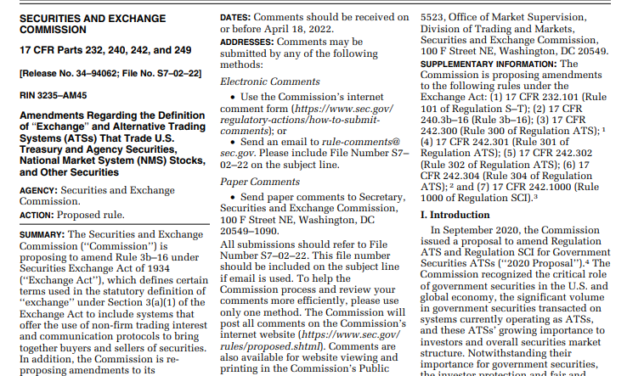
Nonprofit blockchain advocacy group Coin Center has called the Securities and Exchange Commission’s (SEC) proposed redefinition of an “exchange” an “unconstitutional overreach.”The lobby group made the comments in a written response to the SEC’s March 18 Amendments Regarding the Definition of “Exchange”, which details changing the meaning of “exchange” from a “system that brings together the orders” of a security to one that “brings together buyers and sellers.”The SEC’s proposed rule to change the definition of “exchange.”Bringing together orders, which are things, is very different to bringing together people and Coin Center says the latter is tantamount to coercion.The rule change suggests that Communication Protocol Systems are also exchanges which may bring in programmers who merely share code for a crypto trade. If the proposal becomes an SEC rule, decentralized exchanges (DEX) such as UniSwap (UNI) and PancakeSwap (CAKE) would all be on notice that the commission wants them to register as exchanges.A new SEC proposal has a serious change hidden within its complex language. Bottom line: The proposal violates the First Amendment by requiring a license to speak—even of open source developers. It’s unconstitutional and they should change it. Coin Center is pushing back 1/— ɥƃɹnquǝʞןɐΛ ⚖ (@valkenburgh) April 14, 2022Coin Center argues that this shift “to a speech-based definition” would impact “countless developers, publishers, and republishers” who may trade code but not tokens. This is particularly the case for DEX developers.Comments from Coin Center on the SEC’s rule proposal regarding exchanges.The nonprofit reacted to the proposed change in lengthy comments on April 14 by calling it unconstitutional and citing Supreme Court (SC) precedent that it believes could compel the SEC to retract its proposal:“The way it [expands the definition of ‘exchange’] would create an inappropriately broad standard for registration that would impose an unconstitutional prior restraint on the protected speech activities of countless software developers and technologists.”By the SEC’s account, including considerations of Communication Protocol Systems to the definition of “exchange” acknowledges the benefit individual buyers and sellers extract from communicating within a marketplace. It said that adding those users in the definition can “reduce regulatory disparities among like markets.”However, Coin Center argues the new definition is an attempt to abridge freedom of speech in contravention of the First Amendment. The SEC was accused of doing this in the landmark 1985 Lowe v SEC case. In that case, the SEC attempted to force Lowe to stop stop acting as an Investment Advisor by publishing a financial newsletter. The SC stated that Lowe’s newsletter was protected free speech and he won the case.Regarding Lowe v SEC, Coin Center wrote the commission “jeopardized the speech rights of Americans with an overbroad interpretation of its statutory authority.” The SEC will be accepting comments from U.S. citizens regarding the rule proposal until April 18.Related: Ripple CEO: SEC case is going ‘much better than I hoped’Last November, the Infrastructure Bill passed which required software developers, transaction validators and node operators to file taxes as crypto brokers, an overly-broad definition by the account of many in the crypto industry.

Čítaj viac

Získaj BONUS 8 € v Bitcoinoch

nakup bitcoin z karty

Registrácia Binance

Burza Binance

Aktuálne kurzy