Autor Cointelegraph By Brian Newar

Coinbase took out the first Bitcoin-backed loan from Goldman Sachs

America’s largest crypto exchange Coinbase has been revealed as the mystery firm that took out Wall Street’s first Bitcoin-backed loan from Goldman Sachs.Goldman Sachs has $2.5 trillion assets under management as of 2021.Bloomberg reported on Tuesday that the Bitcoin-backed loan issued by Goldman had been taken out by Coinbase as a way to deepen ties between the crypto and tradfi world, with the head of Coinbase Institutional Brett Tejpaul stating that: “Coinbase’s work with Goldman is a first step in the recognition of crypto as collateral which deepens the bridge between the fiat and crypto economies.”The dollar value of the loan has not been disclosed, but it was collateralized by a portion of Coinbase’s total holdings of 4,487 Bitcoin, worth around $170 million today. The loan features 24-hour risk management, but requires Coinbase to top up its BTC collateral if prices fall too low.While Bitcoin-backed and other crypto-backed loans are commonplace in the crypto industry, especially on decentralized finance (DeFi) protocols, they are a curiosity in traditional finance where crypto is seen as too risky and volatile as collateral.However, asset management firm Arca wrote in a May 2 blog post that potential borrowers are looking for more such options. It said, “[This loan] demonstrates the willingness of institutions to utilize new tools with old techniques.”“It is far more likely that Goldman is seeing a lot of demand for this type of transaction and is just testing the waters before making a bigger splash.”News of the Bitcoin-backed loan sparked commentary on Twitter. Regarding the loan, Bitcoin podcaster Preston Pysh tweeted Wednesday: “No wonder the SEC is hiring people.”Armstrong on social mediaMeanwhile, Coinbase CEO Brian Armstrong, has laid out his vision for free speech being enabled through decentralized social media platforms. He told the Milken Institute on May 2 that under new owner Elon Musk, Twitter has an opportunity to “essentially embrace using a decentralized protocol” which the platform could operate on. “I think freedom in all forms is worth defending and crypto, a lot of it, is about economic freedom. Freedom of speech is another version.”Armstrong believes a decentralized social media platform would allow content creators to make their own moderation policies and thaaccess to all the content would be democratized rather than algorithmically ordained. This would prevent certain content streams from being stifled on a platform and allow users to see whatever they choose to.Related: Coinbase CEO responds to insider trading allegations with changes for token listingsIf Twitter does not embrace the opportunity, Armstrong points out that there are teams working on decentralized social media platforms already, which he called DeSo, where users can own their own identity on the platform.Twitter’s founder Jack Dorsey has been working on a decentralized social media platform called Bluesky since 2019, which operates independently from Twitter. Bluesky aims to drive the adoption of technology where “creators have control over relationships with their audiences, and developers have the freedom to build.”Given the surge of interest in Twitter’s future, we thought this would be a good time to clarify the relationship between Bluesky and Twitter.— bluesky (@bluesky) April 25, 2022

Čítaj viac


Argentina's largest two banks to allow crypto trading

Argentina’s largest and second-largest private banks, Banco Galicia and Brubank, have announced that they will allow customers to make crypto purchases.Bloomberg reported on May 2 that a resounding 60% of respondents to an Argentinian poll asked for more access to crypto, which catalyzed the banks’ decisions to begin allowing crypto trading. Affiliate at market research firm Americas Market Intelligence, Ignacio Carballo, tweeted confirmation on May 3 with screenshots of Banco Galicia’s online interface that it had begun supporting Bitcoin (BTC), Ether (ETH), USD Coin (USDC), and Ripple (XRP) purchases..#IMPORTANTE: El Banco Galicia incorpora función de comprar #criptomonedas! Se transforma así en el PRIMER BANCO DE ARGENTINA en ofrecer el servicio #critpo. Impresionante paso de la Banca Tradicional.(P.S.: hay que decirlo: chupate esa mandarina!) pic.twitter.com/0Kpi3oMUIL— Ignacio E. Carballo (@IECarballo) May 2, 2022The South American nation has the sixth-highest crypto adoption rate in the world. Data and survey firm Statista estimates that 21% of Argentines had used or owned crypto by 2021.Allowing customers to purchase Bitcoin and other cryptos through their bank could help Argentines stay ahead of the crushing inflation in the country. The latest data from economic data tracker Trading Economics says Argentina’s inflation rate in April was 55%. Proponents say Bitcoin’s scarcity and decentralization make it the ideal inflation hedge.Last month, the town of Sorradino in Argentina purchased mining rigs and planned on starting a mining operation as a way of earning Bitcoin to fight inflation. Its income from mining was estimated to be several hundred U.S. dollars per month.Taking into account its high adoption rate, the mayor of Argentina’s capital Buenos Aires, Horacio Rodriguez Larreta, announced late last month that the city would begin accepting crypto as payment for public financial services. The city also plans to launch a blockchain-based digital identification (DID) platform for its residents.Related: El Salvador Bitcoin wallet shows ‘strong sign of adoption,’ exec saysHowever, Argentina is not the largest country in South America taking giant leaps forward with crypto adoption. Brazil’s senate finally approved the ‘Bitcoin Law’ bill on April 26 which could help add a much-needed regulatory framework for the local crypto industry. It only needs to pass one more committee to be signed into law by President Jair Bolsinaro.

Čítaj viac

Crypto.com (CRO) slumps 30% as staking rewards are slashed

Crypto exchange Crypto.com announced severe reductions to CRO staking rewards for most tiers of its VISA prepaid card which has forced the token price to fall around 30% in less than a week.Its May 1 blog post explains that card rewards will be reduced by an average of 69.5%, and 100% on its lowest tier Midnight Blue card “to ensure long-term sustainability.” On its highest tier Obsidian card which requires at least $400,000 in CRO to be staked, rewards will drop from 8% to 5%. Changes to the rewards schedule will begin on June 1.However, cardholders who had an active six-month stake before May 1 will not see their rewards schedule change until their current term expires.In addition to rewards rates, there will also be a cap set on three tiers of cards. The Ruby Steel tier will have a $25 per month limit while the Royal Indigo and Jade Green cards will have a $50 monthly limit on rewards.Current stakers are irritated by the exchange’s sudden move to change the rewards. High-profile staker Devchart told his 170,000 Twitter followers on May 2 that the exchange’s decision was “the dumbest move of the day.”And for the dumbest move of the day, https://t.co/2VyM3mIsbK $CRO decided to reduce their staking rewards, add some stupid monthly cap reward that removes staking incentives. Thankfully I just care about the crypto to debit for my expenses but yeah that was a moronic move. pic.twitter.com/qhhpatlpsi— Devchart ‍ (@devchart) May 1, 2022In response to the backlash from the community, Crypto.com CEO Kris Marszalek tweeted on May 3, that planned changes would be adjusted to reflect “a more balanced approach.” He said that rather than issue individual changes per tier, Private Members who use the Obsidian, Icy White, and Frosted Rose Gold cards would receive an 8% annual yield. Royal Indigo and Jade Green holders would have a 4% annual yield. This adjustment has not yet been confirmed on the exchange’s blog.Instead of eliminating card staking earn rates completely, we will offer a more balanced approach: 8% APY for Private Members (Obsidian, Icy White, and Frosted Rose Gold) 4% APY for Royal Indigo and Jade Green card holders— Kris | Crypto.com (@kris) May 3, 2022

When Cointelegraph asked the exchange about how much more sustainability it expects to gain from rewards reduction, a Crypto.com spokesperson responded via email:“Crypto.com is committed to offering the best possible products and services that meet the needs of our customers around the world. Our recent changes were made to bring our substantially scaled programs closer to long-term sustainability, and we continue to provide attractive rewards and opportunities to our customers.”Related: Crypto.com’s Cronos partners with Chainalysis to track CRC-20 tokensThe news has had a clearly negative impact on the price of CRO, the native token for Crypto.com’s CRONOS blockchain network. CRO price began tumbling on May 1 from $0.36 at the start of the day to $0.28 as of the time of writing according to Cointelegraph data. It has lost a whopping 30% over the past seven days according to CoinGecko.

Čítaj viac

Rhode Island proposes crypto rewards for green home builders

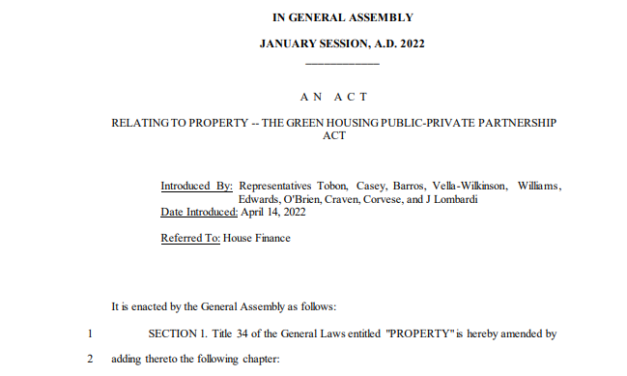
A bill was proposed in Rhode Island’s House of Representatives that would credit a house builder in a “green coin” cryptocurrency for reducing the project’s carbon footprint.The Green Housing Public-Private Partnership Act would oblige the state’s public utility commission to issue annual reports on the utility costs and carbon emissions of a housing project. If the project has been able to reduce its utility costs, the state will award a cryptocurrency credit to the property owner.“Any reduction 24 amount of utility costs attributable to any housing construction project pursuant to this chapter shall 25 be assigned a credit amount which credit shall be eligible for redemption in a byway of cryptocurrency in the form of a green coin.”Funds for the initiative would come from $500 million in donations from local private banks and $125 million from the state which would be known as the “Green Housing Fund.” It is not clear what blockchain network the “green coin” would use, but it would likely be a less costly proof-of-stake (PoS) network favored by mainstream environmentalists these days.The Green Housing Public-Private Partnership Act in Rhode IslandThe bill is designed to tackle both the sudden spike in housing demand in the Ocean State and to further incentivize home builders to stay in compliance with environmental standards. The proposal states: “Immediate action to develop housing using green site standards is imperative to ensure 3 compliance with the goals established by the Act on Climate.”The newly proposed bill is meant to stimulate new housing developments in the state that suffers from a housing shortage exacerbated by increased prices year-on-year according to a report from local news outlet The Providence Journal.Housing data tracker Redfin confirms that Rhode Island’s housing supply has been on a steady decline over the past 5 years, with February 2022 marking a 5-year low.Related: Go green or go home? What the NY State mining moratorium could mean for crypto industryWhile the Rhode Island legislature’s plan to reward environmentally conscientious builders with crypto is fairly novel, crypto in the housing market is not a new idea. It is becoming increasingly common to take out crypto mortgages to help pay for houses.The USDC.homes program issued a loan to a new homeowner in Austin, Texas late last month denominated in USD Coin (USDC) on the Polygon (MATIC) network. The uncollateralized loan functions similarly to traditional loans, but the down payment, also made in crypto, is staked to earn the borrower interest which can be used to help pay down the principal.Bacon Protocol has been issuing nonfungible token (NFT) mortgages since last November and features interest rates far below the national average of 5.5%.

Čítaj viac

Wikimedia Foundation shutters BitPay account halting crypto donations

The Wikimedia Foundation, which backs Wikipedia, will shut down its BitPay account and has announced it will stop accepting cryptocurrency donations based on community feedback.The decision to end crypto donations was made after 232 members, or 71% of the Wikimedia Foundation (WMF) community voted in favor of a Jan. 10 proposal that cited energy consumption, ease of use for sanctioned individuals, exposure to crypto scams, and environmental sustainability as reasons to stop it.These issues raised concerns about how accepting crypto could damage the foundation’s reputation in the long run. Wikipedia is an open-source online encyclopedia and BitPay is a crypto payment service it used as a partner. In a May 1 update to the original proposal from the WMF, Chief Advancement Officer Lisa Seitz-Gruwell stated: “The Wikimedia Foundation has decided to discontinue direct acceptance of cryptocurrency as a means of donating […] Specifically, we will be closing our BitPay account, which will remove our ability to directly accept cryptocurrency as a method of donating.”The proposal and subsequent discussion that ensued revealed that only about $130,000 in crypto donations were made in 2021, which accounted for 0.08% of the foundation’s total revenue. As a result, it is not likely that the foundation will suffer financially following its recent decision.The Wikimedia Foundation has decided to stop accepting cryptocurrency donations. The decision was made based on a community request that the WMF no longer accept crypto donations, which came out of a three-month-long discussion that wrapped up earlier this month. pic.twitter.com/RHAD0FRA5W— Molly White (@molly0xFFF) May 1, 2022WMF member “GorillaWarfare” applauded the move to ban, as they wrote “This is great news. Thank you for listening to the community.”Conversely, a vocal opponent of the ban since January whose ID is “95.91.212.65.01” wrote: “This is a shame. Especially the last argument made for this RfC turned out to be purely reactionary. Compare the media reception of Ukraine accepting cryptocurrencies for donations just a few weeks after.”Mozilla made a similar move to ban crypto donations for its Firefox browser in January, only to partially reverse the decision in April and begin only accepting cryptos over proof-of-stake (PoS) networks like Polygon (MATIC). Several voters at the Wikimedia Foundation cited Mozilla’s situation as one to watch as it could have an impact on how the foundation makes future decisions regarding crypto donations. Related: ‘Ready, steady, NFT:’ Ukrainian government accepts NFT donationsSupporters of the ban do not appear threatened by the prospect of a spurned crypto community. Foundation member “Dronebogus” wrote in support of the ban: “Wikimedia is the largest free web education collective on the planet, what’s Joe Crypto going to do to “destroy us”? Write a nasty op-ed? Tell his 650 Twitter followers to go to Everipedia?”Everipedia is a rival blockchain-based online encyclopedia. The Wikimedia Foundation has accepted crypto donations since 2014.

Čítaj viac

Získaj BONUS 8 € v Bitcoinoch

nakup bitcoin z karty

Registrácia Binance

Burza Binance

Aktuálne kurzy