Autor Cointelegraph By Brian Newar

Trust in stablecoins 'infinitely more important' than collateral

In light of recent market effects due to the collapse of the Terra USD (UST) stablecoin, several questions should be answered about what makes a stablecoin usable as the crypto market expands.Co-founder of crypto financial service provider VegaX Holdings Sang Lee favors decentralized stablecoins over their centralized counterparts but thinks they must be coins that people can trust, which poses a dilemma for the industry.In a conversation with Cointelegraph on May 13, Lee pointed out that the important utility stablecoins serve in the crypto ecosystem was offering traders a uniform unit of account, like the U.S. dollar does for the global markets. However, he noted that “the way in which these things are maintained is important, too.”“The most important thing is that it holds its peg because then that single unit of account begins to be unreliable and unusable.”Lee believes that for stablecoins to be truly usable, people have to trust them. This creates a dilemma because, he said, “you can only use a currency if you trust it, but you trust it because other people use it.” In his view, that dilemma can be nipped in the bud by ensuring there is a broad use case before building because the “use case is infinitely more important than collateral.”The issues of trust and design are at the forefront of the discussion surrounding the UST stablecoin, which lost its peg and drove down the price of Terra (LUNA) and Bitcoin (BTC), its collateral. As trust rapidly faded in the stablecoin, so did its utility, forcing its value and the value of LUNA to evaporate.There are at least 97 stablecoins across the crypto industry today according to CoinGecko, most of which are pegged to the USD. While that number may seem high, Lee contests that there should be “more than a handful” of them, and they should aim to be decentralized. “We can’t have ‘one to rule them all,’ because that’s what we’re trying to stop in the first place.”Among the top five stablecoins by market cap, just Dai (DAI) and Magical Internet Money (MIM) are aiming to be decentralized.Lee acknowledges that it is unrealistic to expect the leading stablecoins to be decentralized right away but feels they “should be on a path to it in the future.” This idea stems from his perception that the single point of failure that cryptocurrency is trying to solve is “a lack of transparency and accountability” in centralized currencies.Related: SEC’s Hester Peirce says new stablecoin regs need to allow room for failureIn pushing crypto into a more decentralized landscape, Lee warns those in the industry to move away from a combative stance and more into a friendly, collaborative one. He said, “We can move the world forward into a blockchain-based ecosystem, which is overall a good thing. But it’s better to talk about what we in blockchain think is important rather than shouting that our tech is better.”

Čítaj viac

Could the SEC case against Ripple falter over a conflict of interest?

Newly discovered documents could pose a major roadblock for the Securities and Exchange Commission (SEC) in its case against Ripple if they prove a former commission official had a conflict of interest.The SEC has been embroiled in a legal battle against blockchain company Ripple (XRP) since 2020 in which the crypto company and senior executives Brad Garlinghouse and Christian Larsen were charged with selling XRP tokens as unregistered securities.In a May 10 announcement, corruption watchdog Empower Oversight claimed that documents obtained under a Freedom Of Information request suggested former SEC Director of Corporate Finance William Hinman had a conflict of interest and should not have made a speech in 2018 in which he stated that Ether (ETH) and its transactions are not securities. Empower Oversight Requests SEC-OIG Conduct Investigation into the Failure of the SEC’s Ethics Office to Prevent Cryptocurrency Conflicts of Interest by Senior Staffhttps://t.co/fMRPTUN0ov#cryptotrading #crypto #Bitcoin $BTC $ETH $XRP— Empower Oversight (@EMPOWR_us) May 10, 2022According to the non-profit watchdog, Hinman should have recused himself from speaking about Ethereum due to his undisclosed “direct financial interest” with the Simpson Thacher & Bartlett law firm that is a member of the Enterprise Ethereum Alliance (EEA). The EEA promotes the use of blockchain technology on the Ethereum blockchain.Founder of legal news outlet Crypto Law lawyer John Deaton told his 198,000 Twitter followers on May 11 that Hinman’s potential compliance failure could jeopardize the SEC’s entire case against Ripple. If the conflict exists, Deaton said the case could be “game set and match” for Ripple. @EMPOWR_us and @JsnFostr retrieved the emails below. If Hinman didn’t submit the speech to conflicts screening it is game set & match. The Ethics Office is going to be pissed and want to throw him under the bus if we force this investigation through letters from Congress. pic.twitter.com/8j9Nwb0OZn— John E Deaton (@JohnEDeaton1) May 11, 2022

According to Law360, a legal news outlet, Hinman worked at Simpson Thacher before joining the SEC, then rejoined the firm in 2021. Empower Oversight said that Hinman was receiving $1.5 million in retirement benefits from the law firm annually while he worked at the SEC, and alleged that he “had repeated contact with the law firm’s personnel.” The organization noted that the SEC’s “Ethics Office explicitly told him not to have any contact with Simpson Thacher personnel.”The organization requested the Office of the Inspector General of the SEC conduct a “comprehensive review of the SEC’s ethics officials” to determine whether Hinman had a conflict of interests. That review would include the following considerations:“(1) Understand the degree to which the conflict involving this former official exacerbated the perception that the SEC’s enforcement actions have selectively targeted some cryptocurrencies while giving others a free pass; (2) Explain to the public how the SEC’s Ethics Office failed to effectively ensure compliance with its clear directives; and (3) Evaluate the SEC’s policies and procedures to identify ways to more effectively monitor compliance with ethics guidance.”(3) Evaluate the SEC’s policies and procedures to identify ways to more effectively monitor compliance with ethics guidance.”This latest development in the case is an unexpected twist on top of former SEC official Joseph Hall’s February prediction that the commission will lose to Ripple based on the merits of the case.Many in the crypto industry have been watching this case closely because the outcome will likely have massive implications. If Ripple wins, it would force the SEC to back off from its aggressive stance towards crypto. If the commission wins, it would almost certainly open the field to a bevy of new litigation against crypto companies.Related: Chairmen from the SEC and CFTC talk crypto regulation at ISDA meetingXRP is 19.2% down over the past 24 hours, trading at $0.41 according to CoinGecko data.

Čítaj viac

Not bothered: Miners ‘not impacted by volatility’ in Bitcoin market

Despite steadily declining prices of Bitcoin and turmoil on the markets today, some of the largest mining companies are unfazed and insist their operations will not be affected by negative price volatility.Some even see it as an opportunity to gain market share as smaller competitors collapse.Bitcoin (BTC) prices have been on a steady decline all year up to the past 24 hours, when the crash accelerated to reach the lowest point since December 2020. However, miners have not been deterred amid that tremendous pressure. Some may even have more fervor for mining if the downtrend in Bitcoin continues through 2022.Each of three different mining operations — two large public companies and one private mining company — that Cointelegraph reached out to shared cool emotions about the prospect of a bear market. They believe it will have little to no effect on their business plans.Bitcoin miner Marathon Digital Holdings (MARA) said that its “asset-light strategy” will keep it insulated from nearly all the effects of a bear market. VP of Corporate Communications Charlie Schumacher told Cointelegraph that it maintained a cost basis of about $6,200 per BTC mined in Q1 by “outsourcing the muscle of our operations and keeping the intellectual power within the firm.”Marathon is the third-largest holder of Bitcoin (BTC) among public companies according to BitcoinTreasuries. It has the capacity to generate 3.9 exahashes (EH/s) of hash power. MARA is down 15.42% and is trading at $9.97 in after hours trading. It is down 92.6% from its Dec. 2014 high of $134.72.Schumacher added that the exit of other miners due to capital constraints during bear markets creates an opportunity for larger operations like Marathon’s which can take advantage of lower mining difficulty from a decrease in hashpower and competition on the Bitcoin network. “As the hash rate declines, there’s a downward difficulty adjustment, which decreases the energy expense for miners who remain hashing. Those who are left standing can therefore benefit by potentially earning more Bitcoin.”Cointelegraph also received responses from Riot Blockchain (RIOT) CEO Jason Les, another large mining company. It currently holds the eighth-most BTC among public companies according to Bitcoin Treasuries. It controls 3.9 EH/s of hash power as of March 4 but did not disclose its cost per coin mined.RIOT is down 9.16% and is trading at $6.83 in after hours trading. It is down 90.5% from its Feb. 2021 high of $71.33.Les also appeared nonchalant about current and future Bitcoin market volatility. Like Marathon and Redivider, Les pointed to his company’s “strong balance sheet with no long-term debt” as key strengths it can rely on from a business perspective. He added, “changes in Bitcoin market conditions do not impact our miner deployment plans, so we continue to grow our hash rate monthly.”“Riot’s miner deployment plans are not impacted by volatility in Bitcoin, we are focused on building a sustainable business that operates in array Bitcoin market conditions.”Redivider CEO Tom Frazier is also untroubled by the prospect of a further prolonged downturn. Redivider is a privately-run data center provider for Bitcoin mining operations specializing in Opportunity Zones designed to benefit workers in underprivileged regions of the U.S.The core of Redivider’s 1.5-year-old business is in managing data centers whose Bitcoin hash power can be rented by mining companies for a fee. Frazier told Cointelegraph in a May 11 call that if its data centers have no renters at a particular time, Redivider can maintain a revenue stream for all of its facilities at any given time by assuming the hash power and block rewards for themselves.He did not disclose what Redivider’s basis price per Bitcoin mined was nor how big its operation is, but he assured “our BTC production price won’t be impacted.”Frazier said that downturns in the Bitcoin market “have little impact on what we do due to our 10-year plan.” “Corrections in the market are happening because BTC is very volatile, which is in line with any other volatile asset class. That volatility will not impede our strategy. These moments present opportunities.”Related: Bitcoin fights to hold $29K as fear of regulation and Terra’s UST implosion hit crypto hardConsidering the present turmoil in the crypto markets following the collapse of the Terra (LUNA) project and Bitcoin currently trading at $28,931, its lowest level since Jan. 1, 2021, according to CoinGecko data, it may become rapidly apparent whether miners can pounce on the opportunity at their doorsteps as they claim.

Čítaj viac

VeChain Foundation reports $1.2B crypto treasury… but spent just $4M in Q1

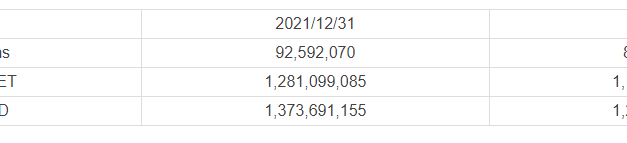
The VeChain Foundation has released its financial report for Q1 2022 showing that the project amassed an impressive $1.2 billion war chest but only spent about $4.1 million in the quarter.VeChain (VET) is a blockchain project designed to enhance supply chain management.. The Foundation’s May 10 financial report for Q1 2022 outlines its balance sheet as of March 31 and how it spent funds through the quarter. Although the treasury opened the year with $1.37 billion in assets between stablecoins, Bitcoin (BTC), Ether (ETH), and VET, it ended with $1.2 billion. The report states that most of the losses were incurred “due to crypto market fluctuations and other VeChain Foundation outgoings.”The BTC price has fallen 34% since, ETH has fallen 36%, and VET has fallen 54% since Dec. 31, 2021 when the project marked the beginning of its Q1 tracking through March 31.In the interest of continued transparency relating to the holdings and expenditures of the #VeChain Foundation, we are happy to share the Q1 2022 Financial Report:https://t.co/eJzc3NmBAx#SmartContracts #Blockchain #Finance #Cryptocurrency #VeChainThor $VET $VTHO— VeChain Foundation (@vechainofficial) May 10, 2022Of the $4.1 million outlaid in the first quarter the Foundation spent $1.8 million on ecosystem business development, which was the highest expense. That includes partnerships, custodians, wallet providers, brokers, community events, and ecosystem project cooperation.VeChain Foundation treasury from Q1 2022Next was $1.1 million on ecosystem operations such as team costs, office space, utilities, consulting fees, and external services.While the report states that the treasury will be used to “ensure the long term development of the VeChainThor blockchain,” it is unclear whether the foundation will open the faucet on its treasury for more expenditures on investments. VeChain Foundation Expenditures through Q1 2022Also absent from the report is how much money the Foundation earned through the first quarter. The VeChainThor blockchain collects fees for transactions that are distributed between validators and other stakeholders in the ecosystem. However, data on the total amount of fees accrued is not clear from the financial report.VeChain’s carbon emissions data management system and VeCarbon’s partnership with cement industry players were announced in the financial report. Related: VeChain can be used as payment in 2M stores — and VET bridged to BNB chainDuring Q1, VeChain launched its own stablecoin through the Stably stablecoin issuer known as VeUSD. It also formed a partnership with Amazon Web Service (AWS) to build the VeCarbon emission management software as a service (SaaS) system for China. VET has a market cap of $2.6 billion and is down about 0.6% over the past 24 hours, trading at $0.04 according to Coingecko data.

Čítaj viac

Top Shot creator unveils $725M fund to support Flow ecosystem

The Flow ecosystem is set to get a boost in support from a new $725 million fund that will be used to invest in the growth of the nonfungible token network.Flow (FLOW) is a layer-1 blockchain developed by Dapper Labs and purpose-made for NFTs. Dapper Labs also created the popular NBA Top Shot NFT collection. Flow utilizes an eco-friendly proof of stake (PoS) consensus algorithm.The new fund was backed by 17 firms that have experience backing other Web3 companies, including large investment firms a16z, Spartan Group, and CoinFund. The funds will be used to attract developers to bring their work onto Flow as opposed to competitor Ethereum (ETH) which still dominates NFTs despite high gas fees. Within the Flow ecosystem itself, the funds will provide support for gaming, infrastructure, decentralized finance (DeFi), content and creators.Today, we’re announcing a $725 Million ecosystem fund to accelerate growth across the entire Flow ecosystem This is the largest joint fund made for ANY blockchain, available for both existing and future developers #onFlow Meet the Flow Ecosystem Fund: https://t.co/8Y8qaLvccz pic.twitter.com/VBKbnZdQEQ— Flow (@flow_blockchain) May 10, 2022Projects awarded grants through the ecosystem fund will be supported by FLOW tokens investments, and what the fund’s webpage calls “in-kind support.”Flow is currently the third largest blockchain by NFT sales volume behind Ethereum and Solana (SOL). Not including May, throughout 2022, Flow has averaged $50.3 million in monthly NFT sales according to CryptoSlam, an NFT market tracker.Host of the NFT-focused podcast The First Mint LG Doucet tweeted on Tuesday a list of five new products he believes should be supported through the funds. They include a whitelist app to help users get whitelisted for a mint, a mobile app, video education, wallet integration on Shopify, and non-cartoon, animal, and athlete art. He added that Flow needs “actual INNOVATION, not just roadmaps that copy ETH projects.”$725M coming to $Flow ecosystemProducts we need built:- WL App like @PREMINT_NFT- Mobile App for @emerald_dao- Video Education on @Flowverse_- Wallet Integration on @Shopify- Non cartoon animal/athlete PFPsAnd actual INNOVATION, not just roadmaps that copy ETH projects— LG DOUCET (@LgDoucet) May 10, 2022

Although Flow is operated by Dapper Labs, which has produced some of the biggest NFT products over the last two years, its NFT sales still lag behind larger layer-1 ecosystems. This may be due to weaker network effects and a smaller ecosystem of decentralized apps (Dapps) running on it. The new ecosystem fund aims to tackle that shortcoming.Other Dapper Labs NFT products include CryptoKitties, one of the first NFT games, UFC Strike, NFL All Day, and Cheeze Wizards.Related: Otherside NFTs fall below mint price while cheaper ETH sees sales volume boostFLOW has a market cap of $1.4 billion and is up 20% over the past 24 hours to $4.01 according to CoinGecko data.

Čítaj viac

Získaj BONUS 8 € v Bitcoinoch

nakup bitcoin z karty

Registrácia Binance

Burza Binance

Aktuálne kurzy