Autor Cointelegraph By Brian Newar

Mashinsky says ‘Sharks of Wall Street’ circling around Celsius and other projects

The CEO of crypto lending and staking platform Celsius Alex Mashinsky believes “the Sharks of Wall Street” can smell blood in the water and are causing instability at several crypto projects.Mashinsky attributes recent Celsius (CEL) price falls, the brief Tether (USDT) depegging, and collapse of Terra (LUNA) — at least in part — to short sellers on Wall Street. CEL has fallen from its all-time high of $8.05 to $0.82, which is a 90% drop.In a Twitter Spaces event on Tuesday, some Celsius users claimed the platform liquidated their holdings as CEL dropped. They said trading was illiquid as the price fell, worsening their losses, and that Celsius should have supported the currency.Mashinsky said CEL had been affected by the wider crypto crash due to the collapse of Terra and that he believed someone was targeting the company. “This is not a coincidence. This is somebody who decided, ‘You know what? I’m going to take down all of Celsius,’” he said during the event.Cointelegraph contacted Mashinsky for further details. He explained there was a deliberate push on from Wall Street to profit by exacerbating crypto’s problems.“They took down Luna. They tried Tether, Maker, and many other companies. It’s not just us,” he said. “I don’t think they have [a] specific hate or focus on Celsius. They are all looking for any weakness to short and destroy.“The point is that the Sharks of Wall Street are now swimming in crypto waters.”Asked to clarify if he meant regulators, or the funds rumored to have attacked Terra, he clarified; “Nothing to do with regulation. Just short sellers looking for weakness.”Mashinsky also took issue with a Barron’s article about the Spaces event titled “Celsius Faces a Revolt as a High-Yield Crypto Plummets”.“We have 1.8 million customers and Barron’s wrote this article because two guys on Twitter complained that they got liquidated after taking a margin loan,” he said. The price of CEL has been on a steady downward trend throughout the year, from the Jan 1 price of $4.38 to the currently price of $0.82 according to CoinGecko. Celsius allows users to stake cryptocurrency which can be used as collateral for loans. Stakers earn up to 80% of the revenue earned by the platform. Regulators in various jurisdictions also have Celsius in their sights, forcing the platform to restrict non-accredited investors from earning interest on deposits in the U.S.Some CEL investors and stakers vented their frustrations with the price performance of CEL to Mashinsky in t May 19 AMA. One investor accused the Celsius team of sitting on its hands while token price tumbled as a result of the Terra fiasco. (Celsius previously denied it had sustained significant losses as a result and reports suggested it had rescued $500M from Anchor Protocol.) The investor said: “You know this stuff going on with Luna, the token obviously started tanking. Alex and the team did not step in whatsoever to support the price on the way down. They essentially just let it drop.”Related: Celsius Network’s crypto mining subsidiary SEC filing suggests plans for IPOIn the AMA Mashinsky assured community members that Celsius “is always working in the best interest of the community,” but that he “does not control price action” on the CEL token. “The culprit here has nothing to do with Celsius. It has everything to do with people FUDding and publishing bullshit information. So if you want to pick a fight, go pick a fight with those people and ask them ‘Why did you publish this article?’.”He added that the liquidations on the Celsius platform that occurred in the past two weeks caused people to get hurt, but he claimed that he personally lost more than anyone. He said, “I lost more value than all the other liquidated people combined.”

Čítaj viac

The Dept. of Commerce has 17 questions to help develop a crypto framework

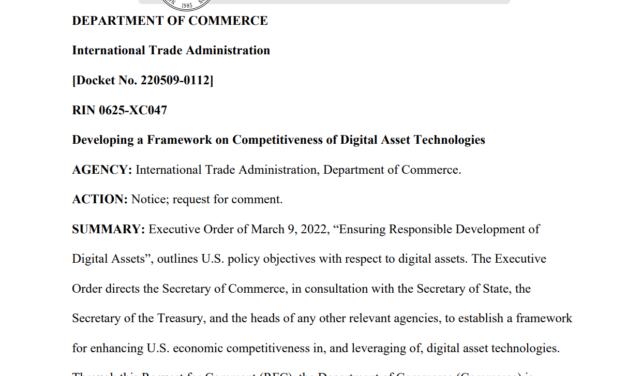
The US Department of Commerce is calling for submissions on how it can establish a framework that will bolster American economic competitiveness in digital assets including crypto and stablecoins.The Department of Commerce (DoC) intends on publishing a series of 17 questions in a request for comment through the International Trade Administration. The request will be published in the Federal Register on May 19. The questions pertain to the DoC’s efforts to develop a framework for challenges to the growth of American economics regarding digital assets, as requested by President Joe Biden’s Executive Order.The unpublished request for comment from the Department of Commerce.The questions will cover a range of topics related to crypto businesses in the US such as views on how regulations can enhance competitiveness and what obstacles business owners currently face. It will also cover digital asset mining, likely in relations to Bitcoin and Ethereum. One asks: “What, if any, is the future role of digital assets mining in the U.S. digital assets sector? In what ways can the U.S. government and U.S. companies drive competitive, sustainable (for the environment and energy consumption) development of digital assets?”The US is currently the largest Bitcoin mining country by producing 37.84% of the world’s hash power as of January, according to the Cambridge Bitcoin Electricity Consumption Index. By that metric, it appears there are many businesses that believe in the future of digital asset mining.Remember Biden’s crypto executive order from two months ago? Buried in it was homework for the Department of Commerce: Make a plan for driving U.S. competitiveness and leadership in crypto.Well… ():https://t.co/zvAbUpG7M8 pic.twitter.com/ymzm1f9g13— Adam Kovacevich (@adamkovac) May 10, 2022Among those miners, demand for sustainable energy sources and carbon neutrality is on the rise. Investors like Kevin O’Leary, who are driving demand for sustainable mining, told Cointelegraph on May 10 that the crypto industry is “at an interesting inflection point” when it comes to environmental conscientiousness. Although the Federal Reserve Board reiterated in its May 9 Financial Stability Report that it currently has no plan to develop a Central Bank Digital Currency (CBDC), one of the questions from the DoC will ask about the potential impact of a CBDC on business.The DoC will also ask whether digital assets can help unbanked Americans gain access to the financial tools they may need but cannot get through traditional means. Banking the unbanked has long been a use case that crypto industry insiders boast as a natural fit for the technology. “What role can the Federal government and the digital assets sector play to ensure that under-served Americans can benefit from the increased commercial availability of digital assets?”The request for public comment will inform the DoC’s thinking in making the framework for an American digital asset business regulatory framework. This early, open approach towards the DoC’s efforts reflects Secretary of Commerce Gina Raimondo’s March 9 statement in response to President Biden’s Executive Order. She said her department would promote “the resilience of the U.S. financial system” by working with digital assets industry partners to “mitigate risks for the businesses and individuals who rely on it.”Related: US agencies warn against the influx of North Koreans in IT and crypto jobs onlineIf the questions are published on May 19 as expected, comments will be accepted through July 5 and can be sent to digitalassets@trade.gov.

Čítaj viac

'Grim Reapers' financial crimes unit revived to investigate Terra collapse

Legal troubles are mounting for the co-founder of failed Terra crypto project Do Kwon as the South Korean government revives the dormant “Grim Reapers of Yeoui-do” to investigate Terra’s fall.The special investigative and prosecutorial team consists of members from various financial regulators, and is designed to prosecute securities fraud and unfair trading schemes. Potentially at risk are co-founders Do Kwon and Shin Hyun-seong, along with core members of the Terra team. Yeoui-do is the financial center of Seoul.Today: Korea’s “Grim Reapers of Yeouido” – Financial and Securities Crime Joint Investigation Team – are back after 2.5 years. And its first target is $LUNA / @terra_money— Jun (@zunahn) May 18, 2022Korean news outlet SBS News confirmed on Wednesday that the Terra case would be the first the resurrected Securities Crimes Joint Investigation Team would investigate. A representative from the team told SBS News that, “The Terra case caused severe damage to average citizens which led us to designate this as the first investigation.”Reforming the feared investigative team may be a political move by the new conservative President Yoon Seok-yeol, reversing the decision by the previous liberal Moon Jae-in administration to disband it. However, the severity of the Terra situation is illustrated by the fact that it is the first case the investigators will handle in two years. The team earned the moniker The Grim Reapers due to the high-profile cases it handled. One of the largest cases the team handled was the $1.2 billion Lime Asset Management embezzlement scandal. The team was disbanded before the investigation was complete, so that case is set to be reopened.Before being disbanded, the team racked up 346 arrests from 965 cases prosecuted from 2013 to 2020.Terra (LUNA) is a layer-1 blockchain. Luna and the stablecoin Terra USD (UST) were each among the top ten cryptocurrencies by market cap until a sell off of UST on May 8 sparked a death spiral that has led to billions in losses. On May 8, Terra had a market cap of $24.8 billion, but is now $959 million according to CoinGecko.Many in the community hold Kwon responsible for the collapse of the project. In South Korea, a group of Terra investors is also set to sue Kwon in civil court for damages and in criminal court for fraud. They will also push for the court to seize Kwon’s assets.$LUNA and $UST Korean investors have filed both civil and criminal lawsuit against Do for committing fraud. They also filed to order a provisional seizure (freeze) of his assets.They are represented by legal firm LKB & Partners.— Doo | StableNode @Permisionless (@DooWanNam) May 18, 2022

As reported by Moonwha Ilbo (Culture Journal) on May 18, the legal team involved in the criminal case will be prosecuting based on provisions in the Capital Markets Act, which is used to regulate financial aspects of the crypto industry but which may be replaced by crypto-specific laws. The legal team at LKB & Partners, the firm handling the case, have a personal stake in the project, as partner Kim Hyeon-kwon stated to Moonwha Ilbo, “Some attorneys at this law firm were investors in Terra.”A representative from the law firm did not immediately respond to a request for comment.Related: Analysts assess the aftermath of the Terra (LUNA) collapse | Cointelegraph interviewKwon’s legal troubles extend beyond South Korea as a resident of Singapore filed suit against Kwon last week on behalf of at least 1,000 other residents who invested in the Terra ecosystem.

Čítaj viac

South Korean legislature considering new licensing system for crypto

A report commissioned by South Korea’s federal government recommends the domestic crypto industry adopt a licensing system for exchanges and token issuers as a way of protecting investors.The report issued by the Financial Services Commission (FSC) to the National Assembly, the country’s legislature, also calls for new regulations to mitigate insider trading, pump and dump schemes, and wash trading.The new regulations would be stricter, and the penalties for failure to comply would be harsher, than those in the Capital Markets Act that the domestic crypto industry currently abides by. The Comparative Analysis of the Virtual Property Industry Act  report obtained exclusively by Korea Economic Daily on May 17 reveals a recommendation to establish a licensing system that would apply to coin issuers, such as companies that operate initial coin offerings (ICO) and crypto exchanges. Varying degrees of licenses would be issued based on the risk involved.Regulating coin issuers through a robust licensing system is considered the “most urgently needed protection” in the market today. That position may be underscored by the untimely market crash sparked by the fall of the Terra (LUNA) project, whose South Korean founder Do Kwon may find himself called before the National Assembly to explain what happened.One recommended regulation would force coin issuers to submit a white paper to the FSC about their project that includes details about the company’s officers, how it plans to use funds raised through an ICO, and what risks are associated with the project. Updates to the white paper would have to be submitted at least seven days before proposed changes could take effect. Even companies with headquarters abroad that want their tokens traded on Korean exchanges would be required to adhere to the white paper rule.It is likely that the FSC had stablecoins on their agenda well before problems arose last week for Terra USD (UST), Dei (DEI), and Tether (USDT). However, there are recommendations to put requirements on stablecoin issuer asset management that would apply to how they use collateral and how many coins an issuer can mint.The report also aims to curb shady trading activity which local exchanges and coin issuers have been accused of for years. It suggested regulations on insider trading, price manipulation, pump and dump schemes, wash trading, and industry standard transaction fees. Cointelegraph reported in April that an industry insider speaking to local media acknowledged that provisions in the Capital Markets Act may not be adequate to properly govern the crypto industry.Related: Leaked report: South Korea to establish crypto framework by 2024South Korea’s new President Yoon Seok-yeol was elected in part due to his eagerness to understand the crypto industry. On May 3, he declared that his regime would push through a bill that extends the tax-exempt status of crypto investment gains until a proper legal framework is in place. The report revealed today could be the beginning of the framework President Yoon had in mind for the crypto industry.

Čítaj viac

Analysts note parallels with March 2020: Will this time be different?

Analysts in both crypto and traditional markets have noted some startling similarities between the recent downturn and the one caused by a pandemic panic in March, 2020.The real question is whether it’s the start of a larger downturn or if there will be a significant bounce-back as in 2020 that led to an extended bull run in both crypto and stocks markets.Podcaster and author of The Pomp Letter, Anthony “Pomp” Pompliano is on the permabull side of the ledger, tweeting on May 18 that since March 1, 2020 when one Bitcoin cost about $8,545, “Bitcoin is up 340%.”Bitcoin is up 340% since March 1, 2020.As central banks around the world devalued their currencies at a historic rate, there is only one asset that stood out from the pack.#bitcoin is the savings technology that shields billions of people from undisciplined monetary policy.— Pomp (@APompliano) May 17, 2022Among those hopeful of a turnaround is investment firm Real Vision’s CEO Raoul Pal who believes Bitcoin markets have been painting a pattern that shares traits with the March 2020 crash. In his May 13 episode of Raoul Pal Adventures in Crypto, Pal explained that with the downward price action last week, Bitcoin (BTC) may have “shot straight down” to the bottom of the current wedge formation and is now in a range that will eventually lead to another rise in price. He said, “That was exactly the kind of pattern we had in March 2020.”On March 12, 2020, investors panic-sold many assets, including Bitcoin, as fear about how the market would be impacted by the COVID-19 pandemic and global lockdowns. On that day, Bitcoin fell 45% from $7,935 to $5,142 according to CoinGecko. The current decline in traditional markets has led to a loss of $7.6 trillion in market cap from the tech heavy Nasdaq, in non-inflation adjusted terms, more than the dot-com bubble and the March 2020 sell-offs.The numbers are obviously not adjusted for inflation but still mind-blowing to see in this context. pic.twitter.com/aHem93mhpo— Mati Greenspan (@MatiGreenspan) May 17, 2022

The Crypto Fear and Greed Index plunged to 8 on May 17 which is the lowest since March 2020.#Crypto fear & greed index is at 8 out of 100.The lowest number since the COVID-19 crash in March 2020. pic.twitter.com/jKVTcjrXV1— Michaël van de Poppe (@CryptoMichNL) May 17, 2022

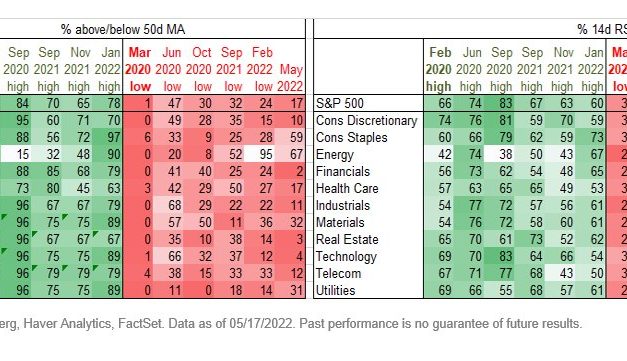
The 50 day moving average (MA) of financials, real estate, and technology investments is close to the overwhelmingly oversold levels seen just over two years ago. Respectively, in March 2020 those levels were 0, 0, and 1 compared to 2, 3, and 4 so far in May based on data from Fidelity Investments. In a May 18 tweet, Fidelity’s own Director of Global Macro Jurrien Timmer called March 2020 “one of the most oversold setups in the history of the market.”Managing partner at The Future Fund Gary Black pointed out on May 17 that Tesla (TSLA) is trading at a 20% discount, the widest from analyst target price since March 2020. He added that “Over the next 12 months, $TSLA rose 660%.”The last time $TSLA traded at this wide a discount (25%) vs the avg Street PT ($984) was in March 2020, at the height of the Covid crisis. Over the next 12 months, $TSLA rose 660%. Source: https://t.co/5fcVwWX78i pic.twitter.com/z2AHe5zkVi— Gary Black (@garyblack00) May 16, 2022

The S&P 500 Index also displays similarities as it recorded a 52-week low of 3,930 on May 12 only to bounce back to 4,088 by market close on May 17. Chief Market Strategist for financial research firm LPL Research observed in a May 18 tweet that the last time the index had done that was in March 2020.The S&P 500 just made a 2% gain in two of the past three days coming off of a 52-week low.The last times that happened?March 2009 and March 2020.— Ryan Detrick, CMT (@RyanDetrick) May 17, 2022

Before traders get too excited, market conditions are very different now, with rising inflation and interest rates. Back then, governments reacted with unprecedented support packages to prop up prices. Reuters reported on May 14 that the strong bounce in the market in 2020 was fueled by what it called an “unprecedented Fed stimulus.” Analyst and author of the Rekt Capital Newsletter, Rekt Capital tweeted on May 17 that BTC “is entering a period of outsized opportunity” based on analysis of the Log Channel which he says resembles what happened in March 2020. However he’s not clear if we’ve bottomed out yet.Related: Fear & Greed Index hits lowest since March 2020 even as Bitcoin price hits $30.5KLast time #BTC lost the Log Channel was in March 2020This is when $BTC also dipped below the blue 200-SMALog Channel clearly shows BTC is entering a period of outsized opportunityBut does price need to drop as low as to the 200-SMA to completely bottom?#Crypto #Bitcoin pic.twitter.com/hTxwfWYdkH— Rekt Capital (@rektcapital) May 16, 2022

As of the time of writing, Bitcoin is up 1.1% over the past 24 hours trading at $30,545.

Čítaj viac

Získaj BONUS 8 € v Bitcoinoch

nakup bitcoin z karty

Registrácia Binance

Burza Binance

Aktuálne kurzy