Autor Cointelegraph By Brian Newar

Coinbase offers 'thousands of tokens' in expanded swap service

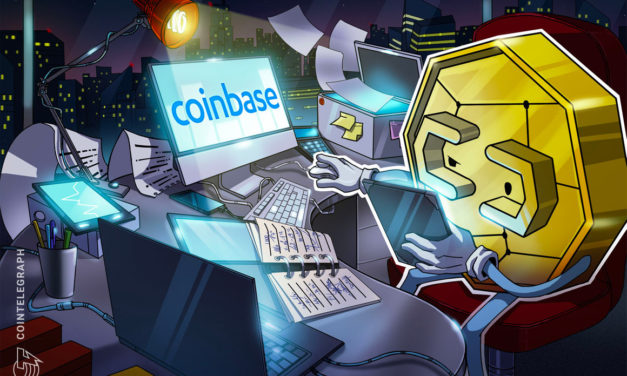
America’s largest crypto exchange Coinbase has added the BNB Chain (formerly Binance Smart Chain) and Avalanche to the Coinbase Wallet’s list of supported networks where users can swap and store cryptocurrencies.The May 24 blog post from the exchange boasts that the added functionality will provide access to “thousands of tokens” which constitute a “greater variety than most traditional centralized exchanges can offer.”One Wallet. Even more networks. Thousands of tokens.Now supporting token swaps on @avalancheavax and @BNBCHAIN on Coinbase Wallet.Learn more – > https://t.co/ZdEg1T8s53 pic.twitter.com/prWhSlPYl8— Coinbase Wallet (@CoinbaseWallet) May 23, 2022The added functionality to BNB Chain (BNB) and Avalanche (AVAX) brings the total supported networks up to four, including Ethereum (ETH) and Polygon (MATIC). Users of the wallet who wish to trade on-chain can use Coinbase’s own in-app decentralized exchange (DEX) on four networks. Token bridging is not yet available.Coinbase Wallet allows users to self-custody their crypto and provides access to on-chain as opposed to the features available on Coinbase’s centralized platform.Coinbase currently has only 173 tokens listed on its exchange. These numbers pale in comparison to the thousands available across the four networks Coinbase Wallet users now have access to. The exchange stated that in coming months, “we’ll be making it possible to conduct swaps on an even greater variety of networks.”“Not only will trading expand, but we’re also planning to add support for network bridging, allowing you to seamlessly move tokens across multiple networks.”Network bridging involves sending tokens between networks without passing through a centralized exchange (CEX). Popular token bridges include Multichain and Wormhole.Although only available for a small number of users at first, Coinbase is also rolling out its Web3 wallet and browser for the mobile app. This will give mobile traders access to the wide ecosystem of DEXes on supported networks beyond just Coinbase’s own.Related: Coinbase launches new crypto think tank to help shape policiesBNB Chain had $74 billion in trading volume, while Avalanche enjoyed $68.5 billion in trading volume over the past 24 hours according to CoinGecko.

Čítaj viac


Core Ethereum developer details changes to expect after the Merge

Core Ethereum (ETH) developer Tim Beiko has outlined a series of suggestions and expectations about the upcoming Merge for applicatio and protocol developers on Ethereum.For the average users of apps and protocols, Beiko simply suggested testing things out to ensure nothing is broken as more tests are executed. He tweeted on May 24 “Run stuff, if something is unclear or broken, leave a comment.”Yes! Run stuff, if something is unclear or broken, leave a comment, as you probably aren’t the only one with that issue User PoV guides, how-go’s, etc. are always super useful, too! https://t.co/tyWqgVBSuc— Tim Beiko | timbeiko.eth (@TimBeiko) May 23, 2022Beiko urged users and developers to “pay attention and make sure you are ready” for the Merge. The Merge is the highly complex and long-awaited moment when the Ethereum network switches from Proof-of-Work (PoW) to Proof-of-Stake (PoS) consensus. At that point, it will be known as “Consensus Layer” and is expected to occur in August this year. Testing on several testnets has been focused on ensuring there are no cross-client issues or that existing applications don’t entirely break after the Merge. Beiko pointed out in a separate Twitter thread that such problems are likely to be rare because “99% of changes affect the protocol layer,” while “there are almost no changes done to the application layer.” A few thoughts on #TestingTheMerge: 1. Protocol layer testing != application level testing. Client + protocol testing teams focus mostly on changes to the protocol not causing cross-client issues or breaking existing applications.— Tim Beiko | timbeiko.eth (@TimBeiko) May 23, 2022

Beiko stated that developers should be aware there will be two significant changes to how smart contracts work with the Merge. First, he reminded them that the method for beacon randomness, which helps run applications, will change. This will be necessary for the switch to PoS, and was published in an Ethereum Foundation (EF) update last November.The second change will be that block times will shorten from 13 seconds per block to 12. As a result of this change, smart contracts that use block production speed as a measure of time will run one second faster after the Merge takes place. Beiko showed an air of confidence that despite the delays in executing the Merge, potential problems have been consolidated into a single echelon.“Aside from cross-client testing and these two edge cases, the biggest risk of disruption is in “tooling and infra pipelines”.”He concluded by assuring if any other issues arise during the thorough testing and shadow forks taking place, the Merge would be further delayed to ensure the security of the network.“At any point, if we find issues, we’ll obviously take the time to fix + address them before moving forward. Only then will we think about moving mainnet to proof of stake.”ETH investors who are worried about coins being unlocked and dumped when the Merge takes place can rest easy. DeFi educator Korpi on Twitter explained on May 23 that the ETH staked on the Beacon Chain now cannot be unlocked without a later upgrade to the network once the Merge takes place. This includes rewards earned from staking.Related: ‘Huge testing milestone’ for Ethereum: Ropsten testnet Merge set for June 8He also stated that once coins are unlocked, they will be released in tapers rather than all at once and that those coins are often an investor’s “never-sell stack” that are not likely to be sold.There are currently 12.6 million ETH staked on the Beacon Chain. The Beacon Chain was one of the first steps taken toward making Ethereum a PoS network, launched in December 2020.

Čítaj viac

Layer-2 adoption could spur the next crypto turning point

A mysterious Redditor has made a data-driven prediction that the next major phase of development in the blockchain space will be in layer-2 solutions, primarily on Ethereum.The May 22 post explains that “We’re at a turning point” where the industry is moving away from bridging between L1 blockchains towards L2’s which are “right out of the gate, more secure and decentralized than alt-L1s and are built to use sound money on a credibly neutral platform.”“L2 adoption is happening now, even if it is slow and in bursts. Behind the scenes, L2’s are improving reliability, decreasing fees, and increasing accessibility. L2’s are still building and improving, and that’s fantastic.”An L2 scaling solution takes advantage of the security of a L1 chain like Ethereum (ETH) and alleviates traffic on it by ‘rolling up’ a number of transactions into a single package to be settled at once.Other L1 chains like Solana (SOL), which boasts relatively cheap and fast transactions, have garnered support from users turned off by high fees. The average SOL transaction costs about $0.0025 while ETH transactions cost about $1.30 at the time of writing. Despite that wild disparity, demand for Ethereum block space has remained overwhelmingly dominant as its $73.89 billion total value locked (TVL) outweighs Solana’s $4.24 billion according to DeFi Llama blockchain tracker. Additionally, Solana has been plagued with reliability issues recently. As of the time of writing, Arbitrum is the largest L2 on Ethereum with $2.65 billion in TVL according to L2beat. The entire Ethereum L2 ecosystem has a TVL of $4.77 billion. These numbers may be set for an explosion if the right forces conspire to draw users and capital away from other L1’s.Several major decentralized apps (Dapps) are already deployed on L2’s. Decentralized exchange (DEX) SushiSwap (SUSHI) and yield aggregator Curve (CRV) are on Arbitrum. Also, crypto derivatives protocol Synthetix (SNX) and DEX Uniswap (UNI) are on Optimism.Related: MakerDAO deploys on layer-2 network StarkNet to enhance functions of DAI stablecoinThe incoming Optimism airdrop could mark the beginning of a rapid influx of users to L2’s. This may be due to the same network effects that attracted users to Ethereum and Ethereum Virtual Machine (EVM)-based decentralized finance (DeFi) protocols over the past two years.Optimism is an L2 with $474 million in TVL. EVM chains are ones that are compatible with Ethereum token standards, such as Binance Chain (BNB), Polygon (MATIC), and Fantom (FTM).Ultimately, if there is an increase in L2 utility, the Ethereum L1 will have a natural increase in use, which could further solidify Ethereum as the world’s leading smart contract and decentralized application platform.

Čítaj viac

Interest in Ethereum Name Service reaching ‘critical mass’

The Ethereum Name Service is having its best month on record for new registrations, account renewals, and revenue thanks to community awareness and low gas fees.Lead developer at Ethereum Name Service (ENS) Nick Johnson tweeted on May 23 the metrics for the Web3 domain service through May so far. He noted numbers were poised to shatter existing records because they were already at all-time highs, “and there’s still a week of May left.”May is now an All Time High for every single ENS metric we track – registrations, renewals, revenue (ETH & USD) and income (ETH & USD).And there’s still a week of May left.pic.twitter.com/u0tTcVPr3f— nick.eth (@nicksdjohnson) May 22, 2022Jonson told Cointelegraph on Monday that the main factor contributing to higher demand in ENS domains is that it is a place where people can “form shared communities without any overarching structure imposed on them beforehand.” This has had astounding results for the domain service. “ENS has reached a critical mass of awareness and adoption; most wallets support ENS names, so the usability factor is significant.”ENS is an open-source blockchain protocol founded in 2017 that allows people to assign a digital identity to their Ethereum (ETH) wallet. Each name is a nonfungible token (NFT) that ends with .eth and can act as an address, a cryptographic hash, or a website URL.The data shared by Johnson shows that there have been 304,968 new registrations, 13,260 renewals, and 3,165.85 ETH in revenue so far in May. All of these metrics leave previous highs in the dust.Johnson also said that ”low gas fees definitely have an impact” on the higher onboarding and renewal rates. To send a fast transaction on Ethereum costs about 22 GWEI as of the time of writing, worth about $0.92 according to gasprice.io. In periods of high volume, gas fees can be higher than $50, which may act as a deterrent to using the network unless in emergencies.“You can register a 5+ character ENS name for a year for $5 – high gas fees can make the cost several times that, so gas prices have a big impact on the affordability of ENS names.”Interest in ENS domains has been quickly rising since April when social clubs such as the 10k Club within ENS gained tremendous attention. The 10k Club was formed by owners of ENS domains numbered between 0-9999. Both new registrations and renewals have nearly doubled since then.Related: Web3, NFTs, Metaverse: The tools for a truly decentralized futureENS’s record high revenues coupled with a market downturn has sparked plans in the ENS decentralized autonomous organization (DAO) to squirrel away funds for ongoing development. Johnson stated that the income slated for funding development and maintenance “for the indefinite future” would help the project weather further market volatility.“With that guarantee against market effects, additional funds can be used more freely to help grow the ecosystem.”However, the bullish metrics have not been reflected in ENS prices. The token has been on a steady decline since its November 2021 launch in which all .eth domain holders were airdropped a portion of the supply. ENS has fallen 86% from its November all-time high to $12.21 according to CoinGecko.

Čítaj viac

Commonwealth Bank puts crypto trading trial on ice as regulators dither

The Commonwealth Bank of Australia (CBA) has put its plans for a second pilot program of crypto trading services on hold indefinitely and cut off access to those in the first round of testing.CBA sent Cointelegraph a transcript of a Tuesday bank briefing where CEO Matt Comyn said that he was still waiting on regulatory clarity. He also said that he was “working with a number of regulators very closely, as you would imagine, about the appropriate treatment of this particular product.”“Our intention still, at this stage, is to restart the pilot, but there are still a couple of things that we want to work through on a regulatory front to make sure that that is most appropriate.”Comyn said there is a Treasury submission for the program already under review, but he did not share any expected timeline for its completion.Comyn said that last week’s wild volatility appeared to support the need for the extended delay even though the second pilot program had already been put on ice by April after financial regulators balked at giving regular bank users’ easy access to crypto. The Australia Securities and Investment Commission (ASIC) objected to the CBA’s services on the grounds that consumer protections were absent.He said “It is clearly a very volatile sector that remains an enormous amount of interest.”“But alongside that volatility and awareness and I guess the scale, certainly globally, you can see there is a lot of interest from regulators and people thinking about the best way to regulate that.”Comyn also suggested that the bank was awaiting the result of Saturday’s Federal election. If a new regime comes into power, it could spell broad changes in the crypto regulatory landscape which Comyn said “will be a focus for the incoming government to think about.”Leadership and entrepreneurship lecturer at Swinburne University Dr. Dimitrios Salampasis told The Guardian that CBA may be going slowly in case of reputational damage. Taking into account the recent price crash across the crypto markets due to the collapse of Terra (LUNA), Dr. Slampasis said “balancing risk, brand equity and regulatory clarity will be key so as to minimize disruption in CBA’s current business model.”Related: Aussie crypto ETFs see $1.3M volume so far on difficult launch dayThe CBA was the first major bank in Australia to offer crypto services through its mobile app last November. As the pilot program proceeded, it promised access to the app’s 6.5 million users once fully rolled out. As of now, those plans are on hold indefinitely.

Čítaj viac

Získaj BONUS 8 € v Bitcoinoch

nakup bitcoin z karty

Registrácia Binance

Burza Binance

Aktuálne kurzy