Autor Cointelegraph By Brian Newar

Kenyan energy company entices Bitcoin miners with geothermal power

Kenyan energy company KenGen has put out a call to Bitcoin miners to move nearby and buy its excess renewable power capacity.KenGen claims 86% of its energy is generated from renewable sources, mostly geothermal from pockets of ground source heat in the Great Rift Valley. Local news outlet The Standard reported that KenGen has space at its new industrial park in Olkaria, near its flagship geothermal power station, which could be rented to Bitcoin (BTC) miners.The Acting Director of geothermal development at KenGen Peketsa Mwangi said that his company was willing and eager to have the miners call Kenya home. “We’ll have them here because we have the space and the power is near, which helps with stability.”Despite his enthusiasm, there have not yet been any reports of miners looking to go to Kenya.Cambridge’s Bitcoin Electricity Consumption Index (CBECI) suggest that the eastern African nation currently houses no known Bitcoin mining operations, but it appears to be ideal for miners due to the region’s estimated potential 10,000 MegaWatt (MW) of geothermal energy capacity. KenGen is currently running at a maximum generating capacity of 863 MW after installing another geothermal power plant in April according to Kenyan financial news outlet Capital FM.By inviting miners to the country, KenGen may be able to accomplish several goals at once. It can increase miners’ environmental sustainability, which has come under great scrutiny around the globe. Mining consumes 119.5 TerraWatt hours (TWh) per year, more than the entire country of the Netherlands, according to CBECI. Only 31 countries consume more energy.It may also drive demand for more development in KenGen’s power grid to increase total supply and reduce cost. Kenya currently has the 12th most expensive electricity in the world where one kilowatt hour (KWh) costs about $0.22 according to Statista. The high cost of electricity in the country may be due to its electrification rate. By 2020, only around 70% of the population had access to the centralized grid according to the WorldBank. Energy grid tracker Energypedia states that Kenya’s high cost to connect to the grid poses a “major obstacle” to its expansion.The Kenyan government could also enjoy greater revenue through fees from miners and even taxes. The Kazakhstan government, for example, is poised to earn as much as $1.5 billion in revenue from miners over the next five years (although it only raked in $1.5 million in Q1 2022).Related: Bitcoin daily mining revenue slumped in May to eleven-month lowKenya enjoys an especially high rate of crypto adoption from its volume of peer-to-peer transactions. The Central Bank of Kenya (CBK) has been exploring its options with a central bank digital currency since last year. CBK stated lower fees and faster transfer rates as benefits of utilizing a CBDC in February.

Čítaj viac

Maker founder proposes MetaDAOs and synthetic ETH in 'Endgame Plan'

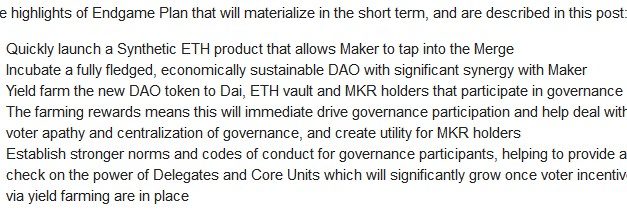
The co-founder of MakerDAO Rune Christensen has issued a new monumental proposal to push the project into its final form called The Endgame Plan. Across 3,000 words including 35 detailed infographics, Christensen explained that the current model of governance at Maker creates a deadlock which makes it difficult for the protocol to effectively process “complicated real world financial deals” and which compromises its competitiveness with financial institutions.Central to Christensen’s May 31 plan is the formation of MetaDAOs designed to tackle specific governance issues within the Maker ecosystem and alleviate congestion on the “slow and single threaded decision making process” that exists now. Each MetaDAO can be thought of like a subsection of MakerDAO, which would issue its own token and be governed by Maker participants interested in its particular goal.Maker (MAKER) is a smart contract lending platform that issues DAI (DAI) stablecoins using Ether (ETH) as collateral. The Maker Foundation previously held responsibility for protocol governance, but the decentralized autonomous organization (DAO) took over last year.Although he feels that Maker’s complexity gives it the ability to pounce on the best opportunities, the use of MetaDAOs would help the protocol focus its abilities into smaller and more manageable parts. He wrote that with de-risked MetaDAOs, “the Maker Core could become a lot simpler than it is today, creating a best of both worlds situation.”“MetaDAOs also allow Maker to overcome the single threaded nature of the current governance process, and let many separate MetaDAOs prioritize and execute in parallel with almost unlimited potential for scale and autonomy.”The first MetaDAO Christensen would see formed is M0, a CreatorDAO to seek out opportunities for profit outside of Maker and to take on some of Maker’s excess complexity. M0 would issue MZR governance tokens through a fair launch via yield farming.The highlights of The Endgame PlanSynthetic EtherChristensen also proposes Maker launches a synthetic ETH token called MATH to take advantage of the Merge and generate more revenue with the lowest possible initial cost.“The lowest hanging fruit of the Endgame Plan Launch is the acceleration of the existing roadmap milestone to quickly launch a simplified version of Synthetic ETH.”MATH fees could initially be set to 0% in order to incentivize its use, but eventually it could generate revenue for the protocol as synths have done for THORChain.The focus in the plan on revenue-generating products may be due to the fact Maker is running in the red. Core developer at Yearn Finance (YFI) Banteg tweeted on Friday that “MakerDAO is in war mode again,” and shared an image from the proposal showing it was no longer profitable. Rune’s back from the vision quest. MakerDAO is in war mode again.https://t.co/XmHeWv0DGO pic.twitter.com/fCHhoKX38M— banteg (@bantg) June 2, 2022The crypto community has had mixed reactions to the new proposal. On June 3 Rari Capital CEO Jay Bhavnani called the proposal “unnecessarily complex and over-optimizing for many problems.”Related: These are the least ‘stable’ stablecoins not named TerraUSDHowever Compound Finance (COMP) founder Robert Leshner tweeted on June 3 that he was pumped, saying the plan was “Complex, but in some sense, ‘back to the basics’ of what Maker was intended to make: new synthetic assets.” As of now, only Synthetic ETH has been proposed by Christensen.I’m so pumped for the @MakerDAO Endgame Plan by @RuneKek Complex, but in some sense, “back to the basics” of what Maker was intended to make; new synthetic assets.https://t.co/d57xO1L11t— Robert Leshner (@rleshner) June 2, 2022

Čítaj viac

OpenSea ‘insider trading’ case see NFTs labeled securities: Former SEC lawyer

Former Securities and Exchange Commission lawyer Alma Angotti says this week’s news about an OpenSea employee being charged with insider trading could open the doors to non-fungible tokens being labeled as securities. On Wednesday, in a first for the industry, prosecutors in Manhattan charged former OpenSea product manager Nathaniel Chastain with insider trading. The U.S. Attorney’s Office for the Southern District of New York said the exact charges were “wire fraud and money laundering in connection with a scheme to commit insider trading.” Until now, the phrase “insider trading” has not been used in regard to cryptocurrency and typically refers to insider trading of securities.Related: EU commissioner calls for global coordination on crypto regulationAngotti was once an enforcement official at the SEC, the U.S. Department of the Treasury’s Financial Crimes Enforcement Network, and the Financial Industry Regulatory Authority. She is now a partner at a consulting firm called Guidehouse. She told TechCrunch: “It could very well be a security under the Howey Test — if you’re buying a piece of an NFT and hoping the price will go up so you make money from it, that’s not very different [from securities].” The Howey Test is used to determine if a transaction qualifies as an investment contract, or security, which is subject to disclosures and registrations. An investment contract exists if an investment results in the expectation of profit from the efforts of others.The OpenSea case of insider trading against Nathaniel Chastain claims that he used anonymous hot wallets and accounts on OpenSea itself to purchase 45 NFTs over the course of a few months that he knew in advance would be featured on the home page. He would then sell them for a profit after they became featured and rose in valu.According to Angotti, the charges are not surprising:“Misappropriating your employer’s confidential information is fraud, and once you move the proceeds of that fraud through the monetary system, it’s money laundering.”In similar news today, the Commodity Futures Trading Commission, which regulates commodities rather than securities, is suing Gemini claiming the crypto exchange lied in their futures contract evaluation. The CFTC claimed that Gemini misled them in 2017.

Čítaj viac

Fed money printer goes into reverse: What does it mean for crypto?

The Federal Reserve is starting the process of paring back its $9 trillion balance sheet that ballooned in recent years in a move called Quantitative Tightening (QT). Analysts from a crypto exchange and financial investment firm have conflicting opinions about whether QT, starting on June 1, will put an end to a decade of unprecedented growth across crypto markets.The worst part about this is that I would imagine ~80% of Americans have no idea what QUANTITIVE TIGHTENING is Why would we, this wasn’t taught in public school The SEC should worry about educating Americans on these terms as I believe that’s part of “PROTECTING” us https://t.co/Z8RwUNPJwF— WendyO.eth ✨ (@CryptoWendyO) May 31, 2022Laypeople can consider QT the opposite of Quantitative Easing (QE) or money printing which the Fed has been engaged in since the start of the Covid-19 pandemic in 2020. Under QE conditions, more money is created and distributed while the FED adds bonds and other treasury instruments to its balance sheet.The Fed plans on shrinking its balance sheet by $47.5 billion per month for the next three months. In September of this year, it plans on a $95 billion reduction. It aims to see its balance sheet reduced by $7.6 trillion by the end of 2023.Bitcoin has never once in its history been in a bull market while the Federal Reserve did quantitative tightening. Smart whales spent the last 12+ months dumping their bags on dumb retail. The mega crash is inevitable!— CryptoWhale (@CryptoWhale) May 4, 2022

Pav Hundal, manager at the Australian crypto exchange Swyftx, believes that QT could have a negative impact on markets. He told Cointelegraph on Wednesday that “It’s very possible you might just see growth in market cap trimmed slightly.”“The Fed is culling assets harder and faster than a lot of analysts had expected and it’s difficult to imagine this won’t have some kind of impact on investor sentiment across markets.”Initiated in March 2020, the impact of QE on the crypto market was dramatic. CoinGecko data shows that the crypto market cap languished through 2019 and early 2020, but a vibrant bull market began in late March 2020 as the money printer fired up. The total crypto market cap burst from $162 billion on March 23, 2020, to a peak of just over $3 trillion last November. Over a similar time frame, the Fed balance sheet increased 2.1 fold from $4.17 trillion on Jan. 1, 2020, to $8.95 trillion on June 1, 2022. That is the fastest rate of increase since the last global financial crisis starting in 2007.Related: UN agency head sees ‘massive opportunities’ in crypto: WEF 2022Financial advisory firm deVere Group CEO Nigel Green believes market reactions to QT will be minimal because “it’s already priced in.” Green said there may be a “knee-jerk reaction from the markets” because of the unexpected speed with which QT is being rolled out, but he sees it as a little more than a wobble.“Furthermore, we expect a market bounce imminently, meaning investors should be positioning portfolios to capitalise on this.”Wage increases among American workers, especially in the hospitality industry, have already been observed as labor demand remains high. Assuming wages remain high through QT, the US may emerge from the economic downturn with lower income inequality. Crypto market analyst Economiser explained in a May 31 tweet that if people wind up with more cash in their pockets from their higher wages, “the crypto market could ultimately benefit” from QT.Wage equality:Interestingly, the highest wage growth is in the hospitality & retail sectors.This could mean that the US comes out of this economic downturn with ↓ income inequality.And if more people have disposable income, the crypto market could ultimately benefit. pic.twitter.com/J3DQ2DwnDZ— Economiser (@economiserly) May 30, 2022

Swyftx’s Hundal added that while markets are experiencing increased volatility lately, Bitcoin (BTC) could benefit as it is now demonstrating its position as a bellwether asset. He noted that Bitcoin dominance is currently at about 47%, up by eight percentage points from the start of 2022. He said, “There are different ways to interpret this,” adding:“It does suggest that market participants are seeking to park value in Bitcoin, meaning we could see weakness continue to trend across alt coin markets if current market conditions continue to play out.”

Čítaj viac

Dogecoin's parents are fighting: Musk and Jackson Palmer exchange barbs

Billionaire Elon Musk and Dogecoin (DOGE) co-founder Jackson Palmer are locked in battle on social media over Palmer’s claim that he could remove Twitter bots with a simple Python script.Australian Palmer said in an interview that his script was capable of automatically tweeting replies to scam tweets as a way of indicating that users should beware of the danger. He told news outlet Crikey on May 30 that Musk had reached out to get the script, but claimed the billionaire’s technical knowledge was so deficient that he didn’t know how to run it.“Elon reached out to me to get hold of that script and it became apparent very quickly that he didn’t understand coding as well as he made out.”Adding insult to injury, Palmer recounted a year ago calling the SpaceX founder, a “grifter” who “sells a vision in hopes that he can one day deliver what he’s promising, but he doesn’t know that.”Musk took the comments badly, and fired back at Palmer on May 31 on Twitter. He suggested Palmer’s code could not deliver on its promise of addressing the Twitter bot problem, adding “My kids wrote better code when they were 12.”“You falsely claimed ur lame snippet of Python gets rid of bots. Ok buddy, then share it with the world …”He challenged Palmer to make the script public, which would open it to greater scrutiny. Palmer has not yet done so.On May 17, Musk tweeted that his deal to buy Twitter could not “move forward” unless Twitter CEO Parag Agrawal shows proof that less than 5% of the platform’s users are bots. Palmer’s beef with Musk was all-too apparent during the interview with Crikey where he claimed Musk intended to destroy Twitter rather than actually acquire it. He said Musk may actually just want to “drive it into the ground at a much lower price, and I think that’s what he’s doing.” The DOGE co-founder left the project way back in 2015 and he harbors a deep resentment for the entire crypto industry, calling it an inequitable “cartel of wealthy figures” last year. Musk meanwhile is one of the memecoin’s biggest proponents and has been nicknamed the CEO of Dogecoin.Related: ‘Yikes!’ Elon Musk warns users against latest deepfake crypto scamThe argument between Musk and Palmer comes just two days after Musk announced SpaceX would accept DOGE as payment for merchandise from the space exploration company on May 29. Investors of the major altcoin DOGE have not reacted to the spat between the two tech moguls as it is down just 1.9% over the past 24 hours, trading at $0.086 according to CoinGecko.

Čítaj viac

Získaj BONUS 8 € v Bitcoinoch

nakup bitcoin z karty

Registrácia Binance

Burza Binance

Aktuálne kurzy