Autor Cointelegraph By Brian Newar

Optimism loses 20M tokens after L1 and L2 confusion exploited

The honeymoon period for the Optimism layer-2 scaling solution has been cut short as an exploit in its market maker’s smart contract led to the loss of 20 million OP tokens.The exploit took place May 26 but has only just been reported to the community. One million tokens valued at about $1.3 million were sold on June 5. An additional one million tokens valued at about $730,000 were transferred to Vitalik Buterin’s Ethereum address on Optimism earlier today at 12:26am UTC. The remaining tokens are dormant for now but could be sold at any time or used to sway governance decisions. Hey folks–in the interest of transparency, we’d like to share some details about an ongoing situation:https://t.co/915vIgRIJGSummary below — Optimism (✨_✨) (@optimismPBC) June 8, 2022OP tokens are the native token for the Optimism Layer-2 (L2) and a portion of the supply was airdropped to network users on June 1. L2 solutions help alleviate congestion on a layer-1 blockchain such as Ethereum.A summary of events from the Optimism team on Thursday detailed how the 20 million OP tokens were intended to be used by the Wintermute crypto market making firm. After sending two test transactions, the Optimism team sent the full amount of tokens.However Wintermute discovered that it could not access the tokens because the smart contract it used to accept the tokens was still on L1 and had not been updated to be deployed on Optimism. This technical oversight opened the contract to an attack in which a bad actor took control of the contract on the L2 themselves. As soon as Wintermute became aware of the problem, it “began a recovery operation with the goal to deploy the L1 multisig contract to the same address on L2,” but its attempt to remedy the situation was too late.“An attacker was able to deploy the multisig to L2 with different initialization parameters before the recovery operation was completed and took control of the 20 million OP tokens.”A multisig contract requires the approval of multiple key holders to execute a transaction.In a June 9 message to the Optimism community, Wintermute took full responsibility for the exploit. The firm stated that it would perform OP buybacks equal to the amount the exploiter sells as a means of making “best efforts to smoothen the effects” of price volatility.Wintermute has also offered to accept the incident as a white hat exploit if the hacker agreed to return 19 million tokens within one week. This offer was made before the hacker transferred another million tokens. Replies to Wintermute’s message mostly applauded the firm for its transparency in revealing the issue and for accepting the blame for what happened.Related: Hacker tastes own medicine as community gets back stolen NFTsIn the short-term, the Optimism team has granted Wintermute an additional 20 million OP grant “so that they can continue with their work as things unfold.” But the team also pointed out that such market making efforts are temporary.“The community should not expect or rely on the Optimism Foundation to support liquidity provisioning efforts in the future.”Some $OP tokens got hijacked.Optimism is grappling with the idea of whether it should use its multisig to take the tokens back from the thief.In this tweet, they’re saying “we coullllld do it.. but then you’d all hate us.. so we won’t.. for now.”DANGEROUSLY CENTRALIZED. https://t.co/p7JiPY2TzU— Chris Blec (@ChrisBlec) June 8, 2022

Host of the Proof of Decentralization podcast Chris Blec said the team had considered (but rejected) regaining control of the stolen funds by performing a network upgrade. This meant that in his view, Optimism (like most DeFi projects with admin keys) is “DANGEROUSLY CENTRALIZED”. Blec also suggested that the most obvious explanation for exploits involve those most closely involved, meaning someone involved with Wintermute may have performed the attack themselves. He asked, “Why is everyone in this space always so opposed to vetting the most obvious possibilities?” There is no evidence at this stage to support this theory.OP investors have responded negatively to the update as the token price is down 31.2% trading at $0.76 over the past 24 hours according to CoinGecko.

Čítaj viac
Solana Ventures sets up $100M fund for GameFi and DeFi in South Korea

Solana Ventures and the Solana Foundation have formed a $100 million fund to help support the growth of nonfungible token (NFT), blockchain gaming and decentralized finance (DeFi) projects in South Korea.In addition to supporting projects built on Solana (SOL), the fund will help keep some Terra-based projects afloat following the collapse of that ecosystem last month.The Solana Foundation believes the developers from Terra should not be held responsible for what happened on the blockchain network. In an interview reported by Bloomberg on June 8, general manager for games at the Solana Foundation Johnny B. Lee said: “The developers did nothing really wrong, but they’re left in the lurch.”The new fund helps solidify Solana’s aim to become an ideal blockchain for gaming. Solana Ventures launched a similar $100 million gaming fund with crypto exchange FTX and Lightspeed Ventures last November. It also has a $150 million fund with game-focused firms Forte and Griffin Gaming Partners.South Korea is expected to become a hotbed of NFT and Metaverse development this decade with the government pledging $187 million to build its own metaverse ecosystem. The Korean metaverse will mainly focus on the growth of digital content and digital corporations within the country.The Solana Foundation is banking on interest in gaming finance (GameFi) and decentralized finance (DeFi) to increase in the country as companies begin to vie for grant money. Competition to build the best platforms quickly is underway with several South Korean platforms already offering NFTs or access to DeFi, such as the Klaytn layer-1 blockchain and Upbit exchange. Klaytn’s biggest DeFi platform is KlaySwap which has $274 million in total value locked (TVL) according to DeFi ecosystem tracker DeFi Llama. Upbit, the country’s largest exchange, has its own NFT marketplace.However it may be difficult for domestic companies to launch their blockchain-based games in South Korea. The law currently prohibits games from giving monetary rewards, including crypto. This law led Korean officials to demand Apple and Google remove play-to-earn (P2E) games from their Korean stores last December.NFT trading and DeFi activity on Solana have been on the rise in recent months. Solana’s top NFT marketplace Magic Eden is the second largest in the world with 35,526 daily traders and $7.31 million in daily volume behind OpenSea according to decentralized app (Dapp) tracker DappRadar.Related: Metaverse tokens up 400% year on year despite altcoin bloodbathBy providing funding for ecosystem growth, Solana may also be able to address the infrequent network instability that has halted operations on the network since last year.SOL price is currently flat, only down 0.5% over the past 24 hours trading at $39.05 according to data from CoinGecko.

Čítaj viac

Metaverse tokens up 400% year on year despite altcoin bloodbath

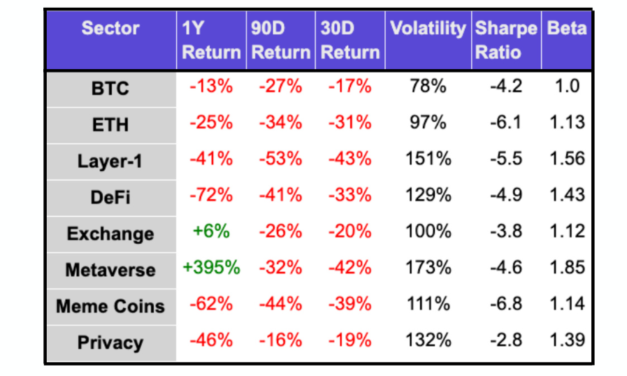
Metaverse tokens are vastly outperforming every other crypto category in the current bearish condition, up by nearly 400% year-on-year.Leading the gains are Decentraland (MANA) up 41%, Sandbox (SAND) up 470%, Axie Infinity (AXS) up 511%, and STEPN (GMT) up 746% according to data from the May 2022 market report by Kraken Intelligence and CoinGecko. Metaverse tokens can be used to pay fees, buy land, and participate in governance. The #NFT boom of 2021 has not only drawn mainstream attention to digital art investments, it has also popularized the crypto metaverse.Kraken Intelligence’s report takes a closer look at how the crypto metaverse will change the way we communicate: https://t.co/kjrf6Pu8yg pic.twitter.com/YHpljpBJR9— Kraken Exchange (@krakenfx) June 7, 2022The next highest category for year-on-year gains were exchange tokens that saw a 6% increase. All other categories saw negative price action in the same time period ranging from -13% for Bitcoin to -72% for DeFi.Kraken Intelligence reveals that Metaverse tokens are up 400% year-on-yearBlockchain-based gaming using nonfungible tokens (NFT) and Metaverse platforms has remained tremendously popular throughout 2022 so far. Despite slumping prices across the market, usership among those games has remained consistent at about 1 million users per day according to data from decentralized app (Dapp) tracker DappRadar. The Kraken report pointed out that although May saw flat daily usership, “NFT volume saw a large decrease with daily volume dropping -87.1%.”Every category tracked by Kraken’s report, including Metaverse and exchange tokens, experienced negative returns over the past 30 days and 90 days. Metaverse tokens were among the worst losers over the past 30 days, dropping 42%, with by far the highest volatility at 173%. Despite the short term price action, money is pouring in to fund the sector. DAppRadar’s Q1 games report noted that $2.5 billion was raised in support of blockchain games and Metaverse projects in the first quarter of 2022. Investors were eager to back games according to the report because 52% of all blockchain activity came from game DApps:“At this pace, play-to-earn and Metaverse-related projects will add $10 billion this year to keep building the future of this industry.”Related: Global Web3 metaverse and tax initiatives continue in the face of a market meltdownLayer-1 tokens such as Solana (SOL) and Cardano (ADA) led the losers as over the past 90 days, they are down 53% and down 43% over the past 30 days. Bitcoin (BTC) and Ethereum (ETH) saw relatively modest losses compared to altcoins over all three time frames measured by Kraken.

Čítaj viac

$72M Illuvium NFT Land Dutch auction saves buyers thousands on gas fees

Open-world blockchain game Illuvium managed to keep the average transaction fee for its nonfungible token (NFT) Land at about $20 by holding the Dutch auction on the Illuvium X Layer-2 scaling solution.The price to mint the NFTs was a fraction of the cost users paid to mint in Yuga Labs’ Otherside sale. Illuvium reports that users spent only $350,000 in fees in total to mint nearly 20,000 plots of Land worth about $72 million, all without any reported network errors.By contrast, the Otherside sale was plagued with issues. Users paid an average of $6,000 in gas fees and some as high as $14,000. Ethereum became congested as buyers attempted to get their orders filled as quickly as possible.The 19,969 plots of Land were sold mainly to ILV holders using a Dutch auction format, where the price per unit decreases over time based on how many are sold ahead of it. This allowed potential buyers to wait for a more desirable price range to place an order. Co-Founder of Illuvium Kieran Warwick said the sale had been designed as an antidote to Ethereum NFT sales that result in wasteful bids that reward miners and cost the buyer.The 4,018 ETH raised in the sale, valued at about $7.4 million, will be redistributed to holders of Illuvium’s native ILV token. However buyers mostly used ILV tokens to make their purchases. The 239,388 sILV2, a staked version of ILV tokens, will be burned.It was a fairly impressive effort considering the NFT bear market which has suffered a major decline in volume over the past 30 days. Sales volume topped $137 million on May 6 and has fallen 78% to $31 million as of June 5 according to NFT market tracker CryptoSlam.Illuvium is a decentralized fantasy RPG of epic scope based on massive battles of creatures called Illuvials.Illuvium NFT Land plots are a pivotal aspect of the game’s ecosystem. Land generates FUEL, which is used to capture game characters called Illuvials or sold for Ether (ETH). There will also be utility for Land on the upcoming Illuvium Zero game.The Illuvium Land Sale is officially over!All Land Plots Sold Out$72M+ in Total Sales239,388 sILV2 to be burned4,018 ETH to be redistributed NO GAS WARSMASSIVE thank you to all participants and partners that helped make this a historic success ♊️ pic.twitter.com/adMTq6PpKe— Illuvium (@illuviumio) June 5, 2022Warwick believes Illuvium’s game design and tokenomics set it apart from other gaming finance (GameFi) competitors. But he told Cointelegraph that Illuvium is free to play for casual gamers who aren’t yet willing to stump up some cash. “It wasn’t an option to not have a free to play version,” he said.The game combines collectibility and built in rarity. Warwick said each in-game character NFT, called an Illuvial, is unique and the supply is deflationary. One method to deflate the supply is that to level up an Illuvial requires burning three others. Each Illuvial also comes in a set that only remains available for six months. Warwick said, “Every six months we produce a new set and you can never collect those Illuvials ever again.” “So people can play for free as much as they want. Using the tier zero Illuvials and shards. But if they want to explore further with higher level characters is when they start paying.”Illuvium will have its work cut out to gain traction in the current conditions with the NFT gaming industry seeing a troubling 82% drop off in daily sales volume. Daily volume hit $70.3 million on Jan 1, 2022, but clocked in at just $13.7 million on June 6 according to decentralized app (Dapp) tracker DappRadar.Related: Could GameFi and carbon currencies reverse blockchain’s climate stigma?

Čítaj viac

Longer-term Bitcoin holder losses hit two year lows

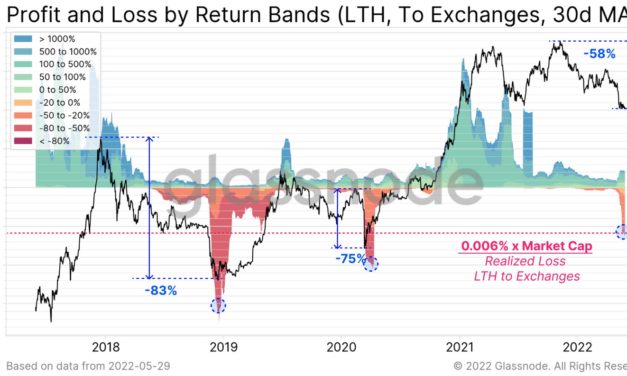
Long-term Bitcoin holders are sitting on their largest losses since the March 2020 capitulation and the 2018-2019 bear market but may have to keep waiting for relief.Calculated by measuring the value of coins deposited to exchanges, aggregated realized losses from long-term holders (LTH) of Bitcoin (BTC) exceeded 0.006% of the market capitalization by May 29 according to Glassnode’s The Week Onchain report from June 6.Long-term holders are suffering their worst losses since March 2020.However, the dramatic losses may continue for some time if historic loss patterns from previous bear markets are to be repeated. From 2018 to 2019, LTH losses reached a peak of 0.015% of the market cap, and those losses extended for about a year. The current losses to long-termers have only been observed for about a month.Glassnode writes that LTH losses now resemble those from previous bear markets, but that they need to continue for a longer period of time before being truly comparable. The report states:“The LTH losses on coins deposited to exchanges have now reached a magnitude comparable to previous bear markets. However, we do not yet have the duration component.”Glassnode defines LTH as a holder that has not moved their coins for at least 155 days. However, anyone that bought BTC before December 2019 will still be up on their investment … for now. It is also worth noting that in both 2019 and 2020, prices rapidly recovered by bouncing off their lows. Cointelegraph reported on Tuesday that there will likely be a capitulation event before any significant price recovery can take place.Despite the gloomy price outlook, inflows to digital asset investment products such as Bitcoin exchange-traded funds (ETF) topped $100 million last week. CoinShares June 6 report highlights that most of the inflows were from the Americas, suggesting that European investors are still bearish at the moment. Related: Amid crypto bear market, institutional investors scoop up Bitcoin: CoinSharesCoinShares also pointed out the difference in exchange flows between BTC and Ethereum (ETH). BTC exchange inflows have netted about $506 million in value through 2022 so far, whereas ETH has had net outflows of $357 million. This suggests that market sentiment for ETH is much lower than that for BTC at the moment.Bitcoin prices are down 5.3% over the past 24 hours, trading at $29,567 according to data from CoinGecko. Ethereum is down 6.7% over the same period, trading at $1,756 having lost 34% over the past month.

Čítaj viac

Získaj BONUS 8 € v Bitcoinoch

nakup bitcoin z karty

Registrácia Binance

Burza Binance

Aktuálne kurzy