Autor Cointelegraph By Brian Newar

Hoskinson pitches software-enabled crypto self-regulation to Congress

Cardano co-founder Charles Hoskinson has told Congress it should make regulations for crypto but leave compliance up to the software developers.Hoskinson likened the ideal arrangement for crypto regulation to the way banking self-regulation works during a June 23 congressional hearing, telling legislators “it’s not the SEC or the CFTC going out there doing KYC-AML, it’s banks.”“It’s a public-private partnership. What needs to be done is to establish those boundaries, then what we can do as innovators is write software to help make that happen.”The Securities and Exchange Commission (SEC) and the Commodity Futures Trading Commission (CFTC) are two of the financial regulators battling over jurisdiction of the crypto industry.Related: US Congressional hearing on digital asset regulation focuses on disclosure Republican Representative Austin Scott from Georgia posed that neither the SEC nor the CFTC have the manpower to oversee the thousands of cryptocurrencies on the market, saying “it’s not possible to regulate all these currencies.”Hoskinson replied that the ability of cryptocurrencies to store and transfer data meant they could carry out much of this regulatory work automatically. He also used it as justification for allowing the crypto industry to create self-regulating organizations (SRO) to guide regulatory compliance, like the private banking industry does. Hoskinson suggested that the industry could create a “self-certification system” that could automatically monitor compliance until an anomaly is encountered, at which point a financial authority would review it. Further illustrating why manpower should not be a concern for crypto regulation, Hoskinson hypothesized that even quadrupling the size of the Internal Revenue Service (IRS) would not be enough to audit every American. Rather, Hoskinson told Representative Scott that cryptocurrencies can be programmed to prevent transaction settlements until legally-mandated checks are performed.Hoskinson’s June 23 testimonial released via the IOHK website demonstrated he was keen to work with federal regulators on developing new rules, stating that compliance with regulation and legislation coming out of the U.S. “must be a guiding value for the blockchain industry.”“However, this is a new technology and a radically new asset class that can not readily fit within the confines of the laws and tests created almost a century ago.”Hoskinson’s pleas for clearer boundaries in the crypto regulatory landscape echo the ones made by other industry insiders in the U.S. last December. SEC Commissioner Hester Peirce recently partly blamed a lack of regulatory clarity for the SEC constantly rejecting spot Bitcoin exchange-traded funds (ETF) from launching in the US.

Čítaj viac


Breaking: Harmony's Horizon Bridge hacked for $100M

The Horizon Bridge to the Harmony layer-1 blockchain has been exploited for $100 million in altcoins which are being swapped for Ether (ETH).The hack may vindicate previously raised community concerns about the robustness of the two of four multisig that reportedly secures the bridge.Starting at about 7:08 am until 7:26 am ET, 11 transactions were made from the bridge for various tokens. They have since begun sending tokens to a different wallet to swap for ETH on the Uniswap decentralized exchange (DEX), then sending the ETH back to the original wallet.1/ The Harmony team has identified a theft occurring this morning on the Horizon bridge amounting to approx. $100MM. We have begun working with national authorities and forensic specialists to identify the culprit and retrieve the stolen funds.More — Harmony (@harmonyprotocol) June 23, 2022So far, Frax (FRAX), Wrapped Ether (WETH). Aave (AAVE), Sushi (SUSHI), Frax Share (FXS), AAG (AAG), Binance USD (BUSD). Dai (DAI), Tether (USDT), Wrapped BTC (WBTC), and USD Coin (USDC) have been stolen from the bridge through this exploit.The Horizon Bridge facilitates token transfers between Harmony and the Ethereum network, Binance Chain and Bitcoin. Harmony, the operator of the bridge, announced late on June 23 that the bridge has been halted. It said the BTC bridge and its assets have not been affected by the attack.The Harmony team also said it was working with “national authorities and forensic specialists” to determine who is responsible. A post-mortem is sure to follow.The developers and the co-founder of Harmony Nick White did not respond to requests for comment. Harmony is a layer-1 blockchain using proof-of-stake consensus. Its native token is ONE.Concerns have previously been expressed as to the soundness of Horizon’s multisig wallet on Ethereum which only required two out of the four signees to drain the funds. A founder of Chainstride Capital crypto-focused venture fund Ape Dev noted on Twitter April 2 that the low number of required signers would leave the bridge open for “another 9 figure hack.”The security of the bridge is currently predicated on a multisig wallet deployed at 0x715CdDa5e9Ad30A0cEd14940F9997EE611496De6. It has four owners, two of which are required to consent in order to execute an arbitrary transaction (i.e. drain the $330m). pic.twitter.com/sgYmyPrYgf— Ape Dev (@_apedev) April 1, 2022

Ape Dev’s prediction appears to have become a reality as the bridge is now down $100 million in assets.He is far from the only developer in crypto to have qualms with the security of token bridges.Vitalik Buterin discussed the issues with token bridges in a Reddit post this January. He posited that when bridges get exploited, it threatens the liquidity on each chain affected. He added that as the amount of token bridges increases, the threat of a 51% attack on one chain could present greater contagion risk to others.Since his prediction, Meter’s token bridge, Axie Inifinity’s Ronin Bridge and the Wormhole Bridge were each exploited for nearly a combined $1 billion.The national authorities and forensic specialists should be investigating *you* to figure out what kind of broken security practices allowed this “theft” to happen.— Chris Blec (@ChrisBlec) June 24, 2022

Multisigs are an ongoing security issue in attacks. The Ronin Bridge was secured by nine validators, only five of which were required to verify a transaction. The attacker took control of the required five validators and extracted over $600 million in assets.Related: Chainalysis launches reporting service for businesses targeted in crypto-related cyberattacksThe market does not yet appear to have responded to the attack as prices of all the coins and tokens in question have not made a significant move. However, ONE has dropped 7.4% over the past 24 hours, with most of the fall coming in the past 5 hours. It is trading at $0.024 according to CoinGecko.

Čítaj viac

Crickets on day 1… but Proshares short Bitcoin ETF volume up 380% on day 2

The first short Bitcoin ETF from ProShares got off to a very slow start on its June 21 launch but gathered pace by increasing trading volume 380% on day two.On launch day June 21, the ProShares Bitcoin Short Strategy Exchange-Traded Fund (BITI) traded a lackluster 183,300 shares which ETF analyst at Bloomberg Eric Balchunas noted in a tweet was “less than 1% of the volume $BITO had at this time on Day One.”However the next day’s trading volume jumped nearly four times to 886,200 shares worth about $36.2 million according to Yahoo Finance.ProShares #Bitcoin short strategy ETF (BITI) trades over 870k shares, 35 million value, on second trading dayhttps://t.co/gyfMcm4UOz— unfolded. (@cryptounfolded) June 22, 2022The BITI exchange traded fund (ETF) allows investors to take short positions on the Bitcoin market without holding BTC themselves. Shorting means speculating that the value of a market or asset will fall.ProShares CEO Michael L. Sapir talked up the volume on day two as indicative of demand and the low fee structure of BITI. “The reception that BITI is getting in the market affirms investor demand for a convenient and cost-effective ETF to potentially profit or hedge their cryptocurrency holdings when bitcoin drops in value.”ProShares also provides the Bitcoin Strategy ETF (BITO), which launched on October 18. BITO saw about $1 billion in volume on its first day of trading.By November, BITO’s volume was among the top 2% of all ETFs, but has now lost 50.93% of its value since inceptionOf course $36M pales in comparison to the $1B long positions on day one. This may mean most investors are uncertain if there is further downside from here. Over the past 30 days, the largest crypto by market cap has lost over 30% of its value. BITI’s relatively poor performance on launch day drew jeers from CFA at Bloomberg Intelligence James Seyffart. On June 21, Seyffart tweeted that within the first hour of trading, BITI had only done about $1 million in volume. Seyffart said that he expected opening volume to be low, but “Yea def not saying it’s a surprise. Though I must admit I’m a tad surprised it’s THIS low.”So.. $BITI, the Proshares inverse #Bitcoin futures ETF that launched today is off to a pretty slow start based on its volume. Granted it didn’t start trading till about 9:57 AM. Sooo we have an hour of trading and only $1 million in total trading volume… https://t.co/Hf0XFeGmsX— James Seyffart (@JSeyff) June 21, 2022

By close, BITI had done about $7.1 million in volume at a daily average price of $39.06 per share.Related: Elusive Bitcoin ETF: Hester Peirce criticizes lack of legal clarity for cryptoAustralia’s new Bitcoin ETFs have also struggled to attract interest. In April, the Cosmos Purpose Bitcoin Access ETF (CBTC) was expected to attract $1 billion in inflows. However, it and the ETFS 21Shares Bitcoin ETF (EBTC) launch days were delayed until May 12. To date CBTC only has $810,000 assets under management while EBTC has $2.8 million. American traders still yearn for a spot Bitcoin ETF which the Securities and Exchange Commission have denied for years. Commissioner Hester Pierce believes a Bitcoin spot ETF can be launched in the US when industry insiders and regulators cooperate closer to ensure that both are on the same page.

Čítaj viac

China warns Bitcoin is heading to zero but BoE looks on the bright side

The Chinese government has capitalized on the violent downturn in the crypto market by warning crypto investors that Bitcoin prices are “heading to zero.” The South China Morning Post reported on June 22 that Chinese national news media agency Economic Daily had issued the warning about the largest cryptocurrency by market cap to further dissuade citizens from adopting the use of crypto.The Economic Daily report says the west is to blame for creating a highly-leveraged market that is “full of manipulation and pseudo-technology concepts” which it said was an “important external factor” which contributes to Bitcoin’s volatility. “Bitcoin is nothing more than a string of digital codes, and its returns mainly come from buying low and selling high,” said the newspaper. “In the future, once investors’ confidence collapses or when sovereign countries declare Bitcoin illegal, it will return to its original value, which is utterly worthless.”The Chinese government banned Bitcoin mining last July and has grand plans to launch its central bank digital currency (CBDC) called the digital Chinese yuan (e-CNY) nation-wide. It banned all cryptocurrency transactions last September, and infamously banned foreign crypto exchanges from operating within the country in 2018.The Chinese Government isn’t the only one weighing in with predictions about where they see Bitcoin’s price going.On Monday, founder and CEO of market analysis firm DeMark Analytics Tom DeMark told Marketwatch he believes the crypto market is in line for prolonged price reductions because BTC has fallen below 50% from its November peak of $69,000, “Such breakdowns bespeak a high probability that recovery to the all-time Bitcoin highs will require many years, if not decades, to accomplish.”However there is still a chance for it to bounce back into the $40,000 range within the next few months he said. “This does not negate the prospect of up to 50-56% recovery over upcoming months which implies bitcoin rally back to $40,000-$45,000.”In contrast to Beijing’s warnings, the Bank of England (BOE) has begun to see the upside potential of building wealth in the crypto space during a bear market. Deputy Governor for the BOE Jon Cunliffe told Bloomberg on June 22 that the crypto firms that manage to stay afloat during the current downturn could be the “dominant players” in the industry when things turn around. “Whatever happens over the next few months to crypto assets, I expect crypto technology and finance to continue. It has the possibility of huge efficiencies and changes in market structure.”Meanwhile El Salvador’s President Nayib Bukele addressed the Bitcoin world on June 19 in regards to the slumping BTC prices. He tweeted that people should “stop looking at the graph and enjoy life,” because he is confident that prices will recover.I see that some people are worried or anxious about the #Bitcoin market price.My advice: stop looking at the graph and enjoy life. If you invested in #BTC your investment is safe and its value will immensely grow after the bear market.Patience is the key.— Nayib Bukele (@nayibbukele) June 19, 2022President Bukele has come under fire for investing in the cryptocurrency and sustaining tens of millions in losses so far but Minister of Finance Alejandro Zelaya has argued that they are not losses “because we have not sold the coins.”Related: Friday’s $2.25B Bitcoin options expiry might prove that $17.6K wasn’t BTC’s bottomAs of the time of writing, BTC is trading at $20,386, 71% down from its high and 0.7% down over the past 24 hours according to CoinGecko.

Čítaj viac

USDC’s ‘real volume’ flips Tether on Ethereum as total supply hits 55.9B

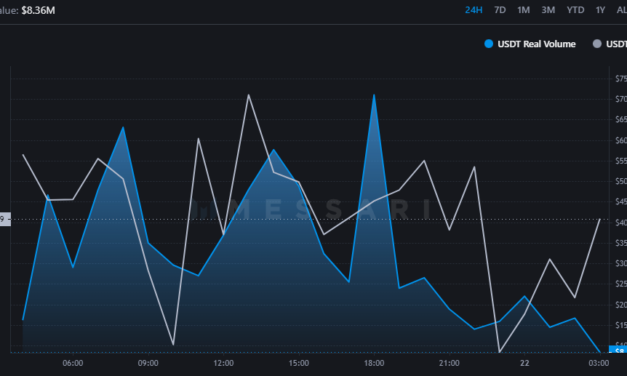
USD Coin is taking a run at the title of the top stablecoin in crypto after its daily ‘real volume’ on the Ethereum network doubled that of Tether’s USDT on Tuesday. According to crypto market data tool Messari, Circle’s USDC posted $1.1 billion in daily real volume on the Ethereum network on June 21, which was double USDT’s real volume of $579 million.Messari’s real volume metric is calculated by compiling data only from exchanges that it believes have “significant and legitimate crypto trading volumes” and thus differs to the more-commonly seen “total volume” metric. Exchanges included in Messari’s Real Volume metric include Binance, Bitfinex, Bitflyer, Bitstamp, Bittrex, Coinbase Pro, Gemini, itBit, Kraken, Poloniex, and those tracked on OnChainFX.24 hr Real Volume for USDT on Ethereum. MessariUSDC supply gaining groundTether’s circulating supply has continued to fall since its all-time high on May 11, dropping nearly 20% from 83.1 billion coins in circulation to an eight-month low of 67.9 billion as of the time of writing. USDC on the other hand has seen its supply increase 13% since May 11 to 55.9 billion. If the trends continue, it could spell the end of Tether’s dominance in the stablecoin space.The collapse of layer-1 blockchain Terra and possible contagion from the fall of crypto lending platform Celsius have caused doubt among investors, made worse by a market crash in recent weeks. Redemptions in Tether have increased significantly in the aftermath, leading to a drop in supply. Tether has been attempting to shore up confidence in its stablecoin – including stating on June 13 that the ongoing calamities in the crypto market involving Terra and Celsius will not have any impact on its reserves. Despite this, investors appear to be migrating to USDC.USDC supply is catching up to USDT. CoinGeckoMessari’s real volume metric does not tell the whole story of course. Across all blockchains and exchanges, CoinGecko shows USDT daily volume still tops the charts at $44 billion compared to USDC’s $5 billion. However it is not known how much of the volume is due to USDT being employed in wash trading to either inflate the numbers for coins or exchanges, which is why the imperfect real volume metric was developed. Related: Record stablecoin market share points to crypto upside: JPMorganIn an effort to combat the ongoing redemptions and doubts about the composition of its reserves Tether CTO Paolo Ardoino told Euromoney on June 15 that his firm plans on getting a proper audit from a top-12 auditing firm. While he would like to have one of the top four firms perform the audit, Ardoino said, “The big four are a bit more cautious about providing a full suit when the rules are not clear,” around stablecoins.

Čítaj viac

Získaj BONUS 8 € v Bitcoinoch

nakup bitcoin z karty

Registrácia Binance

Burza Binance

Aktuálne kurzy