Autor Cointelegraph By Brian Newar

75% of Marathon's mining fleet still offline two weeks after huge storm

Bitcoin mining company Marathon Digital Holdings has revealed that 75% of its mining capability has been out of commission since a severe storm hit Montana on June 11. Marathon finally issued a statement on its website on June 28 explaining that the storm struck across the town of Hardin, Montana on June 11, damaging the power generating facility that supplies Marathon’s local mining operations. According to the company, “initial electrical tests have found that the majority of the Company’s miners were not materially damaged by the storm.”The company noted that 30,000 devices, or 75% of the company’s fleet, have been out of action since the storm. Bitcoin blockchain explorers indicate that the miners have been down for two and a half weeks.“With these miners offline, Marathon’s Bitcoin production is expected to be significantly reduced until repairs to the power generating facility in Montana can be completed or until the miners can be relocated to new facilities.”Marathon noted that the facility will remain without power until the damaged power facility from BeoWulf Energy can be repaired. $MARA Update on mining ops in Montana – Severe storm passed through Hardin on 6/11- Power plant cooling towers need repairs- Majority of miners not damaged- Miners outside Hardin (0.6 EH/s) remain hashing via 3rd party pool https://t.co/ZcaD30S1bh— Marathon Digital Holdings (@MarathonDH) June 28, 2022Marathon’s CEO Fred Thiel stated that the facility could begin mining again at a reduced capacity as early as the first week of July if certain repairs are made in time. It has directed its remaining hashpower to contribute to external mining pools while repairs are being made on the damaged facility.“Marathon has pointed its remaining active miners, representing approximately 0.6 EH/s, away from the Company’s mining pool, MaraPool, and towards a third-party mining pool in order to increase the probability of earning Bitcoin.”Exahash per second (EH/s) refers to the amount of hashpower a miner contributes to secure the Bitcoin network. Marathon contributed about 3.9 EH/s from 36,830 active miners through May and held 9,941 BTC worth about $201.4 million according to CoinGecko. Mining difficulty is at its lowest level since April according to Bitcoin network tracker Coinwarz.Related: Bitcoin mining revenue mirrors 2021 lows, right before BTC breached $69KThe company stated that 19,000 miners representing 1.9 EH/s had been installed in Texas-based facilities and were awaiting the energy needed to switch them on. In light of the functional outages caused by the storm in Hardin, the company said that it is “currently evaluating the possibility of expediting the move of its miners from Montana to new hosting locations,” which could include faster deployment to its new Texas facilities in order to prevent this issue in Hardin from happening again.

Čítaj viac


CoinFLEX recovery plan includes tokenized bad debt and more yields

Crypto investment platform CoinFLEX aims to rectify its liquidity shortage and restart user withdrawals by selling off bad debt through a new $47 million token offering.The new token is known as Recovery Value USD (rvUSD) and will be worth $1 each. It is designed to help CoinFLEX recover $47 million in losses incurred by an account that was allowed to reach negative equity without being liquidated. It will be issued from June 28 through July 1, and the firm stated that it hopes to resume withdrawals by June 30.While the identity of the individual whose account went negative is still unknown, CoinFLEX CEO Mark Lamb insisted in a June 27 announcement that the individual “is a high-integrity person of significant means.” What is known is that in a June 23 blog post, Lamb blamed the individual’s bad debt for halting withdrawals.Hi everyone, we’re sharing our latest update on plans for re-enabling withdrawals on the platform https://t.co/34brwoDYuL— CoinFLEX (@CoinFLEXdotcom) June 27, 2022Under normal circumstances, the crypto lender liquidates accounts before they reach zero equity. However, Lamb explained that in this instance, CoinFLEX opened a one-of-a-kind “non-liquidation recourse account” wherein it agreed to not liquidate the account, and the borrower agreed to keep it filled with plenty of equity. Things did not go according to plan as the account went negative, allegedly causing a liquidity crunch at the firm. Lamb added that this account was the only one on CoinFLEX with negative equity.rvUSD will be issued to non-US resident “Sophisticated Investors” at a minimum subscription of $100,000 per investor. Investments come with a 20% annual percentage rate paid in rvUSD. A Sophisticated Investor is one who has an annual income of at least $200,000, a total net worth of at least $1 million, and has performed the Know Your Customer (KYC) procedure on CoinFLEX.In order to prevent this from happening again, Lamb stated that he would not issue that type of account anymore. His firm will also expand its transparency by making public the notional USD value of every account’s futures positions through an external auditing firm. CoinFLEX CEO explains what happened and why he’s “highly confident” withdrawals will re-open June 30 https://t.co/P9GhSo6BM4 pic.twitter.com/5ERlmRNdYi— Bloomberg Technology (@technology) June 27, 2022

In an interview on Bloomberg Technology with host Emily Chang on June 27, Lamb expressed his company’s belated need for more transparency. He feels that his firm should emulate the transparency that major decentralized finance (DeFi) firms have come to exemplify. He said, “We need to do at least as good as, if not, much better than DeFi with respect to transparency.”“It has a damage to privacy, but we think that traders are going to find that worthwhile for the additional comfort that they get from knowing the risk and the leverage implicit in the system.”CoinFLEX is just the latest in a growing list of centralized financial institutions and investment firms in crypto that have faced public criticism for potential insolvency. Most notable among this beleaguered group is Three Arrows Capital, led by Su Zhu and Kyle Davies, the Celsius crypto lending platform led by Alex Mashinsky, and crypto lender BlockFi led by Zac Prince. Related: Crypto exchange FTX is looking into acquiring Robinhood: ReportCoinFLEX’s native token, FLEX Coin (FLEX), has taken a beating over the past four days by dropping 77% to $0.99 as of the time of writing, according to CoinGecko.

Čítaj viac

Harmony hacker sends stolen funds to Tornado Cash mixer

The funds from Harmony’s Horizon Bridge have begun to move into the Tornado Cash Ethererum mixer, signaling that the attacker has no intention of accepting the $1 million bounty offered.The decision to obfuscate the ill-gotten gains answers questions about whether the Harmony team’s offer of just 1% of the $100 million in crypto funds stolen on June 24 would be enough to convince the exploiter to return them.#PeckShieldAlert ~6k $ETH (~$7.1m) into @TornadoCash from @harmonyprotocol exploiters Intermediary address: 0x432…47ae pic.twitter.com/AR9dmJRQet— PeckShieldAlert (@PeckShieldAlert) June 27, 2022A total of 18,036.3 ETH worth about $21 million was moved out of the Horizon Bridge exploiter’s primary wallet at 03:10 am ET on June 28. These funds were then divided equally three ways and sent to three different addresses in single transactions respectively, over the next 10 hours.Tornado Cash supports mixing a maximum of 100 ETH at a time, which means large sums can easily take several hours to mix. Mixing ETH is a privacy measure designed to obfuscate the transaction path of coins so they cannot be traced back to previous transactions.The first and second wallets that received ETH from the exploiter’s primary wallet have completed mixing the coins and are now left with about 16.3 ETH collectively, an amount likely too small to bother with.The third wallet was busy sending batches of 100 ETH to Tornado in eight-minute intervals and still had 2,800 coins remaining as of the time of writing.Cointelegraph has not received a reply from the Harmony team on what it plans to do to replace the stolen funds in the bridge. The project’s Twitter account reaffirmed on June 27 that the team was working with “two highly reputable blockchain tracing and analysis partners,” along with the Federal Bureau of Investigation, to investigate the hack.1/ We are aware the hacker has begun to move funds through Tornado Cash. The team is working with two highly reputable blockchain tracing and analysis partners, and collaborating with the FBI as part of an investigation into this criminal act. — Harmony (@harmonyprotocol) June 28, 2022

About $80 million in ETH is still in the explorer’s primary wallet. They could possibly return a portion of the stolen funds to Horizon, or they may be taking a break as it has taken the exploiter over 13 hours to mix just $21 million.Although the initial haul was valued at about $100 million at the time, positive ETH price fluctuations have increased the dollar value to $101.5 million.Stephen Tse, the founder of Harmony, confirmed on June 25 that the exploiter took control of the required two Horizon Bridge signees for the multisig address used to secure funds. He noted that the Ethereum side of the bridge affected by the exploit was moved to a more secure multisig wallet that required four signees.Related: Axie Infinity to compensate Ronin exploit victims and relaunch bridgeHorizon is the latest in a growing list of token bridges that have been attacked. The largest token bridge to be hacked was Poly Network in 2021, which lost $610 million that was almost entirely returned.In total, over $1 billion has been extracted from the Meter, Wormhole, Ronin, and now Horizon token bridges through nefarious means in 2022 so far.

Čítaj viac

2022 bear market has been the worst on record — Glassnode

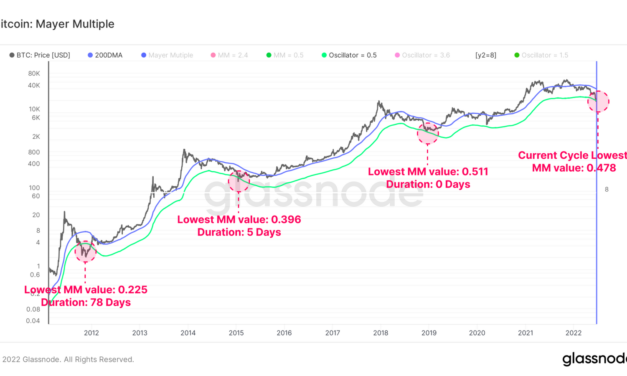
Several factors have contributed to making the current crypto bear market the worst ever recorded as most Bitcoin traders are underwater and continue to sell at a loss, according to Glassnode.Blockchain analysis firm Glassnode’s June 24 report titled A Bear of Historic Proportions outlines how Bitcoin’s current dip below the 200-day moving average (MA), negative deviation from realized price, and net realized losses have conspired to make 2022 the worst in Bitcoin’s history.“In the midst of this, Bitcoin and Ethereum have both traded below their previous cycle ATHs which is a first in history. “The first and most obvious indication of a bear market is when the spot price of Bitcoin (BTC) falls below the 200-day MA and an even more extreme scenario, the 200-week MA. To highlight how rare the current price levels are, Glassnode showed that during the 2022 bear market, Bitcoin has fallen below half the 200-day MA level.Bitcoin price has fallen below 0.5 MM for the first time since 2015 – GlassnodeGlassnode also demonstrated that falling below 0.5 the Mayer Multiple (MM) is an exceedingly rare occasion that hasn’t happened since 2015. The MM factors in price changes above and below the 200-day MA to show overbought or oversold conditions. The report states, “Only 84 out of 4160 trading days (2%) have recorded a closing MM value below 0.5.”“For the first time in history, the 2021-22 cycle has recorded a lower MM value (0.487) than the previous cycle’s low (0.511).”Confirming the severity of current market conditions is the spot price falling below the realized price, which has forced traders to increasingly sell their coins at a loss. Glassnode noted that such a cascade effect is “typical of bear markets and market capitulations.”Glassnode said instances when spot prices trade below the realized price are uncommon, noting that this is only the third time this has happened in the last six years and the fifth time it’s happened since Bitcoin’s launch in 2009. “Spot prices are currently trading at an 11.3% discount to the realized price, signifying that the average market participant is now underwater on their position.”The rarity of this event is illustrated by Glassnode’s model showing that just 13.9% of all Bitcoin trading days have seen spot prices dip below realized prices.Just 13.9% of trading days have seen spot prices below realized price. – GlassnodeThese conditions are exacerbated by investors locking in their losses on the largest crypto by market cap. When Bitcoin fell below the $20,000 mark in June 2022, Glassnode wrote that BTC investors locked in “the largest daily USD denominated realized loss in history.”“Investors collectively locked in a loss of -$4.234B in a single day, which is a 22.5% increase from the previous record of $3.457B set in mid-2021.”Factoring in all the negative metrics, Glassnode assesses that the market is in the midst of a capitulation event. Cointelegraph corroborated this assessment on June 24 by pointing out that miners have started selling their stacks which is another indicator that capitulation has taken place. Such events often signify the bottom price range of a cycle.Related: 5 indicators traders can use to know when a crypto bear market is endingBTC is currently down 70% from its November 2021 high, trading at $21,207 according to CoinGecko.

Čítaj viac

Harmony offers $1M bounty, but is it big enough?

The Harmony layer-1 blockchain project team has offered a bounty equal to just 1% of the $100 million in crypto stolen from the Horizon Bridge hack last week. Harmony tweeted on June 26 that the team had committed $1 million for the return of the funds that were stolen from the Horizon Bridge on June 23. It added, “Harmony will advocate for no criminal charges when funds are returned.”We commit to a $1M bounty for the return of Horizon bridge funds and sharing exploit information. Contact us at whitehat@harmony.one or ETH address 0xd6ddd996b2d5b7db22306654fd548ba2a58693ac. Harmony will advocate for no criminal charges when funds are returned.— Harmony (@harmonyprotocol) June 26, 2022However, concerns have been raised that the modest bounty sum may not be enough to incentivize the attacker to return the funds.The Horizon Bridge is a token bridge between the Harmony blockchain and the Ethereum network, Binance Chain, and Bitcoin. The Bitcoin bridge was not affected in this exploit.Compared to other high-profile exploits this year, Harmony’s bounty offer ranks low. The $10 million offered to the Rari Fuse attacker in May was 12.5% of the total stolen. The Beanstalk Finance team offered $7.6 million which was 10% of the total exploited from the protocol in April. Harmony’s bounty offer is so low that the crypto trader known on Twitter as Degen Spartan called it an “insulting amount.” He added, “imagine losing 100m and thinking you’re in a position to lowball for a 1% bounty lmwo these people are just doing performance art to mitigate legal liability.”1M?insulting amount, gfy https://t.co/TgZ0gDOC43— 찌 G 跻 じ Goblin of the (@DegenSpartan) June 26, 2022

In an incident response update on the Horizon bridge hack on June 25, Harmony founder Stephen Tse tweeted that the hack was not the result of a smart contract code breach, instead, the team found evidence that private keys were compromised which led to the breach of the bridge. 1/ An incident response update on the Horizon bridge hack Confidentiality is key to maintain integrity as part of this ongoing investigation. The omission of specific details is to protect sensitive data in the interest of our community.— stephen tse s.one stse.eth (@stse) June 26, 2022

Tse said that the Ethereum side of the bridge had migrated “to a 4-5 multisig since the incident.” The vulnerability of the multisig wallet requiring just two out of five signers was brought up by a community member in April, but the issue was not addressed by the Harmony team until now. A multisig wallet is a crypto wallet that requires multiple key holders to approve a transaction. These wallets are commonly used at crypto projects.As of the time of writing, the Horizon Bridge hacker has not moved the stolen funds into Tornado Cash, an Ether (ETH) mixer, or any other anonymizer.Related: How can crypto stop getting hacked?Hope is not lost for Harmony, as its $1 million bounty is not the smallest proportional to the amount of funds lost. In 2021, the Poly Network interoperability platform was hacked for $610 million. The team’s bounty offer of $500,000 was 0.08% of the total stolen. The offer was rejected, but luckily the funds were returned anyway.

Čítaj viac

Získaj BONUS 8 € v Bitcoinoch

nakup bitcoin z karty

Registrácia Binance

Burza Binance

Aktuálne kurzy