Autor Cointelegraph By Brian Newar

Haters to unite at the first conference for crypto skeptics

In the middle of crypto’s latest bear market, industry and asset class detractors have rallied together to share their skepticism and network with lawmakers at their own anti-crypto conference.Whereas most crypto conferences exist to promote the latest developments on the cutting edge of the industry, crypto critic journalist Amy Castor said in her July 3 blog post that the Crypto Policy Symposium promises a way for disgruntled nay-sayers to voice their negativity. Crypto skeptics step up lobbying efforts with their first conference – Amy Castor https://t.co/DdUjSfFPIQ— your #1 source for absurdist true crime (@davidgerard) July 3, 2022Author and symposium organizer Stephen Diehl explained to Castor that this first major anti-crypto event aims to provide the community a way to speak directly with policymakers on how they believe the crypto industry should be dealt with.“The main goal of the symposium, as Diehl explained it to me, is to give policymakers access to the information and material they need to make informed decisions around crypto regulation.”A common perception among skeptics like Castor and crypto proponents is that government officials lack a solid foundational understanding of how cryptocurrency works. As Castor notes, government officials are “woefully uninformed.” The similarities may end there as proponents would tout the benefits of the technology and the industry. In contrast, the skeptics will point out the detriments, such as what Castor called “the current DeFi domino collapse.”Join us… walk toward the light.— Amy Castor (@ahcastor) July 3, 2022

Castor complained that policymakers mainly hear from “deep-pocket crypto companies with lots of venture capitalist backing” who could be skewing their policy decisions. Despite her assessment, it still appears quite difficult for the crypto industry to move forward in many jurisdictions, such as New York State, where a Bitcoin (BTC) mining ban looms.In China, where mining and crypto transactions are outright banned, and in Australia, where crypto financial services remain frozen by regulators, progress is also slow or non-existent. Related: Experts weigh in on European Union’s MiCa crypto regulationMembers of government regulatory and financial agencies from the US and Europe have been invited to attend the event. However, it is unclear whether any government officials are confirmed as guests. Only journalists, software engineers, and various professors are confirmed speakers.The symposium will take place in London and will be live-streamed on September 5 and 6.

Čítaj viac


Fork of July: Cardano Vasil upgrade successfully launches on testnet

The much-anticipated Vasil hard fork has been completed on the Cardno testnet, bringing it one major step closer to becoming a reality on the mainnet and promising broad performance upgrades.Project developers, stake pool operators (SPO), and exchanges are now encouraged to deploy their work on the testnet to ensure integrations run smoothly when the mainnet gets the Vasil treatment in about four weeks.We’re happy to report that today at 20:20 UTC the IOG team has successfully hard forked the #Cardano Testnet. This is an important next step in the journey towards the Vasil upgrade on mainnet. 1/10 pic.twitter.com/9F9vzec0pK— Input Output (@InputOutputHK) July 3, 2022Once completed on the mainnet, the Vasil hard fork will allow faster block creation and greater scalability for decentralized apps (dapps) running on Cardano. Input Output HK (IOHK), the organization that produced Cardano, said in a July 3 tweet that in addition to the performance upgrades, developers would benefit from “much-improved script performance and efficiency” and lower costs.Vasil will also enable interoperability between Cardano (ADA) sidechains, one of the main features developers intend to launch in the current Basho phase of the blockchain’s development. Basho is the fourth development phase for Cardano that focuses on scaling and will be followed up with the Voltaire phase, in which governance will be the main focus.The Vasil upgrade is now live on testnet, coming to mainnet in a few weeks. Expect Cardano DeFi to go into the rapids from here— ADA whale (@cardano_whale) July 3, 2022

IOHK also noted that there would not be a proposal to hard fork the mainnet until “ecosystem partners are comfortable and ready,” but it is expected to come in about four weeks.The previous phase, Goguen, saw the launch of smart contract capabilities on Cardano, which decentralized finance (DeFi) developers took advantage of by launching dozens of dapp exchanges and DeFi protocols according to ecosystem tracker Cardano Cube. Related: Ethereum fork a success as Sepolia testnet gears up to trial the MergeCardano’s top dapp with $49.7 million in total value locked (TVL) is currently the decentralized exchange (DEX) WingRiders, according to DeFi data compiler DeFi Llama.The testnet hard fork has done little to move ADA as it is only up 0.1% over the last 24 hours to $0.45, according to CoinGecko.

Čítaj viac

Multisigs mean funds in bridges are 'one small slipup' from being hacked

The recent exploit on Harmony’s Horizon Bridge revealed the inherent flaws with multisig admin keys that leave projects and their users “one small slipup” from deep trouble.Two crypto project leads expressed their concern that the expansion of the multi-chain ecosystem could be hampered by the use of multisig contracts due to the dangers they pose with bridges keeping crypto funds safe. Multisig refers to the requirement of multiple individuals to approve a transaction. The multichain ecosystem is the conglomeration of hundreds of blockchains with varying consensus algorithms that often interact through token bridges.Founder of the Moonbeam blockchain Derek Yoo told Cointelegraph that he advocates for new approaches to security that aim to take the element of human error out of the equation. Yoo said the multichain ecosystem is seeing increased rise in usage due to the “desire to move assets to different chains” but that it needs much better security measures.“There are inherent weaknesses in the multisig approach that expose you to hacking risk. It takes one small slipup and you’re in deep trouble.”Moving assets between chains usually requires token bridges, like the Horizon Bridge which was exploited on June 23 for about $100 million in crypto assets. Horizon was compromised when two of the signee keys for its multisig contract were discovered by an attacker.Yoo pointed out that the multisig approach may be the standard for the industry at present, but it is far from a gold standard. In his estimation, there are much more secure designs that could be implemented to bridge tokens, such as using a separate proof-of-stake (PoS) network for transfers. He feels that while developers have to make compromises to get to chains with a lot of activity:“Communication between chains at the blockchain level is the bleeding edge and is the most secure type of bridging.”CEO of the Mina Foundation which developed the Mina blockchain Evan Shapiro shares Yoo’s distrust of the multisig approach given the more advanced measures available to the industry now. He feels that the biggest problem facing the multichain ecosystem is its over-reliance on trust. He told Cointelegraph on June 30 that “The obvious problem is based on third-party custodians serving as trusted intermediaries for bridges.”In his view, the ideal would be for blockchains to be verified by each other, but acknowledges that that is infeasible and inefficient. An alternative is to utilize zero-knowledge proofs that compress and verify the massive amount of data stored on blockchains. Related: Battle-hardened Ronin bridge to Axie reopens following $600M hackShapiro distilled the dilemma presented by token bridges down to who or what entity users are placing their trust in when bridging tokens. He said that it doesn’t matter if the bridge is the first party, as is the case with the Horizon Bridge, or the third party. “This is not about the development of the code,” he said.“It speaks to the risks of custodial bridges. If you have a custodial bridge, a fixed number of people can compromise it.”

Čítaj viac

Better days ahead with crypto deleveraging coming to an end: JPMorgan

The historic deleveraging of the cryptocurrency market could be coming to an end, which could signal the close of the worst of the bear market, according to a JPMorgan analyst.In a Wednesday note, JPMorgan strategist Nikolaos Panigirtzoglou highlighted increased willingness of firms to bail out companies, and a healthy pace of venture capital funding in May and June as the basis for his optimism. He said key indicators support the assessment:”Indicators like our Net Leverage metric suggest that deleveraging is already well advanced.” The deleveraging of major crypto firms, where their assets have been sold either willingly, in a rush, or via liquidation, began largely in May when the Terra ecosystem collapsed and wiped out tens of billions of dollars. Since then, crypto lenders BlockFi and Celsius, and investment firm Three Arrows Capital have run into their own problems.Panigirtzoglou added that the severity of deleveraging of some crypto firms could be so severe that they “suggest that the tremors from this year’s crypto market fall continue to reverberate.”However, Panigirtzoglou argues that deleveraging may be coming to an end, with crypto entities stepping into to bail out struggling companies, stating: “The fact that crypto entities with the stronger balance sheets are currently stepping in to help contain contagion.”Amid the calamities befalling several blockchain firms such as Three Arrows Capital and Celsius, Sam Bankman-Fried’s FTX exchange is reportedly positioning itself to expand its influence across the industry. Rumors are swirling that FTX is offering to buy the BlockFi crypto lending platform for $25 million, according to a June 30 report from Cointelegraph. However,BlockFi CEO Zac Prince has denied the rumors in a June 30 tweet.Panigirtzoglou also sees the healthy pace of venture capital funding in the crypto space as a good sign. According to JPMorgan’s estimates, there was about $5 billion in VC funding to crypto firms in May and June. Fundraising metrics tracker Dove Metrics using Airtable’s data estimates crypto funding is higher, at $8.6 billion in the same period.This rate of funding is down $2.2 billion from March and April, but up $3.4 billion from May and June 2021.Related: ‘Can’t stop, won’t stop’ — Bitcoin hodlers buy the dip at $20K BTCThe latest predictions from JPMorgan should blow fresh air into the hearts of crypto investors in 2022 who have endured what Glassnode has deemed the worst bear market in the history of crypto trading. Since November 2021 when the total crypto market cap topped $3 trillion, it has fallen below $1 trillion to $934 billion according to CoinGecko.

Čítaj viac

MakerDAO looks to invest $500M into ‘minimal risk’ treasuries and bonds

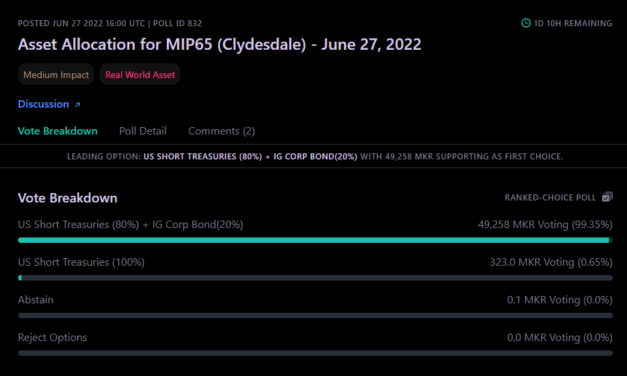
MakerDAO is currently voting on a proposal aimed at helping it weather the bear market and utilize untapped reserves by investing 500 million Dai stablecoins into a combination of US treasuries and bonds.Following a straw poll in a governance ‘Signal Request,’ the decentralized autonomous organization (DAO) members now must decide whether the dormant DAI should go entirely into short-term treasuries or split 80% into treasuries and 20% into corporate bonds.The Maker Governance votes to determine how to allocate 500 million DAI between different investment strategies.This allocation poll is a result of the passage of MIP65: Monetalis Clydesdale: Liquid Bond Strategy & Execution.A recap on how it would work.1/ pic.twitter.com/SdF9QT2OM6— Maker (@MakerDAO) June 27, 2022MakerDAO is the governing body of the Maker protocol, which issues U.S. dollar-pegged Dai stablecoins in exchange for user deposits of Ether (ETH), Wrapped Bitcoin (WBTC), and nearly 30 other cryptocurrencies.This proposal represents a major step for Maker DAO as it signals its intent to extend beyond the crypto realm and earn yield from traditional “safe” financialinvestments with its flagship DAI.MakerDAO allows participants vote on proposals by staking their MKR. So far, the option to split the Dai between treasuries and bonds has 99.3% Maker (MKR) token support, albeit from just 12 voters. Governance participation at Maker is currently at its lowest level in 2022 with 169,196 MKR tokens staked.The poll ends on June 30 at 12pm ET, leaving just a short amount of time for other voters to pick a side, abstain, or reject the options.Once an option is chosen, European wholesale lender Monetalis will provide MakerDAO access to the financial instruments it wants. Monetalis CEO Allan Pedersen issued the Signal Request in the forum with options that his firm could provide the DAO.The firm has a goal of transitioning to low carbon resource efficiency, as per the UN’s definition.The DAO’s decision to invest such a large amount of funds is based on recommendations by several members who believe that deploying the unused funds could help boost the protocol’s bottom line with minimal risk.Related: Less than 1% of all holders have 90% of the voting power in DAOs: ReportMember of MakerDAO’s Strategic Finance Core Unit Sebastien Derivaux posited in a June 20 assessment of the allocation’s feasibility that although the amount in question seems relatively high, it should be a safe choice for the DAO.“An investment of 500M DAI in this context, that is expected to remain liquid and low volatility, is therefore not a significant risk for the DAI peg nor the solvency of MakerDAO.”Derivaux suggested that the two options currently being voted on were the best of the five that were up for debate. Despite the landmark move for Maker, MKR is down 1.6% over the past 24 hours and trading at $964.71 according to CoinGecko.

Čítaj viac

Získaj BONUS 8 € v Bitcoinoch

nakup bitcoin z karty

Registrácia Binance

Burza Binance

Aktuálne kurzy