

Autor Cointelegraph By Brian Newar

Korean startup Uprise lost $20M shorting LUNA

South Korean crypto investment startup platform Uprise reportedly lost around 99% of its assets worth about $20 million when it got liquidated shorting the LUNA token.Uprise’s trading desk Heybit uses an artificial intelligence (AI) trading system that was designed to reduce the risks associated with leveraged trading. Local news outlet Seoul Economic Daily reported on July 6 that Uprise’s AI, which it calls a robo-advisor, made a disastrous misread in May on the LUNA token as it fell precipitously from $60 to fractions of a cent. The system shorted LUNA but got liquidated during the token’s bizarre price pumps along the way, leading to $20 million in customer losses and $3 million of its own losses. In total, Uprise lost about 99% of its assets.Most users of Uprise’s Heybit service are high net worth individuals and corporations who stake their crypto for yield generated by the AI trading on futures markets. The firm has been backed by the Hashed crypto investment firm, Kakao Ventures, and several banks and venture capital firms.The firm has suspended services, but has not issued an official disclosure to its clients about the losses. An Uprise official confirmed to Seoul Economic Daily that: “Due to great unexpected volatility in the market, there has been damage to customer assets. We plan to finalize the report on our virtual asset business soon.”In addition to officially notifying its users, Uprise officials are reportedly working on a compensation plan for its customers so that it can continue to operate. Related: Korea and US agree to share investigation data on TerraWith Uprise in the spotlight, Seoul Economic Daily pointed out that it has not registered as a virtual asset service provider (VASP). It reported that Uprise officials feel that the firm is able to skirt the law requiring it to register as a VASP because it does not collect Korean Won nor directly invest in virtual assets, only futures.Registration helps keep crypto exchanges in compliance with the notorious Travel Rule from the Financial Action Task Force.Uprise is the latest centralized crypto service provider to reveal significant losses stemming from the Terra incident and subsequent contagion. It joins BlockFi, Celsius, and Voyager Digital among the list of firms that have had to take drastic measures to try and stay afloat. FTX US exchange has the option to buy BlockFi, Celsius has been unwinding loans, and Voyager filed for bankruptcy on July 5.

Čítaj viac

Voyager Digital files for Chapter 11 bankruptcy, proposes recovery plan

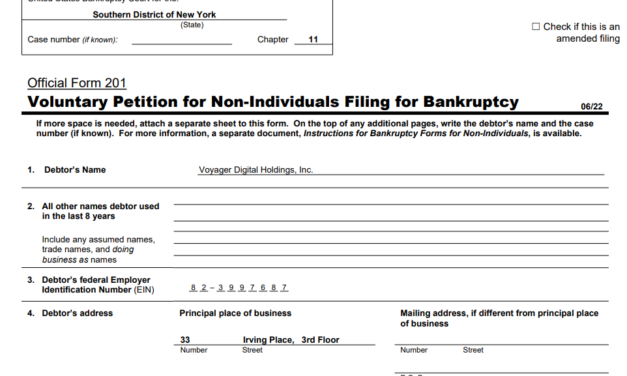
Days after pausing trading, withdrawals and deposits, crypto exchange Voyager Digital is filing for bankruptcy under Chapter 11 in the Southern District Court of New York.Voyager’s Chapter 11 bankruptcy filing indicated that it is on the hook for anywhere from $1 billion to $10 billion in assets to more than 100,000 creditors.The troubled crypto exchange wasted no time after the United States holiday to file for bankruptcy on July 5. In a Wednesday statement,  Voyager explained that the move is part of a “Plan of Reorganization.” When implemented, the plan would enable clients to reaccess their accounts again, and Voyager would “return value to customers.” Voyager CEO Stephen Ehrlich stated in a July 6 tweet that under its proposed plan, customers with crypto in their account will receive a combination of crypto, proceeds from the Three Arrows Capital (3AC) recovery, common shares in the newly reorganized company, and Voyager tokens.Customers with crypto in their account(s) will receive in exchange a combination of the crypto in their account(s), proceeds from the 3AC recovery, common shares in the newly reorganized Company, and Voyager tokens.— Stephen Ehrlich (@Ehrls15) July 6, 2022He also added confirmation that customers with U.S. dollars in their accounts will be able to access those funds after a “reconciliation and fraud prevention process is completed with Metropolitan Commercial Bank.”In the same Twitter thread,  Ehrlich said he felt Chapter 11 was the best route for his clients, considering all factors, and assured that the move would protect assets on the platform and that Voyager will continue operating.Voyager Digital files for Chapter 11 bankruptcy in New York.Voyager said that part of the reorganization process will see the company filing “First Day” motions that will allow it to maintain operations. Related: Keys lost in the Vauld: Singapore crypto exchange freezes withdrawalsVoyager said it intends to pay its employees in the usual manner and continue their “primary benefits and certain customer programs without disruption,” though trading, deposits, withdrawals and loyalty rewards will remain suspended. Signs that Voyager and its clients were experiencing headwinds came after the lending platform entered into a $500 million loan agreement with trading firm Alameda Research to cover losses from its exposure to crypto venture capital firm 3AC. A day later, the platform lowered its daily withdrawal limit to $10,000 and then, on July 1, announced that it would be suspending trading, deposits, withdrawals, and loyalty rewards distributions.The company’s subsidiary, Voyager Digital LLC, also previously issued a notice of default to 3AC for failure to make the required payments for its loan of 15,250 Bitcoin (BTC) and $350 million USD Coin (USDC). However, Three Arrows Capital is going through Chapter 15 bankruptcy proceedings and has reportedly been forced to be liquidated by the British Virgin Islands, suggesting that it could be difficult for Voyager to recover the funds it lent out.

Čítaj viac

MakerDAO voting on collaborating with a traditional bank

MakerDAO is voting on a proposal that will bring a traditional bank into its ecosystem for the first time, allowing the bank to borrow against its assets using decentralized finance (DeFi).Currently 83% of voters are in favor of the proposal. Voting ends at 12pm ET on July 7.The proposal involves creating a vault with 100 million Dai (DAI) for Huntingdon Valley Bank (HVB) as part of a new collateral type in the Maker Protocol.This will essentially allow the Maker Protocol to begin issuing real-world loans to borrowers through a fully backed traditional institution by meeting the bank’s standards.The first collateral integration from a US-based bank in the DeFi ecosystem is getting closer.The Maker Governance votes to add RWA-009, a 100 million DAI debt ceiling participation facility proposed by the Huntingdon Valley Bank, as a new collateral type in the Maker Protocol pic.twitter.com/fOdusdjCFS— Maker (@MakerDAO) July 4, 2022The move to integrate the bank follows hot on the heels of another decision to become more closely entwined with traditional finance after MakerDAO members voted in favor of spending $500 million DAI investing in treasuries and corporate bonds last week.MakerDAO governs the Maker Protocol, which issues U.S. dollar-pegged DAI stablecoins in exchange for user deposits of Ether (ETH) and nearly 30 other cryptocurrencies. Huntingdon Valley Bank (HVB) is a traditional bank from Pennsylvania founded in 1871.The deal with HVB is important for the Maker Protocol because it is not currently allowed to issue U.S. dollar loans directly to borrowers. However, a special entity will be established by MakerDAO to make integration with the traditional bank possible. First, a Multi-Bank Participation Trust (MBPTrust) will be established by MakerDAO in Delaware to link the capital available at HVB with the Dai stablecoin that Maker provides. The trust would ensure that DAI minting and destruction from the vault is carried out properly and would manage commercial issues with HVB.At first, HVB would own 50% of the loans issued through this scheme, but would petition MakerDAO to incrementally reduce its ownership down to a minimum of 5%. The remainder would be owned by MBPTrust. This measure would mitigate the bank’s risks as it would essentially be issuing loans through the Maker Protocol under Pennsylvania law.Related: MakerDAO members shoot down proposal for more centralizationMaker Protocol (MAKER), which has been trying to find strategies to weather the bear market, would be able to earn revenues through vault stability fees associated with maintaining the vault and minting DAI. Revenue would also come from yield, which is estimated to be as much as 75 basis points above the 30-day average Secured Overnight Financing Rate (SOFR) of 0.083%.HVB benefits by effectively increasing its legal lending limit beyond $7 million per borrower. Assuming the HVB integration is a success after a period of time, MakerDAO believes the same MBPTrust could be used to onboard other banks.

Čítaj viac

African infrastructure firm lands $150M to launch crypto water token

South Africa-based H20 Securities has reportedly raised $150 million from the GEM Digital investment firm through the sale of the H20N token.By investing such a tremendous amount, GEM Digital will hold H20N tokens, which will be used to guide funding in water delivery infrastructure in areas that lack sufficient access to fresh water.GEM Digital is a $3.4 billion Bahamas-based investment firm specializing in alternative investments such as digital assets and resource extraction devices. H20 Securities aims to bring more significant development in water infrastructure worldwide and hopes that its solution will increase water availability to the world’s population.In a joint announcement on July 4, CEO of H20 Securities Julius Steyn said, “The focus with the H2ON token is mainly on the financing of water projects internationally and not so much on the technical engineering and construction of such projects.”GEM Digital is no stranger to investing in technologies designed to improve environmental effects and living conditions for humanity. Its portfolio includes investments in Changing World Technologies, a food waste processing firm, and Neos Ocular, a firm that produces lasers to improve vision.GEM previously invested in the digital asset management service QBNK Holding AB.H20N will be used to settle bills between H20N network participants, including water plant operators and their clients. By raising funds to finance water projects, it claims to reduce the time it takes for water suppliers to deliver to new clients compared with traditional means. Related: ‘Buy Bitcoin, plant a tree, lower your time preference’: A Sequoia storyCoinciding with the announcement, H20N was also listed on the Bitmart centralized exchange (CEX) launchpad initial decentralized offer (IDO) platform on July 4.

Čítaj viac

Indian crypto trading volumes slump following hefty taxes

Trading volume on three major Indian crypto exchanges plummeted 72.5% on average since July 1, when a 1% tax per transaction was enforced in the country.The Tax Deducted at Source (TDS) came into effect on July 1 and appears to have negatively affected traders as exchange volumes dropped from 37.4% on BitBNS and 90.9% on CoinDCX by July 3. Volumes have stabilized slightly since hitting lows but are still down 56.8% on average, according to CoinGecko.Indian YouTube channel Crypto India tweeted on July 4 that exchange revenues, based on a 0.1% trading fee, are abysmal due to the low volume levels. At the trough of volume levels, WazirX, CoinDCX, and Zebpay took in a combined $21,649 per day.Indian Crypto exchange’s trading volume have plunged by 90-95% , 3 months after new crypto laws became applicable. Based on current volumes – Exchanges are only able to generate trading fee revenue of $1000 to $3000 Max.Bitbns seems to be still doing well.Tough times ahead. pic.twitter.com/KNDbea9BCn— Crypto India (@CryptooIndia) July 4, 2022For now, crypto traders like Mumbai’s Shounak Shetty are also hurting. Shetty told Economic Times on July 4 that he believes the TDS and the 30% income tax on cryptocurrency trades in India will be detrimental to the talent base in the South Asian nation. He said, “Like other traders, I am trying to figure out if it’s possible to stay profitable on Indian exchanges. This will lead to another brain drain of professional traders to other countries like Dubai that are more welcoming.”WazirX’s Policy Analyst Anuj Chaudhary explained in the June 30 episode of The WazirX Show on YouTube that the 1% TDS is levied on “digital assets whether it’s NFT, crypto assets, metaverse, or any sort of transactions happening on top of public blockchains.” The tax will be in effect for three months as a test to determine the impact it has on the market. While trading volumes are low now, policymakers want to see its results for a longer timeframe.Only gift cards used to obtain goods or get a discount, mileage points, reward points, and loyalty incentives without monetary considerations, and subscriptions to websites, platforms, or applications are exempt from the tax.Related: Reserve Bank of India ranks crypto near the bottom of systemic risks despite harsh criticismChaudhary’s counterpart on the show, Muthuswamy Iyer, Head of Legal at WazirX, accurately predicted that the TDS would negatively impact the high volume, high-value traders on Indian platforms. He added that he believes the TDS would also dissuade newcomers and low-frequency traders from gaining crypto exposure.The average daily transaction volume between WazirX, Zebpay, BitBNS, and CoinDCX in June was about $9.6 million per day, but that has fallen to about $5.6 million as of July 4.

Čítaj viac

Získaj BONUS 8 € v Bitcoinoch

nakup bitcoin z karty

Registrácia Binance

Burza Binance

Aktuálne kurzy