Autor Cointelegraph By Brian Newar

Terra projects band together in migration to Polygon ecosystem

More than 48 different crypto projects formerly based on the failed Terra ecosystem have found a resurgence by migrating over to Polygon. Polygon Studios CEO Ryan Wyatt expressed delight at his network’s ability to onboard many projects to the ecosystem in a July 9 tweet. He hinted that Polygon’s multimillion-dollar Terra Developer Fund has been effective in attracting the talent that was unexpectedly flung into limbo when Terra collapsed in May. UPDATE: Terra projects have begun migration. Over 48 projects and counting… including @OnePlanet_NFT, an exclusive @0xPolygon marketplace, and @DerbyStars_HQ!It was so awesome to help and welcome all these wonderful developers to our thriving ecosystem! Welcome! $MATIC https://t.co/5ypu1QdMBA pic.twitter.com/JcskdWGnZJ— Ryan Wyatt (@Fwiz) July 8, 2022Polygon (MATIC) is a network that serves as a layer-two scaling solution for the Ethereum network.Among the higher-profile projects to move to Polygon are the Lunaverse (LUV) Metaverse platform, the OnePlanet NFT marketplace, and the Derby Stars play-to-earn (P2E) game. OnePlanet has been instrumental in helping other nonfungible Token (NFT) projects migrate to Polygon. It has become a platform dedicated to assisting NFT projects from Terra with its Ark*One initiative.OnePlant’s July 9 blog post outlines how Ark*One has helped “A total of 48 NFT projects, encompassing 90 NFT collections” port over to Polygon. “This represents a large proportion of Terra projects, including some that did not launch on One Planet before the cataclysmic de-peg event.”Since June 15, Ark*One has reduced the support it provides to aspiring projects, but the team says it will “still provide technical support for projects who want to migrate from Terra” and allow projects to launch on Polygon using its launchpad. Polygon appears to have been more successful at attracting Terra projects than the VeChain (VET) ecosystem. So far, it does not appear that many Terra projects have made the move to the layer-1 ecosystem despite VeChain openly welcoming Terra developers to apply for a grant.Related: Korea and US agree to share investigation data on TerraThe Terra ecosystem suffered a monumental collapse in May when its TerraUSD (UST) stablecoin lost its peg, forcing its native token LUNA to crash nearly 100% in value from over $60 to fractions of a cent. The network has been renamed Terra Classic, and its native token now has the LUNC ticker, while a new iteration has adopted the Terra name and LUNA ticker.It has yet to gain much traction or confidence as the crypto bear market deepens.

Čítaj viac

CoinFLEX to begin arbitration for $84 million recovery and open limited withdrawals

Crypto investment platform CoinFLEX is moving forward with its plan to reclaim $84 million in funds by starting arbitration procedures in Hong Kong against an individual account holder.Co-Founders Sudhu Arumugam and Mark Lamb acknowledged in their July 9 announcement that the judgment would provide access to the individual’s “worldwide assets” and that their lawyers were “very confident” they could enforce the award. “We have commenced arbitration in HKIAC for the recovery of this $84m as the individual had a legal obligation under the agreement to pay and has refused to do so.”The firm, however, noted the process could take 12 months to get a judgment in Hong Kong. “Thereafter, we will be able to enforce that judgment against his worldwide assets,” it added.Though the “large individual customer” was not named in the Saturday announcement, Lamb has previously publicly stated that Bitcoin Cash (BCH) proponent Roger Ver was the defaulting customer in question. Ver, however, has denied that he owes any money to the firm. He fired back at the rumors by stating that an unnamed counterparty owes him “a substantial sum of money.”In the most recent update, Arumugam and Lamb said that the individual was “wasting time” by promising to replenish his account with funds that never arrived. They added that liquidating his positions created significant slippage, which has increased the sum the firm says he owes. Initial estimates put the outstanding sum at $47 million, but that amount was increased to $84 million after liquidating his FLEX token positions. FLEX is the native token of the CoinFLEX platform. “Unfortunately, this customer failed to honor his obligations pursuant to this written agreement. Our lawyers believe that we have a very strong case and have commenced legal actions to recover debts owed to us pursuant to this agreement.”Limited withdrawals soon? Amid the drama between CoinFLEX and the individual whale depositor, withdrawals have been suspended since June 23. Lamb said he hoped to have them back up for users by the beginning of July. Arumugam and Lamb stated that they now have plans to create “temporary liquidity for CoinFLEX depositors” by initially making 10% of their account balances available for withdrawal. No date has been set for this to take place, but the duo expect withdrawals to take a week or less. CoinFLEX has been working on ways to make up for the shortfall in funds left by the whale investor’s account. The firm indicated at the end of June that in addition to liquidating accounts and pursuing legal action, part of its funds recovery plan involved issuing 47 million Recovery Value USD (rvUSD) tokens which can be bought for $1 each. It may also offer some depositors the option to roll their deposits into equity in the company.The firm is in “close discussions” with an unnamed large US exchange to enter into a partnership that could help boost CoinFLEX’s viability.Related: Not all investments lose value equally: A recovery period for digital assetsThe price of FLEX Coin fell 71% on July 9 following the announcement to $0.27. It is currently trading at $0.30, according to CoinGecko.

Čítaj viac

What bear market? Consumer confidence higher among crypto owners than normies

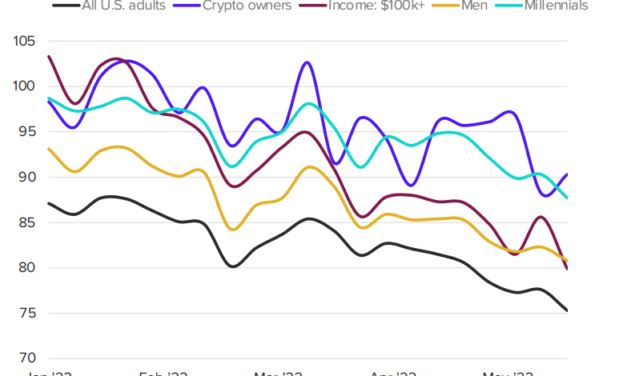
Consumer confidence is considerably higher among crypto owners than the average American adult, with crypto owners sitting 16.4 points higher on the consumer sentiment index. A July 7 report from research firm Morning Consult shows that although average United States (U.S.) adult consumer sentiment has dropped 13.5% since mid-January, confidence amongst crypto owners has held up relatively better, falling only 8.1% over the same period.The research firm said that the discrepancy is partially explained by the fact that the average crypto owner is “more likely to be wealthier, younger and male” than the average U.S. adult. “In recent months, age has been one of the biggest drivers of differences in consumer confidence, as fixed incomes, health risks and memories of past episodes of high inflation in the United States lead older Americans to be more pessimistic,” it said. The report states that Millennial men who earn at least $100,000 per year are the most likely people to own crypto, though Gen Z adults also show fairly high levels of crypto ownership. Baby boomers and women remain the least likely to hodl. The report cites respondents’ lofty price expectations for Bitcoin (BTC) as a driving factor for their optimism, noting that the average crypto user expects the price to bounce back to $38,000 within the next six months.This is despite some experts believing Bitcoin will remain sideways for the foreseeable future and could go as low as $16,000.Price recovery is likely important for the average crypto holder because the majority of crypto owners — 66% primarily see cryptocurrency as a means to make money as opposed to using it to send or as a means of payment, according to the report. Related: Bitcoin vs bank: Nayib Bukele reminds Peter Schiff why banks can’t trump BTCBitcoin was the most popular crypto owned by Americans, with 75% of U.S. crypto owners in possession of the cryptocurrency according to the report. It is worth noting that stablecoin USD Coin (USDC) and the native token of the Solana blockchain (SOL) saw 4% increases in ownership each since January.By a wide margin, #Bitcoin is the most popular#cryptocurrency owned by Americans, as 75% of U.S. crypto owners own Bitcoin. https://t.co/x87mWnFxQF pic.twitter.com/WLoDEtYim8— Morning Consult (@MorningConsult) July 7, 2022The report has also noted that a rising share of Americans favoring heavier regulations on the cryptocurrency space. The portion of Americans that believe the market should be more strictly regulated increased from 17% in January to 21% in June.  The report attributes the increased call for regulations to the “current environment of heightened volatility” stemming from the collapse of the Terra ecosystem and Janet Yellen addressing the risks associated with that event.The report, titled ‘The Crypto Report: Our Analysts on the State of Cryptocurrency’ draws the data from three surveys. Two of the surveys were conducted on 2,200 to 4,400 and 6,000 U.S. adults respectively. The third was conducted monthly in 15 to 17 different countries and again from June 1-7, 2022 on 1,000 adults per country.

Čítaj viac

Marathon Q2 Bitcoin production down 44% as fleet remains crippled

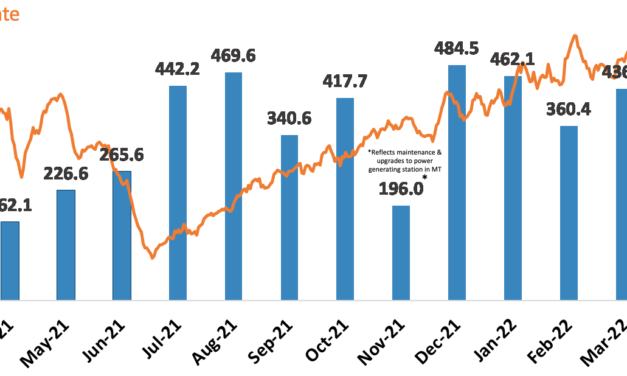
Bitcoin (BTC) mining company Marathon Digital Holdings experienced a steep 43.8% decline in Bitcoin production over the second quarter of 2022, with June registering as the company’s least productive month in over a year following the fall of its Montana facility. In its latest mining operation update released on July 7, Marathon reported that it produced 707.1 Bitcoin in Q2 2022, down 43.8% from 1258.6 Bitcoin mined in Q1 2022. Marathon’s Bitcoin productivity has been on the decline through Q2 2022.The company’s Bitcoin production took a particular hit in June, after Marathon’s Hardin, Montana facility was hit by a massive storm on June 11 which knocked out the power station that fed 75% of its active fleet. The outage made June the company’s least productive month since March 2021, and threatens to continue into July, as to date, the Montana facility is yet to return online, and no new blocks have been mined from the MARA mining pool since June 12. Marathon CEO Fred Thiel acknowledged that the storm in June had a major impact on productivity, but also cast some of the blame for the lack of hash power on Marathon’s new Texas mining facilities which have not yet switched on. Thiel said the company has installed 29,640 miners “representing approximately 2.9 exahashes per second” in Texas already, though the energization of its facilities expected in June has not yet come to pass. Thiel said Compute North, the company hosting mining facilities for Marathon’s devices, can’t be powered until its energy provider gains “federal agency confirmation of its exempt status for tax purposes.”Marathon VP of Corporate Communications Charlie Schumacher told Cointelegraph earlier this month that it may be looking to diversify its mining operations across more states in the future. Schumacher said that in addition to the existing facilities in Texas, the company was exploring options in Dakota, Oklahoma, and Georgia. “We have already been expanding in Texas at different facilities to reduce the reliance on a single major facility. Getting geographic diversity will help protect us in the future.”Concerns have arisen that more Bitcoin miners will sell coins in order to stay afloat amid rising energy costs and falling mining equipment and crypto prices. Cointelegraph reported on July 6 that miner revenues are down over 70% from last November’s high.Related: Bitcoin miners sell their hodlings, and ASIC prices keep dropping — What’s next for the industry?So far, major miners such as Argo, Bitfarms, Core Scientific, and Riot Blockchain have all reported selling coins to pay bills. Schumacher added that Marathon has not sold any coins yet and has no current plans to, but did not rule it out as an option. “When looking at financing the business, we are looking to do it most advantageously.”

Čítaj viac

Crema hacker returns $8M, keeps $1.6M in deal with protocol

The hacker who exploited Solana-based liquidity protocol Crema Finance on July 2 returned most of the funds but was allowed to keep $1.6 million as a white hat bounty.The bounty, 45,455 Solana (SOL), is worth a generous 16.7% of the $9.6 million Crema lost initially, which forced the protocol to suspend services. Crema’s team began an investigation to identify the hacker by tracking their Discord handle and tracing the original gas source for the hacker’s address. Just as it seemed the team may have been onto the secret identity, it announced that it had been negotiating with the hacker. On July 6, the hacker returned 6,064 Ether (ETH) and 23,967 SOL worth roughly $8 million.After a long negotiation, the hacker agreed to take 45455 SOL as the white hat bounty. Now we have confirmed the receipt of 6064 ETH + 23967.9 SOL in four transactions indicated below. A follow-up compensation plan will be released in 48h.— CremaFinance (@Crema_Finance) July 6, 2022The hacker returned the funds in a series of transactions on Ethereum and Solana networks. The first transaction on each network was a test with a negligible amount of coins, while the following was worth the majority of the funds sent.Users of Crema and the team have reason to rest easier now that the funds have been secured, but there is still work to do. The team announced on July 5, before the deal had been reached, that it submitted new code for auditing to ensure that the same exploit did not happen again. Although the community awaits an official post-mortem on the attack, the Crema team outlined what happened in a July 3 thread on Twitter. The attacker took out a flash loan from the Solend decentralized finance (DeFi) lending protocol, which was added as liquidity to a Crema pool. The hacker then fabricated pricing data to make it seem as though they were owed a much bigger reward than they should have. This allowed them to take “a huge fee amount” worth about $9.6 million from the pool to which they added the flash loan. Related: Dutch University set to recover more than twice the paid BTC ransom in 2019The Crema protocol will be back up and running after the audit is complete, according to the team’s tweet. The team will also issue a compensation plan for affected users by July 8.Crema is lucky to have recovered as much funds as it did, considering the calamity that befell the Horizon Bridge on Harmony last month. A hacker stole $100 million in crypto from Harmony’s token bridge and rejected the $1 million white hat bounty to return the funds.

Čítaj viac

Získaj BONUS 8 € v Bitcoinoch

nakup bitcoin z karty

Registrácia Binance

Burza Binance

Aktuálne kurzy