Autor Cointelegraph By Brayden Lindrea

CoinGecko reveals the US state most interested in Bitcoin and Ethereum

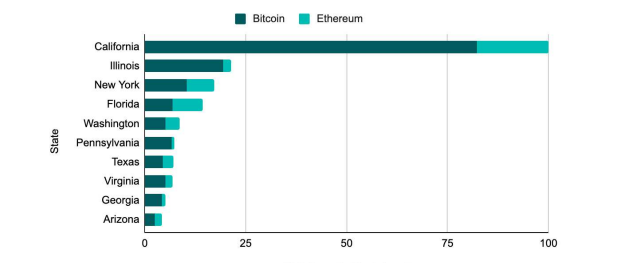
The Golden State of California may be America’s most inquisitive state about Bitcoin (BTC) and Ethereum (ETH), new data from CoinGecko has revealed. In a report shared by CoinGecko, internet users from California accounted for a whopping 43% of all Bitcoin and Ethereum web traffic searches on the crypto tracking website. This is despite the entire state population only accounting for 11.9% of the U.S. population. Bobby Ong, COO and co-founder of CoinGecko said it was “unsurprising” that California took the crown in the blue-chip cryptocurrency interest, given its place as a “major technological hub.” California is also home to Silicon Valley — one of the largest technology and innovation hubs in the world. Among the largest companies situated in Silicon Valley to have invested in blockchain-based applications and crypto startups include Apple, Google, Meta, PayPal and Wells Fargo. Centralized exchange Coinbase was one of the first major crypto companies to be headquartered in California, despite no longer having a headquarters today. The Graph, Helium, MakerDAO, and dYdX are among some of the latest Web3 projects with a presence in the Golden State.Many prestigious universities with excellent engineering and technology departments are also located in California, such as Stanford University, California Institute of Technology, and the University of California Berkeley.CoinGecko also noted that other states with a strong interest in the two cryptocurrencies include Illinois, New York, Florida, and Washington, followed by Pennsylvania, Texas, Virginia, Georgia, and Arizona. Top 10 U.S. states with the most Bitcoin and Ethereum web page traffic. Source: CoinGeckoAcross the top 20 states, most searches on the website appeared to be weighted toward Bitcoin, however, the data found that four particular states saw more searches for Ethereum than its competitor. “What’s especially notable is Colorado, Wisconsin, New Jersey, and Florida’s interest in Ethereum over Bitcoin,” explained Ong. “It remains to be seen how these rankings and market shares will play out in the coming months, with Ethereum’s Merge around the corner.”The data was collected between May. 2 to Aug. 21, 2022, and only collected web traffic data from the U.S. The data was indexed on a scale of 0 – 100, with 100 representing the highest point of web traffic (California) relative to the other states. Related: 70% of US crypto holders started investing in 2021: ReportThe findings come as a recent Study.com survey revealed that over 64% of U.S.-based parents and college graduates with a sufficient understanding of blockchain technology want crypto to be taught in school classrooms. On the global scale, the U.S. has shared the top spot with Germany when it comes to crypto-friendly regulation and legislation, sharing the top spot with Germany and beating out Singapore, Australia, and Switzerland, according to crypto data aggregator Coincub.

Čítaj viac


Helium devs propose ditching its own blockchain for Solana

Internet of Things (IoT) blockchain network Helium could transition to the Solana blockchain following a new HIP 70 governance proposal launched on Aug. 30. The Helium core developers said the need to “improve operational efficiency and scalability” was required in order to bring “significant economies of scale” to the network. The Helium network operates by users installing a Helium Hotspot to provide decentralized wireless 5G network coverage for internet users in their area. Helium uses a unique consensus mechanism — proof-of-coverage to verify network connectivity and distribute HNT tokens to Helium Hotspot providers when coverage is verified. The proposal comes as Helium developers have emphasized the need to fix a number of technical issues in order to improve the network’s capabilities:In the last several months of the network, both have been challenging for network participants with much reduced Proof-of-Coverage activity due to network size and blockchain/validator load, and packet delivery issues.The HIP 70 proposal has been put forward to improve these data transfer and network coverage abilities, according to the Helium GitHub page.If passed, Helium-based HNT, IOT, and MOBILE tokens and Data Credits (DCs) would also be transferred to the Solana blockchain.The network’s HNT tokens are earned by hotspot providers, IOT tokens are earned by node operators that provide the LoRaWAN network, MOBILE tokens are earned when 5G coverage is provided, and DCs are used to pay transaction fees.Helium developers have proposed HIP 70, which would move PoC and Data Transfer Account to Oracles. This simplifies Helium’s blockchain needs, improving scalability, speed, and reliability. It also allows for more rewards for miners and a move to Solana. https://t.co/ZFSWmwYn8f pic.twitter.com/ztnahzGAet— Helium Foundation (@HeliumFndn) August 30, 2022Since its creation in 2013, the Helium network has operated on its own blockchain. “The Hotspot” podcast host Arman Dezfuli-Arjomandi stated in several Twitter posts that “Ethereum was too slow” and “other alternatives [at the time] weren’t all that appealing”.“Helium needed to build its own Blockchain when the protocol first started as “there was no blockchain that this could have been built on that existed at the time.”But despite nearly one million Helium Hotspots deployed worldwide and being backed by the likes of Google Ventures, the network hasn’t come without criticisms.Related: Helium network team resolves consensus error after 4-hour outageLast month, entrepreneur Liron Shapira criticized the network for its “complete lack of end-user demand” following the news that the network was only generating $6,500 per month from data usage revenue, despite raising over $350 million.The Helium network also experienced a four-hour outage, which affected the ability for HNT token holders to exchange their tokens and prevented Helium Hotspot miners from receiving rewards.Community reacts positivelyMany members of the Helium community have responded to HIP 70 with positive sentiment, who are of the view that the integration into Solana will benefit developers tremendously.Ryan Bethencourt, Partner of Web3 backer Layer One Ventures told his 16,000 Twitter followers that the proposal is “huge” for Helium and Solana should the recommendation be approved. Another Twitter user called the combination “simply mind blowing.”Fantastic news from the the most incredible network on the planet. Helium and Solana have extremely hard working relentless communities and teams behind them from all backgrounds. We are builders and not afraid of change.The combination is simply mind blowing ! WAO! https://t.co/SQygB7Dwm9— Jose Marcelino xNFT (@jmarcelino) August 30, 2022

The HIP 70 vote is scheduled for Sept. 12, which will be made available for HNT token holders on heliumvote.com. Voting will end on Sept. 18.The news does not appear to have positively impacted the price of the HNT token which is currently priced at $5.23, down 15.5% over the last 48 hours.

Čítaj viac

Crypto winter? DeFi, Metaverse, and NFT job market still hot — Recruiters

The ongoing crypto winter has seen budgets and jobs slashed, but the search for top-tier talent hasn’t stopped across several Web3 verticals, according to some crypto recruitment firms.Speaking to Cointelegraph, Kevin Gibson, founder of crypto recruiting firm Proof of Search said that the majority of staff cuts in the crypto market have been from centralized exchanges, most notably the 18% staff cut at Coinbase in June, 10% cuts at Gemini in July, and the 5% cut at Crypto.com.Despite this, he said there is “still a great deal of demand” for crypto job seekers to get work with “Game-Fi, Metaverse, De-Fi and NFT-oriented companies.”Gibson explained that crypto job boards continue to be dominated by developer and engineer roles, adding there is also “a shortage of experienced CTO, CMO, and token experts.”Unfortunately several crypto exchanges announced big layoffs recently: – @coinbase 18%- @Gemini 10% – @cryptocom 5%- @BlockFi 20%Despite all this several of our hiring partners are still looking for devs: Rust, Solidity, React, NodeJS… ✉️ DMs are open! #hiring— CryptoCareers | Hiring Web3 Developers (@_cryptocareers) June 14, 2022Gibson added that venture capital firms have continued to deploy capital “to companies with solid business models which have seen sustained hiring activity despite market fluctuations.”These claims appear to be backed by a recent report from crypto analytics firm Messari, which showed that $30.3 billion was poured into crypto companies in H1 2022, which was more than 2021. While Web3 and NFT projects captured $8.6 billion of the total amount invested in the period.Founder of CryptoRecruit Neil Dundon told Cointelegraph that the majority he had seen came from “non-essential areas.”Dundon said however over the short to medium term, the crypto job market will “remain relatively stagnant for the time being until we get confirmation that we have exited the bear market,” despite there still being plenty of “great opportunities” out there for both crypto companies and job seekers. Related: How to start a career in crypto? A beginner’s guide for 2022But bear market or not, Dundon said that a crypto company’s ability to adapt to changing circumstances will go a long way towards success in this market. “Crypto is still a nascent industry the most important attribute to have when entering this space is a start up mentality. The ability to roll with the punches when things get a bit tougher or company direction changes. Building new things is not for the faint hearted.”Some of the world’s largest publicly traded companies have also poured funds into the crypto market in 2022. According to BlockData, Google, Samsung, Microsoft, PayPal, Morgan Stanley, and Goldman Sachs are among some of the companies to have participated in funding rounds.

Čítaj viac

ETH products grow in August as BTC products dip: CryptoCompare report

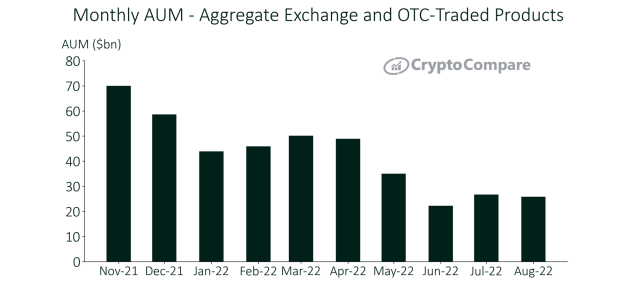
Ethereum investment products increased by 2.36% to $6.81 billion in assets under management (AUM) throughout August, outperforming Bitcoin products which saw a 7.16% drop off to $17.4 billion. The figures were contained in a new report by CryptoCompare. This was also reflected in the Bitcoin (BTC) and Ethereum (ETH)-product trading volumes, with Grayscale’s most notable Bitcoin product, GBTC experiencing a 24.4% drop in volume, while its Ethereum product, GETH actually increased 23.2%. CryptoCompare’s report suggeste the highly anticipated Ethereum Merge was the cause behind the change in trading volumes: Indeed, even at a more granular level, no Bitcoin products covered in this report saw AUM or volume gains in the month of August. We could be seeing interest move away from Bitcoin in the short term, as Ethereum-based products hold the attention with the much-anticipated merge on the horizon.Monthly AUM figures for digital asset investment products fell 4% overall, which was largely attributed to 6% fall from Grayscale’s GBTC product, as it accounts for $13.4 billion of the total $25.8 billion of digital assets under management (53.4%).The largest inflows came from products falling under the “Other” umbrella, representing non-Bitcoin and Ethereum products, which saw a 12.3% increase to $1.13 billion over the first three weeks, according to the  report.Monthly AUM figures for digital asset investment products have steadily dropped throughout the bear market. Source: Crypto Compare.Despite the bear market, a number of highly-regarded financial institutions have launched crypto investment products throughout the month of August. These products have come in the form of Exchange Traded Funds (ETFs), Exchange Traded Certificates (ETC), Exchange Traded Notes (ETN) and Trust products.Among the most notable was BlackRock’s private spot Bitcoin Trust, a move which brought about a “here comes Wall Street” response from former Grayscale CEO Barry Silbert. The launch of the Bitcoin Trust from the world’s largest asset manager came following its partnership with Coinbase to provide its clients with institutional trading services.Charles Schwab was another financial institution to make a play this month, having launched its own “Schwab Crypto Thematic ETF”, tickered STCE on the New York Stock Exchange, which provides exposure to a mix of mining and staking companies, along with several blockchain-based applications. Related: Institutions flocking to Ethereum for 7 straight weeks as Merge nears: ReportBetaShares launched Australia’s first Metaverse-focused ETF on the Australian Stock Exchange (ASX), along with a new Metaverse and nonfungible token (NFT) focused ETF launched by finance firm SoFi.

Čítaj viac

Compound cETH market bricked by update — 7-day wait on vote to fix it

Decentralized lending platform Compound has been plagued by a code bug in a recent governance proposal to update its price feeds. The code error has “temporarily frozen” the Compound ETH (cETH) market, causing cETH transactions to revert, but Compound Labs stated that despite the front end not working, “funds are not immediately at risk.”Compound Labs announced on Aug. 31 that the code bug came from Proposal 117: Compound Oracle Upgrade v3, which was implemented a couple of hours ago to update the oracle contracts on the Compound protocol to a new version that uses Uniswap V3 instead of V2 for price feeds. An hour ago, Proposal 117 was executed, which updated the price feed that Compound v2 uses.This price feed, while audited by three auditors, contained an error that is causing transactions for ETH suppliers and borrowers to revert.https://t.co/a2DFk7h0ET— Compound Labs (@compoundfinance) August 30, 2022In response to the cETH market temporarily freezing, Compound Labs said it aimed to revert to the previous price feed via Proposal 119: Oracle Update. The new proposal was created less than one hour after Proposal 117 had been executed, however it now needs to go through  seven-day governance process before taking effect. According to an update from Security Solutions Architect Michael Lewellen of OpenZeppelin, the code bug came from the “getUnderlyingPrice” function, which did not update the price of cETH tokens, which would return empty bytes and cause the call to be reverted. Read the following post for details on a Compound incident we are working to resolve for the cETH market. A fix is already underway and no funds are at risk at this time. The rest of the cToken markets on Compound V2 and all of V3 remain functional.https://t.co/CiSE3a99Wa— OpenZeppelin (@OpenZeppelin) August 30, 2022

Lewellen also reaffirmed that no funds are at risk:“The primary issue right now is a temporary denial of service for the cETH market which will be resolved by the new governance proposal. No funds are at risk at this time. The rest of the cToken markets on Compound V2 and all of V3 remain functional.”However, Lewellen added that “any users that deposited ETH and obtained cETH for opening borrow positions must be aware that they might get instantly liquidated whenever the fix proposal executes if by that time the price of ETH has dropped significantly.”But the CEO of Compound Labs Robert Leshner also added that users can still repay any debt and add collateral to avoid liquidation. Related: What is a smart contract security audit? A beginner’s guideCompound Labs noted the code bug came despite the oracle contract being audited from three separate smart contract auditing companies, with OpenZeppelin and ChainSecurity among the recent firms to have audited Compound’s smart contracts.Proposal 117 itself didn’t appear to be a controversial one, with all 696,665 votes from 245 different wallet addresses in favor of the price feed upgrade. Crypto investment firm Polychain Capital cast the most votes (306,146) in favor of the proposal.According to DeFi Llama, Compound is the third largest decentralized lending platform, with $2.67 billion total value locked (TVL). The news has not affected the Compound token, COMP, so far which is currently priced at $48.27.

Čítaj viac

Získaj BONUS 8 € v Bitcoinoch

nakup bitcoin z karty

Registrácia Binance

Burza Binance

Aktuálne kurzy