Autor Cointelegraph By Brayden Lindrea

Bitcoin is a 'wild card' set to outperform, says Bloomberg analyst

Bloomberg analyst Mike McGlone has labeled Bitcoin (BTC) a “wild card” which is “ripe” to outperform once traditional stocks finally bottom out. In a five-part Twitter thread on Sept. 7 to his 52,600 followers, McGlone explained that while the United States (U.S.) Federal Reserve tightening will likely determine the direction of the stock market, Bitcoin remains a “wildcard” that could buck the trend, stating:“Bitcoin is a wild card that’s more ripe to outperform when stocks bottom, but transitioning to be more like gold and bonds.” The commodities strategist dived into more detail in a Sept. 7 report, noting that Bitcoin was primed to rebound strongly from the bear market despite a “strong headwind” toward high-risk assets:“It’s typically a matter of time for the fed funds gauge to flip toward cuts, and when it does, Bitcoin is poised to be a primary beneficiary.”McGlone added that while Bitcoin would follow a similar trend to treasury bonds and gold, Ethereum (ETH) “may have a higher correlation with stocks.” The Federal Reserve’s increased quantitative tightening comes amid several major interest rate hikes throughout 2022, with the most recent spike accounting for a 75 basis points increase on Jul. 27.Macro in Five Charts: Crude, Commodities, Stocks, Bonds, Bitcoin – #Crudeoil may be resuming an enduring bear market and refueling the T-bond bull. #FederalReserve tightening as global GDP turns negative may help transmogrify #stocks to going down on bad news and up on good. pic.twitter.com/KZEWsZyI8h— Mike McGlone (@mikemcglone11) September 7, 2022While it is not known exactly when the Fed’s quantitative tightening will end, some economists predicted the endpoint will begin “at some point in 2023” according to a Bloomberg article published in August. Quantitative tightening is a contractionary monetary policy tool that is used by central banks to reduce the level of money supply and liquidity in an economy, which can reduce spending across markets, such as stocks. Related: Bitcoin likely to transition to a risk-off asset in H2 2022, says Bloomberg analystBut despite McGlone’s bullish take, other experts believe that Bitcoin and equity markets have actually become more correlated than before. Cointelegraph contributor Michaël van de Poppe recently said the correlation between the S&P 500 index and BTC was approaching 100%, while a number of IMF economists claimed to have seen a 10-fold increase in correlation between crypto and equity markets in some regions of the world.

Čítaj viac
Ethereum’s Bellatrix upgrade hiccups jangle nerves… but it'll be right on the night

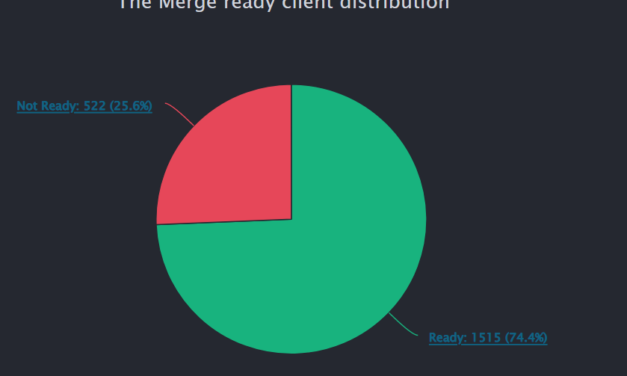
The Bellatrix upgrade preparing Ethereum for the Merge was successfully completed on Sept. 6 – however concerns were raised over an almost one in ten missed block rate across the last 600 slots.The Bellatrix upgrade updated Ethereum consensus layer clients at epoch 144896 on the Beacon Chain prior to the upcoming Merge scheduled for sometime next week .However, 5% of the validators dropped offline during the hard fork, which contributed to the 9% missed block rate, according to Gnosis co-founder Martin Köppelmann. This led some observers to question the network’s readiness for the big switch to proof of stake.Missed block rate in the last 600 slots: >9%Historically this rate has been around ~0.5%. It shows that Bellatrix caused some issues for some validators. Nothing dramatic but still a number to keep an eye on.— Martin Köppelmann (@koeppelmann) September 6, 2022Köppelmann added that the 9% figure was 1700% higher than the historical missed block rate of 0.5%. The issue may be related to the 25.6% of clients that Ethernodes cites at “not ready” for The Merge. Percentage of Ethereum Clients that are Merge ready. Source: Ethernodes.Partner of Cinneamhain Ventures Adam Cochran said he hoped the “big spike” in missed blocks would get debugged before the Merge proper, adding that “we really don’t want to be seeing unexpected issues at this late stage.”But not everyone is concerned. Anthony Sassano, founder of the Daily Gwei said that having only 5% of validators falling off the network was actually an “an amazing result” and confidently stated “there’s not actually much that can go catastrophically wrong.” with the Merge.“I would say that the ‘worst case scenario’ would be if the chain just halts because the switchover from PoW to PoS didn’t work at all – this would then require some sort of coordinated human intervention to fix.”“Though if we see things like validators dropping off the network due to configuration issues, missed blocks/slots or some clients having major bugs, these things wouldn’t be cause for major concern as they are relatively easy to recover from,” he added.So to recap, post-Bellatrix, a few stats: – network participation rate is 94.94%- number of active validators is 403766- number of offline validators 17743- and client diversity for consensus layer clients page will be updated tomorrow so we can check again then— Christine Kim (@christine_dkim) September 6, 2022

Related: 74% of Ethereum nodes ‘Merge ready’ ahead of Bellatrix upgradeThe Bellatrix upgrade is one of the last steps prior to the Merge and enables Ethereum consensus layer clients to execute transactions on the Beacon Chain.The Ethereum Merge will transition the network to a proof-of-stake consensus mechanism, which is set to make the network more efficient and secure.

Čítaj viac

VCs pour $14.2B into crypto in H1 2022, but investments now slowing

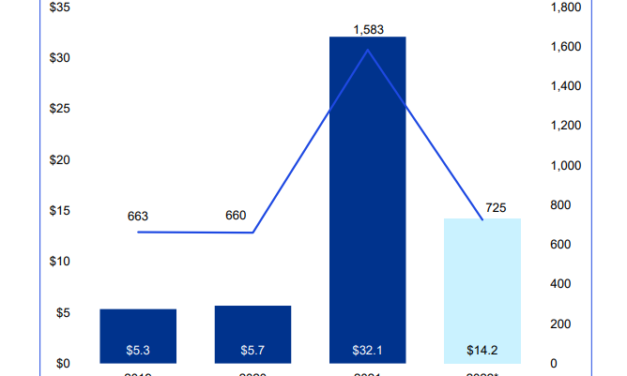
Venture capital firms poured $14.2 billion into crypto across 725 deals in the first half of 2022, but big four accounting firm KPMG predicts investments will likely slow for the remainder of the year. According to a newly released KPMG report on Sept. 6, the largest investments in H1 2022 came from German-based crypto trading platform Trade Republic ($1.1 billion), digital asset custody platform Fireblocks ($550 million), crypto exchange FTX ($500 million), and Ethereum software company ConsenSys ($450 million).Authors of the report, including KPMG’s Global Leader of Fintech, Anton Ruddenklau, noted the investment figures for the first half of 2022 alone were already more than double all years prior to 2021, which “highlights the growing maturity of the space and the breadth of technologies and solutions attracting investment.”However, Ruddenklau said that over-investment during the record-breaking 2021 and first half of 2022, along with a looming potential recession, rising inflation, interest rates, and the Russia-Ukraine conflict would bring about a drop off in investment this year. Total global investment activity (VC, PE and M&A) in blockchain & cryptocurrency. Source: KPMG.KPMG’s prediction for a crypto investment downturn appears to already be borne out in data from July, with monthly inflows into the blockchain venture capital market declining 43% in the month, according to Cointelegraph Research. Ruddenklau expects the slowdown of crypto interest and investment to be particularly felt in retail firms offering coins, tokens, and NFTs. Alexandre Stachtchenko the KPMG France Director of Blockchain & Crypto Assets, stated in the report that “well-managed crypto companies with healthy risk management policies, long-term vision, and strong cost and risk management approach” will best position themselves to survive the current bear market.“Of course, some cryptos will die out — particularly those that don’t have clear and strong value propositions. That could actually be quite healthy from an ecosystem point of view because it’ll clear away some of the mess that was created in the euphoria of a bull market. The best companies will be the ones that survive.”Stachtchenko added that financial institutions have become increasingly interested in blockchain infrastructure solutions and stablecoins to capitalize on the operational advantages of distributed ledger technology.Related: Venture capital financing: A beginner’s guide to VC funding in the crypto spaceKPMG also expects further investment efforts in underdeveloped fintech markets, particularly in Africa. Efforts on this front have been made by crypto exchange Binance, which recently entered into early-stage talks with the Nigerian government to build a crypto-friendly economic zone with the aim to generate long-term economic growth through digital innovation.

Čítaj viac

Ethereum domain names top Bored Apes on OpenSea's weekly chart

Ethereum Name Service (ENS) domain names have surpassed Bored Ape Yacht Club (BAYC) as the most traded asset on NFT marketplace OpenSea over the last seven days — seemingly ahead of the Ethereum Merge. According to OpenSea data, the weekly volume of the Ethereum domain NFTs eclipsed 2,249 ETH at the time of writing, beating out RTFKT Clone X (1,992 ETH) and Bored Ape Yacht Club (1,777 ETH).ENS domains are a distributed, open and expandable naming system on the Ethereum blockchain that allows users to turn a long string of keys for a crypto address into a single ENS domain such as “vitalik.eth.”This simplifies the complexity of copying and pasting a lengthy wallet address to send and receive crypto, as users only need to share their domain name like any other ordinary address or identification details.These domain names can be bought, sold and traded between users in the form of NFTs. The recent spike in ENS trading volume has seen the average price of ENS items increase 167% from 0.1454 ETH to 0.3895 ETH ($641), while daily volume has risen from 120.7 ETH to 1044.6 ETH.There are now over 2 million ENS items on OpenSea, spread amongst more than 508,000 owners, with total sales now sitting at 2,682 ENS domains sold.60-Day Average Price Change For ENS on OpenSea. Source: OpenSea.According to OpenSea, some of the most expensive ENS domain names are 000.eth, which was bought for 300 ETH and is on sale for 5,000 ETH, along with opensea.eth, crypto.eth, google.eth, and nike.eth.The strong start in September follows an impressive ENS sales month in August, which saw more than 300,000 new “.eth” registrations, and monthly revenue of 2,744 ETH, the third-highest month since ENS was founded in 2018.August 2022 stats for ENS- 301K new .eth registrations (total 2.17m names)- $4.7m in protocol revenue (all goes to the @ENS_DAO)- 2,744 ETH in revenue (3rd highest month)- 34K new eth accounts w/ at least 1 ENS name (total 540k)- >99% of OpenSea domain vol pic.twitter.com/utU8i4cBMT— ens.eth (@ensdomains) September 1, 2022The spike in ENS domain name demand comes around a week before the scheduled date of the Ethereum Merge, which is set for Sept. 15. Related: Ethereum Name Service registrations surge by 200% amid lower gas feesOn Sept. 4, Vitalik Buterin tweeted asked his 4.2 million followers what price tag a five-letter ENS domain name should hold over a 100-year period:What is a fair price that someone should have to pay to register and unconditionally guarantee ownership of a 5-letter .eth domain for 100 years?— vitalik.eth (@VitalikButerin) September 4, 2022

The poll found that 49.8% of the 91,130 voters went with “Under $100”, while 18.9% of voters thought “$10,000 or more” could be considered a fair price over a 100-year period. According to OpenSea, the average price of an ENS domain is 0.3207 ETH.

Čítaj viac

74% of Ethereum nodes ‘Merge ready’ ahead of Bellatrix upgrade

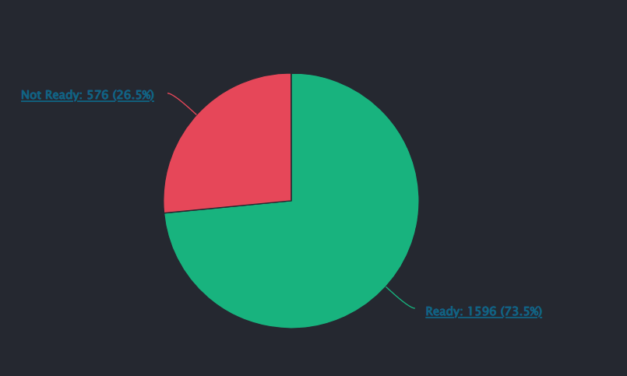
As many as 73.5% of Ethereum nodes are now marked as “Merge ready” ahead of the upcoming Bellatrix upgrade for Ethereum on Sept. 6, according to data from Ethernodes. The Bellatrix upgrade is seen as one of the last necessary steps prior to the official Merge, which will see Ethereum transition to a proof-of-stake consensus mechanism between Sept. 10-20.To become Merge ready, Ethereum node operators must comply with the Bellatrix upgrade by updating its consensus layer clients prior to epoch 144896 on the Beacon Chain, which is scheduled to take place on 11:34:47am UTC on Sept. 6, 2022, according to the Ethereum Foundation. Percentage of Ethereum clients that are Merge Ready. Source: Ethernodes.However, with as many as 26.7% of nodes marked “Not-Ready” for the Ethereum Merge, Ethereum co-founder Vitalik Buterin and core developer Tim Beiko and has taken themselves to Twitter to push the remaining node operators updates their clients.Bellatrix is tomorrow Last chance to upgrade your node if you haven’t yet! We’re mergiiiing https://t.co/0VQ9zb6wjN— Tim Beiko | timbeiko.eth (@TimBeiko) September 5, 2022According to the Ethereum Foundation, node operators that don’t make the update prior to the Bellatrix upgrade will cause the Ethereum clients to “sync to the pre-fork blockchain,” warning: “[Node operators] will be stuck on an incompatible chain following old rules and will be unable to send Ether or operate on the post-Merge Ethereum network.”According to Ethernodes, most of the “Not-Ready” nodes are found on the geth client, who have yet to upgrade to Geth v1.10.23 or higher. Other Ethereum clients that require updating include Erigon, Besu, and Nethermind. Ethereum nodes are required to validate blocks and can be run by different Ethereum client software that varies in the programming language used and code base. All of my validators are merge ready — sassal.eth (@sassal0x) September 6, 2022

Following the Bellatrix upgrade, the last part of the Ethereum Merge will occur in what is called the “Paris event,” which will be triggered when the Terminal Total Difficulty (TTD) reaches 58750000000000000000000, which is estimated to occur around Sept 15. Related: The Merge Q&A: A triumph for Ethereum — or a disaster waiting to happen?Once the execution layer exceeds this TTD, the next block will be produced by a Beacon Chain validator. The finalization of this block will mark the complete transition of Ethereum’s blockchain to the proof-of-stake mechanism. According to the Ethereum Foundation, Ethereum users do not need to do anything with their ETH and Ethereum-based assets during the Merge but should be on the lookout for scams that suggest otherwise.

Čítaj viac

Získaj BONUS 8 € v Bitcoinoch

nakup bitcoin z karty

Registrácia Binance

Burza Binance

Aktuálne kurzy