Autor Cointelegraph By Brayden Lindrea

Algorand Foundation outlines $35M exposure to crypto lender Hodlnaut

The Algorand Foundation has revealed a $35 million USDC hole in its balance sheet as a result of exposure to embattled cryptocurrency lending firm Hodlnaut, which has paused withdraws since Aug. 8. Algorand is an institutional-grade blockchain infrastructure with embedded smart contract functionality. The Algorand Foundation is a not-for-profit community organization focused on developing the Algorand ecosystem.The announcement was made on the Algorand Foundation website on Sept. 9, with the Foundation stating that it’s “pursuing all legal remedies to maximize asset recovery.” Hodlnaut’s financial situation first fell into deep waters when its $300 million investment into TerraUSD (UST) on the Anchor protocol fell dramatically following the de-pegging of UST and collapse of the LUNA token, resulting in the crypto lending firm pausing withdrawals and halting all trading activity, citing a liquidity crisis. Weeks later, the firm was placed under interim judicial management, a form of creditor protection program, by the Singapore court. Today we informed the community about our USDC exposure to Hodlnaut after they suspended withdrawals from their platform on August 8, 2022.The full details can be found here: https://t.co/4pLkSiKW7b— Algorand Foundation (@AlgoFoundation) September 9, 2022The Algorand Foundation said the majority of the investment locked on the platform consisted of “locked, short term deposits,” but are now inaccessible due to Holdnaut’s suspension of withdrawals.However, the Algorand Foundation notes that the $35 million represents less than 3% of the Foundation’s assets and they “do not anticipate [any arising] operational or liquidity issues,” and added that the “funds were a surplus to day-to-day requirements”:“We invest a portion of our surplus treasury capital to generate yield for the purpose of Algorand ecosystem development, and these funds were invested for that purpose.”Embattled crypto lender Hodlnaut is now subject to an Interim Judicial Management to resolve its liquidity issues. Related: 3AC: A $10B hedge fund gone bust with founders on the runUnder Singaporean jurisdiction, corporate entities are placed under Interim Judicial Management for debt restructuring purposes in order to preserve and protect assets at risk prior to onset of legal proceedings.The Algorand Foundation has played a key role, noting that on Aug. 29, the Singapore High Court appointed the Foundation’s nominees Angela Ee along with Aaron Loh of EY Corporate Advisors to act as the Interim Judicial Managers for Hodlnaut, aimed at preserving Hodlnaut’s asset until further court action begins.

Čítaj viac


Ethereum Merge makes network more vulnerable to attack — Security expert

Despite the Ethereum Merge being touted as a major upgrade to the blockchain network, its transition to proof-of-stake theoretically makes it more vulnerable to exploit.Speaking to Cointelegraph, the security researcher explained that unlike proof-of-work (PoW) systems, a proof-of-stake (PoS) system informs node validators in advance what blocks they will validate, thus enabling them to plan attacks. The security expert, who asked not to be named, is a blockchain developer and security researcher working on a proof-of-stake layer-2 blockchain. The researcher explained that an exploit could theoretically occur on the post-Merge Ethereum blockchain if validators manage to line up two consecutive blocks to validate. “If you control two consecutive blocks, you can start an exploit on block N and finish it on block N+1 without having any arbitrage bot coming in and fixing the price that you have manipulated in between.”“From an economic security standpoint, [this vulnerability] makes these attacks relatively easier to pull off.”The expert said that while it’s also possible for miners to validate consecutive blocks in PoW networks — that comes down to “pure luck” and gives the miner no time to plan an attack. As a result, the security researcher argues that Ethereum will be forgoing some strength in security when the Merge takes effect:“As we stand right now [with] the Ethereum proof-of-work versus Ethereum proof-of-stake, Ethereum proof-of-work does have stronger security […] and economic guarantees.”“But that being said […] proof-of-stake [still] has sufficient practical security [and] it doesn’t really matter that it’s theoretically not as secure as proof-of-work. It’s still a very secure system,” he added.Related: Buterin and Armstrong reflect on proof-of-stake shift as Ethereum Merge nearsThe security expert added that “Ethereum is working on fixing [the consecutive block issue]. It is a hard problem to solve, but if that gets done, then proof-of-stake security will [further] increase [as] they’ll have protection against those attack vectors.”Ethereum validators are subject to slashing in PoS, as the consensus rules were designed to economically incentivize validators to correctly validate incoming transactions and any conduct to the contrary would see their ETH stake slashed. The Ethereum Merge is finally set to take place on Sept. 15 at about 2:30am UTC, according to Blocknative’s Ethereum Merge Countdown. The transition to PoS is set to make the Ethereum network more scalable and energy-efficient.

Čítaj viac

'Go to jail:' Community roasts Celsius-themed Monopoly board game

The crypto community is having a field day mocking a new Celsius-themed Monopoly board game named “Celsiusopoly,” which has emerged on a United States-based online e-commerce marketplace. The announcement of the Celsius-themed board game came from the marketplace’s head of sales and partnerships Stephanie Martin, who said the planning and production of the Monopoly spin-off came on the back of “months and months” of hard work.After months and months of back and forth, redesign, negotiating, editing and importing files, etc. we finally have a finished product. #onwardandupward #Celsians pic.twitter.com/vHjN6xWZIJ— Stephanie Martin (@stephusastrong) September 7, 2022According to the marketplace’s website, the Celsiusopoly board game is selling for $99.00, and some sales have reportedly already been made. However, the ill-timed release of the board game has seen the crypto community relentlessly mocking the crypto-lender themed product, with one Twitter user questioning:”Who actually thought this would be a good idea… ? You have no respect for all people that lost their life or are in deep financial hardship cause of Celsius.”Meanwhile, others argue that sales of the board game should be used to “make depositors whole,” and another user jokingly questioned whether the “go to jail” card will only apply to Celsius’ CEO. The chance cards in Celsiusopoly are brutal pic.twitter.com/0z0VmCu2ff— Cam Crews (@camcrews) September 8, 2022

The Celsiusopoly board game has the Celsius logo centered in the middle of the board, with a “Do good. Then do well” slogan beneath, which appears to be in reference to a Jan. 2021 tweet from Alex Mashinsky, the founder and CEO of the Celsius network.In addition to the Celsius-themed game board, box, and play money, the game also features themed Rewards & Interest, Property, Customer Care, Compliance, Loan, and Development Cards, along with an instruction manual and a die. Images of the purported board game do not appear to include any branding from Hasbro Gaming, suggesting the game may not be an official Monopoly board game. Related: Celsius co-founder declares his equity is ‘worthless’ in courtCelsius is a cryptocurrency lending platform that officially went into bankruptcy on Jul. 13, following a long-term liquidity crisis and series of halting withdrawals from customers.The cryptocurrency lending platform recently filed to reopen withdrawals for a minority of customers, with a motion for $50 million worth of the total $225 million held in the Custody Program and Withhold Accounts set to be released to owners.While shipping of the new Celsius-themed Monopoly board game is free for U.S.-based residents, there aren’t any returns available for unsatisfied customers. A Cointelegraph journalist’s attempt at purchasing the board game on the marketplace appears to go through, suggesting this could be a real product that people can purchase. 

Čítaj viac

Weekly active crypto devs drops over 26% over the last 3 months

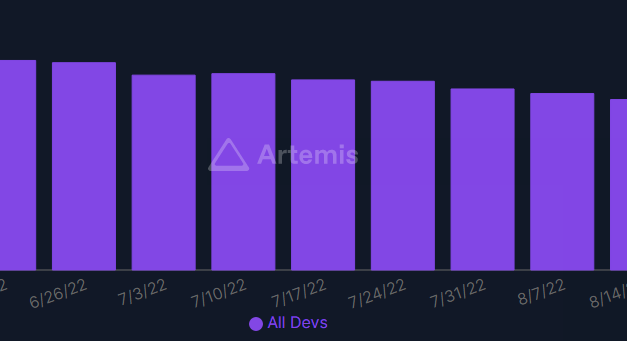
The crypto industry has seen more than a 26% reduction in weekly active developers over the last three months amid a prolonged market slump, the latest data shows. According to Blockchain data aggregator Artemis, the four leading smart contract platforms — Ethereum, Polkadot, Solana, and Cosmos experienced even higher drop-off, clocking 30.5%, 43.6%, 48.4%, and 48.9% reductions in developer activity respectively over the last three months. Source: ArtemisInterestingly, decentralized data storage protocol Interplanetary File System (IPFS) and blockchain network Internet Computer were among the few top smart contract platforms to have seen growth throughout this period, with increases of 206.6% and 21.7% respectively.Blockchain developers are primarily responsible for designing blockchain architecture, maintaining and upgrading infrastructure, and building smart contracts that power decentralized applications. Blockchain developer activity is considered one of the most important metrics for the success of a smart contract platform, as one that lacks developers will likely struggle to grow.Crypto researcher and founder of Tascha Labs, Tascha Che told her 173,700 Twitter followers on Sept. 8 that she doesn’t believe the trend is of much concern, as the fall was attributed to the exit of “tourist builders” and “tourist investors,” which will now allow legitimate builders to “have peace and quiet to get real work done.”Active developers across all crypto protocols have dropped 30% this yr.Tourist builders are leaving along w/ tourist investors.Finally the industry is having some peace & quiet to get real work done.h/t @Artemis__xyz pic.twitter.com/PAGi6Yh7eo— Tascha (@TaschaLabs) September 8, 2022Another Twitter user, identifying themselves as a Binance research analyst didn’t comment on the downward trend but said developer activity will be an “important metric” to consider in the years to come because of the “flywheel effect” it has on the industry.The fall in developer activity follows a crypto market downfall from April to mid-June, which saw the entire crypto market cap slashed from $2.1 trillion to $890 billion.Related: Ethereum dominates among developers, but competitors are growing faster

Čítaj viac

Polygon CSO blames Web2 security gaps for recent spate of hacks

Polygon Chief Security Officer Mudit Gupta has urged Web3 companies to hire traditional security experts to put an end to easily preventable hacks, arguing that perfect code and cryptography are not enough. Speaking to Cointelegraph, Gupta outlined that several of the recent hacks in crypto were ultimately a result of Web2 security vulnerabilities such as private key management and phishing attacks to gain logins, rather than poorly designed blockchain tech. Adding to his point, Gupta emphasized that getting a certified smart contract security audit without adopting standard Web2 cybersecurity practices is not sufficient to protect a protocol and user’s wallets from being exploited:“I’ve been pushing at least all of the major companies to get a dedicated security person who actually knows that key management is important.”“You have API keys that are used for decades and decades. So there are proper best practices and procedures one should be following. To keep these keys secure. There should be proper audit trail logging and proper risk management around these things. But as we’ve seen these crypto companies just ignored all of it,” he added.While blockchains are often decentralized on the backend, “users interact with [applications] through a centralized website,” so implementing traditional cybersecurity measures around factors such as Domain Name System (DNS), web hosting and email security should always “be taken care of,” said Gupta. Gupta also emphasized the importance of private key management, citing the $600 million Ronin bridge hack and $100 million Horizon bridge hack as textbook examples of the need to tighten private key security procedures:“Those hacks had nothing to do with blockchain security, the code was fine. The cryptography was fine, everything was fine. Except the key management was not. The private keys […] were not securely kept, and the way the architecture worked was if the keys got compromised, the whole protocol got compromised.”Gupta suggested that the current sentiment from blockchain and Web3 firms is that if “you fall for a phishing attack, it’s your problem,” but argued that “if we want mass adoption,” Web3 companies have to take more responsibility rather than doing the bare minimum. “For us […] we don’t want just the minimum safety that keeps the liability away. We want our product to be actually safe for users to use it […] so we think about what traps they might fall into and try to protect users against them.”Polygon is an interoperability and scaling framework for building Ethereum-compatible blockchains, which enables developers to build scalable and user-friendly decentralized applications. Related: Cross-chains in the crosshairs: Hacks call for better defense mechanismsWith a team of 10 security experts now employed at Polygon, Mudit now wants all Web3 companies to take the same approach.Following the $190 million Nomad bridge hack in August, crypto hacks have now surpassed the $2 billion mark, according to blockchain analytics firm Chainalysis.

Čítaj viac

Získaj BONUS 8 € v Bitcoinoch

nakup bitcoin z karty

Registrácia Binance

Burza Binance

Aktuálne kurzy