Autor Cointelegraph By Brayden Lindrea

Wife of arrested Tornado Cash dev forbidden to speak with him — Rally organized

Ksenia Malik, the wife of Tornado Cash creator Alexey Pertsev Wife has lashed out at Dutch authorities for treating her husband like a “dangerous criminal” following his arrest last week. The Dutch Fiscal Information and Investigation Service (FIOD)  arrested Pertsev on Aug. 12 over an alleged use of the Ethereum-based privacy tool to launder money and conceal criminal financial flows.Speaking to Cointelegraph, Malik confirmed that Pertsev remains in the hands of Dutch authorities and has not had the chance to contact him since he was put behind bars. “He’s kept in prison as if he were a dangerous criminal,” Malik said, as she expressed her concern that Pertsev was arrested without warning over what she sees as a harmless activity:“It is very unexpected for me that a person can be arrested for writing open source code.”Malik said that she can “only guess how he is doing and how difficult it is for him right now,” as the Dutch authorities have completely barred her [or anyone] from any contact with him, not even “one short call.”Despite Malik feeling helpless in this regard, she isn’t without support. Decentralized finance (DeFi) aggregator 1inch has organized a rally in Amsterdam Aug. 20, to show support for Pertsev and to stand for developers’ rights to create open-source software.1inch has been particularly vocal about the matter, having said that the arrest of Pertsev threatens to “create a dangerous precedent,” as it could “kill the entire open-source software segment” if developers are held responsible for any software they create that is misused by others.1/ Is it really a crime to be an open-source #blockchain developer nowadays ⁉️Stand up for the right to build open-source software!Help Alex Pertsev get out of jail!Sign the petition: https://t.co/r5sdHaYKCN#FreeAlex #OpenSourceNotACrime #DeFiWhy is it important⤵️ pic.twitter.com/CqqD4Ds8AQ— 1inch Network (@1inch) August 18, 2022In light of 1inch’s efforts and the broader crypto community, Malik said that she’s “very grateful to everyone who helps and supports my husband,” as it proves that “people really care.”Malik also hopes that the rally not only draws attention to Pertsev’s injustice but also positively influences public opinion on the nature of open-source code:“We want to achieve publicity so that as many people as possible know about the arrest and the reasons for its wrongness. This is a serious issue, as every open source developer and many other people can be affected by this accusation.”However, Pertsev’s arrest isn’t entirely disapproved of. Venture capitalist Kevin O’Leary stated in a recent interview that crypto privacy tools like Tornado Cash are a part of a “crypto cowboy” culture that “mess with the primal forces of regulation”. While going on to describe Pertsev’s arrest as a necessary one. “If we have to sacrifice him, that’s okay, because we want to have some stability in that institutional capital,” he said. Related: Tornado Cash sanctions will undermine the US and strengthen cryptoPrior to the arrest, the U.S.Office of Foreign Asset Control barred U.S. residents from interacting with Tornado Cash on Aug. 8 amid increasing concerns that it was being used to launder money. The U.S. Treasury believes Tornado Cash has facilitated more than $7 billion worth of money laundering activity since Pertsev created Tornado Cash in 2019.

Čítaj viac

3 cloud providers accounting for over two-thirds of Ethereum nodes: Data

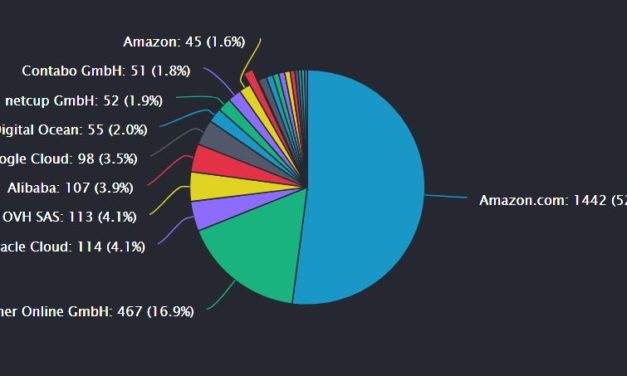
The majority of 4,653 active Ethereum nodes are in the hands of centralized web providers like Amazon Web Services (AWS), which could “expose Ethereum to central points of failure,” according to crypto analytics platform Messari.A Monday post shows that three major cloud providers account for 69% of hosted nodes on the Ethereum Mainnet, with over 50% of that coming from Amazon Web Services (AWS), over 15% from Hetzner and 4.1% from OVH. Figures from Ethernodes additionally show that Oracle (4.1%), Alibaba (3.9%) and Google (3.5%) also provide web hosting services on Ethereum.Distribution of Ethereum nodes from web service providers. Source: EthernodesWhile the distribution of cloud service providers becomes more decentralized among the bottom third of providers, Messari pressed the concern in a December 2020 report that the high-cost nature of node infrastructure may leave Ethereum vulnerable:“High costs to run infrastructure make it more likely that nodes would run infrastructure with cloud computing providers (i.e AWS) – making Ethereum more exposed to central points of failure.”Node distribution issues experienced by Solana are much the same, with Hetzner taking up 42% of hosted nodes on the Solana network, followed by OVH (26%) and AWS (3%).Related: Decentralized storage providers power the Web3 economy, but adoption still underwayFurthermore, Ethernode data also shows that nodes are most geographically concentrated in the United States (46.4%) and Germany (13.4%), accounting for nearly 60% of distributed Ethereum nodes worldwide. As such, government intervention from one of these two countries could severely impact Ethereum’s decentralization at the node level.

Čítaj viac

Aid for Ukraine's $54M crypto fund buys vests, scopes, and UAVs

The crypto community has poured in an impressive $54 million worth of crypto funds through “Aid For Ukraine,” aimed at supporting the country’s military efforts against Russia, the Ukrainian Deputy Prime Minister has revealed. The $54 million has been funneled in through the Ukrainian government-run initiative ‘Aid For Ukraine’, according to Ukraine’s Deputy Prime Minister Mykhailo Fedorov’s Twitter post on Thursday, who thanked the crypto community for their support:“Every helmet, bulletproof vest, and night vision device save the lives of Ukrainian soldiers. Thus, we must continue to support our defenders. Thanks so much to everyone from the crypto community for supporting Ukraine!”According to the Ministry of Digital Transformation of Ukraine, Aid For Ukraine’s $54 million has mostly come in the form of 10,190 Ether (ETH), worth $18.7 million, 595 Bitcoin (BTC), worth $13.9 million, Tether (USDT) worth $10.4 million and USD Coin (USDC), worth $2.2 million.The crypto payments have gone towards military equipment, hardware, and munitions, including $11.8 million worth of unmanned aerial vehicles (UAVs), which are typically used to spot enemy troops and direct attacks. A significant sum of the donations was also spent on armor vests at $6.9 million, along with $3.8 million on field rations, $5.2 million on anti-war media campaigns, and $5.0 million on “weapons of the [Ukraine] Ministry of Defense request”, among other military and medical accessories. With $54 M raised by @_AidForUkraine, we’ve supplied our defenders with military equipment, armor clothes, medicines and even vehicles. Thanks to the crypto community for support since the start of the full-scale invasion! Donation by donation to the big victory. Report below. pic.twitter.com/lifHAP8R4f— Mykhailo Fedorov (@FedorovMykhailo) August 17, 2022“Crypto is playing a significant role in Ukraine’s defense”, said Deputy Minister of Digital Transformation of Ukraine Alex Bornyakov on the government-tied donatiowebsite.Founder of Ukrainian-based crypto exchange KUNA Mike Chobanian added that the contributions from the crypto community have shown the impact that blockchain technology can have on nation-states, stating that it can serve as a “backbone of global security” in times of need. Aid For Ukraine works by transferring crypto into the crypto exchange FTX, which converts crypto into fiat, and is then withdrawn and transferred to the National Bank of Ukraine.Related: Ukraine has received $37M in tracked crypto donations so farBut Aid For Ukraine isn’t the only organization taking in funds to assist Ukrainian defense efforts. Reserve Fund of Ukraine, Come Back Alive, UkraineDAO and Unchain Fund have also contributed funds in the seven-figure range, although the amount of crypto-based funds they’ve taken in hasn’t been disclosed since March.

Čítaj viac

Ontario crypto exchanges impose $30K annual limit on altcoin buys

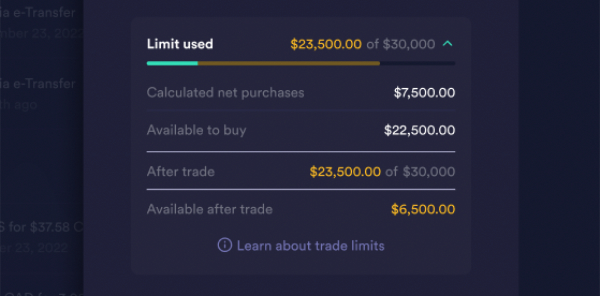
Canada-based crypto exchanges Bitbuy and Newton are enforcing a $30,000 (CAD) annual “buy limit” for “restricted coins” for their users based in Ontario in order to “protect consumers” amid tightened regulations.Newton, a Toronto-based crypto exchange announced the new changes come after working on getting registered with the Ontario Securities Commission and the securities regulatory authorities in other provinces and territories of Canada, noting in an Aug. 16 post: “These changes are to protect crypto investors, like yourself, and to make sure investors are aware of the risks associated with investing in crypto assets.”Under the new changes, Ontario-based crypto traders on Newton and other Canadian crypto platforms will be subject to an annual $30,000 (CAD) “net buy limit” on all cryptocurrency coins excluding Bitcoin (BTC), Bitcoin Cash (BCH), Ethereum (ETH), and Litecoin (LTC). Newton further clarified that if a trader bought and then sold a restricted coin, the sell amount would be subtracted from the limit. The limit resets every 12 months from the first purchase of restricted coins. The buy limits come as the crypto platform announced on Wednesday that they’ve officially registered as a “restricted dealer” in the province of Ontario, which meant that they’re now subject to the regulations set out by the Ontario Securities Commission (OSC).We’re excited to finally announce our registration with the Ontario Securities Commission (OSC) and the securities regulatory authorities in all Canadian provinces, Yukon, and Northwest Territories. pic.twitter.com/8zx8UJy2DE— Newton (@newton_crypto) August 16, 2022Other changes aimed at consumer protection include a “trading questionnaire,” in which the exchange is required to collect information from users about their past experience and knowledge of crypto investing, financial situation, and risk tolerance — which is required to be completed to continue funding the account and trading on the platform. The crypto exchange will also send traders a notification if the trader’s portfolio receives a loss level that they indicated in the questionnaire that they’re not comfortable with. Canadian crypto exchange Bitbuy also confirmed similar purchase limits earlier in the year, noting that similar restrictions also apply to users in the provinces of Manitoba, New Brunswick, Newfoundland, and Labrador, Nova Scotia, Prince Edward Island, Northwest Territories, Nunavut, and Yukon.Similar to Newton, Bitbuy requires traders to fill out a questionnaire to determine whether the investor qualifies as a Retail Investor, Eligible Investor or Sophisticated Investor. However, while Retail Investors remain subject to the $30,000 buy limit, Eligible Investors’ buy limit is upped to $100,000 and no purchase limit exists for Accredited Investors.  Newton provided traders with a snapshot of what they should expect to see when the new rules take effect.Source: NewtonThe Ontario province alone accounts for nearly 40% of the Canadian population, with Toronto being the major metropolitan hub.Newton noted that each province and territory of Canada has its own securities regulatory authority, which combined, makes up the Canadian Securities Administrators (CSA).Related: Cleaning up crypto: How much enforcement is too much?Consumer protection isn’t the only focus of Canadian regulators either. In Apr. 2021, the Canadian federal government announced that they’d undergo a legislative review on the financial sector, with a particular focus on improving the stability and security of digital currencies, and establishing a central bank digital currency (CBDC).Newton, who dubs themselves as “Canada’s trust low cost crypto trading platform” were founded in 2018 and are currently one of the most popular exchanges in Canada, having surpassed 100,000 users in Feb. 2021.

Čítaj viac

Aave calls on members to commit to Ethereum PoS chain

Aave token holders have been asked to take part in an Aave Request for Comment (ARC) that would require them to “commit” to Ethereum’s proof-of-stake (PoS) consensus.The ARC, proposed on Aug. 16, comes in light of Ethereum’s upcoming transition to proof-of-stake. It calls for members to select the Ethereum Mainnet running under PoS consensus as the new “canonical” governance system, while also giving power to an authority to shut down any Aave deployments on any alternative Ethereum forks. ARC for the Aave DAO to signal support PoS ETH upon The Merge https://t.co/0A4YkpHLdq— stani.lens @ ETHLatam (,) (@StaniKulechov) August 16, 2022The proposal will soon be made on Aave’s DAO, which allows Aave token holders to vote on software developments and updates to the AAVE protocol. As outlined on Aave’s governance website, the proposal comes with two main specs. Firstly, members will formally signal that the Aave DAO deployed on Ethereum Mainnet’s PoS consensus is the “canonical governance [mechanism]” of the Aave DAO and Aave markets. Secondly, a signal will give the Community Guardian the authority to shut down any Aave deployments on any other forks that arise from the Ethereum Merge.Aave Companies have proposed this ARC that calls for the Aave DAO to commit to selecting the Ethereum Mainnet running under the Proof of Stake consensus https://t.co/eDGwjLFKz7— Aave (@AaveAave) August 16, 2022

The outcome of the governance vote should give a good indication as to where Aave members stand with respect to Ethereum’s transition to PoS.In the report, Aave also declared that its code was “fully functional” with Ethereum’s consensus change, which was done by deploying Aave V3 on the Ropsten and Goerli testnets during the Merge tests. The Ethereum Merge is set to take effect on Sep. 15, according to the latest tentative schedule set by Ethereum Core Developer Tim Beiko.Related: Aave DAO approving overcollateralized stablecoin splits crypto communityHaving first been deployed on the Ethereum Mainnet, Aave is now on Avalanche, Arbitrum, Optimism, Polygon, Fantom, and Harmony. However, $5.44 billion, or 72.6% of Aave’s total value locked (TVL) resides on Ethereum, so any alternative Ethereum forking that stems from the Merge could impact the Aave market and token price.The price of the AAVE token is $109.95 at the time of writing. AAVE is currently the third largest DAO by market cap ($1.54 billion) after Uniswap (UNI) and ApeCoin (APE).

Čítaj viac

Získaj BONUS 8 € v Bitcoinoch

nakup bitcoin z karty

Registrácia Binance

Burza Binance

Aktuálne kurzy