
Autor Cointelegraph By Brayden Lindrea

What's going on with Cardano testnet and Vasil hard fork?

Cardano founder Charles Hoskinson has continued to refute claims that the Cardano’s testnet is “catastrophically broken,” implying the need to finally move forward with the long-delayed Vasil hard fork.In a Twitter thread on Aug. 21, Hoskinson shared his frustration concerning some of the videos claiming Cardano’s testnet has a “catastrophic” issue, which stems from an Aug. 19 thread from Cardano ecosystem developer Adam Dean.The developer claimed that the testnet is “catastrophically broken” due to an undiscovered bug in Cardano’s Node v 1.35.2 that creates incompatible forks — which had managed to slip under the radar of the previous testing.Following the bug, Cardano released its new client software, Cardano Node v1.35.3, on two separate testnets. However, Dean noted that because the majority of operators upgraded to v1.35.2 to simulate the Vasil hard fork, v1.35.3 is also “incompatible and incapable of syncing” with the original testnet, and the two testnets are “without a block history.”Hoskinson has, however, argued that the coding issue found on that node version had been removed in the 1.35.3 update, sharing his frustration that further testing would lead to further delays of the hard fork. “We of course could as a community delay the launch of Vasil for a few months to retest code that’s already been tested a dozen times and is already running. Is that worth it to all the DApp developers who have been waiting for this update for almost a year now?”During an “Ask-Me-Anything” on Aug. 19, Hoskinson also said that there’s been an “unfair narrative” floating around Cardano and its testnet issues, which he called “incredibly corrosive and damaging.” “You can’t conflate a failed testnet with the mainnet because testnets are constructed and destroyed all the time in this industry. That’s their point. […] They are in no way, in any way harm Cardano itself.”On Sunday, Hoskinson noted that “the realities of something this large and complex is that one can be easily trapped by the things that aren’t working well and forget the things that are.”He added that one of the results of the Vasil hard fork will be a new governance process and more inclusive structures that will lead to “more useful code” and “faster developments.”“Moments that give us a chance to change and grow. Let’s get Vasil done together and then let’s move on to higher ground and fix some of the original sins of the project so Cardano can also grow to its next level.”Related: Sell the news? Cardano price risks 20% drop despite Vasil hard fork euphoriaThe Vasil hard fork has already been delayed several times this year, with the most recent being at the end of July due to issues identified on the testnet. However, Hoskinson said during the AMA that he is optimistic that the Vasil hard fork will ship “imminently.” “The features are there, they’ve worked, they’ve been tested thoroughly, and there’s a high degree of confidence in them. There’s no reason for it not to get over the finish line imminently.”Cardano’s ADA token is priced at $0.45 on Monday, having dropped 18.5% over the last week.

Čítaj viac
Ronin hackers transferred stolen funds from ETH to BTC and used sanctioned mixers

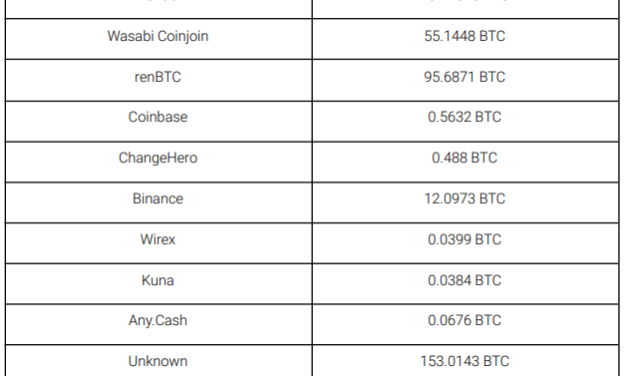
The hackers behind the $625 million Ronin bridge attack in March have since transferred most of their funds from ETH into BTC using renBTC and Bitcoin privacy tools Blender and ChipMixer. The hacker’s activity has been tracked by on-chain investigator ‘₿liteZero’, who works for SlowMist and contributed to the company’s 2022 Mid-Year Blockchain Security report. They outlined the transaction pathway of the stolen funds since the Mar. 23 attack.The majority of the stolen funds were originally converted into ETH and sent to now sanctioned Ethereum crypto mixer Tornado Cash before being bridged over to the Bitcoin network and converted into BTC via the Ren protocol.I’ve been tracking the stolen funds on Ronin Bridge.I’ve noticed that Ronin hackers have transferred all of their funds to the bitcoin network. Most of the funds have been deposited to mixers(ChipMixer, Blender).This thread will illustrate the tracking analysis procedures. pic.twitter.com/yrazcJ22xF— ₿liteZero (@blitezero) August 20, 2022According to the report, the hackers, who are believed to be North Korean cybercrime organization Lazarus Group, initially transferred  just a portion of the fund (6,249 ETH) to centralized exchanges including Huobi (5,028 ETH) and FTX (1,219 ETH) on Mar. 28. From the centralized exchanges, the 6249 ETH appeared to have been converted into BTC. The hackers then transferred 439 BTC ($20.5 million) to Bitcoin privacy tool Blender, which was also sanctioned by the U.S. Treasury on May. 6. The analyst wrote: “I’ve found the answer in Blender sanction addresses. Most Blender sanction addresses are Blender’s deposit addresses used by Ronin hackers. They have deposited all their withdrawal funds to Blender after withdrawing from the exchanges.”However the overwhelming majority of stolen funds — 175,000 ETH — was transferred Tornado Cash incrementally between April 4 and May 19.Related: The aftermath of Axie Infinity’s $650M Ronin Bridge hackThe hackers subsequently used decentralized exchanges Uniswap and 1inch to convert around 113,000 ETH to renBTC (a wrapped version of BTC), and used Ren’s decentralized cross-chain bridge to transfer the assets from Ethereum to the Bitcoin network and unwrap the renBTC into BTC.From there, approximately 6,631 BTC was distributed to a variety of centralized exchanges and decentralized protocols:Platforms the hackers used to transfer BTC to. Source: SlowMist.The report also stated that the Ronin hackers withdrew 2,871 BTC (of the 3,460 BTC) ($61.6 million as of Aug. 22) via Bitcoin privacy tool ChipMixer.BTC balance on platforms after the hackers withdrew funds. Source: SlowMist.₿liteZero concluded the Twitter thread by stating that the Ronin hack remains a “mystery to be investigated” and that more progress is to be made.

Čítaj viac

Hackers exploit zero day bug to steal from General Bytes Bitcoin ATMs

Bitcoin ATM manufacturer General Bytes had its servers compromised via a zero-day attack on Aug. 18, which enabled the hackers to make themselves the default admins and modify settings so that all funds would be transferred to their wallet address. The amount of funds stolen and number of ATMs compromised has not been disclosed but the company has urgently advised ATM operators to update their software.The hack was confirmed by General Bytes on Aug. 18, which owns and operates 8827 Bitcoin ATMs that are accessible in over 120 countries. The company is headquartered in Prague, Czech Republic, which is also where the ATMs are manufactured. ATM customers can buy or sell over 40 coins.The vulnerability has been present since the hacker’s modifications updated the CAS software to version 20201208 on Aug. 18.General Bytes has urged customers to refrain from using their General Bytes ATM servers until they update their server to patch release 20220725.22, and 20220531.38 for customers running on 20220531.Customers have also been advised to modify their server firewall settings so that the CAS admin interface can only be accessed from authorized IP addresses, among other things. Before reactivating the terminals, General Bytes also reminded customers to review their ‘SELL Crypto Setting’ to ensure that the hackers didn’t modify the settings such that any received funds would instead be transferred to them (and not the customers).General Bytes stated that several security audits had been conducted since its inception in 2020, none of which identified this vulnerability. How the attack happenedGeneral Bytes’ security advisory team stated in the blog that the hackers conducted a zero-day vulnerability attack to gain access to the company’s Crypto Application Server (CAS) and extract the funds.The CAS server manages the ATM’s entire operation, which includes the execution of buying and selling of crypto on exchanges and which coins are supported. Related: Vulnerable: Kraken reveals many US Bitcoin ATMs still use default admin QR codesThe company believes the hackers “scanned for exposed servers running on TCP ports 7777 or 443, including servers hosted on General Bytes’ own cloud service.”From there, the hackers added themselves as a default admin on the CAS, named ‘gb’, and then proceeded to modify the ‘buy’ and ‘sell’ settings such that any crypto received by the Bitcoin ATM would instead be transferred to the hacker’s wallet address:”The attacker was able to create an admin user remotely via CAS administrative interface via a URL call on the page that is used for the default installation on the server and creating the first administration user.”

Čítaj viac

Ripple partners with Travelex to launch enterprise crypto payment service in Brazil

Ripple’s XRP token is set to be used to facilitate fast and cost-effective cross-border transactions in Brazil, after the launch of RippleNet’s On-Demand Liquidity (ODL) with forex company Travelex.Digital payment network Ripple announced on Aug. 18 that foreign exchange company Travelex will utilize RippleNet’s ODL to facilitate cross-border payments between enterprises by utilizing Ripple’s XRP token. It also noted that Travelex Bank is the first bank approved by Brazil’s central bank to operate exclusively in foreign exchange. Bom dia! Brazil is open for Ripple’s On-Demand Liquidity with Travelex—our first LATAM bank partner—and the first bank approved by the Central Bank of Brazil to operate exclusively in FX. We’re excited to bring crypto-native solutions to https://t.co/G6U8nh9jIY— Ripple (@Ripple) August 18, 2022While other Latin American companies such as Banco Rendimento, Remessa Online, Frente Corretora, and Banco Topazio have already used RippleNet services, the Central Bank of Brazil’s approval makes this the first time a Latin American bank has utilized ODL, said Ripple. Travelex will firstly enable these cross-border payments between Brazil and Mexico, with plans to open up more payment avenues in the region and with more use cases suited to enterprise needs. The news comes as the Brazilian government approved their first “Bitcoin law” in Apr. 2022, which set out to create a regulatory framework as to how cryptocurrencies would be regulated. Brazil is also in the process of rolling out a central bank digital currency (CBDC). However, the decision has been a controversial one, with Economist Fabio Araujo of the opinion that the CBDC “will be able to halt bank runs and impose other restrictions on citizens’ access to money.”Ripple CEO Brad Garlinghouse said Brazil’s adoption of a crypto-friendly regulatory framework and surging institutional interest in digital asset solutions made the country a great fit for the ODL:“Brazil is a key market for Ripple given its importance as an anchor to business in Latin America, its openness to crypto and country-wide initiatives that promote fintech innovation. As a result, the market is experiencing an explosion of activity as institutions look to adopt crypto and blockchain technology to solve customer pain points.” Related: Latin America’s largest digital bank will allocate 1% to BTC, offer crypto investment servicesGarlinghouse added that with over $780 billion in payments flowing into Brazil annually, Travelex’s use of the ODL service will make cross-border payments much more efficient:“From day one, we’ve focused on building solutions that deliver real utility and we are excited to collaborate with an innovative partner like Travelex Bank to help move money more efficiently for the benefit of its customers across Brazil.”

Čítaj viac

'Programmable money should terrify you' — Layah Heilpern

Government controlled “programmable money should terrify you”, says social media influencer and TV Host Layah Heilpern, who sees central bank digital currencies (CBDCs) as a way for banks and governments to reign control over their people.In an interview on Aug. 19 with British news outlet GB News, Heilpern, who also released Undressing Bitcoin: A Revealing Guide To The World’s Most Revolutionary Asset in September 2021, said the widespread rollout of a central bank digital currency (CBDC) from nation states is on its way, and that it could lead to the financial censorship of citizens in the future. Heilpern stated that as CBDCs are essentially programmable cryptocurrencies that run on blockchains, they could potentially be “programmed against you” at the whims of the centralized authority behind them. “If for whatever reason you say the wrong thing, because you know we’re seeing censorship increasing, then that money can essentially be programmed to be used against you.”Heilpern added that while a lot of people might find this concept to be “quite bizarre,” it’s very realistic given the restrictions that were enforced on unvaccinated people by governments:“With a CBDC, all [the government] have to do really is program that money so you can’t spend it on certain things.”Heilpern also said that while CBDCs will be marketed as “better for the environment,” and serve as a “solution to rising inflation rates,” that’s simply “a lie.” Following up on the interview via a Twitter post,  Heilpern didn’t mince her words as she stated that the “Central Bank Digital Currencies will be marketed as better for the environment and the solution to inflation. It’s a lie. Money is the energy that fuels your life; so programmable money should terrify you.” Central Bank Digital Currencies will be marketed as better for the environment and the solution to inflation.It’s a lie. Money is the energy that fuels your life; so programmable money should terrify you. @GBNEWS is the only UK platform talking about this. pic.twitter.com/AHulCEshNt— Layah Heilpern (@LayahHeilpern) August 18, 2022Notably however, such concerns around financial censorship have been especially prevalent with crypto in general of late, with the recent Tornado Cash debacle, which saw the U.S. Treasury sanction ETH and USDC addresses associated with the Ethereum-based privacy tool.According to an Oct. 2021 report, 110 countries are “at some stage” of CBDC development, with the Bahamas’ Sand Dollar CBDC being the first of its kind to be rolled out in Oct. 2020.But perhaps the most controversial CBDC is China’s “Yuan” (e-CNY), issued by the People’s Bank of China, which had its pilot version launched in Apr. 2020, with some suggesting the ban on crypto was conducted to make way for the digital Yuan. The Bank of Russia has also begun CBDC testing and is aiming to have one launched before their presidential election in 2024.But despite much criticism, CBDCs may offer developing nations more macroeconomic stability in comparison to decentralized currencies, according to IMF Managing Director Kristalina Georgieva, as CBDC’s would have the “backing of the state” and would of course be regulatory compliant.

Čítaj viac

Získaj BONUS 8 € v Bitcoinoch

nakup bitcoin z karty

Registrácia Binance

Burza Binance

Aktuálne kurzy