

Autor Cointelegraph By Brayden Lindrea

Gemini taps Grok for personalized AI-powered prediction market feeds

Crypto exchange Gemini has partnered with Elon Musk’s SpaceXAI to launch an artificial intelligence-powered feature for its prediction markets platform that will allow users to curate personalized feeds.Gemini said on Thursday that its “Command Center” offering would show markets based on users’ open positions and watchlists, and can track crypto, sports, commodities, politics, economics and culture.“Rather than forcing you to dig through social feeds to find what’s relevant, Command Center meets you where you are,” Gemini said. “It learns from your open positions, watchlists, and prediction history to surface the intelligence most likely to inform your next move.”Source: GeminiThe tool is powered by Grok, the AI model created by SpaceXAI, a division of Musk’s rocket-building company SpaceX that runs Grok and the social media website X.Gemini is one of several crypto exchanges expanding beyond spot and derivatives trading into prediction markets and AI amid a crypto market slump that has caused trading volumes and profits to sink.Related: CFTC seeks to reverse settlement deal with Gemini Last month, Gemini introduced a feature letting users connect AI models like ChatGPT and Claude to their trading accounts to autonomously monitor markets and even execute trades on their behalf.Gemini prediction markets revenue hits $400,000 in Q1Gemini said in its first quarter results released earlier this month that its prediction markets platform made a revenue of $400,000 from 20,000 users, a fraction of the revenue and users recorded on market leaders Kalshi and Polymarket. Gemini reported a 42% year-on-year increase in revenue to $50.3 million for the quarter as it continued expanding from a crypto-native trading platform into a financial services company. Gemini also managed to trim its quarterly net loss by 27% year-on-year to $109 million.Magazine: Should users be allowed to bet on war and death in prediction markets? Cointelegraph is committed to independent, transparent journalism. This news article is produced in accordance with Cointelegraph’s Editorial Policy and aims to provide accurate and timely information. Readers are encouraged to verify information independently.

Čítaj viac


CFTC seeks to reverse settlement deal with Gemini

The US Commodity Futures Trading Commission has asked a federal court to vacate its $5 million settlement with crypto exchange Gemini, claiming that the agency’s enforcement action was based on flawed allegations.Gemini settled with the CFTC and paid a $5 million fine in January 2025 in the final weeks of the Biden administration after the agency accused it of making false or misleading statements related to a Bitcoin futures contract.The CFTC filed a joint motion with Gemini in a Manhattan court on Wednesday seeking to vacate the settlement, adding in a statement that it had reviewed the matter and concluded that the “complaint should not have been filed — and would not have been under current enforcement standards.”The CFTC said the complaint, brought under the Biden administration, was “largely based on a whistleblower’s account known to be lacking in credibility.” “Accordingly, the CFTC determined that continuing enforcement of the consent order’s prospective provisions serves neither the CFTC’s mission nor the public interest,” it said.Source: CFTCThe CFTC’s request adds to a string of crypto lawsuits and investigations that the agency and the Securities and Exchange Commission have abandoned under US President Donald Trump.Gemini co-founders Tyler and Cameron Winklevoss each donated $1 million to Trump’s election campaign in 2024.The CFTC’s motion comes after Trump’s former CFTC chair nominee, Brian Quintenz, in September shared on X messages from Gemini CEO Tyler Winklevoss, who asked if he would review the agency’s case against the company if he were made chair.Trump later withdrew Quintenz’s nomination and instead backed Mike Selig, a former lawyer for crypto companies who has taken a supportive stance toward the crypto industry.The CFTC’s request seeks to end ongoing obligations imposed on Gemini under the settlement, including an injunction barring it from making false or misleading statements to the agency. “Applying the remaining provisions — including injunctive relief — prospectively would not be equitable,” the agency said. It noted that Gemini has already paid a $5 million fine, but it was not clear if the agency would refund the penalty.The case stemmed from allegations that Gemini made misleading statements in 2022 during the review of a Bitcoin futures contract, particularly regarding its auction volumes and liquidity. The CFTC said these claims were relevant to assessing risk and the contract’s approval. Related: CME Group to launch regulated Bitcoin volatility futures The CFTC’s complaint relied on allegations from a whistleblower in 2017, who claimed that Gemini inflated trading activity and volumes to distort user demand.The agency argued in its latest filing that the whistleblower’s allegations were based on statements from Gemini’s former chief operating officer and a subordinate, who allegedly made threats against Cameron and Tyler Winklevoss, and was allegedly known to lie about material facts.The CFTC also argued that Gemini was a victim of fraud, claiming that two customers exploited Gemini’s “preferential fee structures through a coordinated rebate-fraud scheme.”It also alleged that the two customers admitted defrauding Gemini of $7.5 million through this scheme, but the past leadership “did nothing with those admissions.”Cointelegraph contacted Gemini and the CFTC for comment.Magazine: eToro founder timed Bitcoin top perfectly due to belief in 4 year cycles

Čítaj viac

Kraken rolls out Bitcoin vault product for holders to earn yield

Crypto exchange Kraken has launched a non-custodial Bitcoin product, giving a 2.5% yearly yield, adding to the company’s yield product offerings amid a rising investor demand for crypto reward products.Kraken unveiled the product on Wednesday with the support of crypto yield infrastructure provider Veda, which said the offering seeks to remove “the headaches that come with wrapping Bitcoin, moving assets, or managing a crypto wallet.”Kraken’s offering comes as Bitcoin (BTC) holders’ demand for yield products has risen, but have seen limited development as the Bitcoin blockchain does not have mechanisms for users to generate yield compared to blockchains such as Ethereum and Solana.“Many Bitcoin holders on Kraken have made it clear they want simple ways to earn on the Bitcoin they already plan to hold,” Kraken Earn product director John Zettler said in a statement.  Source: KrakenAbout 10 hours after the launch, Veda said the Bitcoin yield product had passed $30 million worth of Bitcoin deposits from 4,000 unique wallets. Kraken’s three stablecoin yield products that it launched in January have exceeded around $245 million in customer deposits and generated over $2.2 million in yield since launching on Jan. 26.Related: Coinbase, Apex Group tokenize Bitcoin Yield Fund on Base Kraken’s product generates yield from Bitcoin by swapping it to Kraken Wrapped Bitcoin (kBTC), a token replicating Bitcoin’s price, which crypto platform Sentora then allocates across crypto lending platforms such as Aave, Morpho and Tydro. The product is non-custodial, meaning only depositors can withdraw or transfer their funds. Withdrawals are estimated to take five days to process, and the service providers take a 25% performance fee on rewards.Magazine: Big Questions: Do we really only need 2–5 cryptocurrencies? Cointelegraph is committed to independent, transparent journalism. This news article is produced in accordance with Cointelegraph’s Editorial Policy and aims to provide accurate and timely information. Readers are encouraged to verify information independently.

Čítaj viac
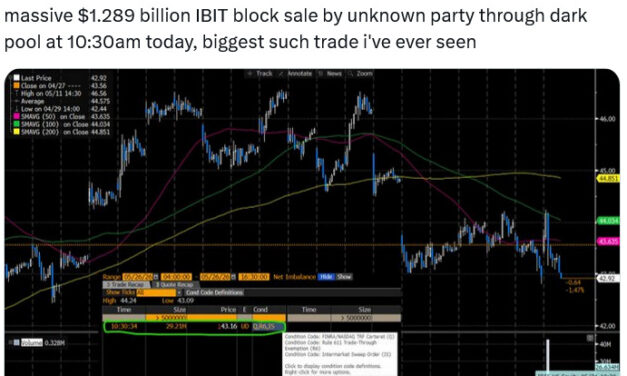
Bitcoin’s recent drop coincides with $1.3B ‘dark pool’ ETF sale: Analyst

An unknown trader’s $1.3 billion sale of shares in BlackRock’s Bitcoin exchange-traded fund on Tuesday has coincided with a steep fall in the price of Bitcoin immediately after the sale, according to analysts.A trader sold 29.2 million shares of BlackRock’s iShares Bitcoin Trust ETF (IBIT) at 2:30 pm UTC on a “dark pool,” a private trading platform that institutions often use to discreetly make large trades outside of public markets.The impact of the $1.3 billion trade was immediately felt in the crypto market, with TradingView data showing that Bitcoin (BTC) fell 1.5% from $77,875 to $76,720 in a short 10-minute window after 2:30 pm UTC.Bitcoin then slid further to a 24-hour bottom of $75,600 about 12 hours later, marking a 2.8% fall for the day.Bitcoin has historically been viewed as an asset that trades outside of the traditional market, but products such as US-based Bitcoin ETFs have removed barriers for institutional investors to trade Bitcoin, and the cryptocurrency has recently traded in high correlation with US markets.Alex Thorn, head of firmwide research at crypto investment firm Galaxy Digital, said in a post to X that it was the biggest trade he has seen made through a dark pool.Source: Alex ThornBloomberg ETF analyst Eric Balchunas also shared that the 29.2 million IBIT shares sold at $43.16 and was over 22 times larger than the second-largest IBIT sell order on Tuesday.Related: Goldman Sachs exits XRP, Solana ETF exposure in Q1 2026 Bitcoin ETF outflow streak continuesUS spot Bitcoin ETFs have now recorded eight straight trading days of net outflows, with a $333.6 million outflow on Tuesday, including a $192.4 million outflow from IBIT.More than $2 billion has now flowed out from the ETFs since May 14, the last recorded net inflow across all the funds, a sign that institutional sentiment toward Bitcoin has weakened, with investors reducing exposure to Bitcoin ETFs at a rate faster than fresh capital flowing into the market.Institutional market maker Jane Street reduced its Bitcoin ETF holdings by around 70% in the first quarter, while investment bank Goldman Sachs reduced its Bitcoin ETF position by 10%. Magazine: Bitcoin ETFs bleed $1B, Aave’s $71M ETH unfreeze bid delayed

Čítaj viac

Bitcoin’s recent drop coincides with $1.3B ‘dark pool’ ETF sale: Analyst

An unknown trader’s $1.3 billion sale of shares in BlackRock’s Bitcoin exchange-traded fund on Tuesday has coincided with a steep fall in the price of Bitcoin immediately after the sale, according to analysts.A trader sold 29.2 million shares of BlackRock’s iShares Bitcoin Trust ETF (IBIT) at 2:30 pm UTC on a “dark pool,” a private trading platform that institutions often use to discreetly make large trades outside of public markets.The impact of the $1.3 billion trade was immediately felt in the crypto market, with TradingView data showing that Bitcoin (BTC) fell 1.5% from $77,875 to $76,720 in a short 10-minute window after 2:30 pm UTC.Bitcoin then slid further to a 24-hour bottom of $75,600 about 12 hours later, marking a 2.8% fall for the day.Bitcoin has historically been viewed as an asset that trades outside of the traditional market, but products such as US-based Bitcoin ETFs have removed barriers for institutional investors to trade Bitcoin, and the cryptocurrency has recently traded in high correlation with US markets.Alex Thorn, head of firmwide research at crypto investment firm Galaxy Digital, said in a post to X that it was the biggest trade he has seen made through a dark pool.Source: Alex ThornBloomberg ETF analyst Eric Balchunas also shared that the 29.2 million IBIT shares sold at $43.16 and was over 22 times larger than the second-largest IBIT sell order on Tuesday.Related: Goldman Sachs exits XRP, Solana ETF exposure in Q1 2026 Bitcoin ETF outflow streak continuesUS spot Bitcoin ETFs have now recorded eight straight trading days of net outflows, with a $333.6 million outflow on Tuesday, including a $192.4 million outflow from IBIT.More than $2 billion has now flowed out from the ETFs since May 14, the last recorded net inflow across all the funds, a sign that institutional sentiment toward Bitcoin has weakened, with investors reducing exposure to Bitcoin ETFs at a rate faster than fresh capital flowing into the market.Institutional market maker Jane Street reduced its Bitcoin ETF holdings by around 70% in the first quarter, while investment bank Goldman Sachs reduced its Bitcoin ETF position by 10%. Magazine: Bitcoin ETFs bleed $1B, Aave’s $71M ETH unfreeze bid delayed

Čítaj viac

Získaj BONUS 8 € v Bitcoinoch

nakup bitcoin z karty

Registrácia Binance

Burza Binance

Aktuálne kurzy

