Autor Cointelegraph By Brayden Lindrea

Network outages have been Solana’s ‘curse,’ says co-founder

Network outages continue to be the Solana network’s biggest challenge, according to its co-founder Anatoly Yakovenko.Launched in 2020, the Solana network has suffered a number of network outages, which have come from a number of different congestion and spam events, according to Yakovenko. In a Sept. 2 interview with Real Vision co-founder Raoul Pal, Yakovenko said the network outages had been Solana’s “curse,” but said the outages have resulted because of the network’s low-cost transactions. “That’s been, I guess, our curse, but it’s because the network is so cheap and fast that there are enough users and applications that are driving that.”However, while the outages have “prevented users” from using the network, the Solana CEO said the network itself hasn’t been compromised. He also argued that each blockchain is built differently and has their own “failure case.”For example, Yakovenko noted that when the Bitcoin network block production halted for two hours in the past, it was still considered normal. “[Bitcoin] is designed to be extremely resilient […] when a bunch of Chinese hash power shut down, there were times where there are two hours between blocks in Bitcoin. And that’s totally fine,” he explained, adding that the same production halt would be seen as a failure for Solana. “If there’s two hours between blocks in Solana, the network’s dead because it’s designed to make a block every 400 milliseconds.”Solana was built to be a high transaction speed, low-cost smart contract platform, which processes “30 million transactions per day,” making it “more than all other chains combined,” said Yakovenko“Once you make a faster network, the failure case is different than one on something like Bitcoin or Ethereum.”However, Yakovenko argued that the outages themselves aren’t entirely a bad thing “because all [of] these challenges are coming because we have users.”“This is our biggest challenge, which is maybe the one that I like to have because of all these challenges that are coming because we have users on the chain on a daily basis,” he added. Related: Reliably unreliable: Solana price dives after latest network outageSolana has suffered at least seven network outages since its launch in 2020, with five of them coming in 2022 alone. One of the longest production halts lasted up to 17 hours in September 2021.Yakovenko said the network outages resulted from the validators not being able to process transaction loads at peak periods:“I think some people have seen 10 million packets per second being submitted to a validator. And if there’s a bug in any one of those validators where memory grows really […] quickly, that validator could shut down.”Among the most notable ones include a denial-of-service attack caused by bots spamming the Raydium protocol in Sept. 2021, another seven hour outage caused by bots on a nonfungible token (NFT) application in May. 2022 and a code bug halting block production on the network in Jun. 2022. The Solana token, SOL, is currently priced at $32, up 3.83% over the last 24 hours.

Čítaj viac
CZ hits back at claims Binance is a Chinese company

Binance CEO Changpeng Zhao (CZ) has hit back at critics and conspiracy theorists who claim Binance to be a Chinese-based “criminal entity” that “secretly [belongs] in the pocket of the Chinese government.”CZ’s response to critics came from a Sept. 1 blog post via Binance, and stems from a Twitter spat with a former Washington Post journalist who asked him; “While I have you here, who’s Guangying Chen?” He explained that the question is in reference to a conspiracy theory alleging that his personal friend and Chinese national Guangying Chen is the secret owner of Bijie Tech (a company he founded in 2015) and possibly also Binance. However, CZ explains that Chen is a colleague of his that he met through a friend, which he hired to “manage the back office” at Bijie Tech before re-hiring her again at Binance, adding that conspiracy theorists then linked her as a secret owner of the firms given that she was one of the few to have initially remained in China.Websites such as Scam Binance allege that Chen at one stage owned 93% of the shares in both Bijie Tech and Binance, among other things. CZ stated that such rumors originated from an “old campaign that a competitor launched via an anonymous microsite.”“As a result, both she and her family have been targeted and harassed by the media and online trolls. Had I known how much of a negative impact this would have on her life, I never would have asked her to do what seemed like such an innocuous step at the time,” he said. Links to ChinaCZ also strongly denied the claims that his company has close links to China and its government, and even went as far as discussing some of his troubling personal and business-related experiences with Chinese authorities. “The greatest challenge that Binance faces today is that we (and every other offshore exchange) have been designated a criminal entity in China. At the same time, our opposition in the west bends over backward to paint us as a ‘Chinese company.'” CZ is of the view that the ill-intended inferences come from the fact that he, along with a few other Binance employees are of Chinese ethnicity, making Binance “an easy target for special interests, media, and even policymakers that hate our industry.””The inference is that because we have ethnically Chinese employees, and perhaps because I am ethnically Chinese, we are secretly in the pocket of the Chinese government,” he said. Views to that effect have been expressed by the media as recently as Aug. 30, with a Fortune India article describing Binance as a “Chinese-origin[ed] crypto exchange”, which claimed Binance and other Chinese-linked centralized crypto exchanges were “invading” India by freely operating their services within India through illegal means.Chinese-infiltrated narratives continue to spread despite Binance never being legally incorporated in China and never operating like a Chinese company culturally, said CZ. CZ added that Binance has subsidiaries in a number of countries, such as France, Spain, Italy, UAE, and Bahrain, and has grown a team around the globe, adding that “we are active in pursuing top talent, no matter where they hail from.”“Over the past two years, as we expanded into Europe and the Middle East and recruited a more senior leadership team, Binance’s executive team is now more heavily dominated by Europeans and Americans. “Our broader employee base is even more globally distributed. Despite these facts, some people insist on calling us a ‘Chinese company,’” he added. Having fled from China to Canada at 12, CZ later returned to start a company in 2015, but was later shut down by the Chinese government:“Two years before Binance, I started a company called Bijie Tech, providing exchange-as-a-service platforms to other exchanges. We got 30 clients on board, and business was good […] Unfortunately, in March 2017, the Chinese government shut down all such exchanges. All of our clients went out of business.”CZ said that he brought a few past Bijie Tech employees in to launch Binance in Jul. 2017, however the Chinese government again effectively shut it down six weeks later by issuing a memorandum stating that crypto exchanges were not allowed to operate in China, adding:“They then blocked our platform behind the Great Firewall. At this point, most of our employees left China. Only a small number of customer service agents remained by late 2018.”Related: Binance CEO sues Bloomberg subsidiary alleging defamationBinance was legally incorporated in Cayman Islands in 2017, but currently has no formalized headquarters. As of Oct. 2021, Binance had accumulated an estimated 28.6 million crypto users, making it the world’s largest centralized crypto exchange. In Nov. 2021, a former Binance executive said the company is worth over $300 million.

Čítaj viac

Tether requests Roche Freedman to be booted from class action

USDT-issuer Tether wants law firm Roche Freedman “terminated” as counsel from the Bitfinex and Tether class action lawsuit following a motion from Kyle Roche to be removed as counsel in the case.In an Aug. 31 court order request by Elliot Greenfield of Debevoise & Plimpton LLP, the law firm representing Tether and Bitfinex requested that Roche’s law firm be removed from the case entirely and to certify that they’ve returned or destroyed all defendant-issued documents and have not shared them with any third-party, including Ava Labs. The request follows shortly after Roche submitted a Notice of Motion to Withdraw from the Tether class action lawsuit amid ongoing fallout from a recent CryptoLeaks expose, which alleged the U.S. lawyer had a secret pact to “harm” Ava Labs competitors in exchange for AVAX tokens and Ava Labs equity. Greenfield said Roche’s statements published on the CryptoLeaks website raised a “serious concern” that Kyle Roche “may be abusing the discovery process” and “misusing information” he learns through litigation.”He states that he is Ava Lab’s ‘crypto expert’ because he ‘sue[s] half the companies in the space’ and ‘know[s] where this market is going’ because he has ‘seen the insides of every single crypto company.’”Greenfield said the concerns are highly relevant to the case, highlighting that Roche Freedman LLP “has served a number of document requests seeking information that has no apparent link to the claims and defenses in this lawsuit.”The lawyer has also stressed the need for the documents to be repressed, “as they include not only confidential, competitively sensitive information about Defendants’ businesses but also information that, if disclosed, would threaten the privacy and security of Defendants and their customers.”While Kyle Roche has filed motions to remove himself from the case and others, Greenfield said the withdrawal of Roche “does little if anything to address the serious issues regarding the potential misuse of discovery.”“Even if he is no longer counsel of record, he would still have access to discovery materials, would retain the ability to direct the conduct of other lawyers at his firm, and would profit from any potential recovery in this lawsuit.”Greenfield added that the “removal would not prejudice Plaintiffs,” as they would continue to be represented by “two other large and experienced firms” including Selendy Gay Elsberg PLLC and Schneider Wallace Cottrell Konecky LLP.The class action lawsuit initiated in 2019 alleged that Tether and Bitfinex manipulated the crypto market by issuing unbacked Tether (USDT) “in an effort to signal to the market that there was enormous, organic demand for crypto commodities.” Over the last few days, Roche has also withdrawn from the Binance, Solana, Tron, BitMEX, Nexo, and Dfinity lawsuits.

Čítaj viac

CoinGecko reveals the US state most interested in Bitcoin and Ethereum

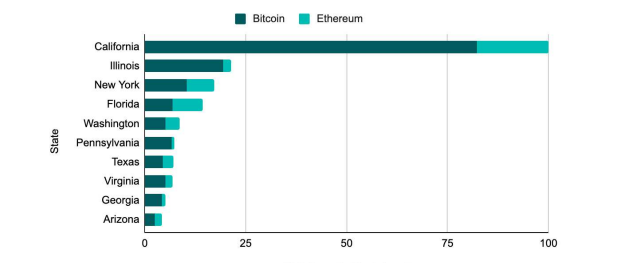
The Golden State of California may be America’s most inquisitive state about Bitcoin (BTC) and Ethereum (ETH), new data from CoinGecko has revealed. In a report shared by CoinGecko, internet users from California accounted for a whopping 43% of all Bitcoin and Ethereum web traffic searches on the crypto tracking website. This is despite the entire state population only accounting for 11.9% of the U.S. population. Bobby Ong, COO and co-founder of CoinGecko said it was “unsurprising” that California took the crown in the blue-chip cryptocurrency interest, given its place as a “major technological hub.” California is also home to Silicon Valley — one of the largest technology and innovation hubs in the world. Among the largest companies situated in Silicon Valley to have invested in blockchain-based applications and crypto startups include Apple, Google, Meta, PayPal and Wells Fargo. Centralized exchange Coinbase was one of the first major crypto companies to be headquartered in California, despite no longer having a headquarters today. The Graph, Helium, MakerDAO, and dYdX are among some of the latest Web3 projects with a presence in the Golden State.Many prestigious universities with excellent engineering and technology departments are also located in California, such as Stanford University, California Institute of Technology, and the University of California Berkeley.CoinGecko also noted that other states with a strong interest in the two cryptocurrencies include Illinois, New York, Florida, and Washington, followed by Pennsylvania, Texas, Virginia, Georgia, and Arizona. Top 10 U.S. states with the most Bitcoin and Ethereum web page traffic. Source: CoinGeckoAcross the top 20 states, most searches on the website appeared to be weighted toward Bitcoin, however, the data found that four particular states saw more searches for Ethereum than its competitor. “What’s especially notable is Colorado, Wisconsin, New Jersey, and Florida’s interest in Ethereum over Bitcoin,” explained Ong. “It remains to be seen how these rankings and market shares will play out in the coming months, with Ethereum’s Merge around the corner.”The data was collected between May. 2 to Aug. 21, 2022, and only collected web traffic data from the U.S. The data was indexed on a scale of 0 – 100, with 100 representing the highest point of web traffic (California) relative to the other states. Related: 70% of US crypto holders started investing in 2021: ReportThe findings come as a recent Study.com survey revealed that over 64% of U.S.-based parents and college graduates with a sufficient understanding of blockchain technology want crypto to be taught in school classrooms. On the global scale, the U.S. has shared the top spot with Germany when it comes to crypto-friendly regulation and legislation, sharing the top spot with Germany and beating out Singapore, Australia, and Switzerland, according to crypto data aggregator Coincub.

Čítaj viac

Helium devs propose ditching its own blockchain for Solana

Internet of Things (IoT) blockchain network Helium could transition to the Solana blockchain following a new HIP 70 governance proposal launched on Aug. 30. The Helium core developers said the need to “improve operational efficiency and scalability” was required in order to bring “significant economies of scale” to the network. The Helium network operates by users installing a Helium Hotspot to provide decentralized wireless 5G network coverage for internet users in their area. Helium uses a unique consensus mechanism — proof-of-coverage to verify network connectivity and distribute HNT tokens to Helium Hotspot providers when coverage is verified. The proposal comes as Helium developers have emphasized the need to fix a number of technical issues in order to improve the network’s capabilities:In the last several months of the network, both have been challenging for network participants with much reduced Proof-of-Coverage activity due to network size and blockchain/validator load, and packet delivery issues.The HIP 70 proposal has been put forward to improve these data transfer and network coverage abilities, according to the Helium GitHub page.If passed, Helium-based HNT, IOT, and MOBILE tokens and Data Credits (DCs) would also be transferred to the Solana blockchain.The network’s HNT tokens are earned by hotspot providers, IOT tokens are earned by node operators that provide the LoRaWAN network, MOBILE tokens are earned when 5G coverage is provided, and DCs are used to pay transaction fees.Helium developers have proposed HIP 70, which would move PoC and Data Transfer Account to Oracles. This simplifies Helium’s blockchain needs, improving scalability, speed, and reliability. It also allows for more rewards for miners and a move to Solana. https://t.co/ZFSWmwYn8f pic.twitter.com/ztnahzGAet— Helium Foundation (@HeliumFndn) August 30, 2022Since its creation in 2013, the Helium network has operated on its own blockchain. “The Hotspot” podcast host Arman Dezfuli-Arjomandi stated in several Twitter posts that “Ethereum was too slow” and “other alternatives [at the time] weren’t all that appealing”.“Helium needed to build its own Blockchain when the protocol first started as “there was no blockchain that this could have been built on that existed at the time.”But despite nearly one million Helium Hotspots deployed worldwide and being backed by the likes of Google Ventures, the network hasn’t come without criticisms.Related: Helium network team resolves consensus error after 4-hour outageLast month, entrepreneur Liron Shapira criticized the network for its “complete lack of end-user demand” following the news that the network was only generating $6,500 per month from data usage revenue, despite raising over $350 million.The Helium network also experienced a four-hour outage, which affected the ability for HNT token holders to exchange their tokens and prevented Helium Hotspot miners from receiving rewards.Community reacts positivelyMany members of the Helium community have responded to HIP 70 with positive sentiment, who are of the view that the integration into Solana will benefit developers tremendously.Ryan Bethencourt, Partner of Web3 backer Layer One Ventures told his 16,000 Twitter followers that the proposal is “huge” for Helium and Solana should the recommendation be approved. Another Twitter user called the combination “simply mind blowing.”Fantastic news from the the most incredible network on the planet. Helium and Solana have extremely hard working relentless communities and teams behind them from all backgrounds. We are builders and not afraid of change.The combination is simply mind blowing ! WAO! https://t.co/SQygB7Dwm9— Jose Marcelino xNFT (@jmarcelino) August 30, 2022

The HIP 70 vote is scheduled for Sept. 12, which will be made available for HNT token holders on heliumvote.com. Voting will end on Sept. 18.The news does not appear to have positively impacted the price of the HNT token which is currently priced at $5.23, down 15.5% over the last 48 hours.

Čítaj viac

Získaj BONUS 8 € v Bitcoinoch

nakup bitcoin z karty

Registrácia Binance

Burza Binance

Aktuálne kurzy