Autor Cointelegraph By Brayden Lindrea

Almost everything could be tokenized in 5-10 years — Matrixport co-founder

In five to ten years, almost every “real world” asset class could be tokenized in the form of a nonfungible token (NFT) according to Cynthia Wu, co-founder of digital asset service platform Matrixport. Speaking to Cointelegraph, Wu said the best case for NFTs would see the widespread representation of real-world assets to be stored and traded on-chain:“Eventually all the major financial asset classes are going to be represented on this new financial infrastructure [and] NFTs could be our instrument to represent off-chain assets like real estate deeds, equities or bonds.”The move on-chain would make these real world assets “more liquid and more tradable” which would improve price discovery and transaction activity, Wu added.But Wu said that while it’s great that we’ve created over two trillion worth of digital native assets on-chain from Bitcoin (BTC), Ethereum (ETH) and other tokens, the only niche to have generated NFT transaction activity has come from digital collectibles — which hasn’t really helped institutional adoption:“We haven’t really been seeing off-chain assets being represented on-chain […] we’re now really only at the first 3-5% of it.”But nonetheless, Wu is confident that the tide will turn.Earlier this month, a report from Boston Consulting Group (BCG) estimated the total size of tokenized illiquid assets to reach $16.1 trillion by 2030.BCG predicted much of this tokenization to come from pre-initial public offering (IPO) stocks, real estate, private debt, and revenue generated from small to medium-sized businesses.However, while the tokenization of real-world assets has piqued the interest of financial institutions, Wu said some have been a bit reluctant to move on from the legacy systems that have served them well over the years.Related: Asset tokenization: A beginner’s guide to converting real assets into digital assetsWu pointed out the traditional financial system hasn’t accounted for the trading of nonfungible assets because they can’t easily be exchanged the same way a fungible or divisible asset can, but tokenization on the blockchain provides a solution for that. She also argued that blockchain infrastructure is the superior option to legacy systems, citing cost efficiencies, improved liquidity, 24/7 market access, and the removal of intermediaries as the main factors that would lead to a more streamlined financial system.Matrixport co-founder Cynthia Wu.Matrixport was established in Feb. 2019, and currently manages between $3-4 billion in digital assets from a broad mix of retail and institutional clients.

Čítaj viac


New Cosmos whitepaper repurposes ATOM token and refines vision

Interoperability-focused blockchain network Cosmos has dropped a new whitepaper proposing a revamped Cosmos Hub aimed at strengthening interoperability and security, along with key changes to its native ATOM token. The new Cosmos whitepaper was released on Monday at the Cosmoverse conference in Medellin, Colombia. The upgrades outlined in the whitepaper are still technically in “proposal” status but changes are expected to be made on-chain on Oct. 3. Cosmos is an ecosystem of blockchains designed to scale and interoperate with each other. Cosmos Hub was the first blockchain to be built on Cosmos, which initially served as an intermediary between other interconnected blockchains.The ATOM token is used to transact within the Cosmos ecosystem, which can also be used for governance and staking purposes.Under the proposed changes, Cosmos will become a more interoperable, decentralized, and secure ecosystem.One of the changes outlined is the reinvention of the Cosmos Hub as the “Interchain” web, which will enable other Cosmos blockchains to borrow the Hub’s validator pool to secure its network rather than having to find their own.Billy Rennekamp, the Cosmos Hub Product Lead added that the value proposition behind this transition to Interchain Security would also make the Cosmos network “legally, defensibly decentralized.”According to the whitepaper, Interchain Security will also enable Cosmos Hub to “host a novel category of applications with complementary functionality,” stating:“Interchain Security gives consumer chains a faster, easier, and cheaper path to market [and] the development platform afforded by Interchain Security allows […] third parties to utilize the Hub’s essential infrastructure to build commercial applications.”The whitepaper also proposes a new issuance model for the native ATOM token, with the aim to strike a better balance between ecosystem growth and interchain adoption “while still preserving the security afforded by the original regime,” according to the whitepaper.The new monetary policy will see two phases: “transition” and “steady state.”The transition phase will see 10,000,000 ATOM issued in the first month, which will then decrease at a declining rate until it reaches the steady state phase 36 months later.Cosmos co-founder Ethan Buchman said this new token issuance model would enable other Cosmos blockchains to become more interconnected with the Cosmos Hub and ATOM.Related: Most of the crypto market is down, but Cosmos (ATOM) price is up — Why?The whitepaper also outlined a plan to further accrue more value to the ATOM token by enabling leveraged liquid staking. This will allow ATOM holders to unstake ATOM tokens as easily as they staked them, which will soon be enabled by the Cosmos “liquid staking module.”“The user experience and capital efficiency improvement offered by liquid stalking is so substantial” that it required “full economic integration” into the new Cosmos interchain-oriented ecosystem, according to the whitepaper.Intern notes on Cosmos’ new 27 page whitepaper TL;DR – Secure economic scaling ⛓- $ATOM as reserve currency – New economic engine Definitely worth a read! (1/2) pic.twitter.com/OseBg1kBYp— (Delphi, Intern) (@delphiintern) September 26, 2022The release of the whitepaper comes a few weeks after research and investment firm Delphi Labs announced a shift of its R&D efforts to focus on the Cosmos ecosystem.The research firm outlined network speed, chain liquidity, sufficient decentralization, and cross-chain interoperability as the key factors behind its decision to provide R&D efforts to help further the growth of Cosmos.

Čítaj viac

Blockchain firm sues Coinbase for $350M alleging patent infringement

Crypto exchange Coinbase has found itself in legal hot water after being accused by blockchain-based software firm Veritaseum Capital of infringing on a patent relating to its blockchain technology — and is now seeking $350 million in damages. According to a lawsuit filed on Thursday by U.S. law firm Brundidge & Stanger in the U.S. District Court in Delaware, Veritaseum alleges that Coinbase infringed on its cryptocurrency payment transfer technology patent, known as the “566 Patent.” Veritaseum said the patent revolves around “novel devices, systems and methods” which enable parties to “enforce value transfer agreements” with “little or no trust” in each other, alleging Coinbase used this for many of its blockchain infrastructure services:“Defendant’s infringing activities include but are not limited to its website […] Coinbase Android mobile wallet […] iOS mobile wallet […] its Coinbase Cloud, Coinbase Commerce APIs, Query and Transact, Participate, Delegate and Validator software, Coinbase Pay, Coinbase Wallet and Coinbase Operated Public Validators.”The law firm also explained that the patent is applicable with proof-of-stake (PoS) and proof-of-work (PoW) blockchains, which could enable the transfer of cryptocurrency payments, trading and staking services on chains supported by those consensus mechanisms.Furthering my many warnings of the risks of poor due diligence, our suit includes infringement of patent claims that cover PoS & PoW Ethereum, transfer of NFTs & Bitcoin. This was public info since 2015, I’ve been tweeting publicly for almost a year. It should surprise no one! https://t.co/MjuJSvYBrc— Reggie Middleton DeFi Patent US11196566, JP6813477 (@ReggieMiddleton) September 22, 2022Veritaseum justified the $350 million figure by arguing that Coinbase had “gained substantial profits by virtue of its infringement” and that Veritaseum Capital “sustained damages as a direct and proximate result.”The attorneys also noted that Veritaseum had previously sent a letter to Coinbase in July warning it of its alleged infringement, adding: “Defendant had prior knowledge, should have known, or at least been willfully blind of the ‘566 Patent. Defendant has been on notice of the ‘566 Patent at least as early as July 3, 2022, if not earlier from other sources or parties.”In July, Vertiaseum’s “Coinbase: Forensic Analysis & Deep Dive” report suggested that there may be other “centralized and decentralized digital asset exchanges” that employ “unlicensed patented IP” from Veritaseum in addition to Coinbase. Related: Coinbase hit with 2 fresh lawsuits amid SEC probeAccording to the court document, Patent 566 was awarded to Vertiaseum founder Reginald ‘Reggie’ Middleton and co-inventor Mathew Bogosian by the U.S. Patent and Trademark Office on Dec. 7. 2021. However, Vertiaseum did not mention how long Coinbase had been allegedly using Patent 566 for.Veritaseum Capital also requested a trial by jury in the Delaware-based court as its preferred means to resolve the dispute. Cointelegraph reached out to Coinbase for comment but did not get an immediate response by the time of publication.

Čítaj viac

Ethereum co-founder Vitalik Buterin shares vision for layer 3 protocols

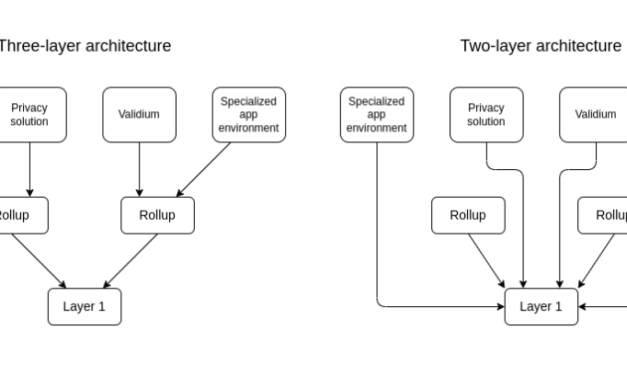
While Ethereum-based layer-2 solutions have been focused on hyperscaling the network, Ethereum co-founder Vitalik Buterin believes layer 3s will serve a far different purpose — providing “customized functionality.” Buterin shared his thoughts in a Sept. 17 post, providing three “visions” of what layer 3s will be used for in the future. The Ethereum co-founder said a third layer on the blockchain makes sense only if it provides a different function to layer 2s, which have been used mainly to enhance scaling via Zero-Knowledge (ZK) Rollup technology. “A three-layer scaling architecture that consists of stacking the same scaling scheme on top of itself generally does not work well. Rollups on top of rollups, where the two layers of rollups use the same technology, certainly do not.”But “a three-layer architecture where the second layer and third layer have different purposes, however, can work,” said Buterin. One of layer 3’s use cases would be what Buterin describes as “customized functionality” — referencing privacy-based applications which would utilize ZK proofs to submit privacy-preserving transactions to layer 2.Another use case would be “customized scaling” for specialized applications that don’t want to use the Ethereum Virtual Machine (EVM) to do computation.Buterin also said that layer 3 could be used for “weakly-trusted” scaling through Validiums, a ZK-proof technology. Buterin said this may be beneficial for “enterprise blockchain” applications by using “a centralized server that runs a validium prover and regularly commits hashes to chain.”But Buterin added that it’s still unclear whether layer-3 structures will be more efficient than the current layer-2 model when it comes to building customized applications on Ethereum.Layer-2 Vs Layer-3 Network Architecture. Source: StarkWare.Related: A beginner’s guide to understanding the layers of blockchain technology“One possible argument for the three-layer model over the two-layer model is: a three-layer model allows an entire sub-ecosystem to exist within a single rollup, which allows cross-domain operations within that ecosystem to happen very cheaply, without needing to go through the expensive layer 1,” Buterin said.But Buterin said that because cross-chain transactions can be executed easily and cheaply between two layer-2s that have committed to the same chain, building layer 3s may not necessarily improve the efficiency of the network.Buterin’s comments on possible layer 3 use cases come as StarkWare’s newly produced recursive validity proofs appear to have possibly put an end to Ethereum’s scalability concerns.Declan Fox, the Product Manager at Ethereum software firm ConsenSys recently told Cointelegraph that “with recursive rollups and proofs, we theoretically can infinitely scale.”These recursive proofs have been well tested in production, with StarkWare co-founder Eli-Ben Sasson recently telling Cointelegraph that its recursive proofs have rolled up as many as 600,000 NFT mints in a single transaction on Immutable X, and that 60 million transactions could soon be on the cards “with more engineering and tweaking.”

Čítaj viac

SEC lawsuit claims jurisdiction as ETH nodes are 'clustered' in the US

The Securities Exchange Commission (SEC) has made an unprecedented claim that Ethereum transactions take place in the United States as ETH nodes are “clustered more densely” in the United States than any other country. The SEC argument is found within a Sept. 19 lawsuit against crypto researcher and YouTuber Ian Balina, which alleged, among many other complaints, that Balina conducted an unregistered offering of Sparkster (SPRK) tokens when he formed an investing pool on Telegram in 2018. The SEC claims that at the time that U.S.-based investors participated in Balina’s investing pool, the ETH contributions were validated by a network of nodes on the Ethereum blockchain, “which are clustered more densely in the United States than in any other country.”The SEC argued that as a result, “those transactions took place in the United States.”At this stage, it is unclear whether such a claim will hold up in court, or whether there is any legal precedent at stake. However, currently 42.56% of the 7807 Ethereum nodes currently situated in the U.S. according to Ethernodes.Speaking to Cointelegraph, Dr. Aaron Lane, an Australian lawyer and Senior Research Fellow at the RMIT Blockchain Innovation Hub said the distribution of Ethereum nodes is largely irrelevant to the case at hand, explaining: “The fact that we’ve got a U.S. based plaintiff, a U.S. based defendant and transactions flowing from the U.S. is what is most relevant here. It doesn’t matter whether the payment was done on Ethereum, Mastercard or any payment network for that matter.”Lane said that while SEC’s claim was an interesting one, he added that even if Balina’s lawyers don’t contest the issue of jurisdiction, it’s not going to have any impact on future cases for now:“The defense may concede jurisdiction here, and if they do it won’t be an issue, and if it’s not a contested issue then the court won’t say anything about it. Any concern about legal precedent at this stage is premature.”Related: 3 cloud providers accounting for over two-thirds of Ethereum nodes: DataThe SEC has been previously critisized for its regulatory approach towards crypto, which has been labelled by some as “regulation by enforcement.” SEC Chairman Gary Gensler recently hinted that Ether-based staking could also trigger U.S. securities laws shortly after Ethereum transitioned to proof-of-stake on Sept. 15.Responding to the lawsuit, Balina said in a 19-part Twitter thread that the charges were “baseless” and that he “turned down settlement so they [SEC] have to prove themselves.”1/ Official Statement on the baseless SEC charges regarding Ian Balina being compensated for promoting Sparkster:The SEC Enforcement Division’s proposed charges against Mr. Balina are an unfounded effort based upon multiple misconceptions of fact and law, enumerated below.— Ian Balina (@DiaryofaMadeMan) September 19, 2022Balina did not comment on the SEC’s claim that the U.S. should be afforded jurisdiction for Ethereum-based transactions because of the heavy distribution of nodes situated in the U.S.Balina’s charges come as Sparkster and its CEO, Sajjad Daya recently settled its case with the SEC on Sept. 19, having agreed to pay back $35 million to “harmed investors” following its ICO in 2018.

Čítaj viac

Získaj BONUS 8 € v Bitcoinoch

nakup bitcoin z karty

Registrácia Binance

Burza Binance

Aktuálne kurzy