
Autor Cointelegraph By Brayden Lindrea

Almost 50% of Gen Z and Millennials want crypto in retirement funds: Survey

Nearly half of Gen Z and Millennials want to see crypto become a part of their 401(k) retirement plans, according to an October survey from United States asset manager Charles Schwab. Asking participants what they would like to see added to their 401(k) retirement products, the firm found that 46% of Gen Z and 45% of Millennials said they “wish” they could invest in cryptocurrencies as part of their retirement planning.It shouldn’t come as a surprise, as the survey also found that 43% of Gen Z and 47% of Millennials are investing in cryptocurrencies outside their 401(k) already, which could suggest the group’s affinity for the asset class. The asset manager surveyed 1,100 401(k) retirement plan participants aged between 21 to 70 to complete the 10-minute survey conducted between Apr. 4 and Apr. 19, 2022. Participants of the survey needed to have worked for a company with 25 or more employees and be current contributors to their company’s 401(k) plans. Millennials generally refer to those born in the early 1980s to mid-1990s, with Gen Z generally born between the mid to late 1990s to the early 2010s. The results are in stark contrast to the surveyed Gen X and Boomers — those born anywhere between the mid-1940s to late 1970s — with just 31% and 11% respectively wanting to invest in cryptocurrencies through their 401(k), and even less being current investors in the asset class. Across the board, inflation was seen as the leading obstacle to retirement. A similar study by Investopedia in April found only 28% of United States-based Millennials and 17% of Gen Z’s surveyed expected to use cryptocurrency to support themselves in retirement, however. Related: Roth IRAs: The ideal long-term cryptocurrency investment?The asset manager currently does not offer any cryptocurrency investments as part of its 401(k) retirement plans, though crypto-based retirement funds have been in the works since Feb. 2019.In April, Fidelity Investment reportedly put plans together to open up Bitcoin investment for ts 401(k) retirement saving account holders, with savers allowed to allocate as much as 20% of Bitcoin (BTC) to their savings portfolio.In Australia, Rest Super became the first retirement fund to offer cryptocurrency allocation as part of a diversified portfolio to its 1.9 million members in Nov. 2021. While most digital asset retirement funds are offered in the form of Bitcoin or Ether (ETH), a North Virginian county speculated putting a proportion of retirees’ pension funds into a decentralized finance (DeFi) yield farming account in May. 2022 — which was later approved in Aug. 2022.But things can go wrong. A Quebec pension fund lost almost all of its $154.7 million which was heavily invested into the now-bankrupt cryptocurrency lending platform Celsius.Controversies like this have left U.S. Senators divided on the seriousness of the risks involved with crypto-exposed 401(k) retirement plans. Among those are Democrat Senators Elizabeth Warren, Dick Durbin, and Tina Smith, who’ve previously argued that it is a “bridge too far” to expose American’s “hard-earned” retirement funds to “cryptocurrency casinos.”

Čítaj viac

Key witness called to testify at Terra parliamentary inquiry is a no-show

The CEO of venture capital firm Hashed and early Terra (LUNC) investor Kim Seo-joon has cited “extreme stress” following the Terra crash as the reason for his no-show at South Korea’s National Assembly’s Political Affairs Committee.Seo-joon was one of six people selected to take part in the South Korean parliament’s latest inquiry to better understand the events that led to the infamous $40 billion wipe out of Terra’s cryptocurrencies, according to an Oct. 24 article from the Korea Economic Daily.According to a letter from Seo-joon, he suffered severe mental harm from the following the sudden collapse of LUNC and the de-pegging of its associated algorithmic stablecoin TerraClassicUSD (USTC), writing: “Since the Luna-Terra crash occurred, I have been suffering from anxiety disorder and panic disorder due to extreme mental stress.”In addition to the letter submitted to the National Assembly, Seo-joon attached an expert opinion and medical certificate which stated that he’d been hospitalized and received psychiatrist treatment since Jul. 29. Medication and counseling treatment were also said to have worsened Seo-joon’s anxiety, who is “in absolute need of emotional stability at this time,” according to the expert opinion.A few months after the infamous LUNC collapse, Seo-joon disclosed that Hashed had suffered a $3.6 billion loss from its peak value in late April, having owned 30 million LUNC tokens, according to an August interview with Bloomberg.Earlier this month, the chairman of the South Korean exchange Bithumb, Lee Jung-hoon also failed to attend the parliamentary hearing on Oct. 6, citing a panic disorder as the reason for his no-show.Related: South Korean authorities raid 15 entities linked to Terra collapseOther witnesses called in various stages of the inquiry include Bithumb major shareholder Kang Jong-hyun, CEO of Dunamu which runs South Korea’s largest crypto exchange UpBit Lee Seok-woo, Chai Holdco Director Shin Hyun-sung, and Terraform Labs co-founder Daniel Shin.Terra CEO and co-founder Do Kwon was not listed to be inquired by Korea’s Political Affairs Committee — as law enforcement units throughout the globe continue to try track his whereabouts.

Čítaj viac

Zuckerberg's $100B metaverse gamble is 'super-sized and terrifying,' shareholder says

A shareholder’s open letter to Meta CEO Mark Zuckerberg has labeled the tech giant’s investment into the Metaverse as “super-sized and terrifying.”The shareholder has urged the company to scale down its investment in the Metaverse and its related technology arm amid a significant fall in its stock price over the last 18 months. The open letter was published on Oct. 24 and was directed at Zuckerberg and the board of directors. It was authored by Brad Gerstner, CEO and founder of technology investment firm Altimeter Capital, which owns roughly a 0.11% share in Meta, according to Hedge Follow.Gerstner said that Meta’s foray into the Metaverse, while important, should not command as much investment from the company as it currently does. He said the company has announced investments of $10 billion to $15 billion per year into its Metaverse project, including AR/ VR tech and Horizon World, but “may take 10 years to yield results,” explaining: “An estimated $100B+ investment in an unknown future is super-sized and terrifying, even by Silicon Valley standards.”Rather, he has urged the company to focus more on artificial intelligence (AI) and less on the Metaverse, as it “has the potential to drive more economic productivity than the internet itself.”“While most companies will struggle to monetize AI, we believe Meta is incredibly well positioned to leverage AI to make all of its existing products better,” he added.Gestner’s comments come on the same day the Bank of America downgraded Meta from a “buy” to “neutral” valuation, partly due to its Metaverse investments likely to remain an “overhang” on the stock because of the “lack of progress” and “new competition from Apple.”Gerstner added that over the last 18 months, Meta’s stock has fallen 55% compared to an average of 19% for its “big-tech peers,” which he suggests “mirrors the lost confidence in the company, not just the bad mood of the market.”Related: Facebook is on a quest to destroy the Metaverse and Web3Gerstner isn’t the only person to think the future of the Metaverse is a relatively “uncertain” one either. On Jul. 30, Ethereum co-founder Vitalik Buterin said that while “the Metaverse will happen,” corporate attempts such as those by Facebook will “misfire” because “it’s far too early to know what people actually want.”The share price for Meta Platforms Inc (META) has plummeted 60.53% over the last year to $129.72 at the time of writing – a far greater fall in the current bear market than the likes of Apple, Amazon and Google.Meta is set to report its third-quarter 2022 results on Oct. 26.

Čítaj viac

Fidelity to beef up crypto unit by another 25% with 100 new hires

$4.5 trillion asset management firm Fidelity Investments is reportedly set to hire another 100 people to bolster the firm’s growing digital assets division — a stark contrast to the recent squeezing out of crypto-talent. A Fidelity representative told Bloomberg on Oct. 22 that the firm has begun a new round of hiring which will bring the Fidelity Digital Asset’s headcount to around 500 by the end of the first quarter of 2023. A search on Fidelity’s job board currently shows 74 live results for digital asset-related positions, which cover areas relating to blockchain technology, business analysis, customer service, finance and accounting, product development, and corporate services including compliance. Almost all of the current listings are based in the United States — with the majority coming from its Boston headquarters, New York, Texas Colorado and Utah.The spokesperson told Bloomberg that the new roles would be situated throughout the U.S., U.K. and Ireland.Fidelity’s hiring spree comes as BlockFi, Coinbase, Gemini and Crypto.com were among some of the largest crypto-native firms to lay off a spree of employees, having cut 20%, 18%, and 10% respectively. The large layoffs appear to have opened a fresh supply of crypto talent for traditional firms like Fidelity to take on board. Related: Fidelity’s crypto ambitions are bigger than expected: reportThe digital asset team expansion should be of little surprise given how gung-ho Fidelity has been to offer more comprehensive digital asset-related services amid growing investor interest.A Fidelity spokesperson recently confirmed to Cointelegraph that they will be offering ETH custody and trading services to its institutional clients from Oct. 28, 2022. In September, industry participants hinted the firm may soon “shift” into offering Bitcoin trading services to its 34 million retail customers.The firm did not confirm the speculation at the time, only noting that “expanding our offerings to enable broader access to digital assets remains an area of focus.”The firm has already launched a service that enables its 401(k) retirement saving account holders to invest directly into Bitcoin (BTC).Cointelegraph reached out to Fidelity in regard to the firm’s expansion plans but did not receive an immediate response.

Čítaj viac

A stablecoin's rise in market share has ignited the ‘Second Great Stablecoin War’

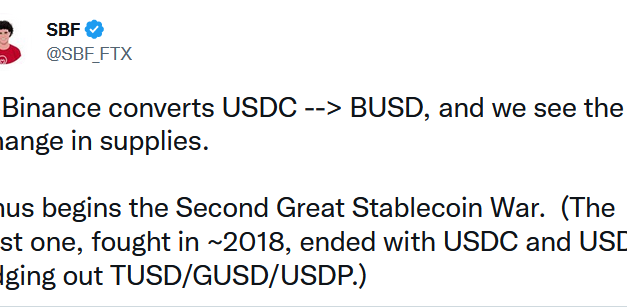
FTX CEO Sam Bankman-Fried (SBF) said the rise of Binance stablecoin BUSD could spark the “Second Great Stablecoin War,” given how fast its market cap has surged over recent months. Bankman-Fried’s recent comments come a month after Binance pushed ahead with plans to auto-convert a host of stablecoins supported on its exchange into BUSD on Sept. 6, — which has seen BUSD’s share of the total stablecoin market rise since. BUSD’s share of the total stablecoin market has risen from 10.01% on Sept. 7 to 15.48% on Oct. 22, according to crypto data aggregator Coin Metrics.Meanwhile, BUSD’s market cap has risen 3.3% over the last 30 days to $21.7 billion, with the stablecoin only trailing Tether USD (USDT) at $68.4 billion and USD Coin (USDC) at $43.9 billion.Commenting on the asset’s growth following the move, the FTX CEO noted via Twitter on Oct. 23 that “Binance converts USDC — > BUSD, and we see the change in supplies,” adding “thus begins the second great stablecoin war.” Bankman-Fried noted that the first “Stablecoin War” was fought between five stablecoins in 2018, leading to USDT and USDC as the two leaders. Today, USDT still holds a considerable lead with a 48% share of the stablecoin market, though it has fallen from 88% since 2020, while USDC has grown in market share from 10% to 32% in the same period. Binance’s stablecoin’s rise is even more prominent, however, growing more than 30x from 0.5% to 15.48% in the same time frame. Tether’s share of the stablecoin market has dropped from 88% to 48% since 2020. USDC has tripled its market share from 10% to 32%BUSD (Binance’s stablecoin) market share has grown by 30x from 0.5% to 15% pic.twitter.com/YpI89elHYU— Will Clemente (@WClementeIII) October 18, 2022SBF added that as BUSD continues to edge its way into the market as the big centralized players fight for dominance, there will likely be more projects sprouting up in the “non-fiat-backed-stablecoin space” also.“It’ll be interesting to see what emerges from the post-Luna and post-DAI-holding-USDC. My guess is that it will be something interest bearing or otherwise with some upside,” he added.Related: BUSD: A case study for stablecoin compliance and securityIn September, Binance announced it would cease a long list of spot trading asset pairs for USDC, USDP Stablecoin (USDP) and TrueUSD (TUSD), with any users still holding the three stablecoins by Sept. 29 to have their holdings auto-converted to BUSD at a 1:1 ratio.Binance stated that the move was a decision to enhance liquidity and capital efficiency for users. At the time, Binance said there were immediate plans to do the same to USDT, but noted that this “may change.”

Čítaj viac

Získaj BONUS 8 € v Bitcoinoch

nakup bitcoin z karty

Registrácia Binance

Burza Binance

Aktuálne kurzy