Autor Cointelegraph By Brayden Lindrea

Uniswap's new privacy policy sees backlash from decentralization buffs

Decentralized exchange (DEX) Uniswap’s recently updated privacy policy appears to have attracted the ire of some members of the community, with concerns that collecting and storing user data works against crypto’s core values. In recent responses to a November blog post regarding its updated privacy policy, some vocal members of the community suggested it i uncharacteristic for a decentralized entity to collect and store information about its users.In the Nov. 11 post from Uniswap Labs, released around the time of FTX’s collapse, the decentralized exchange released its privacy policy to explain how it collected and stored user data“With innovations around blockchain, web3 aims to reclaim users’ privacy and choice after decades of internet businesses that have eroded it.”“That’s why we’re releasing a new Privacy Policy today – we want to be crystal clear about what data we’re protecting and how we use any data we collect. Transparency is key. We never want our users to be surprised,” it said.This privacy policy, which was last updated on Nov. 17 reveals that the exchange collects publicly-available blockchain data, information about user devices such as browser information, and operating systems, and information about users’ interactions with its service providers, among others. Uniswap also stated that none of this information includes personally identifiable information such as first name, last name, street address, date of birth, email address or IP address. Despite this, some in the crypto community have shared concerns that the moves are in contrast to crypto’s core values, which are focused on user privacy and anonymity. The team behind privacy-preserving cryptocurrency Firo argued in a Nov. 21 Twitter post to its 83,700 followers that Uniswap’s privacy update sets a “dangerous precedent” for DEXs: While we have the utmost respect in what @Uniswap has built, we strongly reject the incorporation of data collection to track user behaviour and onchain activity. This sets a dangerous precedent for DEXes. https://t.co/h4kCiQKtl7— Firo $FIRO (@firoorg) November 21, 2022OwenP, an affiliate for the DEX SpookySwap suggested that it was uncharacteristic for a decentralized exchange to collect and store user information on the backend.”We were contacted […] by an infrastructure provider once who asked about our backend and what info we kept we were shocked by the question. ‘None of course’ [was] the answer.”Meanwhile, Twitter user “CryptoDavid” also noted to his 12,000 Twitter followers on Nov. 21 that he wasn’t surprised by Uniswap’s decision, as other DEXs have also started doing the same thing.Related: Digital sovereignty: Reclaiming your private data in Web3Transparency has emerged as a buzzword in the industry following the collapse of crypto exchange FTX earlier this month. Other crypto entities that have recently pledged towards “transparency,” including implementing “proof-of-reserves” in the case of centralized exchanges, include Kraken, Bitmex, Coinfloor, Gate.io and HBTC who’ve already completed audits. Binance, OKX, KuCoin and a host of other exchanges also plan on doing the same.

Čítaj viac

Billionaire investor Bill Ackman says 'crypto is here to stay'

Billionaire investor and hedge fund manager Bill Ackman says he remains bullish about cryptocurrencies, despite the recent collapse of the FTX cryptocurrency exchange and the market turmoil that’s followed it.In a Nov. 20 Twitter thread, the CEO and founder of hedge fund management firm Pershing Square Capital Management said he believes “crypto is here to stay” despite recent challenges, though there’s a need to increase oversight and remove “fraudulent actors” in the space. Bill Ackman is a billionaire American investor most recently calling for the removal of regulatory barriers and easing regulations in New York in order to make the city a crypto hub. He is also direct investor in a number of crypto projects. “I think crypto is here to stay and with proper oversight and regulation, it has the potential to greatly benefit society and grow the global economy,” he said. However, Ackman said that like the invention of the telephone and the internet, the technology improves on the next in terms of its ability to facilitate fraud:“The problem with crypto is that unethical promoters can create tokens simply to facilitate pump and dump schemes. It may in fact be that the vast majority of crypto coins are used for fraudulent purposes rather than for building legitimate businesses.”That being said, Ackman said that with proper oversight from industry leaders, these “fraudulent actors” can be eliminated:“All legitimate participants in the crypto ecosystem should therefore be highly incentivized to expose and eliminate fraudulent actors as they greatly increase the risk of regulatory intervention that will set back the positive potential impact of crypto for generations.” The investor also said while he was initially a “crypto skeptic” he now sees it as having “the potential to greatly benefit society and grow the global economy,” he said, adding: “I was initially a crypto skeptic [but] I have come to believe that crypto can enable the formation of useful businesses and technologies that [before now] could not be created. “The ability to issue a token to incentivize participants in a venture is a powerful lever in accessing a global workforce to advance a project,” he added.Ackman added that “sensible regulation and oversight” would be crucial in progressing the technology forward. Related: Blockchain is as revolutionary as electricity: Big Ideas with Jason PottsThe hedge fund manager’s tweet comes in light of the recent FTX collapse.According to reports, Ackman initially praised former FTX CEO Sam Bankman-Fried for owning up to his mistakes, but later deleted the tweet.

Čítaj viac

Celsius had 'insufficient' accounting and operational controls, says examiner

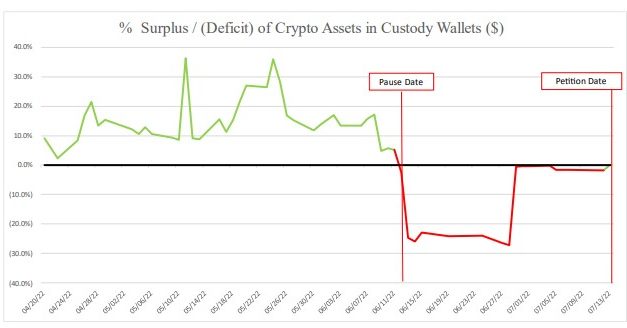
The independent examiner in crypto lender Celsius’ bankruptcy case has alleged that the company failed to set up “sufficient” accounting and operational controls in its handling of customer funds. In an interim report released on Nov. 19, examiner Shoba Pillay made a number of stark observations in her court-appointed investigation into the bankrupt cryptocurrency lending platform. One of the main revelations in Pillay’s report was that Celsius’ “Custody” program was launched “without sufficient accounting and operational controls or technical infrastructure,” which allowed shortfalls in Custody wallets to be funded from its other holdings. “[…] no effort was made to segregate or separately identify any assets associated with the Withhold accounts, which were commingled in the Main wallets.”When it was launched on Apr. 15, Celsius’ Custody program allowed users to transfer, swap and use coins as loan collateral. It was introduced after the firm was ordered by the New Jersey security regulators to create a product that was distinguished from Celsius’ “Earn” product, which receives rewards.This co-mingling of wallets means that there is now uncertainty on which assets belonged to the customer at the time of the bankruptcy filing, said Pillay, noting: “As a result, customers now face uncertainty regarding which assets, if any, belonged to them as of the bankruptcy filing.”The interim report has also shed light on what ultimately forced the lending platform to halt withdrawals on Jun. 12. Pillay said the breaking point came around on Jun. 11, when customers’ Custody wallets became underfunded. By Jun. 24, this fell a further 24% to $50.5 million in underfunding.Celsius’ Surplus and Deficit of Digital Assets in Custody Wallets. Source: U.S. Bankruptcy Court.The revelation comes as a filing with the New York-based bankruptcy court last week states that Celsius customers must file claims against Celsius by Jan. 3. 2023 in order to be eligible for distributions from the case.However, customers who agree with Celsius’s scheduling of their claims do not need to submit proof of claim, according to a Nov. 20 Twitter post from Celsius. Related: Celsius bankruptcy proceedings show complexities amid declining hope of recoveryPillay said that Celsius’ Custody and Withdrawal programs were created on short notice following “intense regulatory pressure” from New Jersey’s Bureau of Securities, who started an investigation into whether Celsius’ “Earn” accounts constituted securities pursuant to U.S. securities laws in mid-2021.Other accounting insufficiencies highlighted in the report include a revelation that Celsius, founded in 2017 by Alex Mashinsky and Daniel Leon, didn’t start tracking its balance sheet until after this confrontation with regulators in May. 2021, which it then used Google Sheets. The collapse of the Terra ecosystem was one of the main factors that led to Celsius’ financial troubles in May. 2022, which saw its native coin, Luna Classic (LUNC), formerly LUNA, and the network’s algorithmic stablecoin TerraClassicUSD, USTC — previously TerraUSD (UST) — fall north of 98% in value.Celsius also stated on Nov. 20 that its next court date is scheduled for Dec. 5, where they plan on advancing discussions around its Custody and Withhold accounts, among other matters.

Čítaj viac

Metaverse ‘explosion’ will be driven by B2B, not retail consumers: KPMG partner

The Australian arm of Big Four accounting firm KPMG could soon be holding executive meetings and closing multi-million dollar deals with clients in the Metaverse, with the firm now exploring how the revolutionary technology can transform its business model.In a recent interview, KPMG’s James Mabbott, Partner in Charge at KPMG Futures said the firm sees real potential in the technology creating new and more efficient ways for businesses and consumers to interact with each other:“I think the really interesting applications are going to be in the business to business context […] And I think that I actually think that’s where the money is going to be [even] more so than the consumer driven participation.”Mabbott also stated that virtual interactions on Metaverse platforms could not only revolutionize client engagement and service delivery but potentially also open up additional revenue streams for the firm.“What we’re looking to do is explore the opportunity to create new business models and new assets with technology that fundamentally transforms the way we deliver our services,” he told Cointelegraph. Building out a metaverse teamThe company has just created a brand new role within Australia’sKPMG Futures team, called Head of Metaverse Futures, which has just appointed Web3 executive Alyse Sue to the position, according to a recent statement sent to Cointelegraph.KPMG Australia noted that Sue previously worked as a senior consultant on the KPMG Innovate team between 2012-2015 before venturing off into the cryptocurrency space — where she co-founded several startups, including Transhuman Coin, a decentralized finance (DeFi) project which invests in and supports emerging technologies.Sue then worked at international software development and consulting firm Palo IT as the Head of Web3 before returning back to KPMG.The new role comes along with a lofty ambition from KPMG to build multimillion-dollar business opportunities for the firm by 2025. To achieve this feat, Mabbott stated that KPMG has been looking into building its own Metaverse for the company’s internal business operations and business-to-business services. Mabbott also noted that Sue will receive the support from some of the 90 members that comprise KPMG’s Futures unit — which includes a focus on artificial intelligence (AI) and Quantum Computing in addition to the Metaverse.KPMG has also established KPMG Origins, a blockchain-based track-and-trace platform used to assist trading partners in codifying trust when carrying out cross-border business activities. Mabbott added that about 30 staff are currently working on the supply chain-focused platform.Metaverse active users not a concernHowever, the firm is also exploring potential opportunities on public Metaverses platforms to see what opportunities are out there and what they might represent for clients, Mabbott said. The KPMG Partner added that he wasn’t too concerned with the recent fall in user activity and reported poor user experiences in some of the largest Metaverses in the industry today:“When you look at some of these spaces, patronage and participation at the moment is not particularly high. But this is when all the really interesting experimentations are happening and the development of those new business models and ways of creating value is falling out.”“Off the back of that, I think there will be an explosion actually in terms of uptake and use and applicability of these technologies as well,” he added.Related: Institutions are exploring the space — KPMG Canada crypto teamMabbott also noted that while a number of video communications platforms — namely Google Meets, Microsoft Teams and Zoom — increased significantly in user activity throughout the COVID-19 pandemic, users cannot fully immerse themselves in that environment like how they can in the Metaverse:“The bit they don’t solve for is the emotional component. [With the Metaverse], your senses are hijacked, and you feel like you’re in that environment. That’s what’s missing from our current Zoom and [Microsoft] Team’s interactions.”“It’s that sense of being in the room and being able to read [other people’s] body language and feel like you’re there. That’s that next step that I think these technologies will bring,” Mabbott added.This isn’t KPMG’s first move in the Metaverse either. In Jun. 2022, the accounting firm also invested $30 million into Web3 employee training for its U.S. and Canada-based teams, which focused on education, collaboration and training across different events and workshops.The Metaverse is expected to be worth $5 trillion by 2030, according to a Jun. 2022 report from international consulting firm McKinsey. While investment bank Citi went one step further in estimating the total addressable market for the Metaverse economy to reach as high as $13 trillion over the same timeframe.

Čítaj viac

Získaj BONUS 8 € v Bitcoinoch

nakup bitcoin z karty

Registrácia Binance

Burza Binance

Aktuálne kurzy