Autor Cointelegraph by Biraajmaan Tamuly

Bitcoin faces fresh capitulation risk as 50K BTC moved at a loss

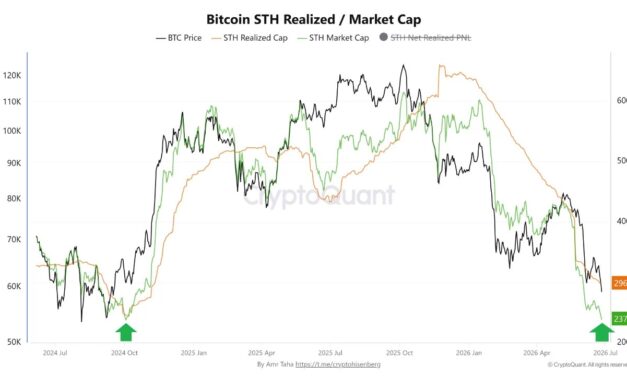
Bitcoin (BTC) is showing fresh signs of short-term holder capitulation after roughly 50,000 BTC moved to exchanges at a loss over the past day. At the same time, the market capitalization of short-term holders fell to $237.7 billion, its lowest level since October 2024. The rise in loss-driven selling comes as tighter monetary conditions and weakening institutional demand continue to weigh on Bitcoin, as analysts underlined a “deeply unfavorable” environment for BTC. Short-term Bitcoin holders show renewed stressCryptoQuant analyst Amr Taha said Bitcoin’s short-term holder (STH) market capitalization fell to $237.7 billion on June 26, its lowest level since Oct. 2, 2024, when it stood near $239.7 billion.BTC STH realized market cap. Source: CryptoQuantThe metric tracks the market value of coins held by investors who bought Bitcoin within the past 155 days. The latest reading shows the cohort’s market value is below its realized value, indicating many recent buyers are holding more unrealized losses.A similar decline appeared during the October 2024 correction, which later aligned with an important Bitcoin bottom. The latest reading serves as a measure of stress rather than confirmation of a market low.Exchange activity adds another layer to the picture. Around 50,000 BTC from short-term holders moved to exchanges at a loss during the past 24 hours, marking the largest loss-to-exchange flow since June 4. Binance alone received roughly 9,500 BTC under similar conditions, its highest reading since June 3.This indicates that near-term sell-side pressure has increased as newer investors react to lower prices.BTC short-term holder profit/loss to exchanges in 24-hours. Source: CryptoQuantHowever, long-term holders’ activity provided a positive development. Bitcoin inflows into accumulation addresses climbed to a record 181,000 BTC on Thursday, almost doubling the previous high of 94,700 BTC recorded in February 2022. These wallets typically receive coins with little spending history, suggesting the surge signals that long-term investors are absorbing supply while short-term holders exit positions.BTC inflows to accumulation addresses. Source: CryptoQuantRelated: Bitcoin may fall lower but BTC power-law frames crash to $58K as ‘normal’Macro headwinds weigh on BTC buyersMarket analyst Darkfost said institutional demand has continued to weaken, with the Coinbase Premium Index staying below zero for 40 consecutive days since May 15.Bitcoin Coinbase premium index. Source: CryptQuantThe indicator compares Bitcoin prices on Coinbase Advanced and Binance. A persistent discount on Coinbase points to heavier selling from professional investors than from retail traders.US macro data also added to the cautious tone. Headline PCE inflation came in at 4.1% against expectations of 4.0%, while Core PCE printed 3.4% versus the 3.3% forecast. GDP also exceeded estimates at 2.1%, keeping expectations for easier monetary policy subdued. Commenting on the current outlook, the analyst said, “This dynamic is a perfect reflection of the current macro backdrop, which remains deeply unfavorable for risk assets such as BTC.”Asset management firm Bitwise said that last week’s Federal Reserve meeting accelerated the hawkish shift after policymakers removed their easing bias and raised the median 2026 Fed funds projection to 3.8% from 3.4% in March. The firm added that tighter financial conditions coincided with continued outflows from crypto exchange-traded products such as the spot ETFs. The attention has also shifted toward Strategy, which has accumulated 174,300 BTC in 2026. Bitwise estimates that roughly 96,000 BTC, or 55% of those purchases, were financed through STRC preferred equity issuances, with another 77,500 BTC funded through MSTR common stock offerings.Now, CryptoQuant noted that STRC traded at a record 17.5% discount to its $100 par value after falling to $82.5 last week, before slipping to around $73 in premarket trading on Friday. Strategy’s cash reserve has dropped 38% since the start of 2026, following the repurchase of a $1.5 billion convertible note. Strategy: Cash reserve and dividend coverage data. Source: CryptoQuantAnnual dividend obligations linked to STRC have also increased to $1.2 billion from $300 million, while dividend coverage has reduced to 14 months, down from as long as seven years. The figures point to tighter funding conditions for one of Bitcoin’s largest institutional buyers, adding another layer of pressure amid rising loss-driven exchange inflows.Related: Bitcoin ETFs post June’s biggest daily outflows as BTC falls below $60K

Čítaj viac
Old Ether wallets move 37,806 ETH as whale conviction faces key test at $1.5K

Eight-year-old Ether (ETH) wallets have started moving coins for the first time since 2017, adding fresh supply to the market as Ether trades just above $1,500. Onchain data shows 37,806 ETH from long-dormant addresses became active, while separate whale transactions point to continued accumulation by other large investors. The mixed positioning comes as total long-term ETH whale profitability has fallen below zero for the first time since 2019, leaving every major whale cohort sitting on unrealized losses. ETH whale traders are split between accumulation and distributionAccording to Lookonchain, four Ethereum wallets that received 37,602 ETH nearly eight years ago at an average price of around $830 became active after years of dormancy. The wallets held through the 2021 and 2025 bull markets, when their unrealized gains exceeded $150 million, sold 33,623 ETH for about $52.5 million at around $1,560 on Thursday. The realized profit now stands near $27.4 million.OG ETH wallets holding period. Source: Lookonchain/XFresh ETH selling has appeared alongside continued buying from other large holders. Blockchain tracker Lookonchain reported that one whale swapped 464 BTC worth $27.6 million for 17,750 ETH, signaling capital rotation into Ether. Meanwhile, investor Chun Wang also acquired another 9,937 ETH and 147 wrapped Bitcoin. Over the past month, Wang has withdrawn almost 87,000 ETH from Binance at an average purchase price of $1,749.Institutional ETH trading also remained active. BlackRock transferred 41,996 ETH and 4,577 BTC to Coinbase Prime, a move commonly associated with custody or operational management rather than a confirmed market sale.Crypto analyst Darkfost noted that Ether whales holding between 1,000 ETH and more than 100,000 ETH are all sitting on negative unrealized profit ratios. This marks the first time since 2019 that every major whale cohort has been underwater. ETH whales’ unrealized profit ratio. Source: XThe analyst said that periods when whale conviction was tested by ETH prices, it often aligned with long-term bottom zones. The current scenario indicates that large holders are facing greater overall pressure in 2026, even as selective ETH accumulation persists.Related: Tether stablecoin flips Ether by market cap as ETH routs to $1.5K$1,500 level for ETH draws trader focusEther dropped to $1,510 during Thursday’s sell-off, though it avoided setting a new yearly low even as Bitcoin fell to fresh 2026 lows. Crypto trader Ardi described $1,500 as Ether’s key long-term support, arguing that daily closes below that level challenge the bullish assumptions built up since the 2022 bear market. Ether/USD, one-week chart. Source: Ardi/XCrypto investor Jelle shared a similar view, saying a sustained break would send Ether back into a trading range last seen in early 2023. Weekly price action shows ETH has defended the $1,500 region during several major corrections since mid-2022, making it one of the altcoin’s longest-standing support zones. However, not all market participants expect a near-term recovery. Popular trader Cyclops identified the $1,070–$1,370 range as a potential accumulation zone, citing it as a key demand area established in early 2023. A move into that range would also see ETH break below its multi-year ascending trendline, a technical development that could further delay a sustained recovery and reinforce the broader bearish market structure. ETH/USD, one-week chart. Source: Cointelegraph/TradingViewRelated: XRP risks drop below $1, but onchain data highlights silver lining

Čítaj viac

Bitcoin’s ‘calm top’ challenges most market bottom estimates: Research

New research from Galaxy Digital suggests that Bitcoin’s cycle low could form at higher price levels than previous bear markets due to the absence of speculation. The analysis places the potential bottom between $62,000 and the network’s realized price at $53,600.Galaxy head of research Alex Thorn analyzed every Bitcoin cycle top and bottom and noted that the four-year cycle continues to track closely with BTC’s historical timing. The peak-to-trough declines have steadily narrowed across market cycles, falling from 85% and 84% in earlier periods to 77% in 2022 and 51% in 2026. Bitcoin’s four-year cycle peak-trough analysis. Source: Galaxy Research/XThorn argued that Bitcoin’s October 2025 top differed from previous cycle peaks. Only two of eleven traditional topping indicators flashed, while the widely followed Pi Cycle Top indicator failed to trigger for the first time. Bitcoin’s MVRV ratio, which compares market value to realized value, peaked at 2.29, compared with 2.93 to 5.91 in prior cycles. The analyst said, “The key insight: a calm top RAISES the floor. Because October’s top was so muted, the network’s cost basis sits at 43.7% of ATH, vs ~34%, 21%, and 17% in prior cycles.”The report also found that several key bottoming signals are still absent. Only four of thirteen indicators have triggered so far, with most of the stronger signals yet to appear.BTC cycle bottom indicator list. Source: Galaxy Research/XHistorical timing also points to the possibility of a bottom ahead. The previous cycle bottoms formed roughly 12 to 13 months after the market peak, while the current drawdown is about eight months old.Thorn noted that, based on the current cost basis of $53,600, Galaxy estimates a base-case bottom range of $40,000 to $46,000. A deeper “washout scenario” points to $30,000-$37,000, while a shallower decline could hold near $51,000-$54,000. Despite the scenarios, Thorn also warns, “The catch: the floor can move. cost basis is reflexive. in a real panic, coins change hands at a loss and drag the average down. A 10-30% cost basis decline pulls the implied floor from ~$40k back toward $28k.”Bitcoin bottom range based on realized price analysis. Source: Galaxy ResearchRelated: Big Tech crash, oil volatility rattles markets: Will Bitcoin hold above $60K?Bitcoin demand still trends lower: CryptoQuantOnchain analysis from CryptoQuant currently places Bitcoin inside a valuation zone historically associated with major bear-market lows. BTC recently traded near $59,000, leaving it roughly 9% above its realized price of $53,600. Bitcoin value zone based on realized price bands. Source: CryptoQuantPast cycle bottoms, including the November 2022 FTX-driven sell-off, formed at or slightly below the realized price, suggesting the bottom range may again fall below the cost basis of $53,600 and overlap with Galaxy’s base projection between $46,000 and $40,000. Demand data paints a more cautious picture. CryptoQuant reported a combined weekly decline of 652,000 BTC across speculative futures demand and apparent spot demand, marking the sharpest contraction since January 2022. The firm’s one-year demand gauge has also turned negative, signaling fewer BTC buyers than a year ago.Related: Bitcoin surfs SpaceX IPO at $64K as trader warns key BTC price support may crumble

Čítaj viac

Bitcoin rally to $70K builds as orderbook structure highlights traders’ confidence

Bitcoin (BTC) is gaining buyers’ interest after setting a new yearly low at $59,000 last week. Order book data and liquidity suggest a rally is pending and more than $2 billion in short liquidity is concentrated near $65,000. BTC’s bid-ask ratio has remained positive since last Friday. The shift in positioning and sentiment also aligns with a bullish chart pattern targeting the $67,000–$70,000 range. BTC bulls attempt to regain control near supportBitcoin’s recent rebound to $63,500 followed a bullish divergence between the price and the relative strength index (RSI) on the four-hour chart. The price printed a lower low during the early-June sell-off while the relative strength index (RSI) formed a higher low. The signal pointed to fading downside momentum before buyers stepped in.BTC/USD, four-hour chart. Source: Cointelegraph/TradingViewBitcoin is also trading within an ascending triangle pattern. A confirmed breakout may target the daily fair value gap between $67,500 and $70,500, an area of trading imbalance or liquidity gap left behind during the recent market correction. The order book activity supports the move. Data from Hyblock shows the bid-ask ratio remained positive at 0.05 after Bitcoin tagged its yearly low at $59,000 last Friday. The metric tracks aggressive buying and selling activity. A positive reading suggests buy-side market orders have been slightly outpacing sell-side orders.BTC price, bid-ask ratio, spot CVD. Source: HyblockThe cumulative volume delta (CVD) data adds another layer of support. Smaller cohorts (up to $10,000 and $100,000 orders) have shown improving buying activity with $53 million and $157 million, respectively, while the largest participants ($100,000-$10 million) have significantly reduced net selling pressure by $900 million. Crypto analyst Kripto Holder highlighted a $2.68 billion short-liquidity cluster near $64,600, calling it the primary upside liquidity pool. The analyst said Bitcoin’s ability to hold above $63,000 following renewed conflict in the US-Iran war adds weight to the recovery case. Spot CVD inflows also indicate demand from spot buyers.Related: Metaplanet to form securities arm through Siiibo acquisitionBTC needs to reclaim $66,000 soon: AnalystMarket analyst PILTR noted that BTC’s long exposure has gradually increased over the past five days. The current positioning tracks 237 long levels against 128 short levels, creating an estimated $4 billion positive imbalance.Those price levels closely align with analysis from crypto trader Ardi, who argued that Bitcoin is still trading within a bear pennant following its decline from $83,000 to $59,000. The analyst identified $64,000 and $66,000 as the two most important levels for the current recovery.BTC/USD, four-hour analysis by Ardi. Source: XAccording to Ardi, a move above $64,000 would clear both horizontal resistance and the pennant structure, giving Bitcoin additional room to the upside. The next hurdle sits near $66,000, a former major range support level that now acts as resistance. Reclaiming that area would strengthen the case for a move into the liquidity zone above the price and the unfilled fair value gap between $68,000 and $70,000.However, PLTR also flagged weekend positioning as a near-term variable. The analyst noted that weekly profit-taking often creates opposing flows into weekends, especially after a sustained build-up in long exposure. Related: Bitcoin miner ‘capitulation’ comes as trader sees later 2026 bear-market bottom

Čítaj viac

ETH futures traders lean into $1.6K range lows: Will Ether lead market recovery?

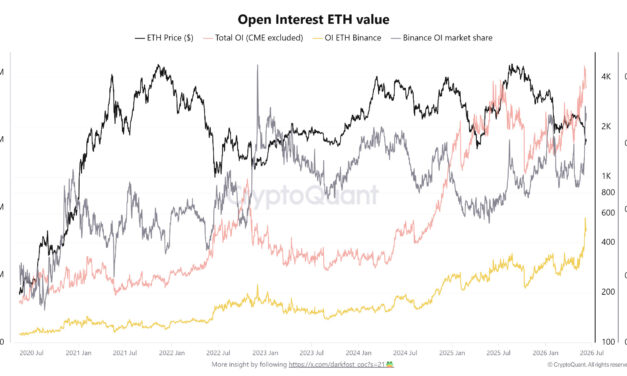
Ether (ETH) traders are increasing their leveraged long positions despite ETH price being down 44% in 2026. Ether’s futures open interest at Binance has climbed to a record 3.7 million ETH, with the exchange accounting for more than 44% of total Ether futures.Crypto analyst Darkfost noted that Ether futures activity has improved despite rising uncertainty driven by geopolitical tensions and weakening economic conditions.The analyst noted that Binance now holds nearly 3.7 million ETH in open futures contracts, marking a new all-time high for Ether open interest on the exchange.ETH open interest value on Binance. Source: CryptoQuantImproving risk appetite for long positions also emerged as Binance’s weekly average taker buy-sell ratio increased to 1.0 from 0.95 after months of seller-led activity. A reading near 1.0 points to a more balanced market after a prolonged period of selling pressure.The trend extends beyond Binance. Across all exchanges, the taker buy-sell ratio has risen to 1 from 0.94 over the past two weeks, indicating that buyers are becoming more active in market orders than sellers.Ether: taker buy sell ratio across all exchanges. Source: CryptoQuantAt the same time, the speculative activity is accelerating faster than spot demand. Binance’s perp-spot volume imbalance indicator climbed to roughly 0.90, close to a record high, while its 30-day Z-score reached 2.53. Perpetual futures volume stood near 5.57 million ETH compared with about 290,000 ETH in spot trading. This indicates leveraged participation is expanding far more quickly than activity in the underlying market.ETH Perp-Spot volume imbalance indicator. Source: CryptoQuantRelated: Audiera’s AI token BEAT beats Bitcoin, Ethereum as price surges 1,500% in a monthETH liquidation risk remains on both sidesMarket analyst Amr Taha highlighted a growing split in exchange positioning. Binance recorded a 30-day open interest increase of 616,400 ETH, its strongest reading since 2019. During the same period, Gate.io posted a decline of 631,700 ETH.Multi-exchange open interest 30-day change. Source: CryptoQuantLiquidation heatmaps show nearly $8 billion in short positions clustered between $2,200 and $2,400. Those levels stand out as key liquidity zones if ETH price begins to push higher. However, near-term positioning remains heavily leveraged on both sides. Roughly $1.72 billion in cumulative long liquidations sits below the current price of $1,500, while nearly $1.90 billion in short liquidation exposure is concentrated near $1,800. The narrow gap between those pools highlights a market where both bullish and bearish positions carry significant liquidation risk.ETH liquidation map. Source: CoinGlassRelated: ETH crash to $1K looms if key support breaks: Will futures traders step in?

Čítaj viac

Získaj BONUS 8 € v Bitcoinoch

nakup bitcoin z karty

Registrácia Binance

Burza Binance

Aktuálne kurzy