Autor Cointelegraph By Arnold Kirimi

China’s central bank releases pilot version of digital yuan wallet

As China’s central bank steps up its effort to create a digital currency, the country has released a pilot edition of its digital yuan wallet application on mobile phone app stores.The People’s Bank of China (PBOC) digital currency research institute developed the “e-CNY (Pilot Version)” app, which was available for download on Chinese Android and Apple app stores on Tuesday in Shanghai.According to a tweet from BlockBeats, a local news source, individual users in China now can download an earlier version of the app to test opening and managing a personal wallet, as well as digital yuan transactions.The e-CNY app is now available on iOS and Android app stores.This App is the official service platform of China’s CBDC for individual users to carry out pilot trials, providing e-CNY personal wallet opening and management, e-CNY exchange and circulation services.#CBDC pic.twitter.com/c8S1newxiw— BlockBeats (@BlockBeatsChina) January 4, 2022However, according to a report from Reuters, the app claims it is in an experimental research and development phase and is only accessible to select individuals through authorized e-CNY service providers. In late fall 2021, PBOC Governor Yi Gang stated that the country would continue to develop its central bank digital currency (CBDC) and improve design and usage, including enhancing interoperability with current payment systems. The PBOC announced in a year-end meeting that it would continue to push for the further development of the digital yuan.Related: China wants US senators to ‘stop making trouble’ out of digital yuanChina has taken a significant lead in developing a CBDC for public use, outstripping the majority of countries, which are still in the research stages of a CBDC. The People’s Bank of China said the digital currency could be used during the Beijing Winter Olympics in 2022. However, Senators from the United States expressed concern over this claim, stating that American athletes should not utilize the currency at an event hosted in China.The Federal Reserve, on the other hand, is still contemplating whether or not to introduce a CBDC for the United States. As reported by Cointelegraph in September, the United States’ central bank stated that it is studying the benefits of creating a digital dollar and will eventually present a paper on the subject.

Čítaj viac

Third-largest whale celebrates Bitcoin's birthday with 456 BTC buy

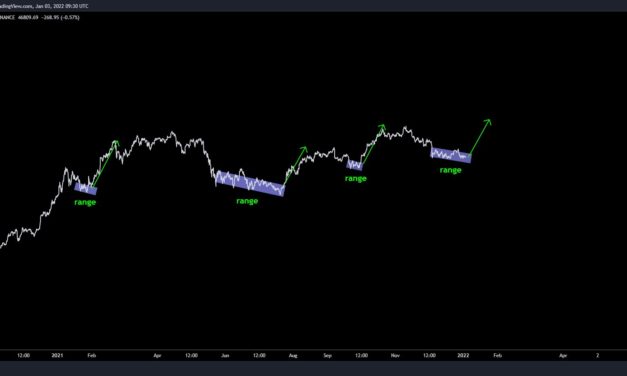
It is now 13 years since the genesis block of the Bitcoin (BTC) blockchain was created, which marked the beginning of the chain. To commemorate the occasion, the third-largest Bitcoin whale appears to be back after the new year holidays, and he or she has just completed the first sizable purchase of 2022.On Jan. 4, the third-largest Bitcoin address added 456 BTC at an average price of $46,363, equivalent to around $21 million, according to data from Bitinfocharts. com. 456 #BTC (21,161,750 USD) transferred from #Coinbase to unknown wallethttps://t.co/1rWMaIYR0y— Whale Alert (@whale_alert) January 3, 2022At the time of this writing, the whale holds 120,845.57 BTC worth over $5.6 billion. The holder’s identity remains a mystery, but it appears that the entity is making full use of the current price volatility. Bitcoin has dropped 1.7% in the last 24 hours and 8.9% over the last week, currently trading at around $46,603.Related: Happy Birthday, Bitcoin! Industry players share a few wordsMeanwhile, the bearish factors weighing on the cryptocurrency market at the end of 2021 have persisted throughout the first week of 2022 after Bitcoin’s price fell below $47,000 on Jan. 1 and it continues to face strong headwinds on shorter timeframes charts.Despite the short-term difficulties for Bitcoin, many investors remain enthusiastic. Analyst and pseudonymous Twitter user GalaxyBTC recently shared this chart showing a potential breakout in the first quarter of 2021.14-month Bitcoin/Tether price chart. Source: Twitter

Čítaj viac

Square Enix CEO reveals plans for blockchain, metaverse, NFTs

Wider adoption of nonfungible tokens (NFT) and play-to-earn games may be on the way, as one of the world’s largest gaming companies sees them as the future of the industry.Yosuke Matsuda, CEO of Square Enix, revealed the company’s intentions for blockchain and NFT spheres in his new year’s message on Saturday. In his letter, Matsuda begins with a discussion of the metaverse before noting that Facebook’s renaming to Meta is proof that the concept isn’t a passing fad. He expects 2022 to be a year of hype for the metaverse as society begins to slowly embrace virtual worlds and their ability to connect individuals across geographical boundaries. He thinks that extended reality technology, the growing use of cloud computing and 5G will all lead to the metaverse’s existence. While discussing the concept, Matsuda wrote:“As this abstract concept begins to take concrete shape in the form of product and service offerings, I am hoping that it will bring about changes that have a more substantial impact on our business as well.”a New Year’s letter from the Square Enix president talks about new tech/concepts including NFTs, the metaverse, and particularly how blockchain games “hold the potential to enable self-sustaining game growth” https://t.co/qtdFCvQdeB pic.twitter.com/FOG4S9Hpgb— Wario64 (@Wario64) January 1, 2022He goes on similarly about NFTs, then blockchain and play-to-earn. Matsuda points out that 2021 was “year one” for NFTs and the metaverse, during which there was a lot of wild trading that didn’t always correspond with market speculations.Investments in blockchain are still rising at a rapid rate, and some of the most adamant in trying to legitimize blockchain technology have been companies from the gaming business. Square Enix initially invested in the metaverse by taking part in a $2-million funding round for The Sandbox, an Ethereum-based metaverse game. Matsuda’s annual letter indicates that the firm is doubling down on several developing technologies.Related: Study: 58% of video game developers are already using blockchainMatsuda’s letter appears to be a reaffirmation of Ubisoft’s position that it will remain committed to its NFT and blockchain ambitions. Another big name in the gaming industry, Andrew Wilson, CEO of video game company Electronic Arts, agreed that NFTs and play-to-earn games are the future of gaming despite the fact that it’s still early to figure out how they’ll function.

Čítaj viac

Slim Shady buys Bored Ape ‘EminApe’ NFT for $460K

Marshall Mathers III, better known as Eminem, joined the “Bored Ape Yacht Club” (BAYC) by purchasing one of the nonfungible token (NFT) Bored Apes for $462,000 on OpenSea’s NFT marketplace. Eminem’s Bored Ape depicts a gold chain necklace and khaki army cap that he wears in real life and has been officially added to his portfolio by OpenSea.The NFT nicknamed the “EminApe” was created by GeeGazza in collaboration with Bored Ape. The transaction was completed by digital agency Six, which has previously worked with other celebrities in the NFT sector, including Wu-Tang Clan, Tycho and Galantis.Congrats! This aged well https://t.co/s82B6sZOAf— 0xFastly.eth (@0xFastly) December 31, 2021This is not the first time that Eminem has invested in NFTs. The Missouri-born rapper currently owns several OpenSea NFTs with the handle “Shady Holdings.” Eminem’s portfolio also comprises a number of “Lil Baby Doodles X” NFTs, with “Ditaggdogg#1,” the rapper’s stencil artwork, and “Superlative Apes #3880” being one of them.Related: NFT music platforms to disrupt Spotify in 2022, Saxo Bank predictsThe “Bored Ape Yacht Club” NFTs rose to popularity in 2021, generating more than $1 billion in trade volume worldwide, according to Defi Llama.The NFT market gains ground every day, and several people, including athletes, are joining in. A number of celebrities have expressed interest in NFTs and revealed their own projects already. A$AP Rocky, Snoop Dogg, Kings of Leon and The White Stripes are among the musicians who have embraced the NFT movement.

Čítaj viac

Estonia’s new AML laws set to clamp down on crypto industry

Beginning in February, Estonia is set to introduce sweeping changes to its definition of Virtual Asset Service Providers, or VASPs, to include several cryptocurrency-related services — a move that could impact Bitcoin (BTC) ownership in the country — according to European compliance specialist Sumsub.On Sept. 21, the Estonian Ministry of Finance published a draft bill to update the Money Laundering and Terrorist Financing Prevention Act (the AML Act) as part of the government’s effort to prevent money laundering and terrorist financing.As Sumsub reported, the legislation is now in the interagency review process, with implementation set for February 2022. Regulated crypto companies have until March 18, 2022 to bring their operations and paperwork into compliance. According to New DeFi CEO Mikko Ohtamaa, the updated law effectively bans non-custodial software wallets, as well as decentralized finance products, in the country. That’s because the bill’s provisions target VASPs, which include crypto exchanges and wallets, in Estonia. When the bill is ready, VASP will be extended to cover decentralized platforms, initial coin offerings and other services. Violation of the provisions may result in a penalty of up to $452,000, or 400,000 euros. According to Ohtamaa’s interpretation, the new law has the following effect: “You are only allowed to hold your Bitcoin in a custodial Virtual Asset Service Provider (VASP). VASP can freeze your account. So it is not effectively your Bitcoin anymore.”Estonia did not only ban #defi, but they also banned #bitcoin.You are not allowed to download wallet and hold #bitcoin anymore in Estonia.— Mikko Ohtamaa (@moo9000) December 31, 2021Related: Estonia’s crypto honeymoon at an end as stricter regulations loomEstonia was one of the first countries in the European Union to license cryptocurrency businesses, but it has had to crack down after hundreds of billions of dollars worth of dirty money was discovered in Danske Bank, positioning Estonia at the heart of Europe’s biggest money-laundering catastrophe.As reported by Cointelegraph, Matis Mäeker, the head of the Estonian Financial Intelligence Unit (FIU), urged the government in October to “turn the rules to zero and start licensing all over again.” He stated that the general public is unaware of the inherent risks of cryptocurrency, especially around its alleged role in money laundering and terrorist financing, as well as the vulnerability of the industry to cybercriminals. 

Čítaj viac

Získaj BONUS 8 € v Bitcoinoch

nakup bitcoin z karty

Registrácia Binance

Burza Binance

Aktuálne kurzy