Autor Cointelegraph By Arnold Kirimi

Meta joins patent alliance, pledges free crypto patents for all

The Crypto Open Patent Alliance (COPA) has welcomed Meta as a member, with the social media giants vowing to make its core crypto patents accessible to all.Meta, formerly Facebook, has joined the COPA, a group that advocates for public patents on crypto and blockchain-related technologies. On Monday, the organization published a statement announcing Meta and noting that Shayne O’Reilly would be its representative.By joining COPA, Meta will become one of 30 other businesses committed to not enforcing their “core cryptocurrency patents.” The general manager of COPA, Max Sills, describes “core cryptocurrency patents” as any “technology that allows the creation, mining, storage, transmission, settlement, integrity, or security of cryptocurrencies.”By forming an association and requiring member firms to contribute their patents to a collective patent library, COPA hopes to stimulate blockchain innovation by lowering the risk of patent litigation.Jack Dorsey, the co-founder of Twitter, commended the development on Twitter stating that “this is great.” Dorsey has declared several times that the crypto market is best served when everyone’s interests are accommodated, not just those of the wealthy.This is great https://t.co/VhwdhzaQja— jack⚡️ (@jack) January 31, 2022For years, Meta’s interest in the cryptocurrency market has been obvious. The decision to join COPA follows Meta’s Diem project officially shutting down. Meta is also reportedly selling the project to Silvergate Bank for $200 million. In addition, Meta also owns Novi, a digital wallet company that was formerly known as Calibra and was started as part of the project named Libra, now Diem.Related: Zuckerberg’s Diem reportedly weighing sale after stablecoin plans falterLast year, COPA sued Australian Craig Wright, better known for his widely disputed claim to be the inventor of Bitcoin, over his attempts to copyright the Bitcoin (BTC) white paper – an issue that has plagued the crypto community for years.

Čítaj viac


Thailand scraps 15% crypto capital gains tax following public backlash

Thailand has decided to suspend the implementation of its 15% cryptocurrency capital gains tax for now. The proposal, which was presented earlier this year, triggered a lot of opposition, but it appears that some sort of crypto tax will still be implemented.Thailand will reportedly not proceed with its 15% cryptocurrency tax plan after traders in the nation expressed strong opposition, according to The Financial Times. On income taxes, tax officials said that earned profits from cryptocurrency trading or mining are taxable as capital gains.The Thai Revenue Department had intended to tighten oversight of cryptocurrency trading after seeing a substantial increase in the size and value of the market in 2021. However, industry stakeholders have issued dire warnings that heavy taxation may stifle the future development of the nascent sector.The Thai Finance Ministry first announced its intention to tax the crypto market in January, but it was considered difficult in practice. For instance, it wasn’t clear if the taxes would be levied on yearly reports or whether the government will force exchanges to deduct them at the source.Related: Thailand to define ‘red lines‘ for crypto in early 2022Last week, the Bank of Thailand, Ministry of Finance, and the Securities and Exchange Commission announced that they will provide regulations for particular digital assets that do not endanger the financial system.In terms of cryptocurrency regulation, governments are focused on taxation, investor protection, and anti-money laundering. Because of DeFi and NFTs, the asset class has experienced a significant expansion in terms of adoption in recent years.Several nations, particularly South Korea, have been considering how to tax the cryptocurrency market. After a lot of resistance, South Korea has delayed its crypto tax plan until 2023.

Čítaj viac

Google Cloud ramps up blockchain efforts by launching digital assets team

Blockchain, cryptocurrency and decentralized technology are all fascinating topics that have been heating up for almost a decade. Nowadays, everyone wants to be part of cutting-edge innovations.A Thursday announcement by Yolande Piazza, Google Cloud’s VP Financial Services, said the firm has established a Google Cloud digital assets team that will assist clients in creating, trading, storing value and launching new products on blockchain-based platforms. The blog reads;“This new team will enable our customers to accelerate their efforts in this emerging space and help underpin the blockchain ecosystems of tomorrow.”We’re launching a new, dedicated Digital Asset Team to help underpin the #blockchain ecosystems of tomorrow. Whether you’re implementing blockchain strategies or blockchain-native, you can rely on our scalable, secure and sustainable infrastructure ↓ https://t.co/YirBzA0sPe— Google Cloud (@googlecloud) January 27, 2022The blog points to blockchain and distributed-ledger-based solutions like Hedera, Theta Labs, and Dapper Labs as examples of firms that have already implemented Google Cloud, adding that the Digital Assets Team will conduct a variety of activities in both the near and long term.Dedicated node hosting/remote procedure call (RPC) nodes for developers; node validation and on-chain governance with some partners; assisting users and developers in hosting their nodes on the “cleanest cloud in the industry;” are some of the activities the team will carry out.The announcement also reveals that, as the new team expands, it will be examining ways to allow Google Cloud customers to make and receive payments using cryptocurrencies.Related: Gemini users can now buy Bitcoin with Apple Pay and Google PayThis is not Google’s first foray into the crypto space. Google Cloud’s parent firm, Google, recently has hired a PayPal veteran to assist with the development of Google Pay as it continues to look towards the future and pursue crypto.Google teamed up with Coinbase in June, allowing customers of the exchange to pay for items and services using Google Pay. In October, Google and Bakkt joined forces to allow customers of the exchange to spend their cryptocurrency through Google Pay.

Čítaj viac

Qubit Finance suffers $80 million loss following hack

High-profile hacks have become more prevalent throughout the cryptocurrency market, and Qubit Finance is one of the latest decentralized finance (DeFi) protocols to be exploited by hackers.Hackers were able to access and steal over $80 million from Qubit Finance which is based on Binance Smart Chain the protocol confirmed via a tweet Friday. The addresses linked to the assault stole 206,809 Binance Coin (BNB) from Qubit’s QBridge protocol. The assets are valued at more than $80 million at the time of writing.Did @QubitFin just get hacked for $80M? Check out this address: https://t.co/1Oao54Ndnb— claudeshannon.eth ⛽️ (@0xclaudeshannon) January 27, 2022QBridge was hacked to create “a huge amount of xETH collateral” that was subsequently used to drain the entire quantity of BNB stored on Q Bridge, according to PeckShield, which analyzed Qubit’s smart contracts.In a report by security firm CertiK, the attacker utilized a deposit option in the QBridge contract to illegally mint 77,162 qXETH, which is an asset representing ether bridged via Qubit. The protocol was duped into believing that attackers had deposited money when they hadn’t.According to CertiK, the hacker carried out these actions multiple times and converted all of the assets to Binance Coin as a result. This makes the exploit the seventh-largest in DeFi, according to DeFiYield Rekt data.Related: Crypto.com shares details on security breach: 483 accounts compromisedThe Qubit team sent out a statement to notify clients that they are still monitoring the hacker and their impacted assets. The blog also notes that we have contacted the attacker to offer the maximum reward as determined by their program. The team has since disabled Supply, Redeem, Borrow, Repay, Bridge and Bridge Redemption features until further notice. However, they indicated that claiming is available.pic.twitter.com/G1WOMglVUU— Qubit Finance (@QubitFin) January 28, 2022

Hacks, rug-pulls, and protocol exploits are all common in the cryptocurrency sector. Earlier this month, decentralized finance security platform and bug bounty service Immunefi revealed that cybercrime losses surpassed $10.2 billion in 2021. On Jan. 17, the popular crypto exchange Crypto.com suffered nearly $34 million in losses following a security breach.

Čítaj viac

Ethereum hash rate scores new ATH as PoS migration underway

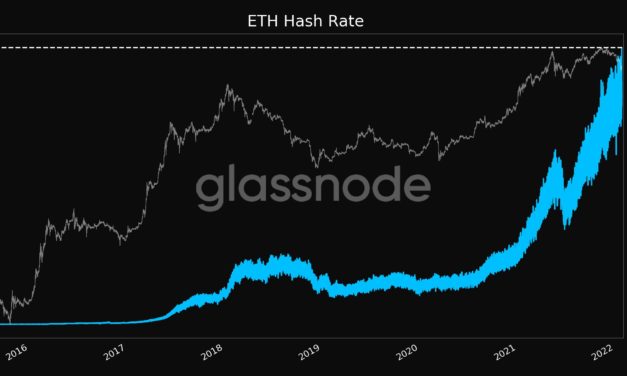
Over the previous year, Ether (ETH) has increased in value to the point that it significantly outperformed Bitcoin (BTC) in terms of returns. The rise of Ethereum has made mining on its network more lucrative over time. This appears to have resulted in additional miners, resulting in an expansion of the network’s hash rate.The hash rate for Ethereum has hit a new high, approaching record levels of 1.11 PH/s according to data from Glassnodes on Jan. 27. The previous ATH was reached previously on Jan. 13, when the ETH price fell from $4,460 to $3,160.Source: GlassnodesWhen the hash rate rises, it indicates that more nodes are joining the network, and the network is becoming more decentralized. As a result, such an increase helps to cement blockchain security. However, if the hash rate is too low, it may be detrimental to the network since there would be fewer nodes, resulting in slow transactions and less security.In December 2021, Ethereum network participants implemented the Arrow Glacier upgrade, which pushed back the switch to proof of stake consensus. It also means that Ethereum mining has a long way to go before it comes to an end. A transition from the proof of work (PoW) algorithm to the Proof of Stake (PoS) algorithm is required before reaching ETH2, which is referred to as The Merge. At that moment, the difficulty bomb will go off, essentially shutting down ETH mining and putting the network into an “ice age” that lasts until the switch is completed.After the switch to proof-of-stake, however, ETH will no longer be mined; instead, transactions will be validated by staking on special nodes.Presently, the network’s hash rate has increased past one petahash. The number is equivalent to around 1,000 TH/s and indicates that the network’s hash rate has risen more than 66,000% since March 2016, when it began being recorded on the network.Related: Bitcoin hash rate jumps to ATH as Jack Dorsey confirms Block’s mining systemAs reported by Cointelegraph, the Ethereum Foundation criticized the branding of Eth2, saying it did not adequately reflect what was going on with the network during its round of upgrades. “ETH2” and the terminology used to distinguish a proof-of-stake chain from a proof-of-work chain may be phased out in the near future, according to the post.We’ve removed all uses of ‘Eth2’ terminology on https://t.co/v9gxnMUQFz Find out why https://t.co/84uJXSD4q1— ethereum.org (@ethdotorg) January 24, 2022Among the reasons for the shift are a bad mental model for first-time users, scam prevention, inclusion, and stake clarity. The switch from a PoW to a PoS consensus mechanism is scheduled to occur in the second or third quarter of this year.

Čítaj viac

Získaj BONUS 8 € v Bitcoinoch

nakup bitcoin z karty

Registrácia Binance

Burza Binance

Aktuálne kurzy