Autor Cointelegraph By Arijit Sarkar

China pilots nationwide blockchain development over real-world use cases

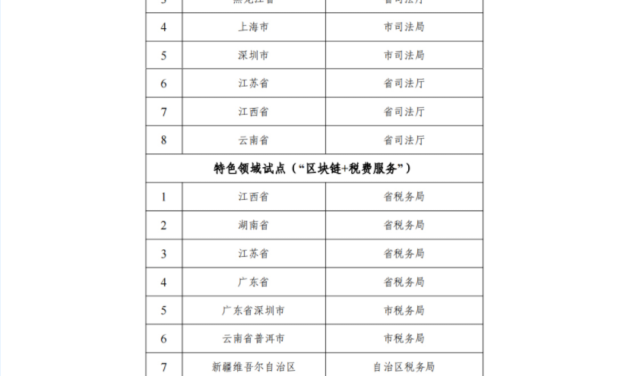
The Cyberspace Administration of China (CAC) announced the commencement of an in-house effort to expedite blockchain development and innovation across 15 zones and 164 entities. The initiative aims for the large-scale implementation of blockchain technology across businesses and government organizations in China. The CAC, along with other government agencies, directed the regulatory authorities to “promote the intensive and balanced layout of blockchain technology infrastructure in the region, form a large-scale production-level cross-chain data exchange support capability, and promote the formation of a multi-party collaborative blockchain industry ecology.”The notice also included a list of cities, companies and other entities — predetermined by the local and departmental recommendations — that will be directly involved in the blockchain pilots.A snippet of CAC’s list for blockchain pilot projects. Source: CACThe key areas of blockchain development include manufacturing, energy, government data sharing and services, law enforcement, taxation, criminal trials, inspection, copyright, civil affairs, human society, education, healthcare, trade finance, risk control management, equity market and cross-border finance.The circular also emphasizes the need for regulatory departments to coordinate the advancement and promotion of the pilot projects “and give full play to the role of blockchain in promoting data sharing, optimizing business processes, reducing operating costs, improving collaborative efficiency, and building a trusted system.”Related: China aims to separate NFTs from crypto via new blockchain infrastructureDespite a strong stance against crypto adoption, the Chinese government continues to show interest in related ecosystems including blockchain and nonfungible tokens (NFT). Most recently, the Blockchain-based Service Network (BSN), a government-backed blockchain project in China, was reportedly working on an infrastructure to support businesses and individuals in building NFT-focused platforms and apps.As Cointelegraph reported, the project aims to support the deployment of platforms capable of trading non-crypto NFTs via fiat currency.

Čítaj viac

Cyber vigilante hunts down DeFi scammers running away with $25M rug pull

In the world of digital finance, where the weapon of choice for a heist is a computer rather than a semi-automatic firearm, tracking down scams and frauds from across the world becomes a near-impossible feat for centralized police forces. However, in an interview with Cointelegraph, an anonymous cyber vigilante shares insights into how he went about tracking down a group of decentralized finance (DeFi) scammers responsible for the $25 million StableMagnet rug pull, coordinating with police authorities and eventually having the stolen money returned back to the investors.The StableMagnet platform lured unwary investors under the pretext of high returns against stablecoin deposits. In a typical rug pull event, StableMagnet managed to run away with the $25 million that was invested by over 1000 users.##StableMagnet #rugpull $22m and growing. Its SwapUtils library code is NOT verified and *DIFFERENT* from main Swap contract: https://t.co/Ls5XNA5UXf. @bscscan There is a need to verify the library code!— PeckShield Inc. (@peckshield) June 23, 2021Right before the rug pull, the cyber vigilante (anonymous for obvious reasons) examined the code to ensure the legitimacy of the project prior to investing himself. However, what he missed out on were a number of messages on Twitter alerting him on the possible exploits and vulnerabilities in the system. Taking things personally, the vigilante — an active ethical hacker — set out to track the scammers and bring justice to the investors. He told Cointelegraph:“I just felt like this was the only opportunity in my life — to have a very meaningful impact in a situation where most people are not going to have the time and the gusto to do that kind of thing.”Starting from tracking down a GitHub account to identifying all family members of the scammers through social media accounts, our vigilante’s investigation pinpointed a group of Chinese locals from Hong Kong. Eventually, the anonymous vigilante tracked down the scammers’ travel to a Chinatown in Manchester — a temporary move until the commotion died down:“I didn’t want them to go to jail. I don’t like the centralized forces to come into the decentralized world as much as we possibly can.”Taking the matter into his own hands, he booked a one-way flight ticket to Manchester while contacting local police authorities citing the narrow timeline before the scammers move to a different location. To the vigilante’s surprise, the Greater Manchester Police reacted swiftly and arrested a few of the scammers.The police retrieved different pieces of a single USB device from the scammers, which contained roughly $9 million:“Once that occurred, it was believable to the other project people (scammers) that I wasn’t BSing about finding them and knowing where they were and being able to get them taught ifFollowing the arrests, other members of StableMagnet cooperated with the cyber vigilante and returned the majority of the loot. Ever since the development, his message has been heard loud and clear, “maybe it’s not a good idea to scam, at least not on the Binance Smart Chain.”

Čítaj viac

Meta goes Brazil to trademark Bitcoin and crypto services

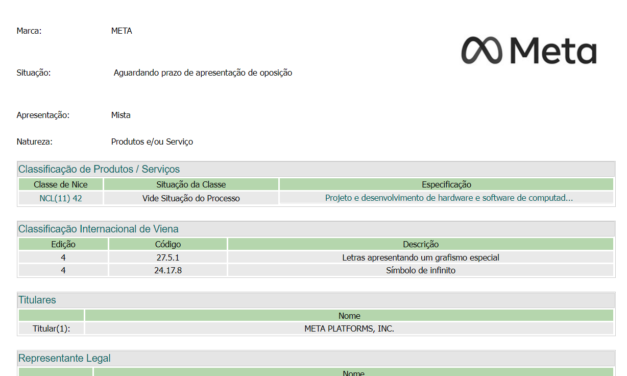
Meta, the world’s biggest social media platform, has filed a trademark registration with the Brazilian authorities to design, develop and provision hardware and software for various Bitcoin (BTC) and crypto-related services. Meta recently rebranded from Facebook as a move to better align with the Metaverse developments despite regulatory hurdles faced during its numerous previous attempts to enter the crypto space.Accelerating this effort, Meta filed a trademark registration with the Brazilian National Institute of Industrial Property (INPI) for crypto products and services related to trading, wallets and exchanges platforms.Meta’s trademark filing with the Brazilian INMI. Source: INPIFurther investigations from Cointelegraph reveal a translated version of the specifications about the products and services to be trademarked for Meta, as shown below:Translated version of Meta’s Products and Services description.”Design, development and implementation of software for third-party verification services for digital currency transactions, including (but not limited to) transactions involving Bitcoin currency.”Meta published the application for registration on Jan. 25 and is currently awaiting opposition prior INPI approval. According to the filing, Meta’s trademark filing order was placed on Oct. 5, 2021, from Jamaica.Meta’s trademark filing with the Brazilian INMI. Source: INPIRelated: Apple stock jumps after CEO reveals it’s investing in the MetaverseDuring the company’s Q1 2022 earnings call, Apple CEO Tim Cook said that he sees considerable potential in the Metaverse space, resulting in a sudden spike on Apple stock prices. As Cointelegraph reported, Apple stocks (APPL) jumped up 8% to $167.23 in after-hours trading. Answering one of the questions about Apple’s opportunities within the Metaverse, Cook spoke about the “potential in this space and are investing accordingly,” adding:“We’re always exploring new and emerging technologies and I’ve spoken at length about how it’s very interesting to us right now.”

Čítaj viac

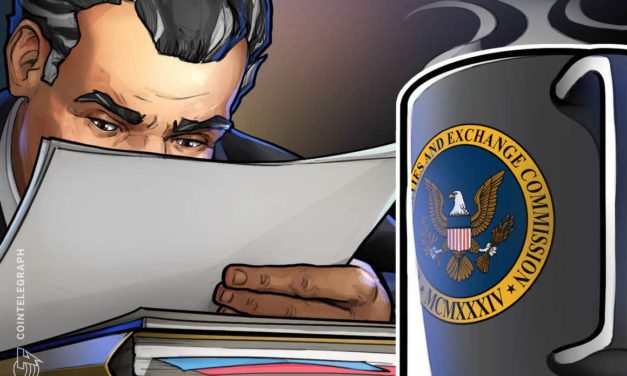
SEC approves BSTX for blockchain settlements on traditional markets

The Boston Security Token Exchange (BSTX), a new facility of the Boston-based BOX exchange, received regulatory approval from the United States Securities and Exchange Commission (SEC) to operate as a blockchain-based securities exchange. BSTX was launched jointly by BOX and Overstock’s blockchain arm tZERO, originally seeking approval for launching publicly-traded registered security tokens. However, the SEC approval to operate as a national securities exchange allows BSTX to use blockchain technology for faster settlements in traditional markets. According to the SEC,“The Commission notes that the [BSTX] Exchange’s current proposal does not involve the trading of digital tokens and such a proposal, or any other additional use of blockchain technology.”While the SEC has previously denied BSTX permission to offer crypto-focused services, the latest approval allows the facility to use a proprietary market data feed, BSTX Market Data Blockchain.In addition, BSTX will also use blockchain technology to help investors experience faster transaction times on the same day (“T+0”) or the next day (“T+1”), instead of the standard two business-day (“T+2”) settlement cycle sported by traditional markets.Along with the regulatory approval based on BSTX’s rule change proposals (SR-BOX-2021-06), the SEC placed four conditions for BOX in line with BSTX’s operations. The requirement includes joining all relevant national market system plans related to equities trading, ensuring Regulatory Services Agreement with FINRA, Intermarket Surveillance Group membership for the BSTX facility, and an applicable governance structure.Related: SEC reportedly probing crypto lending products by Gemini and CelsiusIn line with the above developments, the SEC is also reportedly reviewing some of the high-yield crypto lending products offered by Gemini, Celsius Network and Voyager Digital.As Cointelegraph reported, the SEC is conducting an inquiry into considering registering crypto lending services as securities. A Bloomberg report on the matter suggests that the SEC’s main concern lies with the high-yield offering by crypto lending services.

Čítaj viac

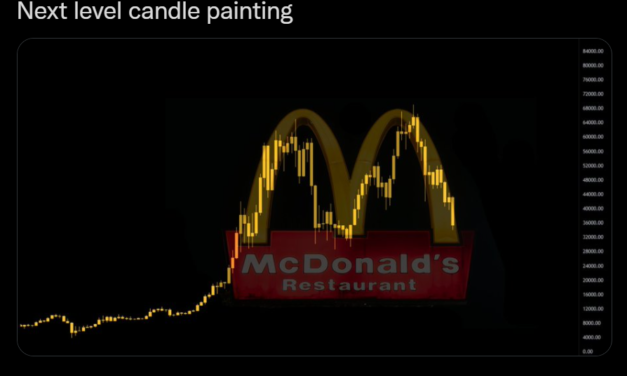
McDonald’s jumps on Bitcoin memewagon, Crypto Twitter responds

Prominent crypto entrepreneurs and supporters, who shared memes on Twitter about doing odd jobs amid an ongoing market crash, were joined by global fast-food giant McDonald”s — the brand infamously linked with temporary Bitcoin (BTC) market crashes. BTC’s price has seen a steady downfall ever since breaching an all-time high of $69,000 back in November 2022. Eventually, as Bitcoin started trading below the $40,000 mark, crypto millionaires and investors on Twitter started sharing memes about getting jobs at fast-food restaurants.Source: Twitter/PlanBSalvadoran President Nayib Bukele, too, embraced the meme culture and uploaded a new profile picture that shows him at one of his speeches sporting a badly photoshopped McDonald’s branded cap and T-shirt.#NewProfilePic pic.twitter.com/YVDlBoA2Cq— Nayib Bukele (@nayibbukele) January 22, 2022Joining in on the fun with numerous others, McDonald’s acknowledged the ongoing developments within Crypto Twitter by following influential members of the community such as Cardano founder Charles Hoskinson and Altcoin Daily. The account drew more attention as it tweeted:how are you doing people who run crypto twitter accounts— McDonald’s (@McDonalds) January 24, 2022

While Binance responded to the question with a picture of a crying face hidden behind a smiling mask, McDonald’s consoled the world’s biggest crypto exchange with a “wagmi,” short for “we are gonna make it.”wagmi friend— McDonald’s (@McDonalds) January 24, 2022

Bukele, however, seems to have bigger plans in mind.Related: Bitcoin could outperform stocks in 2022 amid Fed tightening — Bloomberg analystDespite the uncertain market condition, Bloomberg commodity strategist Mike McGlone believes in the possibility of BTC’s comeback as investors recognize its value as a digital reserve asset.As Cointelegraph reported, McGlone stated:“Cryptos are tops among the risky and speculative. If risk assets decline, it helps the Fed’s inflation fight. Becoming a global reserve asset, Bitcoin may be a primary beneficiary in that scenario.”The analyst expects the “enduring trio” — BTC, Ether (ETH) and USD-pegged stablecoins — to maintain dominance throughout 2022.

Čítaj viac

Získaj BONUS 8 € v Bitcoinoch

nakup bitcoin z karty

Registrácia Binance

Burza Binance

Aktuálne kurzy