Autor Cointelegraph By Arijit Sarkar

Bitcoin ATM installations slow down in early 2022, making a first in history

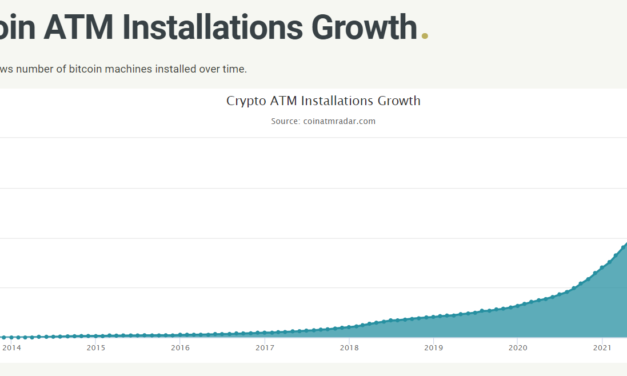
Over the last six months, Bitcoin (BTC) recorded numerous milestones — El Salvador’s mainstream adoption, a new all-time high of $69,000 and a stronger-than-ever network hash rate. However, for the first time in history, global Bitcoin ATM installations in the first two months have slowed down when compared to the preceding year.Bitcoin ATM installations in the first two months of the year have historically increased year-over-year, as evidenced by data from Coin ATM Radar. The trend, however, breaks this year.Overall Bitcoin ATM installations. Source: Coin ATM RadarConsidering only January and February 2022, a total of 1,817 crypto ATMs have been installed worldwide. In the same timeframe last year, 2,435 crypto ATMs were installed, which is 618 ATMs more when compared to this year.In 2020, only 760 ATMs were installed in this timeframe, which overshadowed 2019’s 250 ATM installations. One of the main reasons for the momentary slowdown can be attributed to the lack of involvement from newer jurisdictions. For example, the United States alone contributed to 93% of the total global crypto ATM installations in 2022 with 1,689 new ATMs.Global crypto ATM distribution. Source: Coin ATM RadarOn the other hand, Bitcoin ATMs in Europe were reduced by 1 ATM in the first two months, going down to a total of 1,397 ATMs. At the time of writing, North America represents over 95% of total crypto ATM installations with 34,284 ATMs.World map of Bitcoin ATMs. Source: Coin ATM RadarThere are a total of 36,067 ATMs installed currently. Despite a slower start to the year, crypto ATM installations are expected to grow as jurisdictions such as El Salvador plans to deploy 1,500 Bitcoin ATMs. Unless more governments amp up their efforts to crypto adoption, the ATM installations will find it difficult to maintain an upward trajectory as existing crypto-friendly countries reach saturation in terms of installing new crypto and Bitcoin ATMs.Related: Tourism in El Salvador up 30% since Bitcoin adoption, minister saysOne of the immediate positive effects of Bitcoin adoption for El Salvador is a sudden spike on tourism. Salvadoran Tourism Minister Morena Valdez said on Feb. 22 that the country’s tourism industry surged more than 30% since the adoption of the Bitcoin law in September 2021.Boom! El Salvador’s tourism has grown by 30% since the Bitcoin Lawhttps://t.co/i8t6JRHD1a#ElSalvador #BitcoinLaw #bitcoin #bitcoininvestment #Abtc #tourism #BitcoinCity #blockchain #investments— Mónica Taher ⚡️ (@monicataher) February 22, 2022As Cointelegraph reported, Valdez said that El Salvador’s tourism growth exceeded the government’s expectations, reaching 1.4 million visitors instead of 1.1 million tourists, adding: “We had projected $800,000 in foreign exchange but we obtained more than $1,400 million of income in foreign currency”

Čítaj viac
USDT records new all-time high against Russian ruble as inflation hits

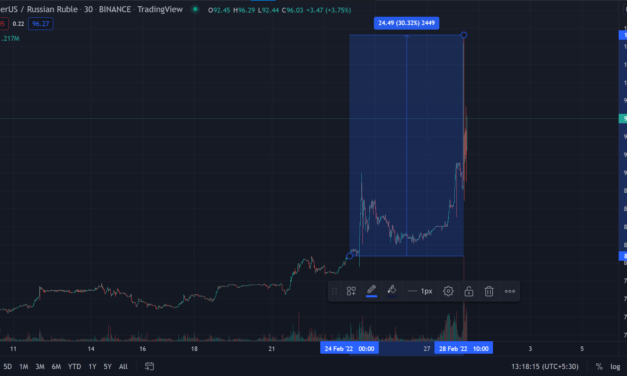
U.S. dollar-pegged stablecoin Tether (USDT) witnessed a spike of over 30% in five days against the Russian ruble — highlighting the negative and immediate impact of the ongoing war on the traditional financial system.Data from Cointelegraph Markets Pro and crypto exchange Binance show that the ruble (RUB) is undergoing inflation as the USDT/RUB trading pair — for the first time in history — crossed 105 RUB.USDT/RUB price performance. Source: TradingViewPrior to the spike, the USDT/RUB pair maintained a comparatively steady market price below 80 rubles. However, with the commencement of the Russia-Ukraine war, the ruble’s market price against USDT surged on Feb. 24, momentarily exceeding 90 rubles.As tensions escalated, on Feb. 27, the European Commission announced plans to remove Russian banks from the Society for Worldwide Interbank Financial Telecommunication (SWIFT) messaging system.Second, we will paralyse the assets of Russia’s central bank. This will freeze its transactions. And it will make it impossible for the Central Bank to liquidate its assets. pic.twitter.com/8H9eWkNCW9— Ursula von der Leyen (@vonderleyen) February 26, 2022Parallel to this timeline, the value of ruble saw a decline and continued to lose its spending power by 30% — eaten away by inflation. As an immediate countermeasure against the rising inflation of its fiat currency, the Russian central bank doubled key interest rates on Feb. 28, from 9.5% to 20%. According to the central bank:“The increase of the key rate will ensure a rise in deposit rates to levels needed to compensate for the increased depreciation and inflation risks. This is needed to support financial and price stability and protect citizens’ savings from depreciation.”In addition, the government has also asked Russian companies to sell 80% of their foreign currency revenues as threats related to a complete international financial ban prevails.Related: Ukraine Bitcoin exchange volume spikes 200% as Russia war sparks currency concernsOn the flip side, Bitcoin (BTC) and altcoin trading volumes on Ukrainian crypto exchanges spiked over 200% amid growing concerns about its fiat stability. As Cointelegraph reported, major crypto exchange Kuna, whose volumes were under $1 million on Feb. 21 spiked up to almost $4.1 million in three days. The National Bank of Ukraine has also implemented cash restrictions including withdrawal limits and banned cross-border foreign currency purchases and withdrawals outright.

Čítaj viac

EU Commission to remove Russian banks from SWIFT cross-border network

The European Commission announced to remove a number of Russian banks from the Society for Worldwide Interbank Financial Telecommunication (SWIFT) messaging system, aimed at hindering Russia’s capacity to carry out cross-border payments. In a joint statement released by the European Commission, leaders from France, Germany, Italy, the United Kingdom, Canada, and the United States highlighted their shared interest in defending Ukraine from the war against Russia:“We will hold Russia to account and collectively ensure that this war is a strategic failure for Putin.”While condemning the Russian president Vladimir Putin’s move to lay siege across Ukraine, the EU Commission committed to undertake a series of measures to isolate Russia from the international financial system. President of the EU Commission, Ursula von der Leyen announced five proactive measures against Russian authorities, starting with the removal of an undisclosed number of Russian banks from the SWIFT messaging system.First, we commit to ensuring that a certain number of Russian banks are removed from SWIFT.⁰It will stop them from operating worldwide and effectively block Russian exports and imports.— Ursula von der Leyen (@vonderleyen) February 26, 2022In addition to cutting Russia’s ties with SWIFT, the EU Commission will “paralyze the assets of Russia’s central bank,” creating another financial barrier for the Russian central bank to liquidate assets. As for the third measure, EU Commission stated:“We commit to taking measures to limit the sale of citizenship— so-called golden passports—that let wealthy Russians connected to the Russian government become citizens of our countries and gain access to our financial systems.”The EU Commission will soon launch a transatlantic task force to ensure effective implementation of all the sanctions, which primarily aims to freeze the overseas assets of Russian officials, elites and their family members. As a fifth measure, the Commission plans to increase coordination against disinformation and other forms of hybrid warfare.Related: Crypto could bypass President Biden’s ‘devastating’ sanctions on Russian banks and elites: ReportAs global markets continue to impose new financial restrictions on Russia, a Cointelegraph report from Feb. 24 highlights how Russian billionaires could potentially circumvent any sanctions put forth by the world leaders by using cryptocurrencies.One thing to listen for this afternoon is whether these sanctions will include barring Russia from the SWIFT messaging system, which would cut it off from almost all international financial transactions.(Except crypto.) https://t.co/x952GNxbah— Scott Bixby (@scottbix) February 24, 2022

“If a wealthy individual is concerned that their accounts may be frozen due to sanctions, they can simply hold their wealth in Bitcoin in order to be protected from such actions.”Now that Russian banks risk getting barred from SWIFT’s international financial network, crypto may be the key for rich individuals to evade sanctions. Quantum Economics founder and CEO Mati Greenspan said:

Čítaj viac

Ukraine accepts Bitcoin, Ethereum, USDT donations to fund ongoing war

Within the first week of the Russia-Ukraine war, the Ukrainian government has reached out to the crypto community on Twitter for raising funds to support its civilians and troops. Ukraine has now started accepting Bitcoin (BTC), Ethereum (ETH) and Tether (USDT) as donations.As Russia threatens to take over Ukraine’s capital city of Kyiv, the government of Ukraine sought help from numerous international organizations to overpower the imminent threat. However, considering time is of the essence, the official Twitter account of Ukraine extended its call for help to Crypto Twitter.Stand with the people of Ukraine. Now accepting cryptocurrency donations. Bitcoin, Ethereum and USDT.BTC – 357a3So9CbsNfBBgFYACGvxxS6tMaDoa1PETH and USDT (ERC-20) – 0x165CD37b4C644C2921454429E7F9358d18A45e14— Ukraine / Україна (@Ukraine) February 26, 2022Additionally, the Vice Prime Minister of Ukraine Mykhailo Fedorov also shared three crypto wallet addresses urging the crypto community to donate and help Ukraine fight against the Russian troops. While the BTC and ETH addresses remain the same, Fedorov’s USDT wallet address is TRC20-based (different from the address shared by Ukraine’s office Twitter handle).Stand with the people of UkraineNow accepting cryptocurrency donations. Ethereum. Bitcoin and Tether (USDTtrc20)BTC — 357a3So9CbsNfBBgFYACGvxxS6tMaDoa1PETH — 0x165CD37b4C644C2921454429E7F9358d18A45e14USDT (trc20) — TEFccmfQ38cZS1DTZVhsxKVDckA8Y6VfCy— Mykhailo Fedorov (@FedorovMykhailo) February 26, 2022

Prominent crypto entrepreneurs including Ethereum co-founder Vitalik Buterin initially suspected that the accounts requesting crypto donations were hacked. However, American diplomat Tomicah Tillemann later confirmed its legitimacy from Ukrainian Ambassador Olexander Scherba.Getting some confirmations from a couple sources that it’s legit. Deleting my warning for now. But continue to be vigilant, and always be slow and careful when sending irreversible crypto transactions. https://t.co/Odv5pxf3mp— vitalik.eth (@VitalikButerin) February 26, 2022

As a direct result of the ongoing war, Ukrainian civilian-turned refugees have reported the loss of access to their fiat savings and credit cards. The United Nations (UN) reported that over 150,000 people have been displaced from Ukraine as of Feb. 26.My Ukrainian credit cards don’t work anymore. I’m safe physically in Kazakhstan, but all my savings are gone.Crypto is the only money I still have, and today I can say without exaggeration that $BTC, $ETH, and #NFT are going to save my life while I can’t come back home.— ARTYOM FΞDOSOV (@usleepwalker) February 25, 2022

While confusion prevailed about the intended use of the crypto donations, Buterin shared another decentralized autonomous organization (DAO) initiative that focuses solely on Ukrainian citizens.An opportunity to support Ukrainians here! Proceeds go to civilian efforts helping Ukrainians suffering from the war. https://t.co/GD7Qlw61nT— vitalik.eth (@VitalikButerin) February 26, 2022

UkraineDAO, led by Pussy Riot’s Nadya Tolokonnikova, launched with the release of a 1/1 nonfungible token (NFT) of the Ukrainian flag to raise funds for Ukrainian civilian organizations to help those suffering from the war initiated by Putin.On Feb. 24, Cointelegraph reported that Ukraine’s Ministry of Defence received numerous requests from foreigners for crypto donations. crypto donations could be helpful: its really easy, fast, cheap and securealso consider this method— timo (@tymo_tt) February 24, 2022

Although unconfirmed, it is now believed that proceedings to the addresses shared by the Ukrainian government will be used directly by the government while the DAO proceedings will be redirected towards the citizen welfare via an NGO. Related: Crypto community reacts to Russia’s war in UkraineAs soon as the Russia-Ukraine war broke out, prominent crypto entrepreneurs took proactive efforts to aid Ukrainians. FTX CEO Sam Bankman-Fried was one of the first to offer monetary support to FTX traders from Ukraine.we just gave $25 to each Ukrainian on FTXdo what you gotta do— SBF (@SBF_FTX) February 24, 2022

As Cointelegraph previously reported, the Ministry of Defense was asked by the crypto community to set up provisions to accept crypto donations — which was previously unavailable.

Čítaj viac

DOJ indicts BitConnect’s Indian founder for $2.4B crypto Ponzi scheme

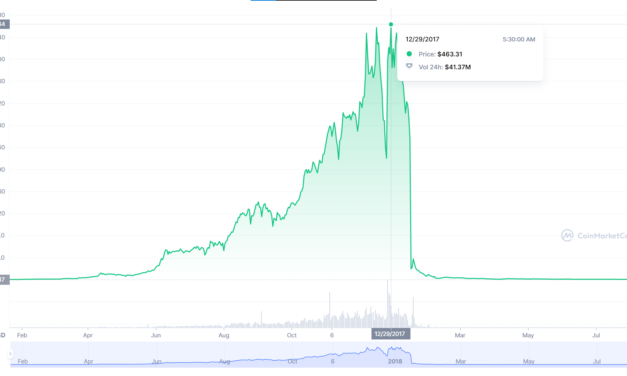
The founder of the infamous crypto exchange BitConnect, Satish Kumbhani, has been charged for allegedly misleading investors globally and defrauding them of $2.4 billion in the process.According to the Department of Justice (DOJ), a San Diego-based federal grand jury specifically charged Kumbhani for orchestrating the alleged Ponzi scheme via BitConnect’s “Lending Program”:“BitConnect operated as a Ponzi scheme by paying earlier BitConnect investors with money from later investors. In total, Kumbhani and his co-conspirators obtained approximately $2.4 billion from investors.”BitConnect (BCC) price history. Source: CoinMarketCapBack in 2017 amid the hype, BitConnect (BCC) recorded an all-time high of $463.31 in trading price, which according to the DOJ reached a peak market capitalization of $3.4 billion. However, as evidenced by the graph above, the prices soon collapsed within a few months causing massive losses to investors. Kumbhani, who resides in Gujarat, India, allegedly promised investors “ to generate substantial profits and guaranteed returns” under the BitConnect’s “Lending Program.” The indictment alleges Kumbhani used the funds from new investors to partially pay back the old investors until abruptly shutting down the program — operating a textbook Ponzi scheme. The DOJ further stated that Kumbhani and his co-conspirators faked market demand for BCC through market manipulation. The resultant investments were allegedly concealed and transferred via “BitConnect’s cluster of cryptocurrency wallets and various internationally-based cryptocurrency exchanges.”[embedded content]Supporting DOJ’s allegations, back in Sept. 2021, former BitConnect promoter Glenn Arcaro pled guilty to fraud charges related to his role in the now-defunct crypto exchange and lending platform.The indictment also alleges that Kumbhani evaded U.S. regulations by failing to register with the Financial Crimes Enforcement Network (FinCEN), as required under the Bank Secrecy Act. All in all, “Kumbhani is charged with conspiracy to commit wire fraud, wire fraud, conspiracy to commit commodity price manipulation, operation of an unlicensed money transmitting business, and conspiracy to commit international money laundering,” said the DOJ press release. The case is currently being investigated by the FBI Cleveland Field Office and IRS Criminal Investigation (CI). If convicted of all counts, Kumbhani will be subject to a maximum total penalty of 70 years in prison. In addition, the DOJ recommends all BitConnect investors register themselves as potential victims. Related: SafeMoon pump-and-dump lawsuit targets Jake Paul, Soulja Boy and othersOn Feb. 20, a new class-action lawsuit demanded a jury trial against popular celebrities and influencers for their alleged participation in a classic pump-and-dump scheme relating to SafeMoon tokens. As Cointelegraph reported, the lawsuit alleged that SafeMoon and its subsidiaries mimicked real-life Ponzi schemes by misleading investors to purchase SafeMoon tokens under the pretext of unrealistic profits.Choose your fighter #SafeMoon #BitConnectttttt pic.twitter.com/b1GMnMHxuF— W◎◎F of Wall Street | CwooFA (@WoofManCapital) April 21, 2021Drafted by plaintiffs Bill Merewhuader, Christopher Polite and Tim Viane, the lawsuit looks to represent and compensate all individuals who bought SafeMoon tokens since March 8, 2021, and were victims of the alleged rug pull attempt.

Čítaj viac

Získaj BONUS 8 € v Bitcoinoch

nakup bitcoin z karty

Registrácia Binance

Burza Binance

Aktuálne kurzy