
Autor Cointelegraph By Arijit Sarkar

Blockchain, crypto set to take sports industry beyond NFT collectibles

Bitcoin (BTC) has been attributed as the most prominent blockchain use case, showing the technology’s prowess in successfully delivering an immutable and truly decentralized ledger over the past 13 years. Adding to the years of innovations since then— that saw the introduction of altcoins, non-fungible tokens (NFT), decentralized finance (DeFi) and more, a study conducted by fintech giant Deloitte highlighted the untapped potential of the crypto ecosystem to open up newer markets for the sports industry.Fan tokens and NFTs were first introduced to the sports industry to increase fan engagement via collectibles and voting mechanisms. However, Deloitte, one of the Big 4 accounting firms, envisions the industry further embracing crypto and blockchain technology over the coming years:“A nexus will form around sports collectibles, ticketing, betting, and gaming. We are just beginning to see its [cryptocurrency’s] potential, as well as the new markets it could lead to.”Highlighting incoming trends in the sports industry, Deloitte’s 2022 sports industry outlook report expects an eventual rise in blockchain-enabled innovations, as a result of which “The use of NFTs, crypto, fan tokens, and ticket innovations will grow and evolve.”“Moving beyond NFTs,” Deloitte expects the sports industry to start soon linking spectators with season tickets over the blockchain. While the initial move toward this goal would mean merely associating game tickets with NFTs as means to reward fans, innovations around smart contracting could potentially open up new use cases:“We could see fractional ownership of season tickets and suites and a reinvention of the ticket resale process.”As a result, new revenue streams can be created for sports organizers and teams as smart contracts streamline the processes related to dynamic ticket pricing and resales. However, Deloitte shared four key factors that need to be addressed by the ecosystem: implementing new standards, educating fans and considering compliance and tax implications.Additionally, Deloitte’s study revealed that NFTs catalyzed the merger between the physical and virtual worlds in sports while predicting over $2 billion in sports-related NFT transactions in 2022 alone.On an end note, the finserv recommended sports organizations keep an eye on the NFT boom and its impact on other segments such as gaming.Related: Aussie media company goes all in on NBA fan engagement with NFTsSupporting Deloitte’s report on the rising NFT trend across the sports industry, Australian media company Basketball Forever recently launched Hoop Hounds, an NFT project aimed to increase National Basketball Association (NBA) fan engagement and provide substantial real-world utility for the tokens. Basketball Forever founder Alex Sumsky resonated with Deloitte’s findings when he told Cointelegraph that the technology is more than just a token tied to a JPG and allows organizations to provide innovative ways to increase user engagement and give the fans real utility.As part of the initiative, Basketball Forever will offer 8,888 different “hounds” — various basketball and NBA personalities depicted as animated canines — each with unique traits and differing levels of rarity.

Čítaj viac
Arthur Hayes to serve 2-year probation owning up to BitMEX’s AML mishap

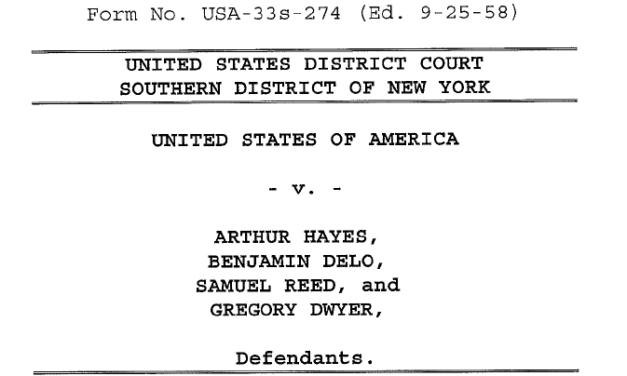
Bringing closure to the long-awaited judgment related to the money laundering activities over the BitMEX crypto exchange, one of the four federal district courthouses in New York reportedly sentenced two-year probation and six months of home detention to founder and ex-CEO Arthur Hayes.Arthur Hayes, along with the other BitMEX co-founders — Benjamin Delo and Samuel Reed — and the company’s first non-employee Gregory Dwyer, pleaded guilty to the Bank Secrecy Act (BSA) violations on Feb 24, admitting to “willfully failing to establish, implement and maintain an Anti-Money Laundering (AML) program at BitMEX.”Indictment against BitMEX co-founders and employees for violating BSA. Source: Justice.govPleading guilty to supporting money laundering is a punishable offense, often carrying a maximum penalty of five years prison time. However, both Hayes and Delo made their guilty pleas ahead of the March trial date and had agreed to pay $10 million in criminal fines each.On April 7, Cointelegraph reported that Hayes voluntarily surrendered to US authorities in Hawaii six months after federal prosecutors first levied charges, to which his lawyers stated:“Mr. Hayes voluntarily appeared in court and looks forward to fighting these unwarranted charges.”According to the indictment, public court filings, and statements made in court, Hayes was released after posting a $10-million bail bond pending future proceedings in New York. However, prosecutors from the Office’s Money Laundering and Transnational Criminal Enterprises Unit found the entrepreneurs to be guilty of not implementing AML safeguards, including not fulfilling know-your-customer (KYC) obligations. Despite the imminent possibility of serving jail time, owning up to the allegations resulted in Hayes being sentenced to a home confinement sentence that requires him to spend the first six months of his sentence from home. In addition, he also agreed to pay a fine of $10 million.Related: Blockchain and crypto can be a boon for tracking financial crimesBusting the myth related to the ease of laundering money using crypto, a new analysis highlights the potential of blockchain technology and crypto to track down financial crimes. While numerous projects within the crypto ecosystem were victims of targeted attacks, bad actors continue to struggle when it comes to cashing out the stolen funds.Speaking to Cointelegraph, Dmytro Volkov, chief technology officer at crypto exchange CEX.IO, said that the notion of crypto being primarily used by criminals is outdated, adding:“In the case of Bitcoin (BTC), whose blockchain ledger is publicly available, a serious exchange with a competent analytics team can easily monitor and thwart hackers and launderers before the damage is done.”

Čítaj viac

Crypto giants co-launch Chainabuse platform to water down rising scams

Seven major crypto companies — Binance.US, Circle, Solana Foundation, The Aave Companies, Hedera, TRM Labs and Civic — joined hands to launch a community-driven scam reporting tool. Named Chainabuse, the tool aims to enable crypto users to issue warnings and discuss ongoing fraudulent activity such as scams and hacks in real-time. Launched on Wednesday, the Chainabuse platform aims to counter the ongoing scams plaguing the crypto ecosystem. On May 4, Cointelegraph warned the community about the rise in Ape-themed airdrop phishing scams. Chainabuse serves as a one-stop-shop platform for crypto users, victims of financial crimes, and crypto businesses to actively report, discuss and issue warnings and ultimately reduce the effectiveness of the scam.In the announcement, TRM Labs highlighted that crypto companies often issue warnings on social media platforms such as Twitter and Discord, which may get difficult to notice or keep track of. However, companies and crypto investors can use Chainabuse’s public forums to upvote, downvote and leave comments to provide additional information about a reported illicit activity.The free-to-use platform also maintains a database of illicit activities, which in the future can be used by crypto users to investigate before investing in projects. Joe McGill, Chainabuse’s chief architect and former U.S. Secret Service and Postal Investigator, called attention to the numerous instances when crypto communities came together “to root out bad actors and help protect each other,” adding:“Chainabuse was designed to make it easier for more people to play an active role in advancing that culture.”Moreover, all the representatives of the seven crypto companies stressed the importance of safeguarding the interests and people of the crypto community — pointing out that fear of rug pulls and being hacked hampers the overall adoption of cryptocurrencies. Related: Binance takes legal action against fake billboard ads in TurkeyThe Turkish arm of crypto exchange Binance recently took an offensive stance against scammers that were found to be using billboards to advertise fake Binance-branded investment opportunities.Bir süredir Türkiye’nin farklı bölgelerinde aşağıdaki görsele benzer reklam panoları göze çarpmaktadır.Aşağıdaki görselin #Binance ile ilgisi yoktur❗️Dolandırıcılık faaliyeti içinde oldukları açıkça belli olan kişiler hakkında gerekli hukuki süreçler başlatılmıştır.#SAFU pic.twitter.com/znvJDLRP7v— Binance Türkiye (@Binance_Turkish) May 8, 2022In the latest warning issued by Binance Turkey, the billboard is shown sporting an advertisement for “Binance Tourist exchange” that has no affiliation with the original Binance, founded by Changpeng “CZ” Zhao. On April 15, Binance launched its first 24/7 customer service center in Turkey as it prepares to expand the service worldwide.

Čítaj viac

NEAR developers to get seamless Web3 app deployment with Pocket Network

Pocket Network, a relay infrastructure middleware protocol, announced a service integration to improve the network bandwidth of NEAR blockchain while enabling faster deployment times for Web3 developers.According to Pocket Network, the latest integration with NEAR allows native developers to deploy their applications on other supported blockchains, including Ethereum, Solana, Fuse, Avalanche, Harmony and Polygon. In addition, by having integrations with multiple blockchains, NEAR developers can overcome concerns regarding single points of failure due to bottlenecks or other service disruptions.Pocket Network aims to accomplish 100% up-time for projects via a globally distributed network of over 47,000 full nodes that service Web3 applications across 46 blockchains. Pocket Network aims to bring about revenue generation opportunities for full-node operators by offering payments in its in-house token Pocket Network (POKT) for servicing traffic across the network. “It’s a win-win-win scenario for NEAR apps, NEAR nodes and the Pocket Network protocol,” noted Michael O’Rourke, co-founder and CEO of Pocket Network.With Pocket Network’s integration autonomously allocating bandwidth and relays, the NEAR ecosystem is expected to witness reduced friction when connecting decentralized applications (DApps) via Pocket Portal, a layer-2 product on top of the Pocket Network protocol. Speaking on the development, Cameron Dennis, head of ecosystems at NEAR Foundation stated:“I’m thrilled NEAR developers will now have the opportunity to choose between Pocket Network’s decentralized network of RPC endpoints and other centralized solutions.”Related: Polygon and others extend helping hand to Terra blockchain projectsIn an attempt to revive Terra’s fallen developer community, numerous popular blockchains including Polygon and Fantom offered a helping hand in assisting them to migrate their services to other chains.We are working closely with a variety of Terra projects to help them migrate over swiftly to @0xPolygon.We will be putting capital and resources against these migrations to welcome the developers and their respective communities to our platform.We will be sharing more soon.— Ryan Wyatt (@Fwiz) May 15, 2022According to Polygon Studios CEO Ryan Wyatt, The Polygon community “is ready to welcome the developers and communities of these Terra projects.”Any Terra Luna projects out there looking for a new chain, please PM us.Fantom’s uptime is 100%, fast, low-cost, and reliable, with a great community.Can assist with a grant program, integration, marketing, and connections.#terra #Terra_Luna #Luna— Fantom Foundation (@FantomFDN) May 15, 2022

Layer-1 blockchain project Fantom, too, extended its support to the Terra community by promising to assist any project or developer who desires to move away from Terra blockchain.

Čítaj viac

UK Treasury en route to legalizing stablecoins amid Terra's UST crash

United Kingdom’s Department of Treasury, or Her Majesty’s Treasury, has reportedly decided to go ahead with regulating stablecoins as legal tender. While welcomed by the crypto community, the decision comes as a shocker due to its proximity to the recent fall of one of the most popular algorithmic stablecoin, TerraUSD (UST).A local report from The Telegraph highlighted the Treasury’s intent to regulate stablecoins across Britain, which was revealed during the Queen’s Speech. During the speech, Prince Charles announced the introductions of new legislation across various sectors, including measures to drive economic growth to improve living standards in the region, adding:“A bill will be brought forward to further strengthen powers to tackle illicit finance, reduce economic crime and help businesses grow [Economic Crime and Corporate Transparency Bill]”Cointelegraph’s report from April 4 called attention to the U.K.’s Economic and Finance Ministry department, which cited the amendment of its existing regulatory framework for incorporating stablecoins as a means of payment.Economic Secretary @JohnGlenUK announced today that stablecoins will be brought into UK payments regulation.This places the UK financial services sector at the forefront of technology, creating conditions for stablecoin issuers and service providers to operate and invest. pic.twitter.com/14SsIGW5bf— HM Treasury (@hmtreasury) April 4, 2022While the recent crash of the Terra ecosystem — which saw an unrecoverable downfall of LUNA and UST — was expected to raise red flags among the regulators, the UK Treasury maintains its course “to ensure the UK financial services industry is always at the forefront of technology and innovation,” as previously stated by the Chancellor, Rishi Sunak.However, the Treasury’s plan does not involve legalizing algorithmic stablecoins and instead prefers 1:1 fully-backed stablecoins like Tether (USDT) or USD Coin (USDC). According to the Treasury spokesman:“Legislation to regulate stablecoins, where used as a means of payment, will be part of the Financial Services and Markets Bill which was announced in the Queen’s Speech.”By legalizing stablecoins for the UK market, the Treasury aims to open up growth opportunities while ensuring financial stability as it introduces new financial technologies. Underscoring the fact that the value of Terra’s UST token was tied to a different cryptocurrency, the spokesperson stated:“The Government has been clear that certain stablecoins are not suitable for payment purposes as they share characteristics with unbacked crypto assets.”Related: SEC’s Hester Peirce says new stablecoin regs need to allow room for failureCommissioner Hester Peirce of the United States Securities and Exchange Commission (SEC) recently highlighted the need for “room for there to be failure” while backing a regulatory framework for stablecoins.I’d be happy to talk about how to achieve the SEC’s regulatory objectives without impeding the trial and error that is so essential to innovation. CommissionerPeirce@sec.gov— Hester Peirce (@HesterPeirce) May 14, 2022

While speaking at an online panel, Peirce mentioned the rising interest in stablecoins among regulators. As Cointelegraph reported, Peirce urged the SEC to provide exemptions to particular technologies, which according to her, would allow for necessary experimentation:“We need to allow room for there to be failure because that obviously is part of trying new things and our framework really does allow for that kind of trial and error. I hope that we will use it for that purpose.”

Čítaj viac

Získaj BONUS 8 € v Bitcoinoch

nakup bitcoin z karty

Registrácia Binance

Burza Binance

Aktuálne kurzy