Autor Cointelegraph By Arijit Sarkar

Bitcoin per transaction cost goes down every four years, coincidence?

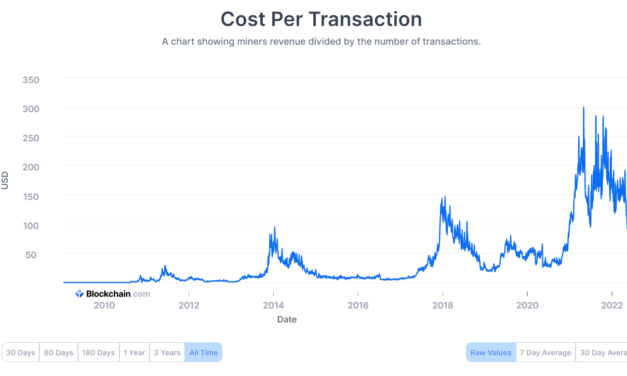
Diving deep into the thirteen-year-old Bitcoin (BTC) ecosystem makes one come across interesting patterns powered organically by investor sentiment and market conditions. With BTC’s per transaction cost coming down to $56.846 on July 14, the ecosystem unveiled a cycle wherein the per transaction costs invariably fall every four years.The cost per Bitcoin transaction is calculated by dividing miners’ revenue by the number of transactions, thus implying an unpredictive trend — however, data from Blockchain.com reveals a pattern many would find satisfying.Bitcoin cost per transaction YTD. Source: blockchain.comThe cost per transaction dropped over 81% in July 2022 from its all-time high of $300.331 in May 2021, factored by a combination of a prolonged bear market and fewer on-chain transactions due to regulatory hurdles imposed on the general investors. However, the rise and fall of the cost per transaction is a pattern seen every four years. Ever since its launch in 2009, Bitcoin’s cost per transaction went through its rollercoaster cycle three times — in 2014, 2018 and 2022. If history were to repeat itself regardless of market conditions, the cost per transaction would overshadow the current all-time high by 2026, which would be accompanied by an eventual downfall around the $50 range.Overall, miners’ revenue has also seen a significant reduction throughout the year 2022, with July marking the month of lowest income from Bitcoin mining in over two years. Related: Global GPU price drops to compensate for falling Bitcoin mining revenueImpacted by the falling market prices, Bitcoin miners found themselves barely making profits owing to the high operating costs associated with BTC mining. However, falling graphic cards or GPU prices are set to offset the losses as miners get access to affordable mining hardware.GPU price trend over the past one year. Source: TechSpotWith card manufacturers resuming operations following the end of the global chip shortage, GPU prices declined massively, with some cards selling for below MSRPs. In May 2022, mining hardware prices dropped over 15% on average as supply exceeded the market demand. 

Čítaj viac


The regulatory implications of India’s crypto transactions tax

The Indian crypto landscape lost some momentum this year as the government introduced two laws demanding crippling taxes on crypto-related unrealized gains and transactions.India’s first crypto law, which requires its citizens to pay a 30% tax on unrealized crypto gains, came into effect on April 1. A commotion among the Indian crypto community followed as investors and entrepreneurs tried to decipher the impact of the vague announcement with little or no success.Knowing that India’s second crypto law — a 1% tax deduction at source (TDS) on every transaction — would translate into an even greater impact on trading activities, numerous crypto entrepreneurs from India considered moving bases to friendlier jurisdictions. Following the imposition of additional taxes, Indian crypto exchanges reported a massive drop in trading volumes. Data from CoinGecko confirmed that trading volumes on Indian crypto exchanges are down 56.8% on average as investors eye off-shore exchanges to cut their losses on unforgiving taxes. However, India’s finance minister Nirmala Sitharaman previously acknowledged the resultant backlash and revealed plans to reconsider amendments to crypto-related taxes upon careful consideration. Grassroot impact of crypto regulations in IndiaWithin just days of implementing India’s infamous crypto laws, crypto exchanges in the region reported a massive slump in trading volumes. Nihal Armaan, a small-time crypto investor from India, told Cointelegraph that taxation is not a deterrent when dealing with cryptocurrencies. Instead, he compared the imposition of a flat 1% tax as a way of capital lock-in, a feature used by corporates to prevent investors from taking away their funds, adding that “The TDS isn’t the issue, the amount of TDS is — since it evidently reduces the number of trades a person can carry out with their capital at hand.”The North Block of the Central Secretariat, the residence of the Chairperson of the Central Board of Direct Taxes, New Delhi. Source: Edmund Gall.Kashif Raza, founder of crypto education startup Bitinning, told Cointelegraph that implementing TDS is a good first step in ring-fencing the crypto industry in India. While Raza added that investors like himself who trade less might not feel the repercussions of such a law, he did acknowledge that “the amount of TDS is a topic of debate as there are many active traders in the crypto industry who have been affected by this decision.”Contrary to the popular belief of trade slowdowns, Om Malviya, president of Tezos India, told Cointelegraph that he envisions little to low disruption for long-term investors. Instead, he expects pro-crypto reforms in the current laws over the next three to five years. While awaiting friendlier tax reforms, he advised investors to gain a deeper understanding of the technology, adding, “Even the users from smaller cities will be forced to study the cryptocurrency, study about the team and technology and the fundamentals behind it, and then make any investment or trading decision.”Rajagopal Menon, vice president of crypto exchange WazirX, told Cointelegraph that despite falling trading volumes, the exchange continues to focus on complying with the new taxes rules and meeting the standards set by the local regulators, adding, “The TDS will not affect the serious crypto investors, a.k.a, hodlers, as they have a long-term horizon in mind.” In 2021, the exchange witnessed over 700% growth in signups from smaller cities such as Guwahati, Karnal and Bareilly.Recent: Crypto payments gain ground thanks to centralized payment processorsHowever, Anshul Dhir, chief operations officer and co-founder of EasyFi Network — a layer-2 decentralized finance (DeFi) lending protocol — told Cointelegraph that unless the Indian government introduces friendlier crypto regulations with prolonged exposure to taxes, passionate investors may join crypto entrepreneurs in the exodus away from India.Crypto taxes and the creation of long-term holders While the crypto trading volume has seen a drastic reduction across Indian exchanges, it indicates investors’ willingness to hold on to their assets until pro-crypto regulations kick in. In order to ensure profitable trades, Indian investors speaking to Cointelegraph revealed that they have been waiting for a bull market to sell a part of their holdings for profits. Concurring with this change in the present investor mindset, Malviya added that “if you want to pay this amount of high taxes, you have to be really sure that your investment is going to be worth more than what you’re more than today.” Armaan reiterated that the TDS itself is not a deterrent to crypto traders, but “the 30% tax on profits without the provision to set off losses is harsh and discourages any new trader even to try trading in the cryptocurrency industry.” Even though many Indians welcomed the tax regime, as it gives a sense of legitimacy to the crypto industry in the country, Dhir believes that “the tax rate is a deal-breaker and will cause a lot of prospective investors to hold their investments in virtual digital assets.”On this front, Menon warned investors against trying to find loopholes in the law by using foreign exchanges, peer-to-peer sites and decentralized exchanges. Regardless of the platforms used, all Indian citizens are liable to pay the TDS; failure to do so would result in non-compliance with the existing tax laws of the land. The slowdown in trade volumes was accompanied by a drop in liquidity, which also impacted the global liquidity for the overall crypto ecosystem. India’s interaction with CBDCsCentral banks worldwide seem to have unanimously agreed on either experimenting with or launching their own versions of central bank digital currencies (CBDC). India, on that front, is expected to introduce a digital rupee by 2022–23. According to the country’s finance minister, Nirmala Sitharaman, it is expected to provide a “big boost” to the digital economy.While CBDCs fundamentally differ from how cryptocurrencies operate, governments are in a race to create a fiat-based system that incorporates the best features offered by the crypto ecosystem. Raza added that a CBDC backed by the Indian rupee “will help in faster and cheaper inward remittances and global payments” but doubts its acceptance as a store of value by retail.As pointed out by Malviya, CBDCs are well suited to cater use cases that demand immediate issuance of funds, adding, “but it is not going to void the case for cryptocurrencies essentially.” Dhir, however, believes that CBDCs will complement the digital asset industry, particularly the DeFi projects. Moreover, India’s central bank, the Reserve Bank of India, needs to formulate policies conducive to innovation and growth and highlight the positives of the budding technology to the general public.For many, India’s crypto taxes seem like a proactive move to discourage trading. Still, speaking from an investor’s point of view, Armaan argued that the government did the best they could in terms of explaining the tax structure with the information they had at their disposal. The waiting gameFriendlier tax reforms are a waiting game for Indian entrepreneurs and inventors, but both communities have to be compliant while preparing for greener pastures. For investors, this means educating themselves about the ecosystem and best practices for trading. Armaan’s approach in the current scenario is to have low allocation and a systematic investment plan approach to investing. In addition to being watchful of the market developments, Dhir advises the community to engage with the government in their own capacities with a positive frame of mind and not engage in antagonistic banter on social media. “The new use cases, new projects and new products are only going to come out and this space is only going to get bigger. So if you do want to part or not, you have to do your own research, and you have to be committed,” added Malviya.Recent: Andorra green lights Bitcoin and blockchain with Digital Assets ActMenon recommended that entrepreneurs keep engaging with the government in the hopes that it will tweak its policies one day. “Parallelly, all the developments need to be shared with the government as well, so they are aware of the innovation happening in this space by the talent at home; this may have an overall positive impact on the industry at large,” added Raza.Furthermore, Malviya stated that entrepreneurs must be committed to the cause as they strive to build solutions catering to a growing number of use cases, adding that “you don’t necessarily have to focus on shifting out of India; I think the first focus should be what problem you’re trying to solve.”In the meantime, investors are hopeful for constructive frameworks around cryptocurrencies to help weed out bad actors from the equation.

Čítaj viac

What is Bitcoin whale watching and how to track Bitcoin whales?

Whales are held responsible for sudden price fluctuations in the crypto and traditional markets every so often. Given their capability to manipulate market prices, it becomes paramount for the general Bitcoin (BTC) investors to understand the nuances that make one a whale and their overall impact on trading.Wallet addresses that contain large amounts of BTC are identified as Bitcoin whales. Dumping or transferring large amounts of BTC from one wallet to another negatively impacts the prices, resulting in losses for the smaller traders. As a result, tracking Bitcoin whales in real-time allows small-time traders to make profitable trades amid a fluctuating market.Despite Bitcoin’s global and decentralized nature, tracking down and monitoring whales simply boils down to accessing readily available trading data from crypto exchanges and services. There are four primary ways to track whale activities, which include monitoring known whale addresses, order books, sudden changes in market capitalization and trades on crypto exchanges. Monitoring known whales provide a headstart to smaller investors as the likeliness of coming across a whale trade increases significantly. Moreover, keeping track of market changes via order books and trades on crypto exchanges indicates incoming whale trades, which can be leveraged to profit during volatility. 3,463 #BTC (73,208,868 USD) transferred from #Coinbase to unknown wallethttps://t.co/fD08jpYD4P— Whale Alert (@whale_alert) July 16, 2022The crypto community also uses free services that inform investors about successful whale trades, often including information about the sender’s and receiver’s wallets and the amount. One of the most popular services for automatically tracking whale trades is @whale_alert on Twitter, which issues alerts related to large transactions as shown above.Related: Bitcoin whales still ‘hibernating’ as BTC price nears $21KIn a recent market update, Cointelegraph revealed that on-chain data suggested that the largest Bitcoin hodlers were reluctant to act at current prices. BlockTrends analyst Caue Oliveira supported the above finding by highlighting a “hibernation” continuing among whale wallet. He added:”Institutional movements, or commonly called “whale activity” can be tracked based on the transaction volume moved over a short period of time, both denominated in BTC and USD.”Moreover, numerous altcoins continue to mimic Bitcoin’s bearish trends as whales await a greener sentiment across the crypto market.

Čítaj viac

SEC dismisses claims against John McAfee, fines accomplice for ICO promo

The United States Securities and Exchange Commission (SEC) obtained the final judgment for an initial coin offering (ICO) promotion scheme against late entrepreneur John McAfee and accomplice Jimmy Gale Watson, Jr., filed on October 5, 2020. In the original complaint, the SEC alleged that McAfee and Watson promoted ICO investments on Twitter without disclosing that they were paid for them. Watson allegedly assisted McAfee in negotiating promotional deals with ICO issuers and cashing out the crypto payments, among other pump-and-dump charges.The U.S. District Court for the Southern District of New York found Watson guilty of violating the law and imposed a cumulative fine of $375,934.86. In addition, Watson has been barred from participating in ICO-related issuance, purchase, offer or sale. The litigation states:“However, that such injunction shall not prevent Watson from purchasing or selling securities for his own personal accounts.”Providing closure to the impending case, the SEC’s claims against McAfee were dismissed after the Commission filed a notice of death for the infamous entrepreneur. Related: US Treasury calls for public comment on digital asset policy, following Biden’s executive orderThe U.S. Treasury sought input from the public to include in reporting to the president on the possible implications of digital assets on finance and payment infrastructures. Sharing his views on the matter, Nellie Liang, Under Secretary of the Treasury for Domestic Finance stated:“For consumers, digital assets may present potential benefits, such as faster payments, as well as potential risks, including risks related to frauds and scams.”Therefore, Liang hopes to gain input from Americans and market participants to understand better the impacts of mainstreaming crypto assets.

Čítaj viac

How to identify and avoid a crypto pump-and-dump scheme?

Educating oneself about the crypto ecosystem is crucial for investors to pursue during a bear market while awaiting a bull cycle. That being said, having a good understanding of crypto investment entails keeping an eye out for fraudulent projects that threaten to drain assets overnight, a.k.a. pump-and-dump schemes.Pump-and-dump in crypto is an orchestrated fraud that involves misleading investors into purchasing artificially inflated tokens — typically marketed and hyped by paying celebrities and social influencers. SafeMoon token is one of the most prominent examples of an alleged pump-and-dump scheme involving A-list celebrities, including Nick Carter, Soulja Boy, Lil Yachty and YouTubers Jake Paul and Ben Phillips.Once the investors have purchased tokens at inflated prices, the people owning the biggest pile of tokens sell out, resulting in an immediate crash in the token’s prices. While fraudsters disguise pump-and-dump schemes under the pretext of creating the next batch of crypto millionaires, knowledgable investors have the upper hand in identifying and avoiding their involvement. Pump-and-dump schemes are usually accompanied by false promises around three broad categories — solving real-world use cases, guaranteed exorbitant returns and unwithered backing from celebrities and influencers.The long-term success of a cryptocurrency is heavily dependent on the use cases it serves. As a result, people supporting pump-and-dump projects often suffice their involvement by highlighting the use cases the token aims to serve. In addition, such schemes typically rope in celebrities by upfront payments in cash and the project’s in-house tokens. Celebrities then market the fraudulent tokens to trusting fans, usually with promises of high investment returns. In the case of SafeMoon, celebrities were accused of a slow rug pull, implying a slow sell-off of holdings as the trading volume from retail investors remained inflated. Binance, the biggest crypto exchange in terms of trading volume, also warned investors from taking investment advice from celebrities and influencers.Superstars ≠ crypto experts.Music artist @JBALVIN says “do your own research”.On 2.13 when big names try to give you crypto advice — sound #CryptoCelebAlert and grab 1/2222 NFTs of basketball star @JimmyButler!Learn more ⬇️https://t.co/3rC7r0uJ8M pic.twitter.com/Hml8AN2aEs— Binance (@binance) February 7, 2022In the next bull cycle, traditional and crypto investors across the globe will amp up efforts to recoup losses from the ongoing bear market. Knowing this information, fraudsters will try and find opportunities to dupe unwary investors by presenting unrealistic gains. As a result, do your own research (DYOR) stands as one of the best pieces of advice in crypto.Related: Sygnia CEO criticizes Elon Musk for alleged Bitcoin pump and dumpElon Musk was recently accused of manipulating crypto prices by prominent South African billionaire businesswoman Magda Wierzycka. Wierzycka believes that Musk’s social media activity and its implications on the price of Bitcoin (BTC) should have made him the subject of an investigation by the U.S. Securities and Exchange Commission. She believes that Musk knowingly pumped up the price of Bitcoin via tweets, including those mentioning Tesla’s $1.5 billion BTC purchase, then “sold a big part of his exposure at the peak.”

Čítaj viac

Získaj BONUS 8 € v Bitcoinoch

nakup bitcoin z karty

Registrácia Binance

Burza Binance

Aktuálne kurzy