Autor Cointelegraph By Arijit Sarkar

Bitcoin mining revenue jumps 68.6% from the lowest-earning day of 2022

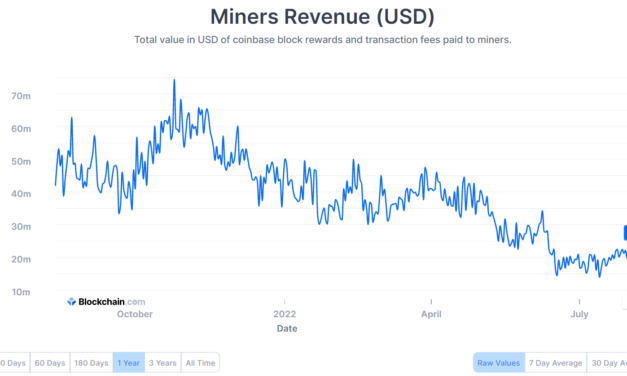
The Bitcoin (BTC) mining industry endured immense financial stress throughout the year 2022 as a prolonged bear market directly impacted their earnings when translated to the U.S. dollar. However, miners resilient to the year’s lowest mining revenue day, June 13, witnessed a 68.63% increase in mining revenue within a month.Over the year, revenue from Bitcoin mining dropped due to a multitude of factors centered around investor sentiment — driven by tensions arising from market crashes, ecosystem collapses and loss-making investments. Cutting through the noise, the Bitcoin ecosystem recovered across numerous determinants, including miners’ revenue in dollars, network difficulty and hash rate.Total miners revenue over time. Source: blockchain.comData from blockchain.com confirms that BTC mining revenue jumped nearly 69% in one month — from $13.928 million on July 13 to $23.488 million on Aug. 12. The significant increase in mining revenue reassures Bitcoin mining as a viable business despite high operational costs. In addition, lower mining equipment (GPU) prices have allowed BTC miners to expand their existing infrastructure as they pursue mining the last 2 million BTC.Alongside mining revenue, Bitcoin’s hash rate grew over 10% over the last month, adding to the network’s resilience against double-spending attacks. However, as a result, network difficulty — a measure of how difficult it is to mine a new BTC block — increased for the first time since June.Related: BTC mining stocks double in a month as production rampsMirroring the positive outcomes across the Bitcoin network, crypto mining companies reported increased stock prices over the last month. Crypto mining companies, including Hut8 Mining Corp., Marathon Digital Holdings and Core Scientific, revealed skyrocketing stock prices, each performing at least 95% better than June 2022. All three companies, however, posted widened losses, driven by impairment losses on their crypto holdings.

Čítaj viac
Interlay launches trustless BTC stablecoin bridge on Polkadot

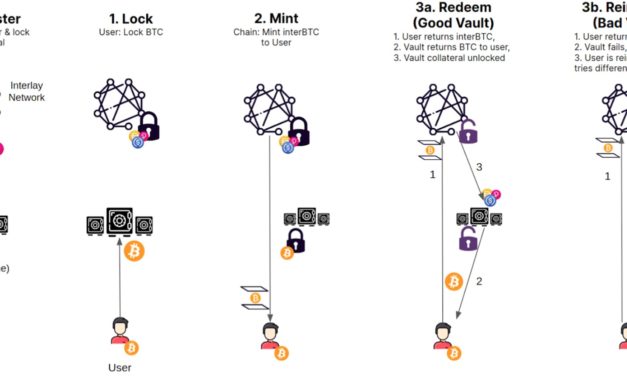
Interlay, a London-based blockchain firm, launched a Bitcoin (BTC)-based cross-chain bridge on Polkadot (DOT). Named interBTC (iBTC), the bridge allows the use of Bitcoin on non-native blockchains for decentralized finance (DeFi), cross-chain transfers and nonfungible tokens (NFTs), among others.interBTC operates as a BTC-backed stablecoin, secured by a decentralized network of overcollateralized vaults, which according to Interlay, resembles MakerDAO’s DAI token, a stablecoin on the Ethereum blockchain. The iBTC vaults use mixed-asset collateral to insure BTC reserves, making iBTC redeemable 1:1 with BTC over the Bitcoin blockchain. As a preventive measure during unforeseen vault failure, the collateral is programmed to get slashed and reimburse the BTC depositors. Sharing the thought process behind the initiative, Interlay co-founder and CEO Alexei Zamyatin stated:“Bitcoin is the driving force behind global crypto adoption, while Polkadot, Ethereum & co. is where technological innovation is happening. With interBTC, we combine the best of both worlds while preserving the trustless nature of Bitcoin.”Interlay’s announcement also highlighted Ethereum co-founder and Polkadot inventor Gavin Wood’s vision of creating a fully decentralized Bitcoin bridge on Polkadot, which was made possible by interBTC. Acala and Moonbeam will be the first DeFi hubs to host iBTC’s debut, which will be supported by a $1 million liquidity program offered by the Interlay network treasury and partner projects. The roadmap for iBTC involves being available on other major DeFi networks, including Ethereum, Cosmos, Solana, and Avalanche. Related: DeFi market has room for growth in Korea: 1inch co-founder — KBW 2022Echoing Interlay’s interest in serving the DeFi and other crypto markets, DeFi aggregator 1inch Network eyes geographical expansion in newer jurisdictions. Speaking to Cointelegraph, DeFi aggregator 1inch Network co-founder Sergej Kunz revealed plans to expand its reach in Asia.Kunz disclosed that 1inch is actively looking to partner with Asia-based Web3 companies despite the small DeFi market in Korea and Asia, adding that:“Here, there are a lot of people who like gaming and a lot of things like that, so I think the DeFi market can grow a lot in South Korea.”1inch’s primary use case as a decentralized exchange (DEX) aggregator involves identifying pools with the largest liquidity, lowest slippage and cheapest cryptocurrency exchange rates.

Čítaj viac

Six reasons why blockchain makes sense for commercial real estate: Deloitte

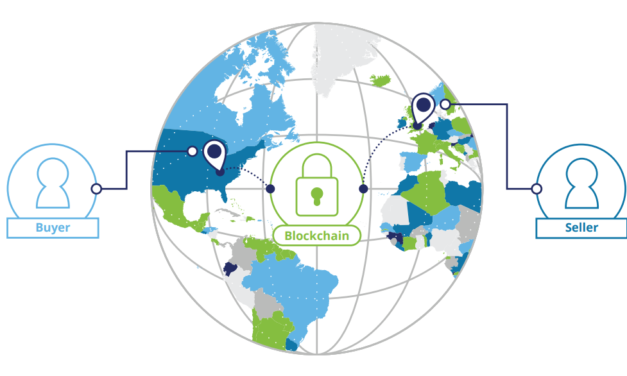
Solutions built around blockchain technology offer several upfront benefits, including a censorship-resistant, irreversible distributed ledger. Deloitte’s study revealed blockchain’s position as a perfect fit for real estate use cases around leasing and selling.Blockchain innovations often outdo traditional systems by not only digitizing information but also introducing a near real-time trustless environment, among other features. Big Four accounting firm Deloitte uncovered six opportunities for blockchain to disrupt the commercial real estate (CRE) industry.The above infographic highlights six key pain points for CRE owners when leasing and selling their properties and maintaining complex transaction data. With this in the backdrop, Deloitte noted six opportunities for blockchain to serve the industry, which include improving processes around searching for properties and allowing people to make better decisions around leasing and purchasing. Due to paperless processes, Deloitte envisions blockchain expediting property and payment evaluations and better-streamlining cash flow management. In addition, the technology’s inherent qualities also offer cheaper means of managing property ownership history while enabling efficient processing of financing and payments.The study reveals that blockchain technology is well-positioned to take over more than 50% of the leasing and sale process, excluding steps requiring physical intervention such as property inspection and loan negotiations. Deloitte noted:“Blockchain seems to be most applicable to dynamically configurable or co-sharing spaces, which have a relatively higher number of tenants and shorter duration leases.”While Deloitte’s report reaffirms blockchain’s potential to drive transparency, efficiency and cost savings for commercial real estate owners, companies and CRE owners are advised to follow a three-step approach — educate, collaborate or create, facilitate — in determining the best way ahead for blockchain implementation.Related: Nonfungible tokens don’t live on the blockchain, experts sayWhile nonfungible tokens (NFTs) have been advertised as blockchain-based technologies, experts contradict the notion.Speaking to Cointelegraph, Jonathan Victor, the Web3 storage lead at Protocol Labs, revealed that main chains are very limited in size, which in turn makes storing data on the blockchain to be expensive. As a result, NFT ecosystems often opt for off-chain storage solutions. Alex Salnikov, the co-founder of Rarible, confirmed the above claim as he told Cointelegraph:“It is important to understand that the NFT living in a user’s wallet only points to the file it represents — the actual file itself, also known as an NFT’s metadata, is typically stored elsewhere.”Despite the revelation, both experts noted that storage for NFTs can still be considered decentralized.

Čítaj viac

Binance, KuCoin, OKX CEOs flex security amid Solana FUD storm

With Solana hitting the headlines for succumbing to a hack on Wednesday, prominent crypto CEOs — including Binance’s Changpeng “CZ” Zhao, KuCoin’s Johnny Lyu and OKX’s Jay Hao — recommended that Solana (SOL) investors move their holdings over to their own exchanges as an immediate security measure.Numerous blockchain investigators and crypto investors flagged an alleged widespread private key compromise, allowing the attacker to steal native SOL tokens and Solana-compatible SPL tokens such as USD Coin (USDC) from Phantom and Slope wallets. However, the root cause of the attack remains a mystery as all parties, including Solana and Phantom, denied faults at their ends. Phantom’s official stance on the matter shared with Cointelegraph:“We are working closely with other teams to get to the bottom of a reported vulnerability in the Solana ecosystem. At this time, the team does not believe this is a Phantom-specific issue.”Parallel to the ongoing investigations of the Solana fiasco, CZ warned investors of “an active security incident on Solana” that drained funds in SOL and USD Coin (USDC) off over 7000 wallets. His recommendation to unhacked investors was to transfer their assets to a cold wallet or Binance.There is an active security incident on Solana. Many (7000+ and counting) wallets are drained of SOL & USDC. Don’t know root cause yet. Maybe permissions granted to apps. For remediation, send the funds to a cold wallet or CEX like @Binance. https://t.co/nQrBXAgCbf— CZ Binance (@cz_binance) August 3, 2022Lyu gave a similar assurance to KuCoin users as he confirmed that all SOL assets were not impacted by the hack; as he said:“We’re in close contact with the Solana team and have blocked the suspicious addresses as requested.”Hao, however, echoed CZ’s recommendation as he advised investors to move their assets to OKX to protect themselves from the hack.There are reports that a massive #Solana hack has more than 7,500 hot wallets drained.It might be advisable to move your funds to a hardware wallet, or a trusted exchange like #OKX to protect yourself from this hack.Stay safe out there.— jay_star.okx ⚛️ OKX CEO (@star_okx) August 3, 2022

Given the uncertainty behind the hacker’s potential and reach, other crypto exchanges such as Bybit have proactively suspended all deposits and withdrawal of assets on the Solana blockchain. Related: Hacker drains $1.08M from Audius following passing of malicious proposalA hack that passed a malicious governance proposal resulted in the transfer of tokens worth $6.1 million, with the hacker making away with $1 million. Hello everyone – our team is aware of reports of an unauthorized transfer of AUDIO tokens from the community treasury. We are actively investigating and will report back as soon as we know more.If you’d like to help our response team, please reach out.— Audius (@AudiusProject) July 24, 2022

Speaking to Cointelegraph, Audius co-founder and CEO Roneil Rumburg clarified that no members of the community were involved in the passing of the malicious proposal:“This was an exploit — not a proposal proposed or passed through any legitimate means — it just happened to use the governance system as the entry point for the attack.”Blockchain investigator Peckshield later narrowed down the fault to Audius’ storage layout inconsistencies.

Čítaj viac

European Central Bank bets on CBDCs over BTC for cross-border payments

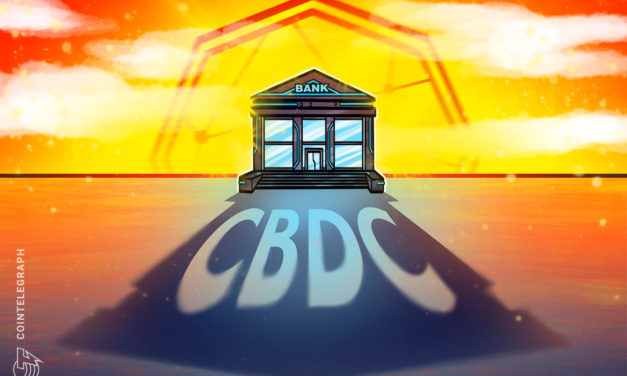
A recent study conducted by the European Central Bank (ECB) on identifying the ultimate cross-border payment medium crowned central bank digital currencies (CBDCs) as the winner against competitors, including banking, Bitcoin (BTC) and stablecoins, among others.ECB’s interest in identifying the best cross-border payment solution stems from the fact that it serves as the central bank of the 19 European Union countries which have adopted the euro. The study, “Towards The Holy Grail of Cross-border Payments,” referred to Bitcoin as the most prominent unbacked crypto asset.EBC’s opinion of Bitcoin as a bad cross-border payment system boils down to the settlement mechanism of the highly volatile asset, adding that:“Since the settlement in the Bitcoin network occurs only around every ten minutes, valuation effects are already materializing at the moment of settlement, making Bitcoin payments actually more complicated.”While the study highlighted Bitcoin’s inherent scaling and speed issues, it failed to consider the timely upgrades — Taproot and Lightning Network — that improve the network performance, concluding that “The underlying technology (and in particular its “proof-of-work” layer) is inherently expensive and wasteful.”On the other hand, the ECB recognized CBDCs as a better fit for cross-border payments owing to greater compatibility with forex exchange (FX) conversions. Two major advantages highlighted in this regard are the preservation of monetary sovereignty and the ease of instant payments via intermediaries such as central banks. Related: Australian central bank governor favors private sector crypto technologyContradicting the ECB’s reliance on CBDCs, Australian central bank Governor Phillip Lowe believed that a private solution “is going to be better” for cryptocurrency as long as risks are mitigated through regulation.Mitigating risks related to crypto adoption can be fended off by strong regulations and state backing, stated Lowe, adding:“If these tokens are going to be used widely by the community, they are going to need to be backed by the state or regulated just as we regulate bank deposits.”In Lowe’s view, private companies are “better than the central bank at innovating” the best features for cryptocurrency.

Čítaj viac

Získaj BONUS 8 € v Bitcoinoch

nakup bitcoin z karty

Registrácia Binance

Burza Binance

Aktuálne kurzy