Autor Cointelegraph By Arijit Sarkar

Are non-KYC crypto exchanges as safe as their KYC-compliant peers?

Many see implementing Know Your Customer (KYC) tools in crypto as a deterrent to the Bitcoin (BTC) Standard, which has predominantly promoted anonymized peer-to-peer transactions. However, regulators stay put on promoting KYC and anti-money laundering (AML) implementations as a means to ensure investors’ safety and protection against financial fraud. While most crypto exchanges have begun implementing regulatory recommendations to remain at the forefront of crypto’s mainstream adoption, investors still have the choice to opt for crypto exchanges that promote greater anonymity by not imposing KYC processes. But does opting for the latter as an investor mean compromising on safety?A matter of trustAnonymity goes both ways in most cases. Owners of crypto exchanges running non-KYC (or non-compliant) operations often choose to remain anonymous to avoid legal scrutiny. As a result, investors must have a high level of trust in the people responsible for running the exchange. On the other hand, decentralized exchanges such as dYdX use trustless protocols for establishing a community-controlled trading platform. This, in turn, instills trust within investors despite no mandate of KYC on the platform. Therefore, monitoring the platform’s track record and the people running it becomes paramount when trading on non-KYC platforms. Blockchain remembers foreverWhile the suits backing traditional finance portray crypto as tools of money laundering, illicit cryptocurrency transactions have consistently declined year-over-year. Despite the ease of using cryptocurrencies without KYC verification, a Chainalysis study confirmed that only 0.15% of all crypto transactions in 2021 were linked to illicit activities.Moreover, immutable blockchain records allow authorities to retrace owners of the transactions, further deterring bad actors from using crypto — both KYC and non-KYC platforms — to fund their practices.The permanent nature of blockchain has allowed authorities across the world to hunt down scammers, fraudsters and launderers of crimes they committed years ago. Not your keys, not your coinsOne of the biggest concerns when operating with crypto exchanges is the lack of control over the assets. Cryptocurrencies stored over crypto exchanges mean handing over the private keys to the exchange.Using unvetted crypto exchanges that market no KYC requirements exposes investors to the risks of permanently losing their funds. While both types of exchanges — compliant and non-compliant to KYC — require investors to hand over their crypto assets to third parties, KYC-compliant exchanges instill greater trust among investors and regulators.The answer to the question ‘Are non-KYC crypto exchanges safe?’ lies in understanding the abovementioned nuances. KYC or not, crypto investors remain equally vulnerable to the risks related to external factors such as the intent of the owner and shady business practices, in addition to getting no backing from the government. Additionally, investing with a non-KYC crypto exchange comes with limitations on the trading value, available tokens and other services offered by the provider.

Čítaj viac

Fei Protocol founder proposes ghosting Tribe DAO following hack repayment

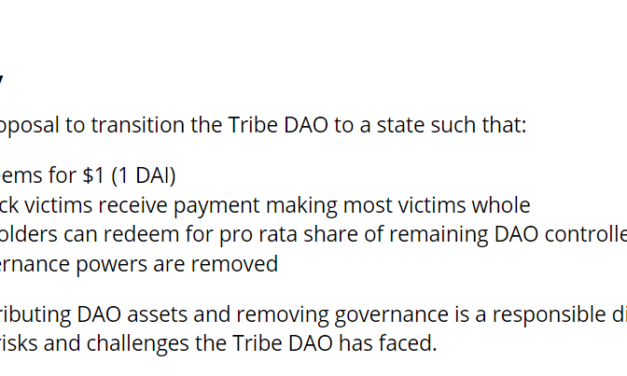
An attack in April 2022, which drained off nearly $80 million from various Rari Fuse pools, required the decentralized finance (DeFi) platform Fei Protocol to come up with a solution that minimizes damage to the ecosystem. Fei Labs’ latest proposal, which partly recommends revoking participation from Tribe DAO, received mixed sentiments from the community.Fei Protocol founder Joey Santoro announced the latest proposal, TIP-121: Proposal for the future of the Tribe DAO, revealing the company’s intent to reimburse Fuze victims. It also details plans for asset redemption and the distribution of protocol-controlled value (PCV) assets that manage the liquidity and yield.I hope this proposal resonates with the community and thank you for your support.https://t.co/RjpS9j4x2H— Joey ’s ERC-4626 (@joey__santoro) August 19, 2022Members of the community questioned the lack of timelines and hard numbers within the proposal. A snippet of the proposal TIP-121. Source: tribe.fei.moneyOne of the members, onigiri, stated:“I think trust has been broken, and I can’t believe such vague proposal probably overlooked by an army of blood-thirsty lawyers will be in the users’s favor.”Fei Protocol previously offered the hacker a $10 million bounty for returning the $80 million worth of assets, which received no response from the hacker. We are aware of an exploit on various Rari Fuse pools. We have identified the root cause and paused all borrowing to mitigate further damage.To the exploiter, please accept a $10m bounty and no questions asked if you return the remaining user funds.— Fei Protocol (@feiprotocol) April 30, 2022

While seeking a responsible direction that reduces risk, the protocol intends to defend the FEI peg without the need for governance. “Upon completion of this proposal, and irrespective of whether the individual pieces of it fail or succeed, Fei Labs will no longer be participating in the Tribe DAO,” read the proposal.Related: BlueBenx fires employees, halts funds withdrawal citing $32M hackOn the positive side, Ethereum-based algorithmic stablecoin project Beanstalk Farms relaunched just four months after shutting down following a $77 million governance exploit.Today, Beanstalk Farms is thrilled to announce that Beanstalk has been Unpaused on the one year anniversary of its initial deployment.https://t.co/HxZmwWksZe— Beanstalk Farms (@BeanstalkFarms) August 6, 2022

“Beanstalk has come out on the other end of this ordeal stronger than ever. It is a testament to the creditworthiness of the protocol and its potential to help realize a permissionless future,” said Publius, the developer group behind the BEAN stablecoin and protocol, speaking to Cointelegraph.

Čítaj viac

Binance vs. FTX: CZ calls out ‘bad players’ for crypto exchange jitters

The CEO of crypto exchange Binance, Changpeng ‘CZ’ Zhao, raised concern for traders after learning about the infamous phenomenon of trade jitters on other crypto exchanges. Jitters in crypto trading relate to a trade event wherein an investor’s buy or sell order gets stuck and moves down in the list, allowing newer trade orders to go through.Just learned a new word, jitters. On 1 particular exchange, sometimes your orders will be stuck for a bit, and a few other orders will get in front of you. Apparently, this happens often enough on this exchange that the traders coined a term for it, jitters. (Front running) — CZ Binance (@cz_binance) August 19, 2022While CZ’s concerns against jitters did not explicitly target any particular exchange, the crypto community on Twitter assumed it was a dig at FTX, a crypto exchange led by Sam Bankman-Fried. Responding to the community’s reaction that suggested ‘jitters’ as a well-known and accepted situation, CZ added:“All of you guys knew and didn’t say anything. We need to fight the bad players.”CZ further reached out to the VIP traders on Binance, who allegedly confirmed knowing about the illicit trade activities. The indirect allegation against FTX perfectly coincides with the timeline when the Federal Deposit Insurance Corporation (FDIC) issued cease and desist order to the exchange and four other crypto companies.According to the FDIC, FTX US, SmartAssets, FDICCrypto, Cryptonews and Cryptosec allegedly misled investors by claiming their products were insured by the FDIC. Reacting to the order, FTX US president Brett Harrison deleted a tweet making the claims opposed by the FDIC. However, Crypto Twitter was quick to point out numerous other instances when Harrison falsely claimed FDIC insurance. pic.twitter.com/6u06tJjS6E— AG123 (@AG123321GA) August 19, 2022

In an attempt to cushion the freefall, SBF revealed his intent to work with the FDIC in the future while reiterating the fact that “FTX US isn’t FDIC insured.”Related: United Texas Bank CEO wants to ‘limit the issuance of US dollar-backed stablecoins to banks’Running parallel to the above developments, FTX has reportedly begun blocking accounts that have sent cryptocurrencies through zk.money, a private layer-2 chain provided by the Aztec Network on Ethereum.Recently, FTX froze a user account who sent coins to @aztecnetwork ‘s zkmoney. According to FTX, Aztec Connect – Aztec network / zk money has been identified as a mixing service, which is a high-risk activity prohibited by FTX.— Wu Blockchain (@WuBlockchain) August 19, 2022

In response, SBF backed FTX’s decision to monitor the accounts citing anti-money laundering (AML) compliance. However, he refuted the claims by adding, “but that does not mean that any accounts were frozen.”

Čítaj viac

For greater good: NY judge allows Celsius to mine, sell Bitcoin

Not even 24 hours after revealing a three-month cash flow forecast that threatens total exhaustion of funds, a New York judge allowed crypto lender Celsius Network to mine and sell Bitcoin (BTC) during its bankruptcy.Since July 2022, Celsius Networks stands at the crosshair of United States officials after reports of bankruptcy surfaced, which risks losing the live savings of numerous crypto investors. Last week many got very upset with me as I said @CelsiusNetwork would run out of money & solutions needed to be acted upon faster. I was told I don’t understand Chapter 11. They have now confirmed they run out of money by October. https://t.co/CyzjgKpId7 pic.twitter.com/vBIRIGEmG2— Simon Dixon (Beware Impersonators) (@SimonDixonTwitt) August 15, 2022During the second day of the case hearing, chief bankruptcy judge Martin Glenn, Southern District of New York, approved Celsuis’ request for running BTC mining and selling operations as a means to reinstate financial stability. However, Glenn raised concerns related to the immediate profitability of BTC mining as he rightly pointed out the high upfront investments needed for setting up mining infrastructure.Today, alongside the Unsecured Creditors Committee (UCC), made up primarily of customers, the U.S. Trustee, and a number of other key parties, we participated in the Second Day Hearing where we continued the dialogue around Celsius’ efforts to maximize value for our community.— Celsius (@CelsiusNetwork) August 17, 2022

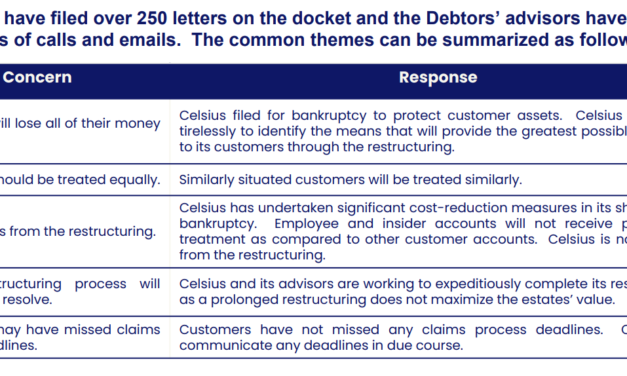
The recent approval, however, is only limited to mining and selling the mined BTC. The court barred Celsius from selling equity or debt investments in other crypto companies and required the crypto lender to disclose information about the assets beforehand. The decision to allow a defaulting crypto company to begin crypto mining operations stems from the concerns raised by investors about the unfair outcomes filed by over 250 customers — as shown above.Despite fears of running out of money by October, the company’s attorney reaffirmed that investing in mining will generate profits for Celsius. The U.S. Department of Justice and the Texas State Securities Board, who previously opposed Celsius’ intent to delve into BTC mining, also withdrew their objection after Celsius clarified that it would only sell the mined Bitcoin for cash.Celsius also revealed during the hearing that BTC prices have grown by 25% since the company had filed the petition. The final hearing will take place on Sept. 1, which will see the finalization of the plan prior to Celsius’ exit and distribution of funds.Related: German crypto bank Nuri with 500K users files for insolvencySingapore-based crypto lending platform Hodlnaut suspended withdrawals and deposits on Aug. 8, citing poor market conditions and lack of liquidity. Dear users, we regret to inform you that we will be halting withdrawals, token swaps and deposits immediately due to recent market conditions. We have also withdrawn our MAS licence application. Here is our full statement https://t.co/5KfHUBzWsn Our next update will be on 19 Aug.— Hodlnaut (@hodlnautdotcom) August 8, 2022

Soon after revealing the suspension of services, including token swaps, Hodlnaut announced to have been working on recovery plans, adding:“We are consulting with Damodara Ong LLC on the feasibility and timelines of our intended execution plan and are strategizing our recovery plan with our users’ best interests in mind.”Following the service shut down, Hodlnaut suspended all of its social media accounts except for Twitter and Telegram.

Čítaj viac

Blue chip NFT performance fails recovery, but investors HODL even harder

The market performance of blue chip nonfungible tokens (NFTs), often considered a good long-term investment, revisited its all-time low range for the second time since June 2022 — falling down below 10,000 Ether (ETH) in the blue-chip index maintained by NFTGo.Blue chip NFTs marked their best performance not too long ago, on April 29, amounting to nearly 14,900 ETH. However, June 13 was the worst performing day in blue chip NFT history when the index fell down to 9,331 ETH — primarily driven by a floor price adjustment in CyberKongz and CyberKongzBabies projects. Performance indicator of blue chip NFTs. Source: NFTGoIn the last 30 days, over 53% of NFT investors made losses on sale trades. Despite the evidently cold market sentiment, the number of investors that hold their NFT investments continues to rise. Investor behavior pattern show increase in long-term holders. Source: NFTGoNearly 500,000 users joined the growing pool of NFT investors in June and July alone who intend to hold for the long-term, taking the number of holders above 3 million at the time of writing. Out of all the NFT categories, PFP (picture for proof) NFTs boast the biggest market capitalization of $13.95 billion. Former leaders such as collectibles, games and art NFTs together represent approximately $6.7 billion in market capitalization. Related: OpenSea introduces new stolen item policy to combat NFT theftTaking a proactive measure to counter illicit activities via NFT trades, NFT marketplace OpenSea announced plans to design policies around the sale of stolen NFTs on its platform.2/ Our policy is designed to keep our community safe, but we know in some cases its side effects have damaged your trust in our platform. We’ve failed to proactively and transparently communicate the rationale behind our approach.— OpenSea (@opensea) August 10, 2022OpenSea admitted that buyers unknowingly bought stolen items and were penalized for no fault of their own. As a result, the marketplace adjusted its policy to expand the use of police reports in identifying threats.

Čítaj viac

Získaj BONUS 8 € v Bitcoinoch

nakup bitcoin z karty

Registrácia Binance

Burza Binance

Aktuálne kurzy