Autor Cointelegraph By Arijit Sarkar

Binance Pay partnership allows UAE entrepreneurs to repay loans using crypto

Binance marked its presence among the Middle East investors by running various licensed operations in Abu Dhabi, Dubai and other regions. Targeting efforts in United Arab Emirate’s (UAE) mainstream corporate sector, Binance partnered with business lender Virtuzone, allowing new entrepreneurs to repay loans using cryptocurrencies.Virtuzone joins the list of mainstream businesses in the UAE, such as JA Resorts and Hotels and Majid Al Futtaim, to officially accept cryptocurrencies after integrating Binance Pay into its payment gateway. In addition, by providing businesses the option to repay seed and other forms of funding through cryptocurrencies, the company intends to reduce barriers to entrepreneurship and support the startup communities.As UAE’s no. 1 company formation specialist, #Virtuzone takes the lead by becoming the first corporate services provider in the country to form a strategic partnership with @binance & accept #crypto payments via #Binance Payhttps://t.co/2fZWbh5uQs@nadeemladki @GeorgyGeorge9 pic.twitter.com/uiZxPAaTXp— #VIRTUZONE (@Virtuzone_UAE) August 29, 2022With blockchain venture capital funding going down over 43% in July, entrepreneurs are on the lookout for obtaining funds for new crypto ventures amid an ongoing bear market. In addition to serving this need, Virtuzone also revealed plans to expedite Web3 adoption in the Middle East. On this note, speaking to Cointelegraph, Richard Teng, head of Binance Middle East and North Africa (MENA), stated:“The market that is developing in the UAE around the Web3 industry, thanks to a number of government initiatives, is one that will become a global hub for investors in digital assets.”Binance also expects the MENA region to enjoy strong demographic growth in the next three decades. However, Teng believed that entering the untapped market requires the introduction of a regulatory framework for crypto and digital assets.Related: Binance Aus ramping up measures to protect vulnerable users, says CEOBinance CEO Changpeng ‘CZ’ Zhao’s intent to work with the regulators has been established as a well-known fact. In doing so, the exchange restricted the account of Tezos staking rewards auditor Baking Bad “as the result of a law enforcement request.”“Binance is required to cooperate with such requests, the same as any other exchange. There is a process to contest the seizure with the agency should you wish to pursue that path. But that is done through the agency, Binance has zero control over that process,” explained the exchange while sufficing the move.

Čítaj viac

MakerDAO co-founder recommends DAI-USD depegging to limit attack surface

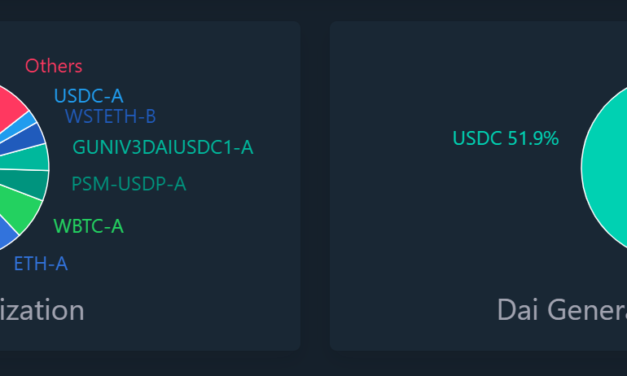
In light of the recent discussions around depegging its native token from USD Coin (USDC) amid sanctioning of Tornado Cash, MakerDAO co-founder Rune Christensen reached out to the community explaining why free-floating DAI may be the only choice for the decentralized autonomous organization (DAO).In his blog post, “The Path of Compliance and the Path of Decentralization: Why Maker has no choice but to prepare to free float Dai,” Christensen disclosed miscalculating the risks related to risk-weighted assets (RWA). He stated:“Physical crackdown against crypto can occur with no advance notice and with no possibility of recovery even for legitimate, innocent users. This violates two core assumption that we used to understand RWA risk, making the authoritarian threat a lot more serious.”While revealing the protocol’s inability to comply with regulators, Christensen suggested that “we must choose the path of decentralization, as was always the intent and the purpose of Dai.” DAI collateralization data. Source: Dai StatsHe believes that decentralizing Maker would reduce the impact of crackdowns on the overall protocol, adding that “The only choice is then to limit attack surface by reducing RWA exposure to a maximum fixed percentage of the total collateral – this requires free floating away from USD.”It is important to note that over 50% of DAI is currently collateralized by USDC, as evidenced by daistats data.Related: MakerDAO should ‘seriously consider’ depegging DAI from USD — FounderJoey Santoro, the founder of the decentralized finance (DeFi) platform Fei Protocol recommended revoking participation from Tribe DAO after reimbursing Fuze victims.Previously, Rari Fuze hacker was offered a $10 million bounty for returning the $80 million worth of assets, but Fei Protocol received no response from the attacker.

Čítaj viac

GameFi investors are now prioritizing fun factor over money: Survey

GameFi, the fusion of gaming and decentralized finance (DeFi), attracts a set of investors that tend to choose projects based on their use case rather than money-generating potential.The GameFi ecosystem attracts GenZ investors and gaming enthusiasts. As a result, it stands as an entry point for numerous first-time investors. A ChainPlay survey participated by 2428 GameFi investors revealed that 75% of the respondents joined the crypto space solely because of GameFi.3 in 4 respondents joined cryptocurrency because of GameFi. Source: ChainPlayWhile roughly half of the investors joined the GameFi space initially for profits, 89% of GameFi investors succumbed to Crypto Winter 2022 — with 62% of them losing more than 50% of their profits. GameFi profits are decreasing. Source: ChainPlayHowever, investors believe that poor in-game economy design was the main reason for their losses. In accordance with this sentiment, the survey revealed that, in 2022, investors worldwide spent an average of 2.5 hours per day participating in GameFi, which is down 43% to 4.4 hours from last year.The fear of rug pulls and Ponzi schemes coupled with sub-par graphics are some of the biggest drivers preventing investments in new GameFi projects. As a result, 44% of investors believe that the involvement of traditional gaming companies can be key to GameFi’s growth.Moreover, when it comes to future GameFi projects, 81% of GameFi investors are moving away from the traditional mindset and prioritizing the fun factor over profit-making as they seek positive in-game experiences.Related: GameFi and crypto ‘natural fit’ for game publishers: KBW 2022Blockchain gaming and the Metaverse were the least affected ecosystems by the Terra (LUNA) debacle, confirmed a DappRadar report.In addition, a sustained institutional investment was seen in both blockchain gaming and the Metaverse, highlighting that many top companies see the potential for strong economic growth in both sectors moving forward.

Čítaj viac

Top 10 most Googled questions about cryptocurrency and its implication

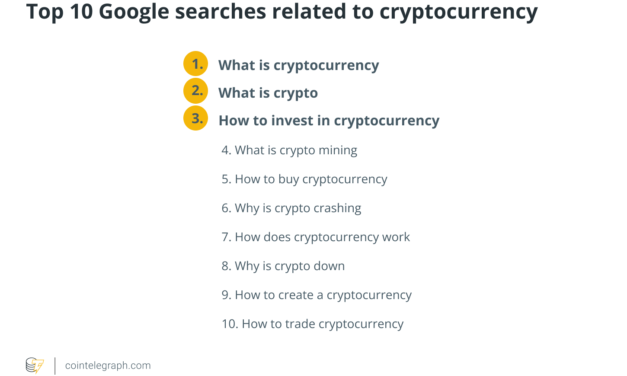
What people end up searching on Google provides raw insights into the real mindset, often revealing their interest, fear, and range of other emotions about a particular topic. To identify investor sentiment amid a bear market that is yet to find its bottom, Cointelegraph dug deep into the web to find out the most Googled questions about cryptocurrencies. The top 10 Google searches related to cryptocurrencies uncover an increase in curiosity among general investors — represented by two ‘Whys,’ three ‘What’s’ and five ‘How’s.’ Let’s go through the most crypto-related Google searches, from highest to lowest.What is cryptocurrencyEven after thirteen years of disruption to traditional finance, the most popular question that general investors ask Google is, “What is cryptocurrency.” With a global search volume (GV) of 256,000, this Google search overshadows the second most crypto-related Google search by nearly five (4.7) times.This indicates the gap — and a vast scope — in educating the masses about cryptocurrencies. However, despite the evident conflict of interests, crypto entrepreneurs from across the globe put their differences aside and agree that educating the masses about cryptocurrencies can serve as a catalyst for mainstream adoption.What is cryptoThe second most Googled question about cryptocurrencies is, surprisingly, just an iteration of the top question, which reads, “What is crypto.” The question recorded a GV of 54,000, which, when combined with its predecessor, strengthens the case for educating the masses about cryptocurrencies.The wh-question highlights the lack of understanding among the masses and the need to shorten the learning curve for new and aspiring investors. How to invest in cryptocurrencyIn the third place for most popular Google searches comes the first investment-related question, “How to invest in cryptocurrency.” With a GV of 44,000, the Googled question shows rising interest in crypto investments despite the prolonged bear market. The keywords also highlight the need for simplifying the process of investing in cryptocurrencies. This implies a redesign of trading platforms to make them more intuitive for new investors moving over from traditional finance.What is crypto miningTaking the fourth spot with a GV of 37,000 is a Google search that is surprisingly the most natural progression one would take when learning about the crypto ecosystem in depth — “What is crypto mining.”Investors with base-level understanding of the crypto ecosystem tend to try out mining as a means to make passive income via cryptocurrencies. The thought of repurposing an old computer for earning cryptocurrencies by supporting the network is a popular search, relevant from the early days of cryptocurrencies. However, off-the-shelf mining rigs have allowed novice miners to consider crypto mining as a viable career.How to buy cryptocurrencyGiven the rising popularity of cryptocurrencies, the search for “How to buy cryptocurrency” takes the fifth position as a the most searched crypto-related keywords on Google. The GV of 36,000 shows the evident interest in purchasing cryptocurrencies.Bear markets are often viewed as perfect timelines for making high-yield investments. Given the falling prices, existing and new investors are in a race to identify such investments as market prepares to recover into a bull run.Why is crypto crashingThe impact of prolonged bear markets seeped into top Google searches as investors try to find answers to the question, “Why is crypto crashing.” The 2022 bear market proved to be catastrophic to several crypto ecosystems, wiping out millions of dollars overnight. As a result, the Google search represented a GV of 33,000.The ongoing freefall in prices, along with no evident support to cushion the fall, generated negative investor sentiment across the globe. However, despite the losses, inflation in traditional finance has forced investors to reconsider Bitcoin (BTC) and other popular cryptocurrencies as hedges against draining buying power.How does cryptocurrency workAn essential question asked by today’s investors — “How does cryptocurrency work” — stands as the seventh most Googled question about cryptocurrencies, with a GV of 27,000. Following massive losses, the general public has become vary about the inner workings of a crypto project. Understanding how cryptocurrencies (or a particular crypto project) work helps uncover the hidden risks of investments. Why is crypto down With popular projects such as Polygon making consistent headlines for service disruptions, the general public asks, “Why is crypto down,” resulting in a GV of 21,000. With projects being forced to stop withdrawals and blocking funds for various reasons, investors tend to find answers over the Internet. This search making the top 10 list showcases the unprecedented increase in the shutdown of services. Untimely services and blockchain shutdowns are the primary drivers of negative investor sentiment. How to create a cryptocurrencyFor many, the idea of creating, marketing and selling their own cryptocurrency seems better than investing in something created by others. “How to create a cryptocurrency” stands as the ninth most Google searched term in the crypto space with a GV of 14,000.Off-the-services now allow anyone to launch their own tokens. However, merely launching a cryptocurrency without aiming to serve a use case is destined to fail in the long term.How to trade cryptocurrencyLast in the top 10 Google questions list is “How to trade cryptocurrency,” with a GV of 13,000. Investors continue researching new ways to trade cryptocurrencies despite the growing mainstream popularity of cryptocurrencies.Based on the jurisdictions, crypto platforms have started offering services tailored to meet the region’s regulatory requirements. As a result, investors must research to identify the most suitable platforms for crypto trading while ensuring compliance with local laws.

Čítaj viac

Hetzner anti-crypto policies: A wake-up call for Ethereum’s future

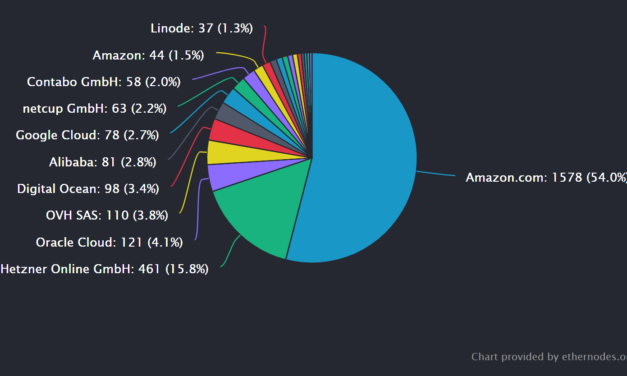
Just when the Ethereum ecosystem reached its final stages in preparing for the much-anticipated upgrade, The Merge, german cloud provider Hetzner, reiterated its stance against allowing mining operations for both proof-of-stake (PoS) and proof-of-work (PoW) applications.Hetzner, a private, centralized cloud provider, stepped in on a discussion around running blockchain nodes, highlighting its terms of services that prohibit customers from using the services for crypto activities. However, the Ethereum community perceived the revelation as a threat to the ecosystem as Hetzner’s cloud services host nearly 16% of the Ethereum nodes, as shown below.Ethereum Mainnet Statistics. Source: ethernodes.orgIn crypto, the reliance on centralized service providers has been historically perceived as a negative trait when it comes to long-term sustenance — and for a good reason. Redditor u/Supermann- questioned the anti-crypto policies laid down by the second biggest Ethereum Mainnet host, Hetzner. Clarifying the doubts and legal implications associated with using its services for crypto activities, Hetzner stated:“Using our products for any application related to mining, even remotely related, is not permitted. This includes Ethereum.”The company also stated that the non-allowance extends to running nodes, mining and farming, plotting, storage of blockchain data and trading. While acknowledging the extensive use of its services for powering Ethereum, Hetzner revealed that “we have been internally discussing how we can best address this issue.” As a fair warning to the community, Hetzner added:“If you, or any other potential customers are unsure about whether your use case will violate our ToS, please reach out to us.”The latest revelation from german cloud provider Hetzner showcases the impact of the decision made by centralized entities on thriving crypto ecosystems. The majority of the Ethereum ecosystem currently runs on Amazon.com, which hosts 54% of the total Ethereum nodes. Some of the mainstream cloud providers that currently host Ethereum nodes include Oracle Cloud (4.1%), Alibaba (2.8%) and Google Cloud (2.7%).Related: Ethereum Foundation clarifies that the upcoming Merge upgrade will not reduce gas feesDiscussions around the Ethereum upgrade have unknowingly spurred numerous misconceptions about what it means for the future of the blockchain. Cointelegraph’s report highlighted the top five misconceptions about the anticipated Ethereum upgrade.Reduced gas fees and faster transactions are the biggest rumors spreading across the ecosystem, which have been confirmed to be untrue. However, a subsequent upgrade, named the Shanghai upgrade, will deliver faster and cheaper transactions.

Čítaj viac

Získaj BONUS 8 € v Bitcoinoch

nakup bitcoin z karty

Registrácia Binance

Burza Binance

Aktuálne kurzy